




Chafing Dish for Sale: Retail vs Wholesale Pricing Explained
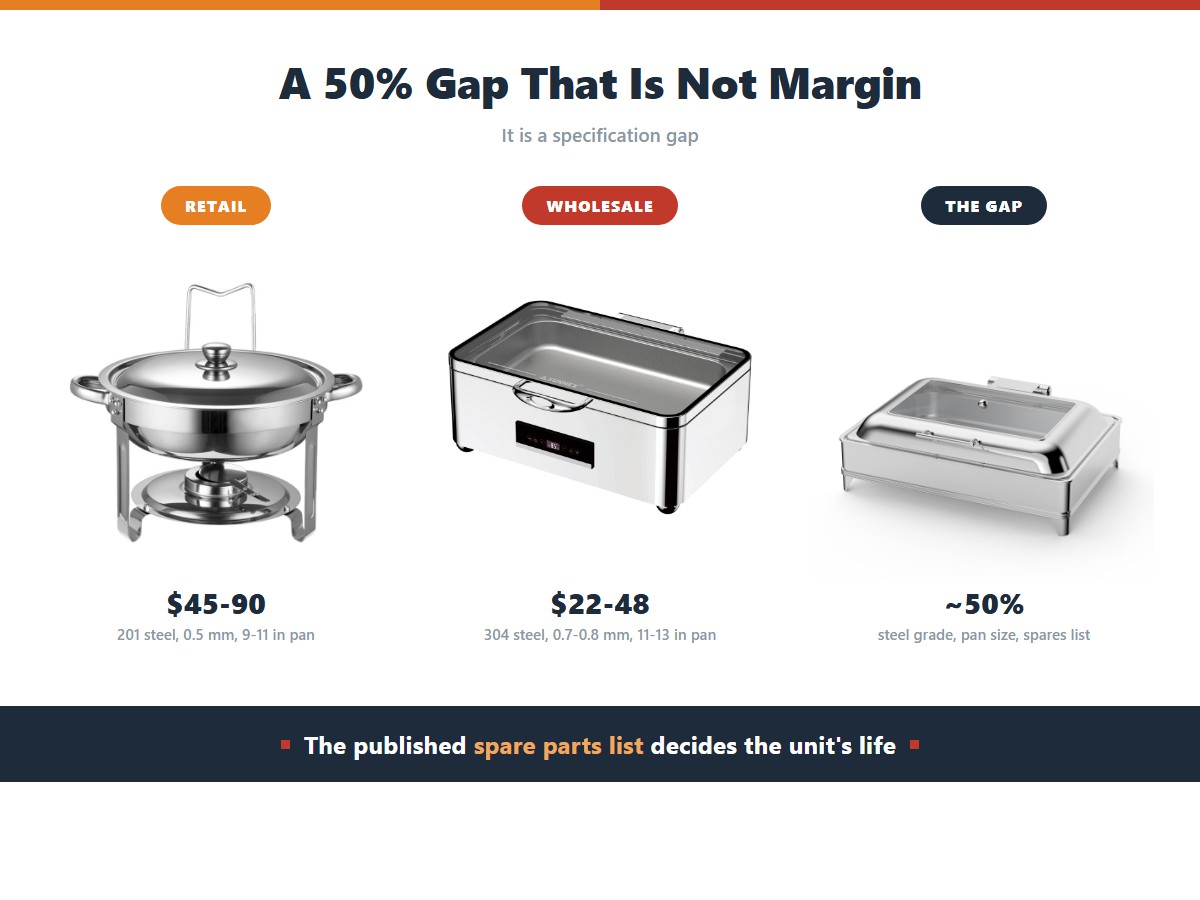
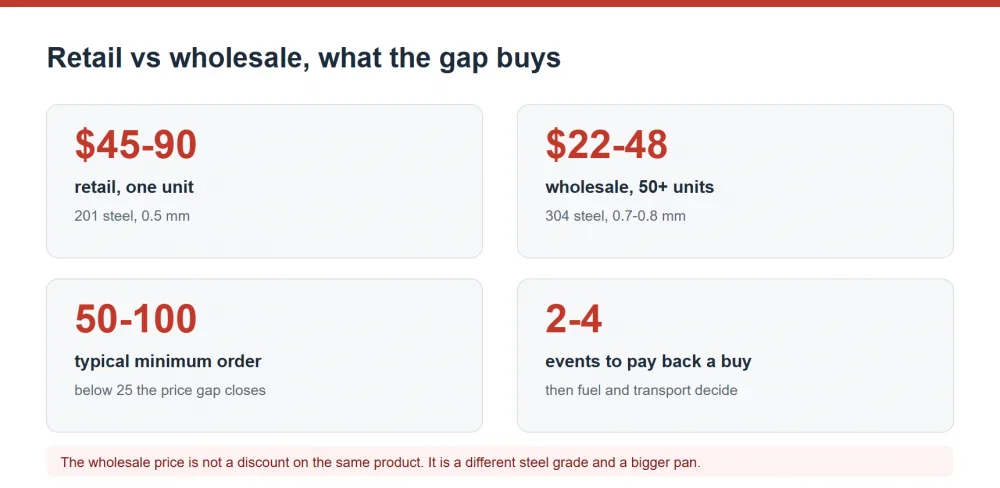
Short answer: A chafing dish bought one at a time from a retail store typically costs $45–90, while the same round model bought wholesale costs $22–48 per unit once you clear a 50–100 piece minimum order. The gap is not margin on the same product: wholesale units are 304 stainless instead of 201, carry a 0.7–0.8 mm body and include a lid and fuel holders that retail listings sell separately. See chafing dish ranges before you compare prices.
Finding chafing dishes for sale locally requires understanding the different retailer types, product quality levels, and pricing structures that various suppliers offer. Whether seeking equipment for professional catering operations or home entertaining, knowing where to look and what to evaluate ensures purchases that deliver value and performance. Local purchasing offers advantages that online shopping cannot match, though selection may be more limited.
Retailer Categories
Restaurant supply stores specialize in commercial food service equipment, offering professional-grade chafing dishes designed for daily use in demanding environments. These suppliers typically serve professional buyers but often sell to individuals willing to invest in commercial quality. Restaurant supply stores offer professional equipment.
Catering equipment dealers focus specifically on mobile food service needs, understanding the portability, durability, and setup requirements that catering operations demand. Specialty dealers offer expertise that general retailers lack. Catering specialists understand mobile needs.

Kitchen supply stores target home cooks and occasional entertainers, with quality levels suitable for intermittent use but potentially inadequate for professional applications. Consumer retailers serve home markets. Kitchen stores serve home consumers.
Professional Supplier Benefits
Commercial quality at professional suppliers exceeds consumer-grade equipment in durability, performance, and lifespan, with construction designed for daily use rather than occasional deployment. Commercial equipment lasts longer. Professional quality justifies investment.
Expert guidance from professional supplier staff helps buyers select appropriate equipment for specific applications, with knowledge that consumer store employees typically lack. Expert advice improves selection. Knowledgeable staff add value.
After-sale support including parts availability and service referrals provides value that discount retailers cannot match, with established suppliers maintaining customer relationships beyond initial sale. Support services add value. Ongoing support matters.
Quality Assessment
Material quality determines equipment lifespan, with heavier gauge stainless steel indicating commercial construction that thin materials cannot match. Weight often correlates with quality. Material gauge reveals construction quality.
Construction details including weld quality, hinge durability, and frame stability indicate overall build quality that affects long-term satisfaction. Detail examination reveals quality. Construction quality determines longevity.

Stainless Steel Alcohol Chafing Dish
Stainless Steel Alcohol Chafing Dish illustrates the construction quality that buyers should examine. Professional assembly and quality materials indicate equipment built for reliable performance.
Component examination should cover lids, handles, fuel holders, and frame connections, with smooth operation and solid attachment indicating quality. Component quality affects satisfaction. Details reveal overall quality.

Pricing Considerations
Initial pricing varies by retailer type and quality level, with professional equipment commanding higher prices that reflect superior construction and performance. Price reflects quality level. Higher prices indicate better construction.
Total cost of ownership includes maintenance, repair, and replacement over equipment lifespan, with quality equipment often costing less long-term despite higher initial prices. Long-term cost matters more. Quality reduces total cost.
Value assessment should balance price against quality, expected use frequency, and importance of reliability for specific applications. Value exceeds price comparison. Quality justifies investment.
Selection Factors
Size selection should match typical serving quantities and available space, with full-size, half-size, and round options serving different menu items and presentation styles. Size affects functionality. Appropriate size matters.
Style options include roll-top lids, lift-off covers, and dome designs, each offering advantages for different serving situations and menu types. Style affects service convenience. Lid type influences operation.
Capacity requirements depend on guest counts and menu variety, with adequate equipment quantity ensuring efficient service for event sizes. Capacity affects service capability. Quantity requirements vary by event.
Supplier Evaluation
Reputation research through reviews and industry references reveals supplier reliability that marketing materials cannot demonstrate. Reputation indicates trustworthiness. Reviews reveal service quality.
Inventory breadth affects one-stop shopping convenience, with comprehensive suppliers reducing coordination complexity through single-source procurement. Selection variety adds convenience. Broad inventory saves time.
Service quality including responsiveness, expertise, and support distinguishes suppliers beyond pricing, with excellent service adding value that discounters cannot match. Service quality affects satisfaction. Good service adds value.
Purchase Timing
Seasonal availability peaks during holiday periods when retailers stock serving equipment for entertaining seasons, with selection improving during peak times. Seasonal timing affects selection. Holiday seasons offer variety.
Sale opportunities occur during clearance events and holiday promotions, with timing flexibility enabling cost savings for non-urgent purchases. Timing flexibility saves money. Sales reduce costs.
Inventory fluctuations throughout the year affect availability, with popular items potentially out of stock during high-demand periods. Inventory timing affects access. Demand affects availability.
Local vs. Online Comparison
Immediate availability distinguishes local purchasing from online orders that require shipping time, with local stores enabling same-day acquisition for urgent needs. Local availability serves urgency. Immediate pickup meets urgent needs.
Hands-on inspection allows quality assessment before purchase, preventing the disappointment that sometimes accompanies online orders where products differ from expectations. Physical examination prevents surprises. Inspection reveals quality.
Selection breadth favors online retailers who can stock extensive inventory that local stores cannot physically accommodate, providing more options but requiring shipping wait. Online selection exceeds local. Broader options available online.
After-Sale Support
Warranty coverage varies by brand and supplier, with professional equipment typically including better warranty terms than consumer alternatives. Warranty protection provides security. Better warranties indicate quality.
Parts availability for repairs ensures long-term serviceability, with established brands maintaining parts inventories that lesser-known manufacturers may not. Parts support extends equipment life. Parts availability matters.
Service referrals for maintenance and repair provide value that some suppliers offer while others leave customers to find service independently. Service support adds value. Maintenance support matters.
Browse the full chafing dish range for current models and configurations.
What the Price Gap Actually Buys
| Specification | Retail single unit | Wholesale unit | Why it matters |
|---|---|---|---|
| Body steel | 201 stainless, 0.5 mm | 304 stainless, 0.7–0.8 mm | 201 resists rust poorly; 304 survives salt |
| Round pan diameter | 9–11 in | 11–13 in | Larger pan = fewer refills per queue |
| Fuel holders | 2, sometimes sold apart | 4, included | Saves $18–30 per unit |
| Lid | Optional, $14–26 | Included | Saves $14–26 per unit |
| Spare parts list | Not published | Published with part numbers | Decides the unit's life, not its price |
| Unit price, typical | $45–90 | $22–48 | Gap of roughly 50% |
Order Size and Break-Even
| Order quantity | Unit price | Freight share | Total per unit landed | Worth it? |
|---|---|---|---|---|
| 1–5 units | $45–90 | 0% | $45–90 | Buy retail |
| 10 units | $38–62 | 4–8% | $41–67 | Marginal |
| 25 units | $30–48 | 3–6% | $32–51 | Yes, for repeat events |
| 50 units | $26–42 | 2–5% | $27–44 | Yes |
| 100 units | $22–36 | 2–4% | $23–37 | Yes, for rental fleets |
The honest reason wholesale is cheaper is that retail units are a different product with a different steel grade and a smaller pan, sold one at a time. Treating the two price points as the same item on sale is the mistake that leads to a fleet that warps after eight months. A $30 saving per unit is worth less than one pan that bows in a 200-guest service.
Frequently Asked Questions
Is a wholesale chafing dish better than a retail one?
Usually yes, and not because the seller is being generous. Wholesale units use 304 stainless at 0.7–0.8 mm instead of 201 at 0.5 mm, and they include the lid and fuel holders that retail listings charge extra for. Verify the steel grade before assuming the price gap is a bargain.
What is the minimum order for wholesale chafing dishes?
50 to 100 units is the common threshold, and it varies by model. Some suppliers accept 25 on standard round pans. Below 25 units the per-unit price usually lands within 15% of retail, and you take on the freight and storage risk for nothing.
How much does one chafing dish cost at retail?
Roughly $45–90 for a 9–11 inch round pan, and $140–260 for a full 8–9 pan rectangular unit. A fuel-burning unit sits at the top of that range; an electric unit with a thermostat in the middle.
Do retail chafing dishes warp?
Thin 201 steel at 0.5 mm can bow under an empty pan heated for two hours, especially with alcohol fuel. It rarely fails outright, but a warped pan leaks and looks bad on the line. 304 steel at 0.7 mm does not bow at normal holding temperatures.
Is it worth buying chafing dishes one at a time?
For a single event, yes, and the retail price is the correct price. For any operation holding events repeatedly, wholesale pricing plus a spare parts list is worth the ordering effort well before the 50-unit threshold, because the parts list matters more than the unit price.
Related reading
- Commercial Chafing Dishes Wholesale: Bulk Buying Guide
- Stainless Steel Grades Explained: 201 vs 304 vs 316 for Buffets
- Chafing Dish Rental for Weddings: Packages, Pricing, Pitfalls
- Buy Chafing Dishes in Bulk: Wholesale Prices for Restaurants
- Chafing Dishes for Sale: Best Deals for Catering Businesses
- Food Heat Lamps for Sale: Best Deals for Catering Companies