




Heat Lamp Replacement Parts: What Wears Out First
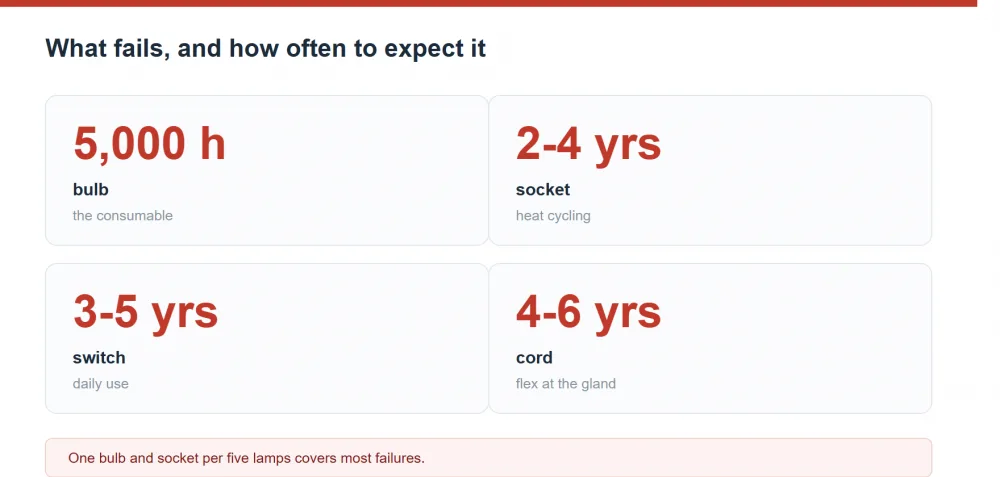
Short answer: four parts fail in order — the bulb (rated 5,000+ hours), the socket (heat cycling), the switch (daily use) and the cord (flexing). Keep one bulb and one socket per five lamps in stock: a failed lamp then becomes a five-minute fix instead of a replacement order. Parts fit most units in our heat lamp range.
The bulb is a consumable, not a part
Treat the bulb the way you treat a printer cartridge: buy it in multiples and replace it on schedule rather than on failure. A 250 W infrared bulb rated at 5,000 hours lasts about 18 months at ten hours a day. Bulbs that fail in weeks are usually running on an over-voltage supply or in a vibrating position, not from a bad batch.
Sockets fail from heat cycling
The bulb base reaches 200–300°C. A ceramic socket tolerates that; a plastic one softens, the contacts lose spring tension, and the lamp starts working only when the bulb is nudged. If you see brown discolouration around the socket, replace it before it strands the lamp mid-service.
Switches and cords: the cheap failures
An inline rocker switch takes a full current surge every time it closes. On a 250 W lamp at 230 V that is about 1.1 A — modest, but repeated thousands of times. Cords fail where they leave the housing: look for a cracked sheath at the strain relief, which is a flex fatigue point rather than a manufacturing fault.
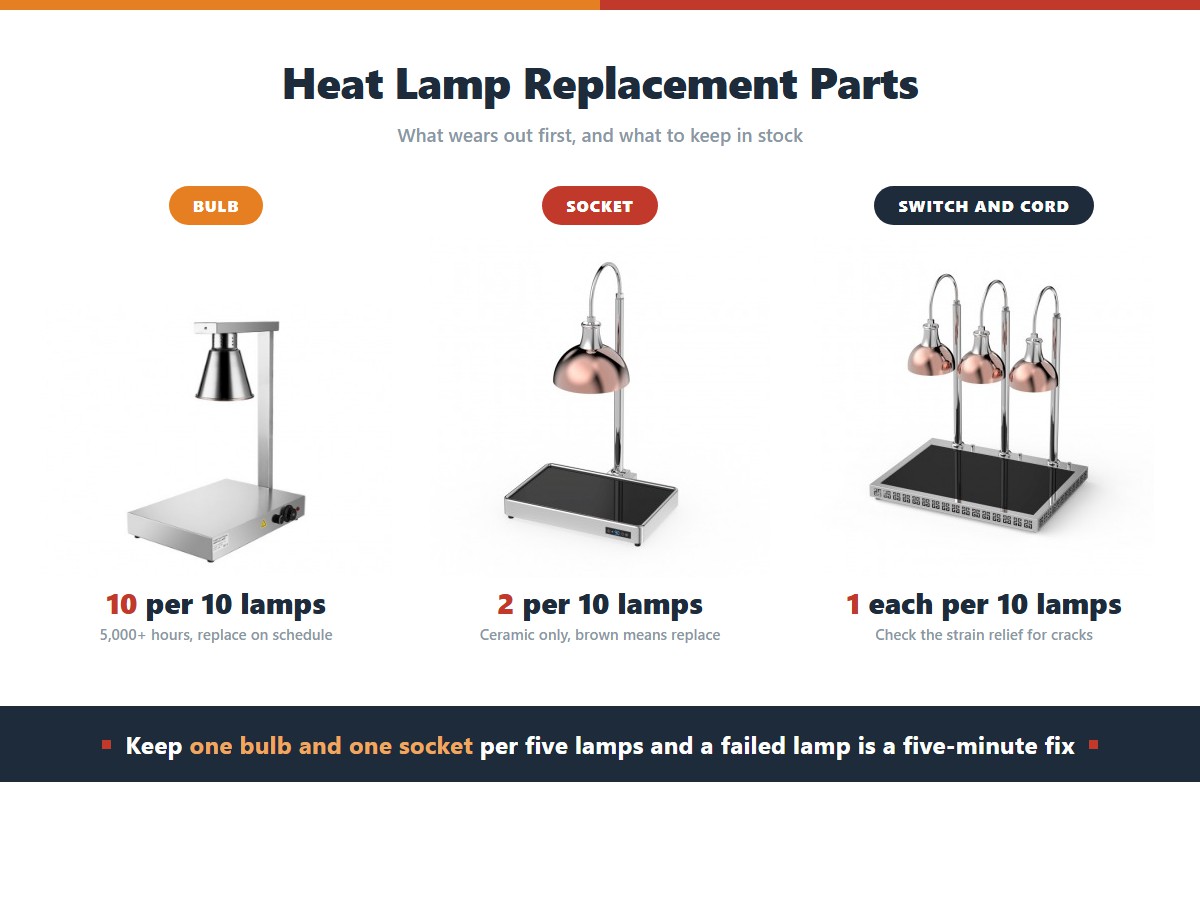
Stocking policy: what to keep per ten lamps
- Ten bulbs — one per lamp, replaced on a schedule rather than on failure.
- Two sockets — the second most common failure and cheap to hold.
- One switch and one cord set — covers the remaining electrical faults.
- One complete spare lamp — so a station never waits for a repair.
Which part fails, and how to tell
| Part | Symptom | Typical life | Fix |
| Bulb | No glow, or a dark patch on the envelope | 5,000–7,000 hours | Replace with the same wattage |
| Socket | Bulb works intermittently, scorched contacts | 2–4 years | Swap the ceramic socket |
| Switch | No response, or a click without heat | 3–5 years | Replace the inline switch |
| Cord | Cracked sheath near the strain relief | 4–6 years | Replace the cord set |
Ordering the right part
Three numbers identify a compatible part: the wattage, the fitting (E27 for almost all commercial food lamps) and the plate voltage. A 230 V bulb in a 120 V lamp glows dimly; a 120 V bulb in a 230 V lamp fails within minutes. Photograph the label on the housing before you order and keep the photo with the spare parts.
Reading a parts quote
A parts quote should list the part number, the material and the rated life. A bulb described only as "250 W infrared" tells you nothing about whether it will last 1,000 or 7,000 hours, and the price difference between those two is usually under a dollar. Order the consumables with the original lamps rather than later — shipping one socket on its own often costs more than the part.
One more practical note: keep the replacement part with the lamp it belongs to. Mixing a 375 W bulb into a 250 W housing because it was the only spare on the shelf is how sockets get scorched, and it usually happens at the worst possible moment.
Frequently Asked Questions
How often should I expect to replace a bulb?
At 10 hours a day, a 5,000-hour bulb lasts about 18 months. A bulb failing in weeks usually points to over-voltage or vibration, not a bad batch.
Which spares should I keep on the shelf?
One bulb and one socket per five lamps, plus a spare switch. That covers roughly 90% of failures without holding a whole lamp in stock.
Can I fit a higher-wattage bulb?
Only if the housing and socket are rated for it. A 375 W bulb in a 250 W housing overheats the socket and shortens its life.
Is it safe to replace parts myself?
Bulbs and switches, yes — unplug first and let the housing cool for 15 minutes. Socket or cord replacement should be done by someone competent with mains wiring.
When is it better to replace the whole lamp?
When the housing is corroded, the reflector is pitted, or two or more parts fail together. At that point a new lamp costs less than the parts and labour.
Related reading
- Heat lamp bulbs keep burning out: causes and fixes
- Food heat lamp buying guide: features to look for
- Commercial heat lamp guide: wattage, height and food safety
- Buffet equipment maintenance schedule
- Food Heat Lamp Bulbs (100W): Long-Lasting Replacement Parts
- Chafing Dish Replacement Parts: What Fails and What to Stock