




Chafing Dish Replacement Parts: What Fails and What to Stock
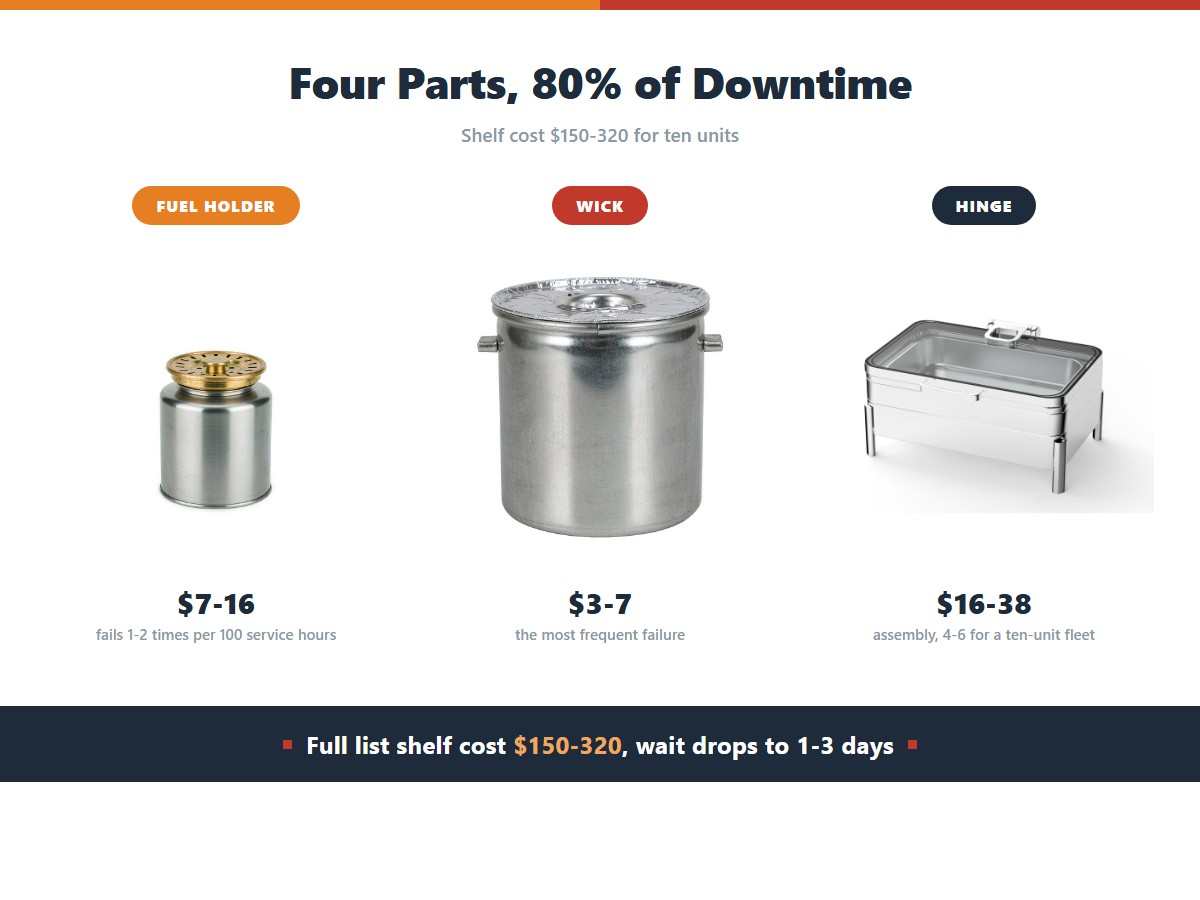
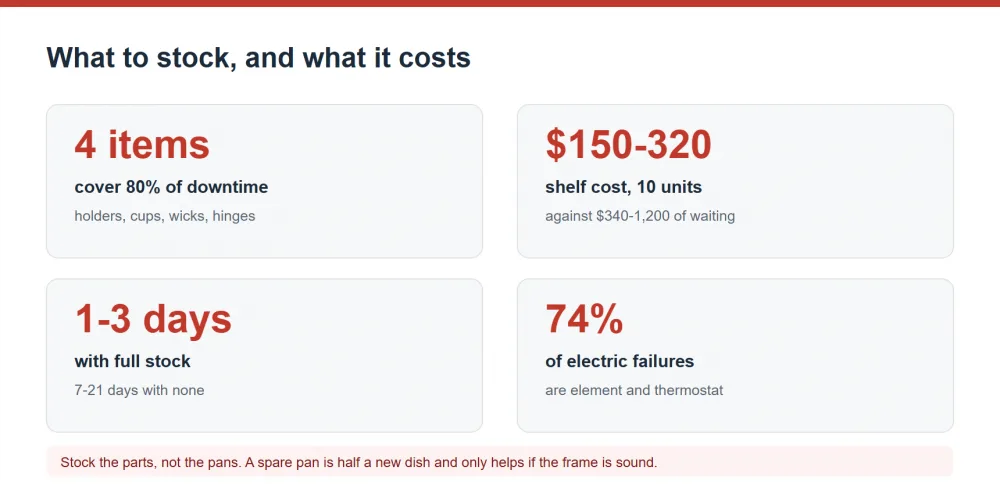
Short answer: Stock four items and cover about 80% of chafing dish downtime: fuel holders at $7–16 each, fuel cups at $4–9, wicks at $3–7 and hinge assemblies at $16–38. Total shelf cost for a ten-unit fleet is $150–320. A tenth item, the 201 versus 304 body, is not a part and not stockable. See chafing dish ranges to match part numbers to models.
Finding replacement parts for chafing dishes locally enables equipment maintenance and repair without the delays that ordering online creates. Whether replacing fuel holders, lids, handles, or other components, understanding where to source parts locally keeps equipment operational and extends service life. Parts availability affects equipment longevity and catering operation continuity in ways that equipment purchases alone cannot address.
Common Replacement Parts
Fuel holders and fuel cans require regular replacement as fuel depletes and holders accumulate residue from use, with compatible replacement options needed for continued operation. Fuel system parts need regular replacement. Fuel holders are consumable items.
Lids and covers sustain damage from handling and transport, with replacement lids available for roll-top, lift-off, and dome-style chafing dishes. Lid replacement restores functionality. Lids suffer handling damage.

Handles break or loosen with repeated transport and handling, requiring replacement to maintain safe and convenient operation. Handle replacement ensures safety. Handles need occasional replacement.
Local Parts Sources
Restaurant supply stores often carry common replacement parts for popular brands, with inventory that includes fuel holders, food pans, and frequently needed components. Local suppliers provide immediate access. Restaurant stores stock common parts.
Equipment dealers who sell chafing dishes typically maintain parts inventories for brands they carry, providing local access to components for equipment purchased through their channels. Dealers stock parts for brands sold. Equipment dealers have brand parts.
Hardware stores may carry universal components like fuel holders and basic hardware, though selection is limited compared to specialty suppliers. Hardware stores offer basic items. Universal parts available locally.
Parts by Category
Food pans in various sizes enable menu flexibility and replace damaged pans that affect presentation and function, with standard sizes fitting most chafing dish frames. Food pans are standard replacements. Standard sizes fit most frames.
Water pans hold the hot water that provides even heat distribution, with replacement needed when corrosion or damage affects performance. Water pan replacement restores heating. Water pans affect heat distribution.

Stainless Steel Electric Buffet Warmer with Visible Window
Stainless Steel Electric Buffet Warmer with Visible Window illustrates the quality construction that uses standard parts. Standardized components simplify sourcing when replacement becomes necessary.
Frame components including legs, supports, and brackets occasionally need replacement after damage, with availability varying by brand and model. Frame parts vary by manufacturer. Structural parts need brand matching.

Brand Considerations
Major brands maintain better parts availability through established distribution networks, with local suppliers more likely to stock parts for widely-used brands. Brand choice affects parts access. Popular brands have better availability.
Generic parts may fit multiple brands and provide cost savings, though compatibility should be verified before purchase to ensure proper fit and function. Generic parts offer alternatives. Compatibility verification prevents problems.
Specialty brands may require direct manufacturer contact for parts, with limited local availability for less common equipment lines. Specialty brands may need direct ordering. Uncommon brands limit local options.
Compatibility Verification
Model identification ensures parts compatibility, with equipment specifications varying between models even within the same brand. Model numbers determine part fit. Identification prevents wrong purchases.
Measurement verification confirms part dimensions when model information is unavailable, with physical comparison preventing incompatible purchases. Measurements ensure compatibility. Physical specs matter for fit.
Supplier expertise helps confirm compatibility when purchasing parts, with knowledgeable staff preventing costly mistakes through proper identification. Expert assistance prevents errors. Supplier knowledge adds value.
Online vs. Local Parts
Immediate availability distinguishes local parts purchasing from online ordering that requires shipping time, with local sources enabling same-day repairs. Local availability serves urgent needs. Immediate access enables quick repairs.
Selection breadth favors online retailers who can stock extensive inventory that local stores cannot physically accommodate, providing access to obscure parts. Online selection exceeds local. Broad selection available online.
Price comparison between local and online sources should include shipping costs that narrow apparent price differences, with total cost determining value. Total cost determines best value. Shipping affects online pricing.
Preventive Parts Inventory
Spare parts inventory enables rapid repairs without waiting for parts acquisition, with commonly needed items kept on hand for quick replacement. Parts inventory prevents delays. Spares enable immediate repairs.
Fuel supplies should be maintained as consumable inventory, with adequate fuel quantities ensuring continuous operation without last-minute sourcing. Fuel inventory prevents shortages. Consumables need regular replenishment.
Critical components that commonly fail should be stocked as spares, with lids, fuel holders, and handles representing items worth keeping on hand. Critical spares prevent downtime. Common failure items need backup.
Parts Quality
OEM parts from original equipment manufacturers ensure compatibility and quality that aftermarket alternatives may not match, with proper fit and function guaranteed. OEM parts ensure quality. Original parts guarantee fit.
Aftermarket parts may offer cost savings but require careful quality evaluation to ensure they meet performance requirements. Aftermarket quality varies. Generic parts need evaluation.
Universal components like standard-size food pans fit multiple brands and provide easy replacement options for common needs. Universal parts offer flexibility. Standard sizes fit many brands.
Supplier Evaluation
Inventory breadth determines whether suppliers can serve as single sources for multiple parts needs, with comprehensive inventory reducing sourcing complexity. Comprehensive inventory saves time. Broad selection adds convenience.
Knowledgeable staff help with parts identification and compatibility verification, with expertise that prevents purchasing mistakes. Expert assistance adds value. Knowledgeable staff prevent errors.
Return policies protect against incompatible purchases, with flexible policies allowing exchanges when parts do not fit as expected. Return flexibility protects buyers. Good policies enable exchanges.
Browse the full chafing dish range for current models and configurations.
Parts to Stock, by Failure Frequency
| Part | Unit cost | Fails per 100 service hours | Stock for 10 units | Lead time |
|---|---|---|---|---|
| Fuel holder with seal | $7–16 | 1–2 | 8–12 | 2–7 days |
| Fuel cup | $4–9 | 1–2 | 8–12 | 2–5 days |
| Wick | $3–7 | 2–4 | 12–18 | 1–3 days |
| Hinge assembly | $16–38 | 0.5–1 | 4–6 | 3–10 days |
| Burnt element, electric | $30–70 | 0.3–0.8 | 2–4 | 5–14 days |
| Thermostat | $25–60 | 0.2–0.6 | 2–3 | 5–14 days |
| Glass lid | $18–34 | 0.2–0.5 | 2–3 | 3–7 days |
| Side handle | $12–26 | 0.1–0.4 | 2–3 | 3–7 days |
Shelf Cost Against Downtime Saved
| Stocking level | Shelf spend | Expected wait per failure | Failures per year | Cost of waiting |
|---|---|---|---|---|
| Nothing | $0 | 7–21 days | 4 | $340–1,200 in lost service |
| Consumables only | $60–120 | 3–7 days | 4 | $120–420 |
| Consumables plus hinges | $110–210 | 3–7 days | 4 | $120–420 |
| Full eight-item list | $150–320 | 1–3 days | 4 | $40–160 |
| Full list plus one spare unit | $200–420 | 0 days | 4 | $0 |
Stock the parts, not the pans. A spare round pan is $22–40, which is nearly half a new dish, and it only helps if the body frame is sound. A fuel holder at $7–16 restores a unit that was otherwise ready for service, and that is the difference between a one-line buffet and a two-line buffet on the morning of an event.
Frequently Asked Questions
What chafing dish parts should I keep in stock?
Fuel holders, fuel cups, wicks and hinge assemblies cover roughly 80% of downtime for $150–320 of shelf cost on a ten-unit fleet. Add an element and thermostat only if you run electric units, because those two parts make up about 74% of electric failures.
How long does it take to get chafing dish replacement parts?
Consumables such as wicks, cups and holders usually arrive in 1–7 days, and hinges take 3–10 days. Elements and thermostats are 5–14 days. That gap is the reason a spare unit on site is often more valuable than a shelf of parts for the electrical side.
Are chafing dish parts interchangeable between models?
Often, and it depends on the diameter of the fuel cup and the thread of the wick. Round 9, 11 and 13 inch pans usually share a fuel holder, but rectangular units do not. Confirm the part number rather than assuming, because a mismatched holder will not seal properly and you will find out mid-service.
Should I stock spare pans?
No. A spare pan is $22–40, close to half the price of a new dish, and it only helps if the frame is sound. Spend that on a spare fuel holder and a spare hinge instead, which restore a unit that was otherwise ready to work.
What is the most overlooked replacement part?
The fuel holder seal. The holder itself rarely breaks, but the sealing ring hardens and starts to weep, and a weeping holder soaks the fuel and creates a fire risk around the wick. Replacing the seal takes 10–25 minutes and costs $9–22.
Related reading
- Chafing Dish Water Pan: Replacement Parts for Food Warmers
- Chafing Dish Fuel Wick: Replacement Wicks for Fuel Cans
- Chafing Dish Food Pan Sizes: Which Replacement Pan Fits Your Chafer?
- Chafing Dish Pans: Replacement Pans for Food Warmers
- Remove Hard Water Scale from Chafer Pans: 5-Min Fix
- Food Heat Lamp Bulbs (100W): Long-Lasting Replacement Parts