


Rectangular Chafing Dishes: Ideal for Large Food Servings
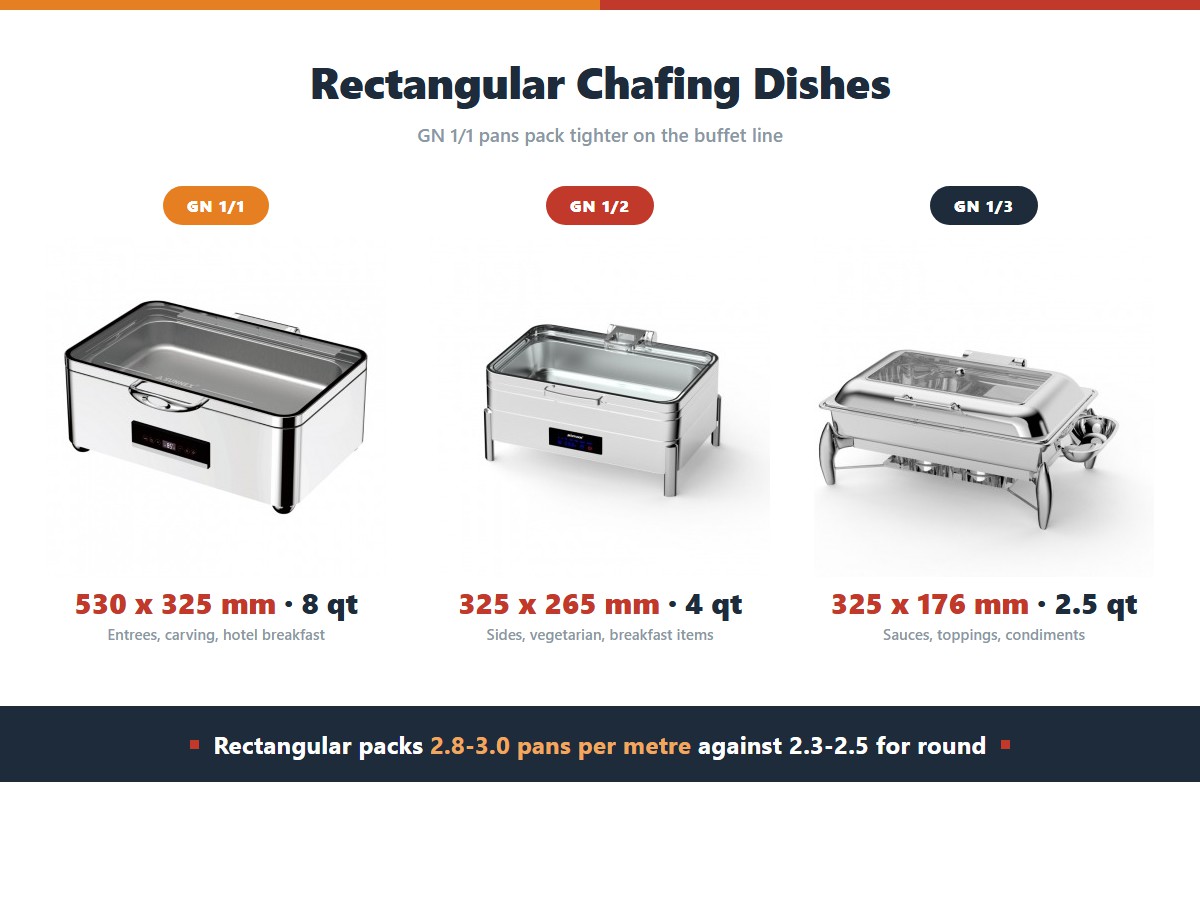
Short answer: rectangular chafing dishes take a GN 1/1 pan (530×325 mm) and sit flush with their neighbours, giving about 2.8–3.0 pans per metre of counter against 2.3–2.5 for round — roughly 20–25% more capacity in the same run. Use them for hot lines, carving and volume service; use round units for focal displays. See sizes in our chafing dish range.
Why rectangular wins on a line
A straight edge gives guests a straight run to serve along, so the queue moves in one direction and a server can reach every part of the pan from one side. Round pans force a reach across the rim, which slows each guest by a second or two — a small effect that compounds over 200 covers.
The capacity difference is the bigger argument. An 8 qt rectangular pan holds 40–48 portions of 150 g. A round 4–6 qt pan holds 20–36 in a similar footprint. On a fixed counter that is the difference between one refill and three, which is where the labour cost lives.
Sizes and what each is for
| Pan | Dimensions | Capacity | Typical use |
| GN 1/1 | 530×325 mm | 8 qt | Entrées, carving, hotel breakfast |
| GN 1/2 | 325×265 mm | 4 qt | Sides, vegetarian, breakfast items |
| GN 1/3 | 325×176 mm | 2.5 qt | Sauces, toppings, condiments |
| GN 2/3 + 1/3 | 353×325 mm | 6 qt + 2.5 qt | Mixed station in one frame |
Keep depth consistent at 65 mm so pans interchange between frames, and 100 mm for sauces where a deeper pan is genuinely needed. Mixed depths mean pans that do not sit level in the water bath.
How many pans fit your counter
Measure the usable run, subtract 10 cm between units so a guest can set a plate down, then divide. A 4 m run holds about six full-size frames or eight half-size frames at 60–70 cm centres. The same run in round units holds five and leaves curved gaps that guests step into.
If the counter is deeper than 50 cm, a two-tier layout works better: chafers at the front, plates and cutlery behind, service edge clear. That is the difference between a line that queues and one that flows.
What to check before buying
- Pan fit. A standard GN 1/1 should drop in without rocking. Nominal pans look identical in photos.
- Food pan gauge. 0.6–0.8 mm of 304 steel; 0.4–0.5 mm dents in transit and warps when dry-fired.
- Frame gauge. 1.0–1.2 mm with welded corners. Rivets loosen after a season of stacking.
- Lid seating. A lid that does not sit flat leaks steam and dries the food at the edges.
- Hinge. Replaceable, and damped if the unit travels.
Cleaning and storage
Rectangular pans are easier to clean than round ones because there is no curve to reach into. The places that collect soil are the four corners and the seam where the base meets the wall. A soft brush reaches them in seconds; a sponge does not, and a scoured corner is where rust starts on a thinner gauge.
Store frames stacked with a cloth between them, and pans separately and dry. A pan left inside a frame traps condensation against the base; two seasons of that leaves a chalky ring that looks like scale and is corrosion.
Rectangular Capacity by GN Pan Size
| Unit | GN pans | Total capacity | Serves | Footprint | Typical use |
|---|---|---|---|---|---|
| Round 9 in | 1 × 1/2 | 2.5–3 L | 25–35 | 330 mm sq | Condiments, one side dish |
| Round 11–13 in | 1 × 1/1 | 5.5–7 L | 40–60 | 400–450 mm sq | One main per point |
| Rectangular 4-pan | 4 × 1/1 | 16–20 L | 120–180 | 550 × 360 mm | Buffet line centrepiece |
| Rectangular 6-pan | 6 × 1/1 | 24–28 L | 180–260 | 800 × 360 mm | Banquet, two dishes |
| Rectangular 8-pan | 8 × 1/1 | 32–38 L | 260–380 | 1,100 × 360 mm | Hotel breakfast, expo |
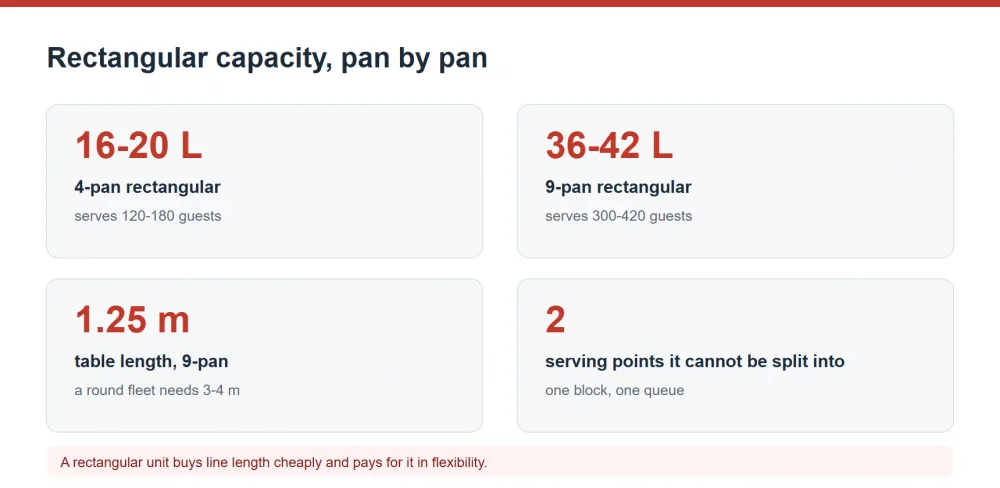
| Rectangular 9-pan | 9 × 1/1 | 36–42 L | 300–420 | 1,250 × 360 mm | Full buffet run |
Where Rectangular Wins and Where It Loses
| Factor | Rectangular | Round | Verdict |
|---|---|---|---|
| Pans per unit | 4–9 | 1 | Rectangular wins clearly |
| Line length for 200 guests | 1.2–1.8 m | 3–4 m of units | Rectangular wins |
| Serving points split | Hard, a unit is one block | Easy, one pan each | Round wins |
| Refill granularity | One pan at a time, 1/9 of the unit | All or nothing | Rectangular wins |
| Appearance at a wedding | Institutional | Formal | Round wins |
| Cleaning time | 30–45 min per unit | 8–12 min per unit | Round wins |
| Transport | Wide, needs two people | One person | Round wins |
| Pan interchange with kitchen | Standard GN, perfect fit | Round pans rarely matched | Rectangular wins |
| Power, electric | 20–32 A per unit | 10–13 A per unit | Round wins |
| Cost per serving point | $340–900 divided by 4–9 | $45–160 each | About even |
The honest summary is that a rectangular unit is a way of buying line length cheaply, and it pays for that in flexibility. A nine-pan unit puts a whole buffet run on 1.25 metres of table, which no collection of round dishes can match. What it cannot do is serve as two separate serving points, which is why a venue with 200 guests should usually run a rectangular unit at the centre and two or three round dishes at the edges rather than trying to split one large unit.
Frequently Asked Questions
Why choose rectangular over round?
Capacity per metre and a straighter serving edge — about 20–25% more pans fit the same counter, and the queue moves in one direction.
What size pan does it take?
Full-size frames take GN 1/1, 530×325 mm. Half-size frames take GN 1/2. A full frame also takes two 1/2 pans, three 1/3 pans, or a 2/3 plus a 1/3.
How many portions per pan?
40–48 portions of 150 g in a full-size 8 qt pan; 20–24 in a 4 qt half pan.
Can I mix rectangular and round?
Yes — rectangular for the hot line, round for desserts and focal stations at the ends.
Does shape affect heat retention?
Slightly. A rectangular lid seals along a straight edge, which is easier to keep tight than a round rim, so less steam escapes.
Related reading
- Rectangular vs round chafing dish: which shape fits your service?
- Chafing dish size guide: how much food per pan
- What size food pan fits a full-size chafing dish?
- How much counter space a buffet line needs
- Why Chefs Hate Roll-Top Chafing Dishes (And What They Use Instead)
- Round vs Rectangular Chafing Dishes: Which Shape Serves Better?