




Chafing Dishes for Food Trucks: Portable Food Warming Solutions
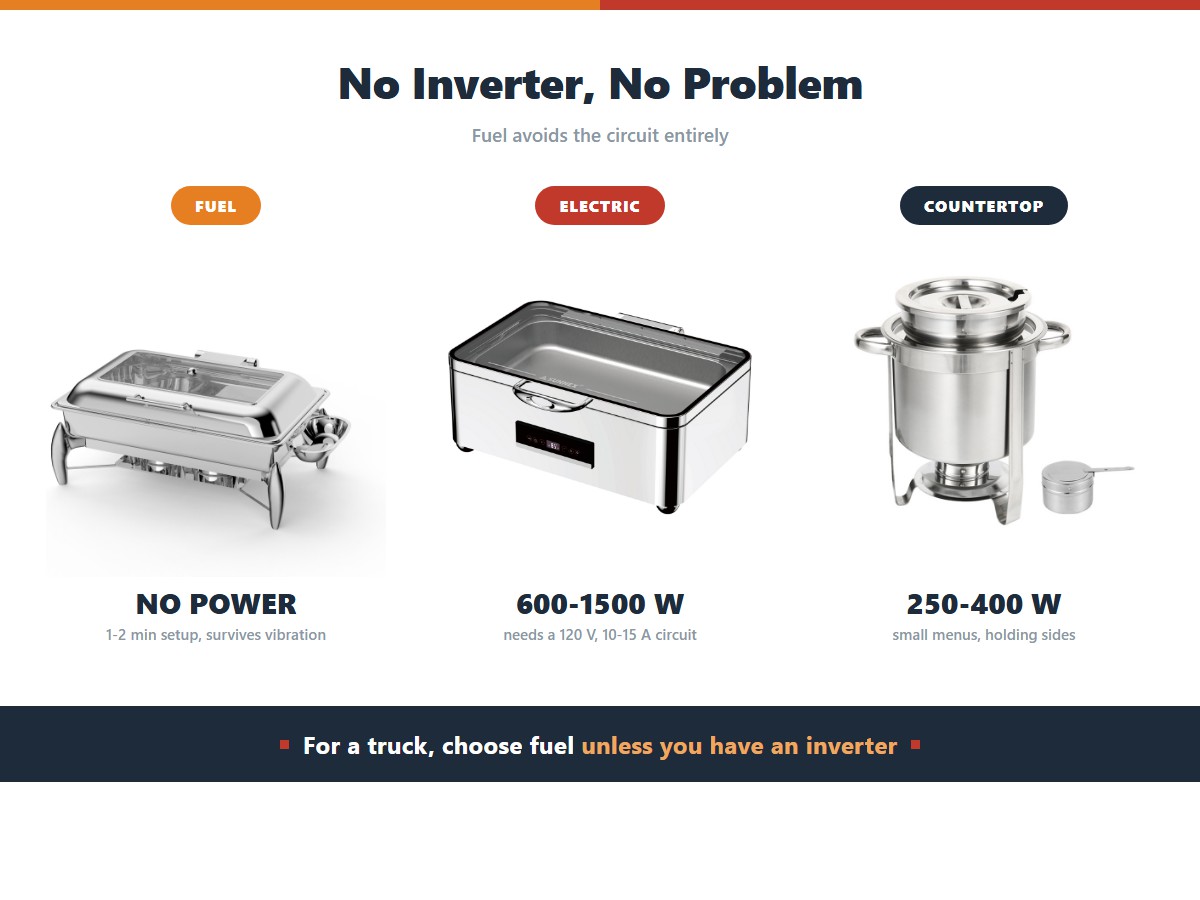
Short answer: Food trucks need holding gear that survives vibration, power spikes and a two-minute setup: 304 stainless, a bolted frame, and a lid that latches. Fuel chafing dishes avoid the inverter entirely; electric units need a 120 V, 10–15 A circuit, which is roughly 600–1500 W. For a truck, choose fuel unless the generator is already running. See chafing dishes and heat lamps for mobile service.
Food trucks face unique challenges for hot food holding that traditional restaurants do not encounter, including limited space, vehicle movement, and the need for quick setup and breakdown at each location. Portable chafing dishes designed for mobile operations address these challenges through compact designs, secure mounting options, and fuel efficiency that suits the constraints of mobile food service. Understanding portable warming solutions helps food truck operators maintain food quality throughout service.
Space-Efficient Designs
Compact footprints in food truck chafing dishes maximize serving capacity within the limited counter space that mobile operations provide. designs optimized for food trucks often sacrifice the elegant appearance of full-size catering equipment for practical space utilization. Compact sizing enables efficient layouts.
Stackable designs allow efficient storage during transit and quick deployment when service begins, with some models designed specifically for the setup-breakdown cycle that food trucks perform daily. Stackability reduces storage space requirements while enabling rapid service initiation. Stackable units suit mobile operations.

Multi-compartment configurations provide menu variety within single units, allowing food trucks to offer multiple items without the space that separate chafing dishes would require. Compartment designs maximize menu options in limited space. Multi-compartment units expand offerings.
Vehicle Movement Considerations
Securing mechanisms prevent chafing dishes from shifting during transit between locations, with options including mounting brackets, non-slip bases, and restraint systems that keep equipment stable. Vehicle movement creates challenges that stationary operations never face. Secure mounting prevents damage and spills.
Lid designs for mobile operations prevent spills during vehicle movement while providing easy access during service, with tight-sealing lids that contain contents even on rough roads. Lid security protects both food quality and vehicle cleanliness. Secure lids prevent road-related spills.
Stability features including low center of gravity designs and broad bases resist tipping that vehicle movement can cause, maintaining food safety and presentation during transit between locations. Stability design prevents the accidents that movement creates. Stable designs resist vehicle motion.
Fuel Options for Mobile Use
Sterno fuel provides the simplicity that food truck operations appreciate, with no electrical requirements and easy replacement during service. Fuel cans work well for operations without reliable electrical access or those prioritizing simplicity. Fuel simplicity suits mobile constraints.
Electric heating offers consistent temperature control without fuel replacement needs, though electrical capacity must support heating loads alongside other food truck equipment. Electric heating suits trucks with adequate electrical systems. Electric heating provides consistency.
Butane cartridges offer higher heat output than traditional sterno while maintaining portability, with cartridge systems providing the heat that some menu items require. Butane systems bridge the gap between sterno simplicity and electric power. Butane provides higher heat output.
Setup and Breakdown Speed
Quick-deployment designs allow food truck operators to begin service within minutes of arriving at locations, with equipment that sets up faster than traditional catering chafing dishes. Speed of deployment directly affects service time and revenue. Quick setup maximizes service time.
Easy-cleaning features enable rapid breakdown between locations, with smooth surfaces and accessible components that simplify the cleaning that health codes require. Cleaning efficiency affects turnaround time between locations. Easy cleaning speeds breakdown.
Storage-friendly designs allow efficient stowing during transit without requiring disassembly, with fold-down handles and nesting components that minimize storage space. Storage efficiency affects vehicle organization. Compact storage suits vehicle constraints.
Temperature Maintenance
Insulation quality in portable chafing dishes maintains safe food temperatures despite the challenges of mobile service, including door openings and variable ambient conditions. Temperature maintenance protects food safety throughout service. Insulation ensures food safety.

Full Size 11L Electric Chafer
Full Size 11L Electric Chafer illustrates the temperature maintenance capabilities that food trucks require. Reliable heating keeps food safe throughout service regardless of outdoor conditions.
Wind protection becomes critical for outdoor food truck service where wind can cool chafing dishes rapidly, with designs that shield flames or heating elements from air movement. Wind-resistant features maintain heating efficiency. Wind protection ensures consistent heating.
Temperature monitoring options help food truck operators verify food safety during extended service, with some portable models including thermometer ports or built-in indicators. Temperature visibility supports food safety compliance. Monitoring capability aids compliance.

Durability for Daily Use
Heavy-duty construction withstands the daily handling that food trucks require, with equipment subjected to setup, breakdown, cleaning, and transit stresses that stationary operations never experience. Durability determines equipment lifespan in mobile applications. Heavy-duty construction extends equipment life.
Corrosion resistance matters more for food trucks exposed to outdoor conditions and frequent cleaning than for indoor equipment, with stainless steel construction that resists the elements. Weather resistance protects equipment investment. Corrosion resistance suits outdoor exposure.
Impact resistance prevents damage from the knocks and bumps that mobile operations inevitably encounter, with rugged designs that absorb impacts without denting or malfunction. Impact durability prevents service interruptions. Impact resistance prevents damage.
Menu Flexibility
Variable temperature zones allow food trucks to hold different items at appropriate temperatures within single units, with adjustable heating that accommodates varied menus. Temperature flexibility enables diverse menu offerings. Variable heating suits menu variety.
Compatibility with standard food pans allows food trucks to use existing equipment inventory rather than purchasing specialized containers for chafing dishes. Standard compatibility reduces equipment costs. Standard sizing simplifies operations.
Quick-change inserts enable menu changes during service without replacing entire chafing dishes, with removable food pans that allow rapid menu adjustments. Quick-change capability supports menu flexibility. Removable inserts enable variety.
Regulatory Compliance
Health department requirements for mobile food service often specify equipment standards that differ from stationary restaurant requirements, with temperature maintenance and construction standards specific to mobile operations. Compliance verification prevents permit issues. Regulatory awareness ensures compliance.
Fire safety regulations for mobile food service may restrict fuel types or quantities, with local codes that food truck operators must understand before selecting equipment. Fire code compliance prevents operational restrictions. Fire safety compliance protects operations.
NSF certification indicates equipment meets commercial food service standards that health departments may require, providing verification that simplifies permit applications. Certification demonstrates compliance capability. Certification simplifies inspections.
Browse the full chafing dish range for current models and configurations.
Holding Options on a Food Truck
| Option | Power draw | Setup time | Survives vibration | Best for |
|---|---|---|---|---|
| Fuel chafing dish | None | 1–2 min | Good, no electronics | Short stops, wind-exposed sites |
| Electric chafing dish | 600–1500 W | 2–3 min | Fair, element can loosen | Long stops with a generator |
| Countertop warmer | 250–400 W | 1 min | Good | Small menus, holding sides |
| Heat lamp | 250 W typical | 1 min | Poor, bulb fragility | Dry food only, indoor shelter |
| Insulated box | None | 30 s | Excellent | Transport, not service |
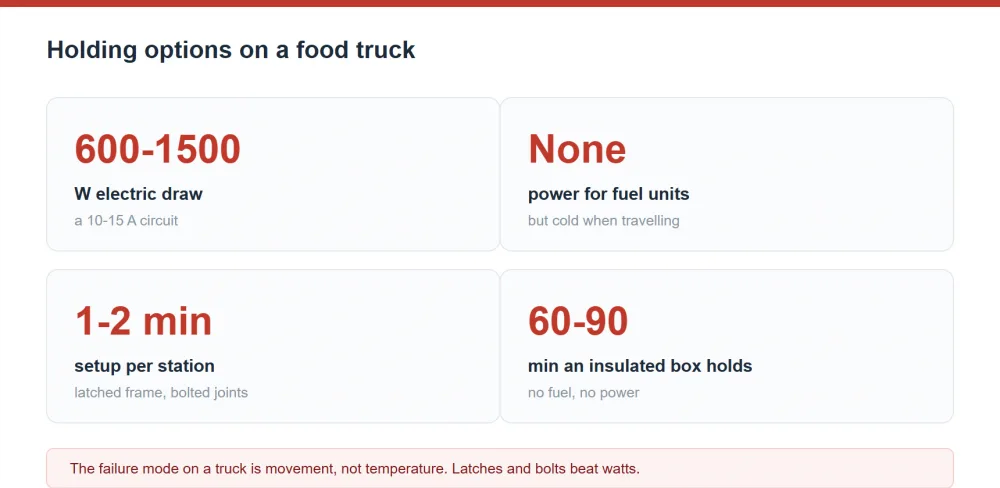
The failure mode on a truck is not temperature, it is movement. Latches, bolted frames and shock-mounted burners matter more than watts, because a loose part becomes a projectile at 50 km/h.
Frequently Asked Questions
Can a food truck run an electric chafing dish?
Yes, if the generator or inverter can supply 120 V at 10–15 A continuously, not just peak. Most small trucks have 1000–2000 W inverters that are already committed to the cooking line, so the honest answer is often no.
Is fuel safe on a moving vehicle?
Only when cold and sealed. Gel cans travel in a vented, latched box away from the cooking line, and the burner is lit after the truck stops. A lit can in a moving vehicle is the single worst combination on this list.
What is the best way to hold food between stops?
An insulated transport box, not a chafing dish. Insulation keeps food above 60°C for 60–90 minutes with no fuel and no power, and the chafing dish is set up only when you have arrived and stopped.
Do heat lamps work on a food truck?
Poorly. Bulbs break in transit and the lamp needs a still-air environment to hold temperature, which a truck at a curbside pitch is not. They suit sheltered indoor service, not a mobile window.
How do I secure a chafing dish while driving?
Remove it, or strap it in a latched cabinet. Any unit standing on a service shelf becomes a 5–10 kg projectile in a hard stop, and that includes the water pan if it has not been emptied.
Related reading
- Portable Food Heat Lamps: Lightweight Warming for On-The-Go Use
- Roll Top Chafing Dishes: Convenient Self-Serve Buffet Solutions
- Disposable Chafing Dishes for Catering: Time-Saving Solutions
- Disposable Chafing Dishes with Lids: Convenient Event Solutions
- How to Remove Burnt Carbon From Chafing Dishes Without Scratching Them
- Food Heat Lamps for Food Trucks: Portable Warming Solutions