




Roll Top Chafing Dishes: Convenient Self-Serve Buffet Solutions
Short answer: A roll top chafing dish uses a horizontal sliding lid so a guest can serve one-handed without lifting anything. Full-size GN 1/1 units hold 40–60 portions, half-size units 20–30. Expect a 15–25% price premium over a dome lid, and choose roll top when the line is self-serve and queue speed matters. Compare formats in the chafing dish range.
KEY TAKEAWAY: Roll top pays off on a self-serve line with 80+ guests.
The mechanism is the whole product - a stainless track with nylon rollers survives years of daily service. See our roll top vs lift-off guide.
Roll top chafing dishes introduce a sliding lid mechanism that transforms how buffet service operates in self-serve environments. The horizontal rolling cover opens smoothly along the unit length, providing unobstructed access without the awkward lifting and temporary placement that traditional dome lids require. This functional advantage makes roll top designs increasingly popular across catering operations ranging from hotel breakfast service to corporate eventbuffets.
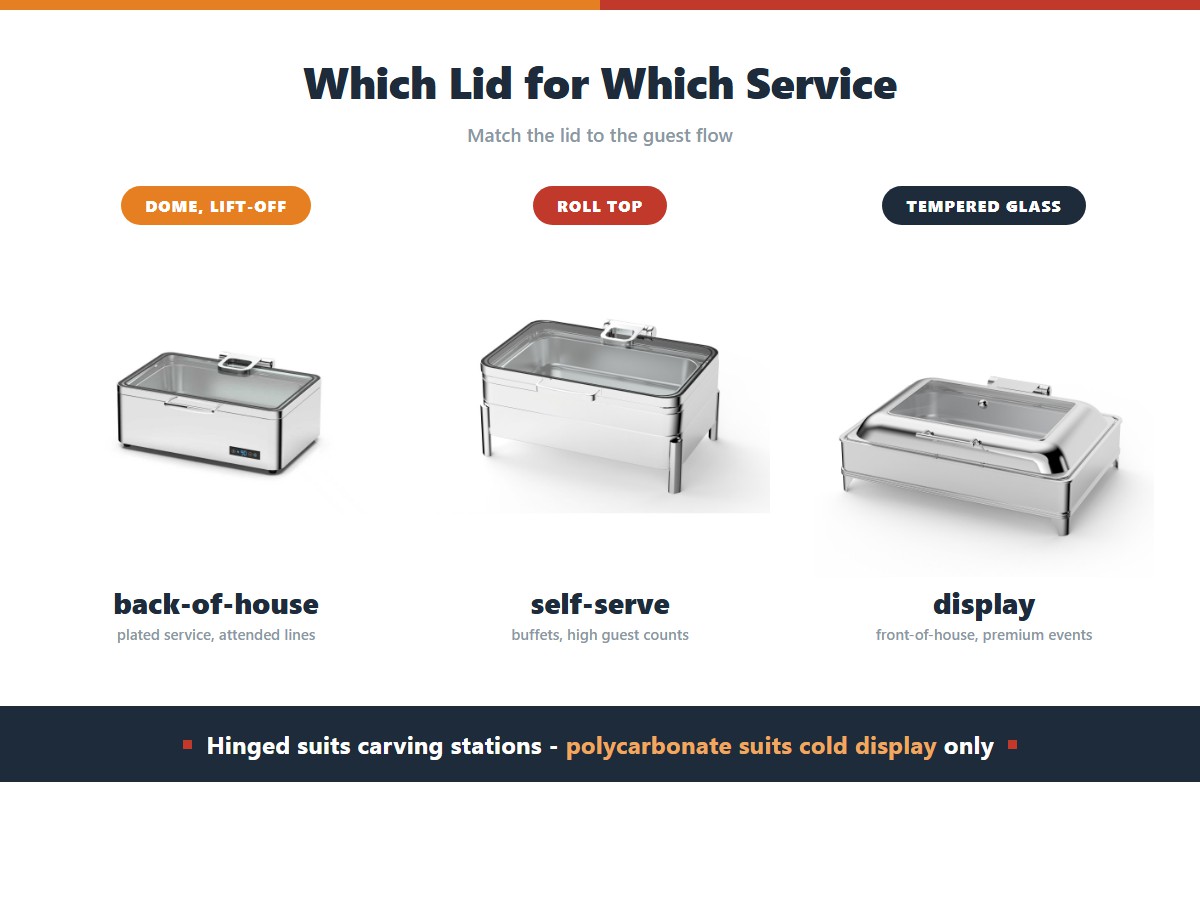
How Roll Top Mechanism Works
The roll top lid slides along tracks mounted above the chafing dish body, rolling to one end to expose the food pan completely. This motion requires minimal vertical clearance, making roll top units practical where ceiling height or overhead obstructions limit traditional dome lid operation. The sliding action creates a natural flow pattern that encourages guests to move along the serving line rather than clustering around a single access point.
Track mechanisms must maintain precise alignment to function smoothly over years of service. Quality roll top units feature reinforced tracks that resist the bending and misalignment that heavy use introduces. Budget alternatives often sacrifice track durability, leading to binding and operational problems that undermine the convenience roll tops promise.
The lid remains attached throughout service, eliminating the cluttered lid placement that traditional designs create. This containment proves particularly valuable in formal settings where stray lids create visual distraction and potential safety hazards. The streamlined appearance contributes to the professional presentation that upscale events demand.
Advantages Over Traditional Dome Lids
The most significant practical advantage lies in service efficiency. Guests serving themselves can open the roll top and access food without waiting for staff to remove and replace dome lids between servings. This continuous access model substantially increases throughput during peak service periods when buffet lines form quickly.
Ergonomics favor roll top designs for staff handling as well. Lifting dome lids, particularly when hot from extended service, creates both safety concerns and operational delays. The sliding mechanism requires minimal physical effort and avoids the awkward lifting motions that contribute to workplace strain injuries.
Space efficiency offers another meaningful advantage. Dome lids require clearance space above and beside the unit for placement during service. Roll top units eliminate this requirement, allowing tighter placement of multiple units along serving counters. This space savings enables more diverse menu offerings within limited buffet counter areas.

Ideal Applications for Roll Top Designs
Hotel breakfast buffets represent the most common roll top application, where high volume traffic and continuous self-service access justify the premium pricing roll top units command. The reliability advantage proves particularly valuable during weekend brunch rushes when service intensity peaks.
Corporate events with extended service periods benefit from the consistent access roll tops provide. Conference catering that serves throughout presentation breaks requires equipment that handles frequent openings without service interruption. Roll top units maintain temperature more consistently because the lid seal remains intact even during active service.
Outdoor catering events present challenging conditions for traditional equipment. Wind creates dome lid stability problems, and ground surfaces may not accommodate safe lid placement. Roll top designs eliminate these concerns, providing reliable self-service capability in tent and outdoor venue environments.
Construction Quality Considerations
Track material and construction determine long-term reliability. Steel tracks with smooth rolling surfaces provide years of maintenance-free operation, while aluminum tracks may deform under heavy use. Verify track specifications before purchase, particularly for units intended for high-volume professional applications.
Lid construction quality varies substantially between manufacturers. Premium lids feature reinforced structures that resist the warping that temperature cycling creates. Economy lids may perform adequately initially but develop gaps and sealing problems within months of regular use.
Heat-resistant handles ensure safe operation throughout extended service. Quality units feature handles that remain cool to touch even after hours of operation, while budget alternatives may transfer enough heat to cause discomfort or injury. This safety consideration merits attention regardless of other cost pressures.
Capacity Planning for Roll Top Equipment
Standard roll top units accommodate full-size GN 1/1 food pans serving 40-60 portions, matching the capacity that traditional full-size chafing dishes provide. Half-size units serving 20-30 portions work well for appetizer or side dish service where smaller portions reduce waste and maintain variety.
Consider the ratio of roll top units to expected service volume carefully. The access efficiency advantage only materializes when multiple units eliminate bottlenecks. A single roll top unit among several dome-lidded units creates inconsistent service patterns that confuse guests and slow overall throughput.
Maintenance Requirements
Track cleaning requires attention during regular maintenance to prevent debris accumulation that affects rolling smoothness. Food particles, crumbs, and dust collect in tracks during service, with the problem intensifying in dusty environments or outdoor settings. Establish cleaning protocols that address track maintenance specifically.
Lubrication requirements vary by design. Some roll top units feature sealed bearings that require no ongoing maintenance, while others benefit from periodic lubrication that maintains smooth operation. Understand your specific unit requirements and establish appropriate maintenance schedules.
Making Your Selection
Roll top chafing dishes deliver genuine operational advantages for self-serve environments where the sliding lid mechanism enhances service flow and efficiency. Evaluate your specific application requirements, volume expectations, and service environment when considering roll top investments.
The premium pricing that roll top units command proves justified for operations running frequent self-serve buffets where the efficiency advantages accumulate across many service events. Occasional use applications may not recover the additional investment, making traditional dome-lidded units more appropriate for lower-volume operations.
Browse the full chafing dish range for current models and configurations.
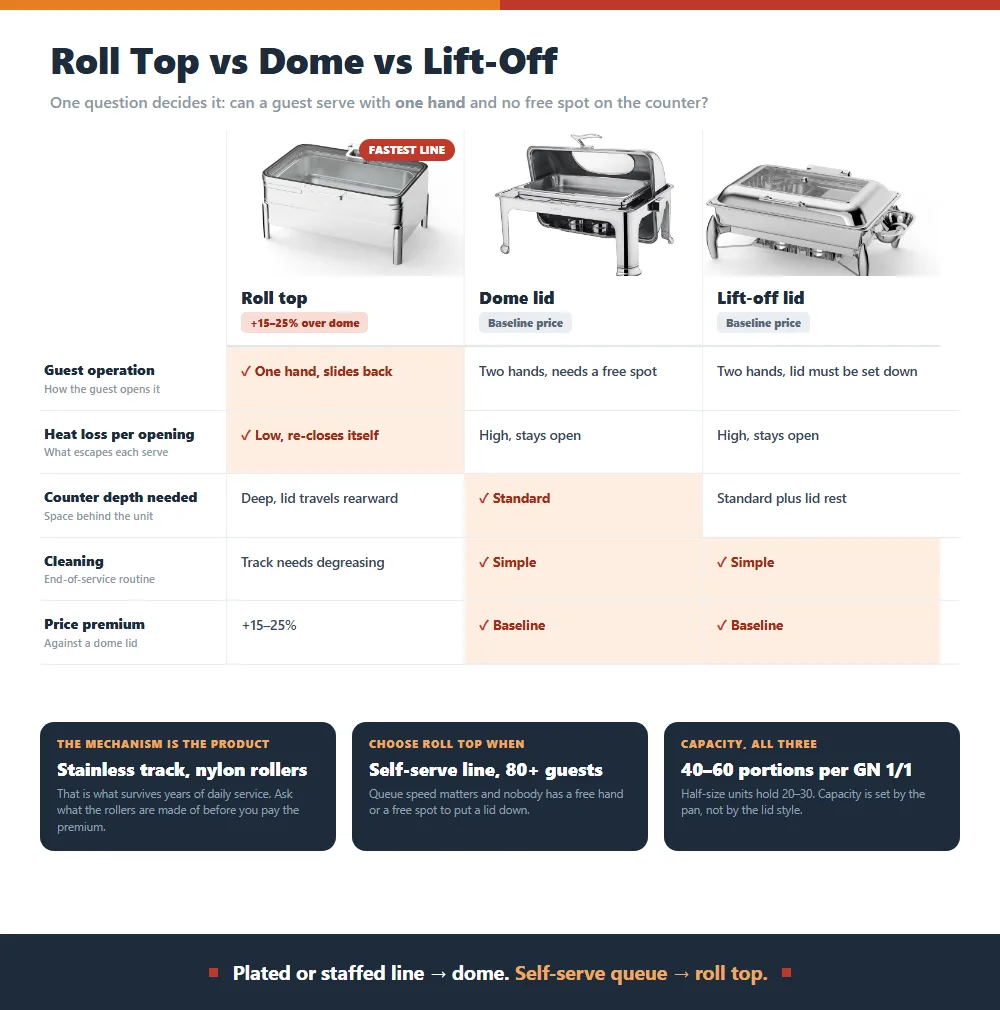
Roll Top vs Dome vs Lift-Off
| Attribute | Roll top | Dome lid | Lift-off lid |
|---|---|---|---|
| Guest operation | One hand, slides back | Two hands, needs a free spot | Two hands, lid must be set down |
| Heat loss per opening | Low, re-closes itself | High, stays open | High, stays open |
| Counter depth needed | Deep, lid travels rearward | Standard | Standard plus lid rest |
| Cleaning | Track needs degreasing | Simple | Simple |
| Price premium | +15–25% | Baseline | Baseline |
The mechanism is the whole product. A roll top with a plastic track will bind within a season under buffet grease; a stainless track with nylon rollers survives years of daily service.
Frequently Asked Questions
What is a roll top chafing dish?
It is a chafer whose lid slides horizontally on a track instead of lifting. The guest pulls the lid back with one hand, serves, and the lid returns under spring or gravity tension, so the food is covered again without anyone thinking about it.
Are roll top chafing dishes worth the extra cost?
On a self-serve line with more than about 80 guests, usually yes. The premium is 15–25% per unit, and the return comes from faster service and less heat loss per opening. On an attended carving station the advantage disappears, so a hinged or dome lid is the better buy.
Can the roll top lid be removed for cleaning?
On most commercial models the lid lifts off the track after releasing two stops. Clean the track separately with a degreaser, because the grease that collects there is what makes the slide stiff and eventually strips the rollers.
Do roll top dishes hold heat as well as dome lids?
Comparably, provided the lid closes fully. The advantage is behavioural: guests close a roll top because it is one motion, while a dome lid is often left open for the rest of the service. That habit is worth 5–8°C over an hour.
What size roll top do I need for 100 guests?
Two full-size units as a starting point, since each covers 40–60 portions, plus one half-size unit per two side dishes. If the menu is a single main course served over 90 minutes, three full-size units give the refill rotation that keeps the line stocked.
Related reading
- Disposable Chafing Dishes with Lids: Convenient Event Solutions
- Chafing Dishes for Food Trucks: Portable Food Warming Solutions
- Chafing Dish Fuel Holder: Safe Fuel Storage Solutions
- Heat Lamps for Self-Serve Buffets: Placement and Wattage
- Why Chefs Hate Roll-Top Chafing Dishes (And What They Use Instead)
- Roll Top vs. Lift Off Chafing Dishes: Key Differences