




Chafing Dishes for Catering: Why Every Business Needs Them
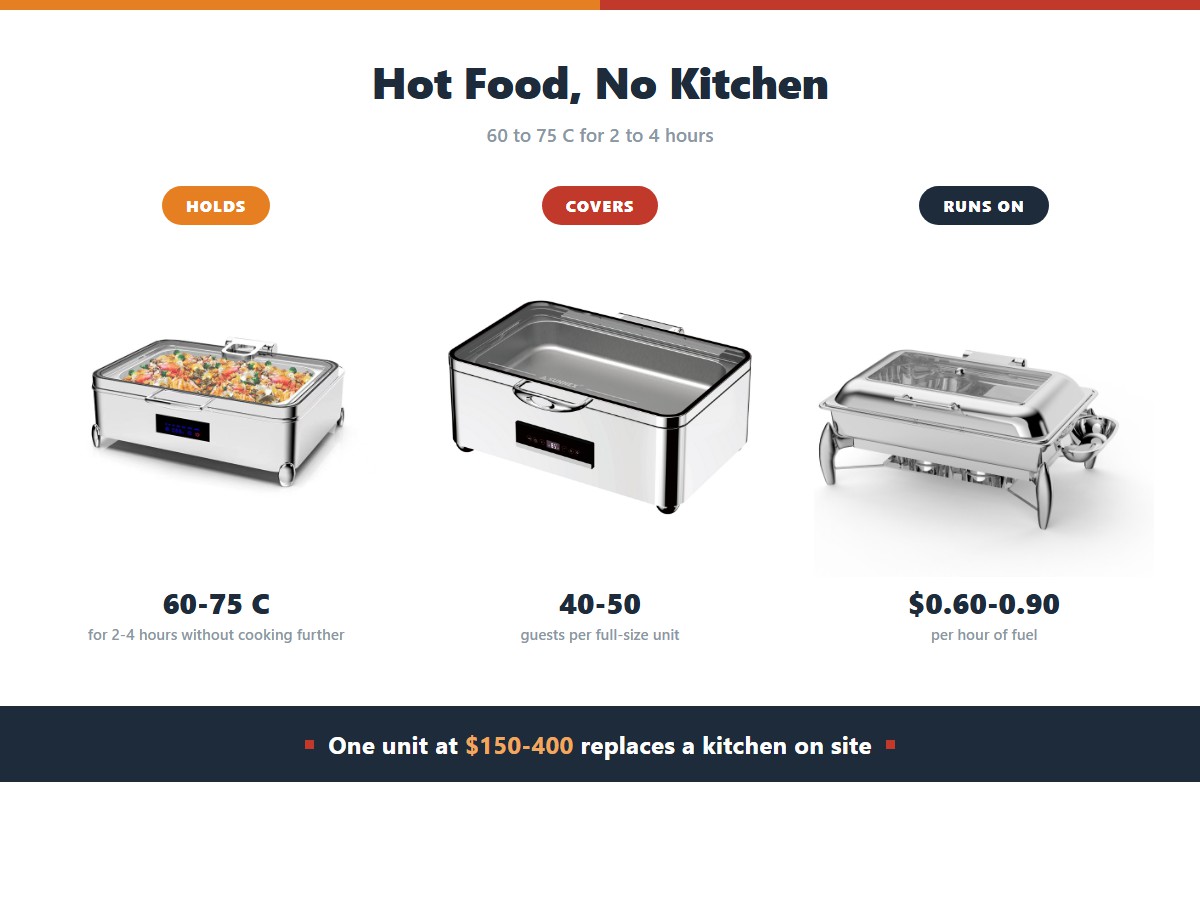
Short answer: A chafing dish holds food between 60°C and 75°C for 2–4 hours without cooking it further, which is what lets a caterer serve restaurant-quality hot food away from a kitchen. One full-size unit covers 40–50 guests at $150–400 of equipment and $0.60–0.90 an hour of fuel. See commercial chafing dishes for the range.
Catering businesses operate in a competitive environment where food quality, service reliability, and professional presentation determine success. Chafing dishes form the backbone of hot food service operations, enabling caterers to deliver restaurant-quality dining in any venue. Understanding why these equipment pieces matter helps business owners make informed investment decisions that directly impact profitability and reputation.
Enabling Mobile Food Service
Restaurant kitchens provide controlled environments where chefs manage temperatures and timing precisely. Catering operations face venues without kitchens, timelines without control, and conditions that require portable solutions. Chafing dishes solve this fundamental challenge by providing independent heating that works anywhere power or fuel exists. Mobile service depends on portable equipment. Chafing dishes enable off-site dining.
The self-contained heating system means caterers accept events in locations that would otherwise be impossible, expanding business opportunities beyond traditional venue categories. Self-contained heating expands possibilities. Caterers serve anywhere.
Multiple units running simultaneously maintain different menu items at appropriate temperatures, enabling complex menus that single-unit setups cannot support. Multiple units enable menu variety. Complex events need complex capabilities.
Food Safety Compliance
Health regulations require hot foods to remain above one hundred forty degrees Fahrenheit during service, with violations potentially resulting in closures, fines, or worse. Chafing dishes provide the consistent temperatures that regulations demand, protecting both guests and business operations. Temperature compliance protects guests. Professional equipment ensures standards.
Reliable equipment reduces anxiety about health inspections, with professional-grade units providing confidence that inspection concerns cannot challenge. Professional equipment provides compliance confidence. Inspections cannot find problems with quality tools.
Documentation of equipment capabilities supports regulatory compliance arguments, with professional-grade specifications providing evidence of proper food safety investment. Documentation supports compliance. Professional specs demonstrate investment.

Professional Presentation
Food presentation affects guest perception significantly, with attractive displays commanding premium pricing while sloppy presentations undermine perceived value. Chafing dishes provide heated serving vessels that enhance food appearance throughout service periods. Professional presentation commands premium pricing. Appearance affects perceived value.
The wide range of available finishes and styles enables caterers to match equipment aesthetics to event themes, with elegant mirror-finish units serving upscale occasions while durable options handle demanding work environments. Aesthetic variety serves different markets. Matching equipment to events projects professionalism.
Consistent temperature maintains food appearance that cooling would compromise, with hot foods maintaining visual appeal that cold or cooling items cannot match. Temperature maintains appearance. Visual appeal affects guest satisfaction.
Operational Flexibility
Chafing dishes accommodate various fuel types including gel, electric, and induction options, with fuel flexibility enabling operations in venues with different infrastructure capabilities. Fuel options provide infrastructure flexibility. Different venues need different solutions.
Scalability lets catering businesses adjust equipment investment to match current demand while positioning for growth, with modular units enabling gradual expansion without major upfront capital commitment. Scalability serves growing businesses. Gradual investment minimizes risk.
The wide market for quality used equipment provides exit strategies for businesses that close, with professional-grade units retaining significant resale value relative to consumer alternatives. Resale value protects investment. Professional equipment holds value.
Labor Efficiency
Self-monitoring equipment reduces the constant supervision that less reliable solutions require, with professional chafing dishes maintaining temperatures without continuous staff attention. Self-monitoring reduces labor requirements. Professional equipment maintains itself.
Simple operation enables training staff quickly, with intuitive designs reducing the learning curves that complex equipment creates for temporary event workers. Simple designs enable quick training. Event staff learn faster.
Reliable equipment prevents the service disruptions that equipment failures create, with failure-prevention protecting staff from crisis management that stresses everyone involved. Reliability prevents service failures. Consistent equipment protects staff from crisis.
Menu Versatility
Hot holding enables menu items beyond what cold service allows, with soups, sauces, proteins, and vegetables all benefiting from temperature-maintained presentation. Hot holding expands menu possibilities. Temperature maintenance enables variety.
Simultaneous service of multiple courses requires coordinated temperature management that separate hot holding units provide. Multiple courses need coordinated holding. Several units manage different items.
Specialized menu concepts like action stations or live cooking demonstrations incorporate chafing dish elements, with customer-facing heated elements adding entertainment value to dining experiences. Specialized concepts incorporate heated elements. Entertainment value enhances experiences.
Business Growth Support
Quality equipment enables bid acceptance on premium events that require professional-grade capabilities, with specifications that exclude competitors lacking proper equipment. Professional equipment enables premium bids. Specifications exclude under-equipped competitors.
Reliable equipment builds reputation through consistent service quality, with reputation driving referral business that advertising cannot match in cost efficiency. Reliable service builds reputation. Reputation drives affordable referrals.
Equipment investment signals business seriousness to potential clients, with professional appearance demonstrating commitment that affects client confidence significantly. Professional equipment signals commitment. Clients notice the details.
Cost Effectiveness
Per-use cost calculations reveal surprisingly low expenses for quality equipment, with durable units spreading purchase price across thousands of successful services. Per-use cost reveals value. Durable units spread investment across many services.
Energy efficiency in modern designs reduces ongoing fuel and electricity costs that older equipment cannot match, with efficiency improvements paying for themselves over operational lifespans. Energy efficiency reduces operating costs. Modern designs pay for themselves.
Maintenance costs for quality equipment stay low when operators follow recommended care procedures, with preventive maintenance preventing the expensive repairs that neglect creates. Preventive maintenance reduces costs. Care prevents expensive repairs.
Competitive Necessity
Clients increasingly specify equipment requirements in catering contracts, with professional-grade chafing dishes becoming minimum entry requirements for serious business. Contract requirements specify professional equipment. Minimum standards exclude inadequate operators.
Social media presence amplifies both excellent and poor presentations, with client events becoming advertising that professional equipment ensures trends positively. Social media amplifies presentations. Professional equipment ensures positive amplification.
Competitors already invested in quality equipment operate more efficiently, with equipment advantages translating directly into pricing flexibility that under-equipped businesses cannot match. Competitor equipment advantages affect pricing. Quality tools enable competitive operations.
Event Type Coverage
Corporate events require the professional presentation that clients expect, with business meals demanding the same quality restaurants provide. Corporate events need professional presentation. Business clients expect restaurant quality.
Wedding receptions benefit from elegant equipment that matches celebration importance, with couples investing significantly in their reception experience. Wedding elegance matters. Celebrations deserve quality equipment.
Social gatherings from birthday parties to family reunions all benefit from proper food service equipment, with hosts wanting to provide the same quality their guests enjoy in restaurants. Social events benefit from proper equipment. Hosts want restaurant quality for guests.
Conclusion
Chafing dishes are essential for catering businesses because they solve fundamental challenges that off-site food service presents. Food safety compliance, professional presentation, operational flexibility, and menu versatility all depend on quality heating equipment. The investment in professional-grade chafing dishes pays returns through expanded service capabilities, competitive positioning, and reliable operations that build lasting reputations. Catering businesses that treat equipment investment seriously position themselves for sustainable success in a demanding industry.
Browse the full chafing dish range for current models and configurations.
What Chafing Dishes Replace
| Without a chafer | Cost of the alternative | What it costs you |
|---|---|---|
| Bring food from a kitchen | Second trip, driver, insulated boxes | Labour and 20–30% more equipment |
| Cook on site | Hob, gas, ventilation, a cook | Permits and a full kitchen crew |
| Serve cold | Free menu change | Lower perceived value, fewer covers |
| Use a hot box | $400–900 per unit, power needed | Fixed menu, no guest self-service |
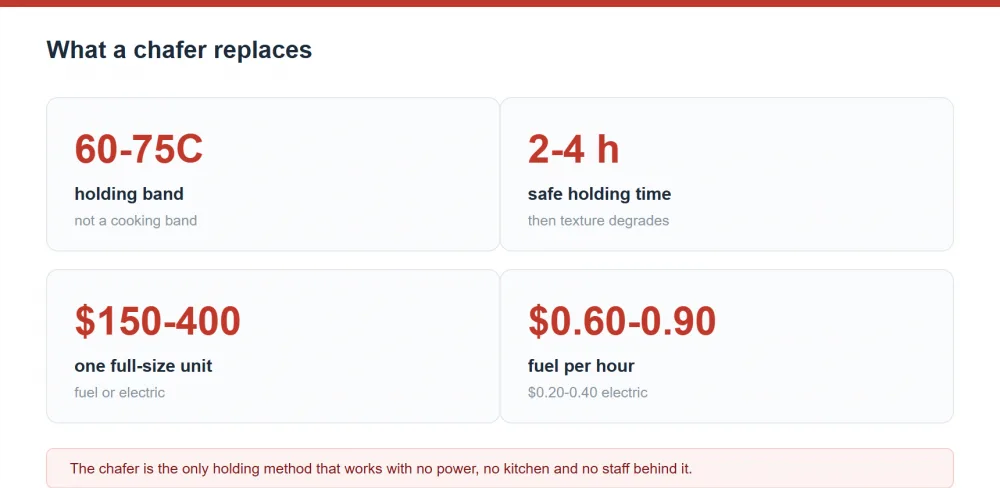
The chafer wins because it is the only holding method that works with no power, no kitchen and no staff standing behind it. Everything else trades flexibility for capability, and most events need flexibility more than capability.
Frequently Asked Questions
Why are chafing dishes essential for catering?
Because they decouple food from the kitchen. A chafer holds a cooked dish safely for hours with no power and no supervision, so the kitchen finishes its work before guests arrive and the service runs itself. Nothing else at this price does that.
How long can a chafing dish hold food safely?
Two to four hours above 60°C, which is the holding band rather than a cooking band. After four hours the texture starts to degrade even where safety holds, so plan the service window rather than stretching it.
Can I run a catering business without chafing dishes?
Only with a hot box or a mobile kitchen, both of which cost more and fix your menu. Most new caterers start with four to six chafers, which is $600–2,400 of equipment that covers 160–300 guests.
Do I need one chafer per dish?
One per hot dish, yes. A single full-size unit covers 40–50 guests for one protein or starch, so a three-dish buffet for 100 guests needs three units plus 20% spare capacity for the first wave.
Is a chafing dish better than a slow cooker?
For service, yes, because it is designed to be loaded, carried, opened and closed by guests. A slow cooker is a cooking appliance with a cord, and it cannot be moved once it is hot or served from safely.
Related reading
- 6QT Compact Chafing Dish for Small Catering Businesses
- How to Choose Chafing Dish for Catering Business
- Chafing Dishes for Sale: Best Deals for Catering Businesses
- 5 Benefits of Buffet Stoves for Catering Businesses
- Starting a Catering Business? Buy These 5 Things First
- Disposable Chafing Dishes for Catering: Time-Saving Solutions