


6QT Compact Chafing Dish for Small Catering Businesses
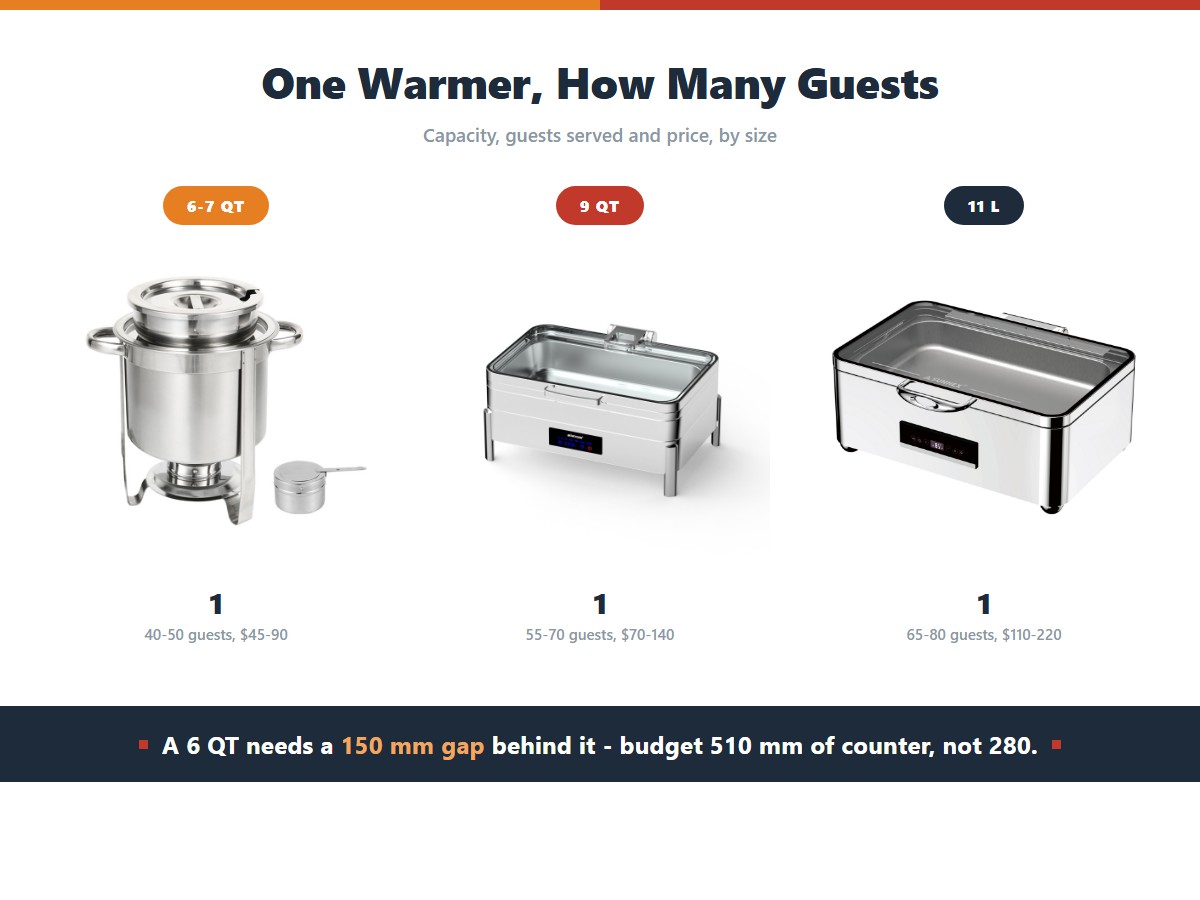
Short answer: A 6 QT chafing dish serves 40–50 guests, which covers a small catering business's single-dish and side-dish work, and the four numbers to check before buying are 0.6–0.8 mm body thickness, a 400–500 W element drawing 3.3–4.2 A, a 330 × 280 mm footprint that still needs a 150 mm working gap behind it, and a price between $45 and $90. Below $45 you are buying 0.5 mm steel and no spare parts. See chafing dish size options.
Introduction
Small catering businesses operate on tight margins with limited kitchen space and equipment budgets. The 6QT compact chafing dish has become the go-to solution for startups, boutique caterers, and independent operators serving 50-150 guests per event. Unlike full-size 11L units that overwhelm small operations, compact 6QT models deliver professional performance while fitting into compact kitchens, delivery vans, and event setups.

Modern 6QT compact chafing dishes combine space-efficient design with 400-900W heating power, achieving optimal serving temperatures in 10-15 minutes. For small catering businesses building their equipment fleet, these units provide the versatility, affordability, and reliability needed to compete with larger competitors. The integration of rapid heat-up technology and 75%+ thermal efficiency makes them indispensable for growing catering operations.
1. Space Efficiency: Maximizing Limited Kitchen Footprint
Small catering businesses often operate from home kitchens, shared commercial spaces, or compact prep areas with limited counter and storage space. 6QT compact chafing dishes with 1014 inch footprints fit efficiently into these constrained environments, allowing businesses to maximize their workspace.
The lightweight design (8-12 lbs) enables easy transport in compact delivery vehicles, reducing fuel costs and expanding service range for small caterers. Unlike bulky full-size units requiring dedicated transport cases, compact models fit into standard catering totes alongside other essential equipment. This space efficiency directly reduces overhead costs for startups and small operators.
Vertical stacking capability allows 5-8 units to stack in the space of 2-3 traditional chafing dishes, optimizing storage in small prep kitchens. For catering businesses operating from 500-1000 sq ft facilities, this storage density directly impacts equipment capacity and business scalability.
2. Capacity Optimization: Perfect for Small Events
Small catering businesses typically serve 50-150 guests per event, making 6QT capacity ideal for intimate weddings, corporate lunches, private dinners, and networking events. This size eliminates food waste from oversized portions while providing sufficient capacity for multiple menu items simultaneously.
The 6QT capacity accommodates 2-3 menu items per unit when using divider pans, increasing menu versatility without additional equipment costs. Small caterers can serve proteins, sides, and vegetarian options from a single compact unit, reducing setup time and equipment requirements. This flexibility proves particularly valuable for diverse events requiring varied menu offerings.
Rapid heat-up (10-15 minutes) enables last-minute event additions and quick menu changes, critical for small catering businesses handling dynamic client requests. The compact size allows placement on buffet tables, serving stations, and even guest tables for family-style service, enhancing presentation flexibility.
3. Cost Efficiency: Affordable Growth for Small Caterers
6QT compact chafing dishes range from $150-400 per unit, significantly lower than full-size alternatives ($300-800). Small catering businesses achieve full ROI within 6-12 months through reduced equipment costs, lower transportation expenses, and expanded service capacity.
Energy efficiency delivers immediate savings: 75%+ thermal utilization rates reduce electricity costs by 25-35% compared to standard warmers. For small caterers operating 5-10 units across multiple events weekly, these savings accumulate to $800-2000 annually. The compact size reduces delivery vehicle fuel costs by 10-15% compared to transporting full-size equipment.
Versatility eliminates duplicate equipment purchases: compact units serve equally well at intimate dinners and larger events when multiple units are deployed. Small catering businesses can scale their fleet incrementally, purchasing additional units as their client base grows without overinvesting in equipment during early stages.
4. Durability: Commercial Performance for Small Budgets
Despite compact size, commercial-grade 6QT chafing dishes feature 304 stainless steel construction that withstands daily use, frequent transport, and constant cleaning. Small catering businesses report 5-8 year service life from quality compact units, delivering strong value despite lower upfront costs.
The polished stainless steel surface resists staining and corrosion from food acids and cleaning chemicals, maintaining professional appearance despite heavy use. Small caterers competing with larger competitors benefit from equipment that presents professional image to clients, justifying premium pricing for their services.
Reinforced handles and stackable designs withstand the bumps and vibrations of daily transport, reducing equipment damage and replacement costs. For small businesses where every dollar counts, this durability directly impacts profitability and business sustainability.
Conclusion
6QT compact chafing dishes represent the optimal investment for small catering businesses prioritizing space efficiency, cost effectiveness, versatility, and professional performance. The combination of compact design, suitable capacity, commercial-grade durability, and strong ROI makes these units essential for catering startups and growing operations. Investing in quality compact chafing dishes enables small caterers to compete effectively with larger competitors while maintaining healthy profit margins and sustainable growth trajectories.
Browse the full chafing dish range for current models and configurations.
Chafing Dish Sizes Against Real Catering Work
| Size | Capacity | Guests served | Footprint | Element | Current at 120 V | Typical price |
|---|---|---|---|---|---|---|
| 4 QT | 3.8 L | 25–35 | 330 × 250 mm | 300 W | 2.5 A | $35–$60 |
| 6 QT | 5.7 L | 40–50 | 360 × 280 mm | 400–500 W | 3.3–4.2 A | $45–$90 |
| 9 QT | 8.5 L | 55–70 | 430 × 330 mm | 600–800 W | 5.0–6.7 A | $70–$140 |
| 11 L | 11 L | 65–80 | 480 × 360 mm | 1,100 W | 9.2 A | $110–$220 |
| 4-pan rectangular | 16–20 L | 120–180 | 550 × 360 mm | 1,400–1,800 W | 11.7–15.0 A | $220–$450 |
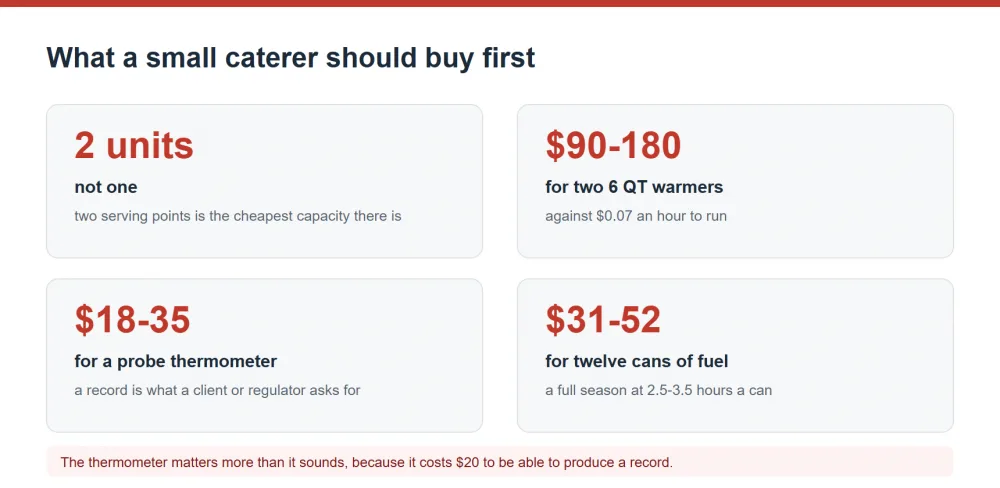
What a Small Caterer Should Buy First
| Purchase | Cost | What it solves | Buy it when | Skip it if |
|---|---|---|---|---|
| 2 × 6 QT chafing dish | $90–$180 | Two serving points for the main and the side | You serve 40–100 guests | You serve more than 150 |
| Fuel holder set, 4 spare | $28–$64 | Stops a failed event when a holder deforms | You use fuel at all | You are fully electric |
| Pan set, 4 spare | $40–$90 | Pans get dropped and dented, not worn out | You transport your own pans | You buy locally on site |
| Insulated transit boxes, 2 | $70–$140 | Hot food stays above 57°C in transit | You travel more than 20 minutes | Your kitchen is on site |
| Digital probe thermometer | $18–$35 | Proves the food was safe, which you may need to show | Always | Never |
| Fuel, 12 cans | $31–$52 | A full season of fuel at 2.5–3.5 hours a can | You burn fuel | You are fully electric |
| Insulated covers | $25–$50 each | Cuts moisture loss roughly in half over a long service | You hold food over 2 hours | Service is under 90 minutes |
| Spare element | $28–$45 | Elements fail at 2–4 years, and lead time is 5–14 days | You have more than 4 units | You have one or two |
Two 6 QT units at 400 W cost $0.07 per hour to run, against $0.16 for one 11 L unit, and they give you two queues rather than one. For a business whose growth is limited by how fast it can serve, that difference matters more than the $60 saved on the purchase. The rule of thumb is that the second serving point is the cheapest capacity you will ever buy.
Frequently Asked Questions
How many guests can a 6 QT chafing dish serve?
40–50 guests, provided it is the only pan at that serving point and service takes under two hours. It is 5.7 litres, which is one large pan of a rice, pasta, stew or protein side. Beyond 50 guests you are refilling a pan during service, and a refilled pan draws down the queue for anyone arriving at that moment.
Is a 6 QT chafing dish big enough for a small catering business?
For 40–100 guests it is the right size, and buying two of them is better than buying one larger unit. For 100–180 guests you need a 4-pan rectangular or three 6 QT units. The failure mode for small caterers is buying one unit for a job that needs two, and then running a single queue that caps how fast the business can serve.
How much does a 6 QT chafing dish cost to run?
A 400 W unit at a commercial tariff of $0.10 per kWh costs about $0.04 per hour, so $0.80 for a four-hour service. A 500 W unit costs $0.05 per hour. That is genuinely small next to the cost of a served meal, which is why the fuel or electric choice for a small caterer is usually decided by whether the venue has a circuit, not by running cost.
Can two 6 QT warmers share one kitchen outlet?
Yes. Two 400–500 W units draw 6.7–8.3 A together, which fits a 10 A circuit with a little headroom for a kettle. Just do not add a 1,100 W full-size unit to the same circuit, because that alone takes 9.2 A and the combination will trip under load during service.
What should a small caterer buy before anything else?
Two chafing dish units rather than one, a set of spare fuel holders or elements, insulated transit boxes if you travel, and a probe thermometer. The thermometer matters more than it sounds, because a written temperature record is what a client or a regulator asks for after a complaint, and it costs $20 to be able to produce one.
Related reading
- 10 Best Buffet Warmers for Catering Businesses
- Chafing Dishes for Sale: Best Deals for Catering Businesses
- 5 Benefits of Buffet Stoves for Catering Businesses
- Best Chafing Dishes for Small Businesses: Budget-Friendly Picks
- Starting a Catering Business? Buy These 5 Things First
- Commercial Chafing Dish for Professional Catering Use