




The Future of Chafing Dishes: Electric & Smart Food Warmers
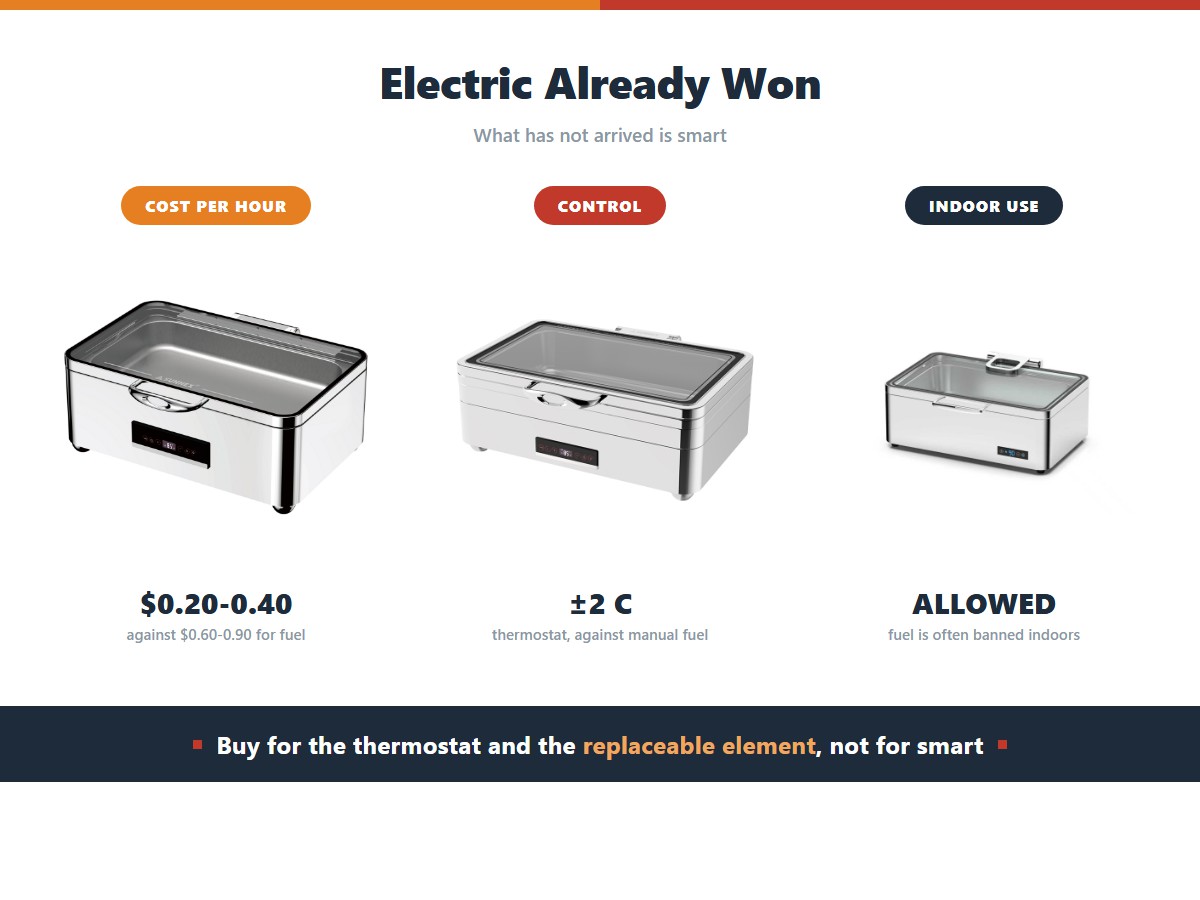
Short answer: Electric warmers already beat fuel on running cost ($0.20–0.40 an hour against $0.60–0.90) and on indoor legality, and they are the direction of travel. What has not arrived is "smart": networked buffet warmers with real telemetry are still a niche. Buy for the thermostat and the replaceable element, not for an app. See chafing dishes for current electric models.
The catering equipment industry is undergoing significant transformation as electric and smart food warming technologies challenge traditional fuel-based systems that have served the industry for decades. Understanding emerging developments helps catering businesses make informed equipment decisions while preparing for shifts that will affect operations throughout the sector. The convergence of precision engineering, connectivity technology, and sustainability concerns is reshaping what food warming equipment can and should do.
The Shift Away from Traditional Fuel
Gel fuel and canned heat have powered chafing dishes since their introduction, providing reliable heat sources that work without electrical infrastructure. These traditional fuels present ongoing challenges including ventilation requirements, fire safety concerns, and the ongoing cost of consumable fuel that electric operation eliminates. Traditional fuel dependency creates operational limitations. Infrastructure-free heating enables new possibilities.
Electric heating eliminates open flames, reducing fire hazards that fuel systems cannot eliminate regardless of careful handling. Safety improvements affect insurance costs, venue acceptance, and staff training requirements. Flame elimination improves safety across multiple dimensions. Reduced hazards benefit everyone involved.
Ventilation requirements for fuel-burning equipment limit venue options, with some facilities refusing fuel-based equipment entirely. Electric operation removes these restrictions, enabling service in venues previously unavailable to caterers. Electric flexibility expands venue access. Infrastructure independence removes restrictions.
Precision Temperature Control
Traditional fuel burners provide heat that varies with fuel level, ambient conditions, and wind exposure. Electric systems maintain precise temperatures through feedback-controlled heating elements that respond to conditions automatically. Precision control improves food quality. Consistent temperatures serve food better.
Digital temperature displays enable monitoring without physical contact, reducing contamination risks while providing data for food safety documentation. Digital monitoring serves compliance needs. Data collection supports regulatory requirements.
Programmable temperature profiles accommodate different menu items that require different holding temperatures. Multi-temperature capability expands menu possibilities. Specialized warming serves diverse cuisines.
Smart Connectivity Features
Network-connected warming equipment enables remote monitoring that on-site presence has always required. Operators track temperatures, fuel levels, and equipment status from anywhere, reducing the physical presence that service demands. Remote monitoring reduces labor requirements. Connected equipment serves operators efficiently.
Automated alerts notify operators when temperatures drift outside acceptable ranges, enabling intervention before food safety suffers. Automated notification prevents safety failures. Early warning enables quick correction.
Usage data collection supports operational analysis that manual tracking cannot achieve efficiently. Data-driven insights improve planning. Usage analytics reveal optimization opportunities.
Sustainability Considerations
Electric operation eliminates single-use fuel cans that create waste disposal challenges. Sustainability concerns affect client preferences increasingly, with green initiatives influencing vendor selection. Waste elimination serves environmental goals. Sustainable practices attract conscious clients.
Energy efficiency improvements in modern electric warmers reduce electricity costs while decreasing environmental impact. Efficient operation serves both economic and environmental goals. Modern technology improves performance while reducing impact.
Long-term operational costs for electric systems often fall below fuel costs despite higher initial equipment investment. Total cost analysis reveals long-term savings. Investment analysis justifies premium initial pricing.
Battery and Portable Power Integration
Battery-powered warming units eliminate electrical infrastructure dependence while removing fuel requirements. Portable power solutions enable truly mobile food service that neither fuel nor electrical outlets can support. Battery integration enables complete portability. Power independence serves mobile catering.
Solar charging capability for battery systems addresses sustainability goals while reducing operating costs. Renewable power integration serves environmental commitments. Solar capability reduces grid dependence.
Battery technology improvements continuously expand capacity while reducing weight, enabling more capable portable equipment. Technology advancement improves performance. Modern batteries serve more demanding applications.
Industry Response and Adoption
Major catering companies are beginning fleet electrification initiatives that signal broader industry transformation. Early adopters demonstrate viability while refining operational procedures. Industry leadership drives transformation. Early adoption reveals practical considerations.
Equipment manufacturers are investing heavily in electric and smart product development as demand increases. Product development investment reflects market confidence. Manufacturer commitment signals market direction.
Venue requirements are increasingly specifying electric-only equipment, with some facilities prohibiting fuel-based systems entirely. Venue restrictions accelerate transition. Policy changes drive adoption timelines.
Cost Analysis and Investment Decisions
Initial equipment costs for electric systems often exceed traditional fuel equipment, requiring analysis that considers long-term operational savings. Investment analysis reveals true cost of ownership. Initial pricing does not reflect total cost.
Energy cost comparison between electricity and fuel varies significantly by region and usage patterns. Regional analysis affects economic justification. Local energy costs determine savings potential.
Maintenance cost differences favor electric systems that lack fuel-related components requiring regular replacement. Reduced maintenance improves economic case. Fewer wearing parts lower ownership costs.
Hybrid Solutions
Hybrid equipment combining electric and fuel capabilities provides flexibility during transition periods. Dual-capability units serve diverse venue requirements. Flexibility supports gradual transition.
Backup fuel capability ensures operation continues when electrical service fails. Backup capability prevents service disruption. Redundancy serves reliability goals.
Portable generator compatibility enables electric operation in venues without reliable electrical infrastructure. Generator compatibility extends electric capability. Infrastructure bridging serves temporary venues.
Training and Operational Adaptation
Staff training requirements shift from fuel management to electrical safety and equipment operation. Training adaptation reflects technology change. New skills replace old procedures.
Operational procedures adapt to temperature monitoring capabilities that traditional systems lack. Data availability changes operational practices. Continuous monitoring enables proactive management.
Maintenance skills shift from mechanical fuel systems to electrical components. Technical training reflects technology change. Electrical competency becomes essential.
Regulatory Environment
Food safety regulations increasingly specify temperature monitoring documentation that electric systems provide automatically. Compliance automation affects regulatory appeal. Automatic documentation serves inspection requirements.
Fire codes increasingly favor electric equipment in public assembly venues. Code changes affect venue restrictions. Safety regulations drive equipment selection.
Environmental regulations targeting single-use fuels accelerate transition timelines in some jurisdictions. Regulatory pressure affects industry timing. Compliance deadlines drive adoption.
Technology Development Trajectory
Artificial intelligence integration promises predictive maintenance that prevents failures before they occur. AI capability extends equipment intelligence. Predictive systems prevent service disruption.
Machine learning algorithms optimize heating patterns based on usage history and menu content. Learning algorithms improve performance. Historical data enables optimization.
Integration with inventory management systems connects food warming to broader operational management. System integration improves coordination. Connected equipment serves management goals.
Conclusion
The future of chafing dishes clearly trends toward electric operation and smart capabilities that traditional fuel-based systems cannot match. Precision temperature control, connectivity features, sustainability benefits, and operational cost advantages drive adoption across the catering industry. While transition periods require hybrid solutions and operational adaptation, the direction is clear. Businesses that prepare for this transformation position themselves advantageously as the industry evolves. The convergence of technology advancement, regulatory pressure, and economic factors ensures that electric and smart food warming systems will define the next generation of catering equipment.
Browse the full chafing dish range for current models and configurations.
Where Electric Already Wins, and Where It Does Not
| Factor | Electric | Fuel | Verdict |
|---|---|---|---|
| Cost per hour | $0.20–0.40 | $0.60–0.90 | Electric wins |
| Heat-up time | 8–15 min | 12–18 min | Electric wins slightly |
| Temperature control | Thermostat, ±2°C | None, manual | Electric wins clearly |
| Indoor legality | Allowed | Often banned | Electric wins |
| Outdoor use | Needs power and shelter | Works anywhere | Fuel wins |
| Upfront cost | $300–900 | $150–400 | Fuel wins |
| Failure mode | Element or thermostat | Wick or can | Both repairable |
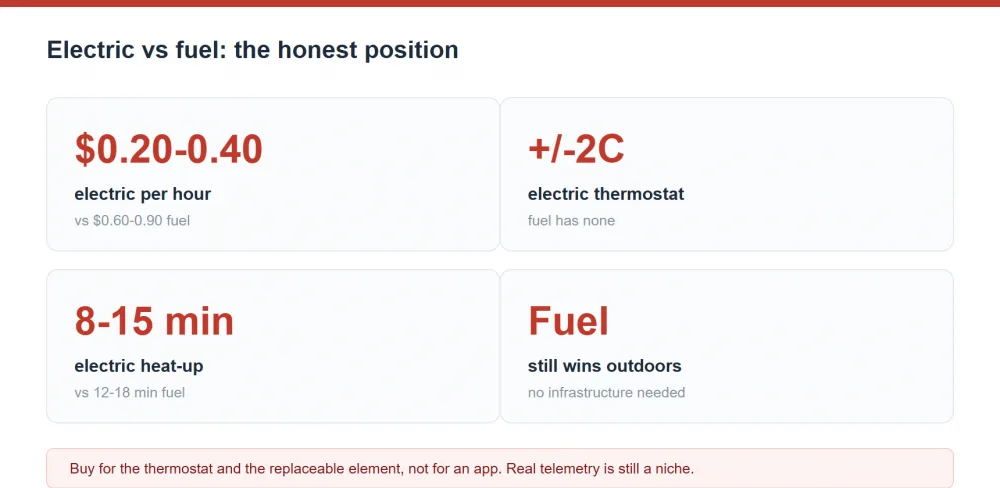
The honest position: electric is the default for permanent indoor lines and the better choice wherever a circuit exists. Fuel remains the right answer outdoors and at venues that will not allow a connection, and that is not changing soon.
Frequently Asked Questions
Are electric chafing dishes better than fuel?
Indoors with a circuit, yes: lower running cost, a thermostat and no open flame. Outdoors or at venues without power, fuel still wins because it needs nothing but a can and a match.
What are "smart" food warmers?
Units with a thermostat, a timer and in some cases a temperature probe and a display. Genuine telemetry that logs holding temperatures to a dashboard exists but is still a niche product, and it costs several times a standard commercial electric unit.
Is it worth paying extra for a smart warmer?
Usually not, in 2026. What pays for itself is a reliable thermostat and a replaceable element. An app adds cost and a failure mode without changing food safety, which the log sheet already handles.
Will fuel chafing dishes disappear?
Not while outdoor events and power-limited venues exist. Fuel needs no infrastructure, which is exactly what a marquee, a food truck and a heritage building do not have. The mix is shifting toward electric, not replacing it.
What should I buy today if I want to be future-proof?
A commercial electric unit with a thermostat, a replaceable element and a parts list from the manufacturer. Those three things are what determine whether the unit is still serviceable in ten years, regardless of what else changes.
Related reading
- Buffet Warmers: Electric vs Fuel Cost per Cover
- How Buffet Warmers Enhance Food Safety
- Induction vs Electric vs Fuel: Which Warmer Heats Fastest?
- Electric Chafing Dish Thermostat Not Working: Diagnosis and Fixes
- Best Chafing Dish Brands in 2026: China, Turkey, Italy Compared
- Top Electric Chafing Dishes for Catering & Home Use