


Buffet Warmers and Food Safety: What They Actually Protect
Short answer: A buffet warmer supports food safety only if it holds 60°C or above and you verify it with a probe rather than a dial. The dangerous window is 15–60°C, where bacteria can double every 20 minutes. A thermostatic unit with a $12 probe and a two-hour swap discipline removes most of the risk. Our buffet station equipment range lists published temperature specifications.
In the food service industry, maintaining proper food temperature is one of the most critical factors in ensuring food safety. Buffets, whether in hotels, restaurants, catering events, or corporate cafeterias, present unique challenges because food is often left out for extended periods for guests to serve themselves. Without reliable temperature control, hazardous bacteria can multiply rapidly, leading to foodborne illnesses that endanger customers and damage a business's reputation. This is where high-quality buffet warmers play an indispensable role, transforming how food is held and served while significantly enhancing overall food safety standards.

Understanding the Temperature Danger Zone
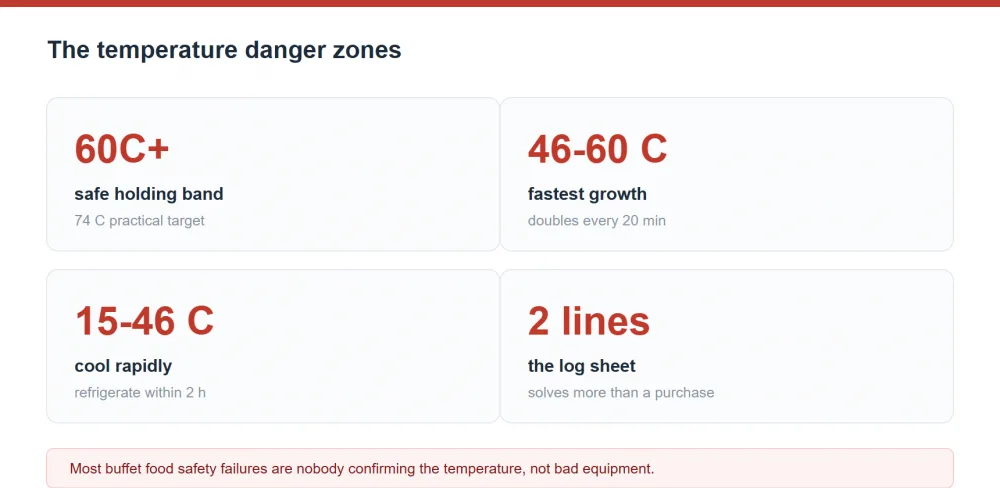
To grasp the importance of buffet warmers for food safety, it's first essential to understand the 'temperature danger zone' defined by food safety regulators worldwide. This zone ranges between 40°F (4°C) and 140°F (60°C) — the temperature range where harmful bacteria such as Salmonella, E. coli, and Listeria grow most rapidly. In ideal conditions, these bacteria can double in number every 20 minutes, turning a safe batch of food into a health hazard in just a few hours.
For buffet service, food is typically prepared in advance and held for 1 to 4 hours before service ends. Without consistent, reliable heating, food will quickly fall into the danger zone, even in moderately warm room temperatures. Buffet warmers are specifically designed to keep hot food held at or above 140°F (60°C) consistently, eliminating the conditions that allow dangerous bacteria to proliferate.
Key Ways Buffet Warmers Improve Food Safety
- Consistent, Uniform Temperature Maintenance: Unlike makeshift heating solutions such as hot plates or slow cookers, professional buffet warmers deliver even, consistent heat across the entire food container. Hot and cold spots are a common problem with low-quality equipment, and even a single cold spot can allow bacteria to grow. High-end buffet warmers use advanced heating elements and insulation to maintain a steady temperature throughout the food pan, ensuring every portion stays out of the danger zone.
- Preventing Cross-Contamination Through Proper Design: Modern buffet warmers are designed with food safety in mind. Many models feature sealed food pans, covers, and easy-to-clean surfaces that prevent cross-contamination from airborne pathogens, dust, or contact with unwashed surfaces. Covered warmers also protect food from contact with guests, reducing the risk of contamination from accidental touching or sneezing.
- Reduced Food Waste Through Extended Safe Holding Time: When food is held at safe temperatures longer, it doesn't need to be discarded as frequently. This not only reduces operational costs for businesses but also minimizes the chance that contaminated leftover food might be accidentally served. Buffet warmers allow caterers and restaurant staff to safely hold food throughout entire service periods without needing to replace batches prematurely.
- Precise Temperature Control for Different Food Types: Different types of food require different holding temperatures to remain safe and palatable. Modern electric buffet warmers come with digital temperature controls that allow staff to set and maintain the exact temperature needed for each dish. Whether you're holding soups, meats, vegetables, or desserts (for warm dessert buffets), you can adjust the warmer to keep food at a safe, optimal temperature.
The Impact of Buffet Warmers on Compliance with Food Safety Regulations
Food service businesses are required to adhere to strict local and national food safety regulations, which mandate that hot food be held at specific temperatures during service. Regular health inspections check for proper temperature maintenance, and violations can result in fines, mandatory closures, or negative publicity that drives customers away.
Investing in high-quality buffet warmers makes it much easier to maintain compliance with these regulations. Professional models often come with built-in temperature displays or digital thermostats that let staff check temperatures at a glance, making it simple to document temperature logs required by most health departments. This proactive approach to temperature control not only keeps your business compliant but also creates a culture of food safety that benefits both customers and staff.
Additional Food Safety Benefits Beyond Temperature Control
Beyond maintaining proper holding temperatures, buffet warmers offer other food safety advantages. For example, electric buffet warmers eliminate the need for open-flame fuel canisters that are commonly used with traditional fuel-based chafing dishes. Open flames present a fire hazard in busy buffet settings, and fuel canisters can accidentally be knocked over or leak, creating additional safety risks. Electric models remove these hazards while providing more consistent temperature control.
Additionally, high-quality buffet warmers are constructed from food-grade materials such as 304 stainless steel, which is non-porous, resistant to bacterial growth, and easy to sanitize between services. Unlike plastic or lower-grade metals, stainless steel doesn't absorb food particles or bacteria, making it much easier to maintain a clean, safe serving environment.
Choosing the Right Buffet Warmer for Maximum Food Safety
When selecting a buffet warmer for your business, there are several factors to consider to ensure maximum food safety. First, prioritize models with accurate, reliable temperature control. Digital thermostats maintain more consistent temperatures than manual dials, reducing the risk of temperature fluctuations that can put food in the danger zone. Second, choose the right size and capacity for your typical buffet service. Overcrowding a warmer can lead to uneven heating, so it's important to have enough warmers to hold all your hot dishes without overcrowding. Finally, opt for easy-to-clean designs with removable parts that allow you to thoroughly sanitize every surface between uses.
Conclusion
Buffet warmers are far more than just a convenience for keeping food hot — they are a critical investment in food safety. By maintaining consistent temperatures outside the danger zone, preventing cross-contamination, simplifying regulatory compliance, and eliminating unnecessary hazards, high-quality buffet warmers protect both your customers and your business. For any food service operation that offers buffet service, having reliable, professional-grade warmers is not an optional upgrade — it's an essential component of a comprehensive food safety program.
Recommended Products
Full Size 11L Electric Chafer

This commercial-grade electric buffet warmer features 1100W power that heats up in just 12 minutes, with precise digital temperature control to maintain consistent safe holding temperatures. Constructed with food-grade 304 stainless steel, it is easy to clean and resistant to bacterial growth.
View Details →Electric Chafing Dish Food Warmer (Digital Temperature Control)

With 400W rapid heating technology and 304 stainless steel construction, this buffet warmer delivers even heat distribution to eliminate cold spots. Its digital thermostat allows for accurate temperature adjustment to keep different food types at safe holding temperatures.
View Details →Browse the full chafing dish range for current models and configurations.
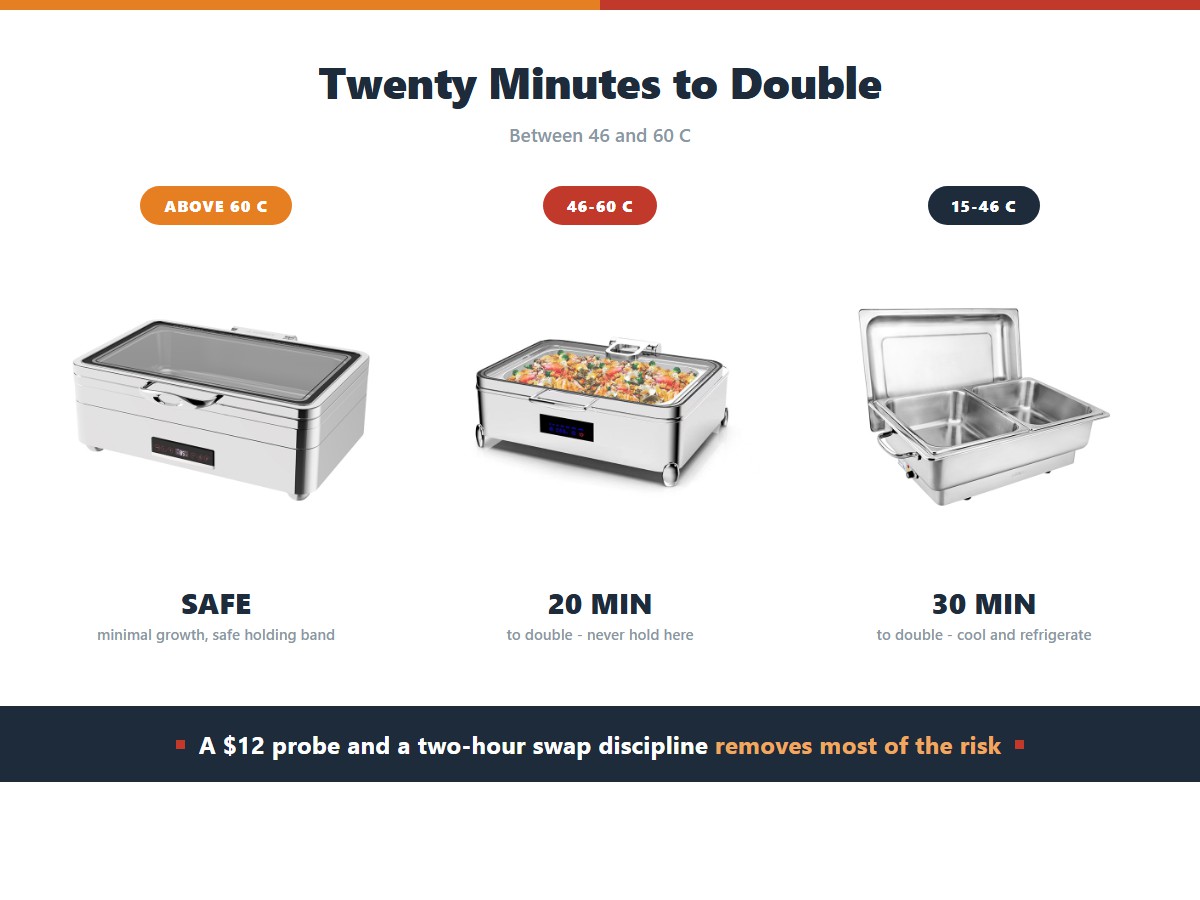
The Temperature Danger Zones
| Temperature band | Bacterial growth | Time to double | Food service rule |
|---|---|---|---|
| Above 60°C | Minimal | Hours | Safe holding band |
| 46–60°C | Very fast | 20 minutes | Never hold here |
| 15–46°C | Fast | 30 minutes | Cool rapidly, then refrigerate |
| Below 15°C | Slow | Hours | Safe cold storage |
What Warmer Features Improve Safety Outcomes
| Feature | Safety benefit | Evidence needed | Approximate cost |
|---|---|---|---|
| Thermostatic control | Holds within a narrow band | Verify with probe at service | Included in most units |
| Probe thermometer | Removes all guessing | Calibrate monthly | $9–18 |
| Probe logging | Evidence for audits | Export per service | $60–150 on smart units |
| Lids and covers | Slows edge cooling | Check pan edge temperature | $6–11 per lid |
| Water pan | Moist heat, less scorching | Fill to the marked line | Built in |
| Non-slip feet | Prevents unit being knocked | Visual check | Built in |
There is one safety feature that is not really a feature at all: writing down what you measured. Most food safety failures in buffet operations are not caused by bad equipment, they are caused by nobody confirming the temperature. A two-line log sheet solves more incidents than any purchase.
Frequently Asked Questions
What temperature should a buffet warmer hold food at?
Above 60°C, with 74°C as the practical target for most services. Below 46°C and above 60°C is the fastest growth band, and a pan sitting at the edge of a chafing dish can be 5°C cooler than the centre.
Do I need to check buffet food temperature every service?
Yes. Check the first pan at fifteen minutes, then hourly, and always after any fuel change or pan swap. Record the readings; an unrecorded check is the same as no check when an inspector asks.
Are electric buffet warmers safer than fuel ones?
For food safety specifically, yes, because there is no combustion and no chance of fuel residue contaminating a pan. For fire safety, neither is inherently better, and both need the same clearance discipline.
How long can food sit safely on a buffet?
Four hours above 60°C in a single service. After that, quality degrades even where safety holds, and local codes commonly cap buffet service at two to four hours regardless.
Does a chafing dish kill bacteria?
No. A chafing dish holds, it does not cook. Bacteria are only destroyed when food reaches about 70°C for a sustained period, which a holding unit never produces because it is designed not to.
Related reading
- 10 Best Buffet Warmers for Catering Businesses
- Buffet Warmer Safety Tips You Should Know
- Cruise Ship Buffet Equipment: Space, Safety and Durability
- Electric vs Alcohol Fuel Chafer: Heat, Cost and Safety
- Hotel Breakfast Buffet on a $5,000 Budget: Exact List
- 2026 Food Safety Rules: What They Mean for Buffets