


Food Heat Lamp Stands: Adjustable & Sturdy Mounting Options
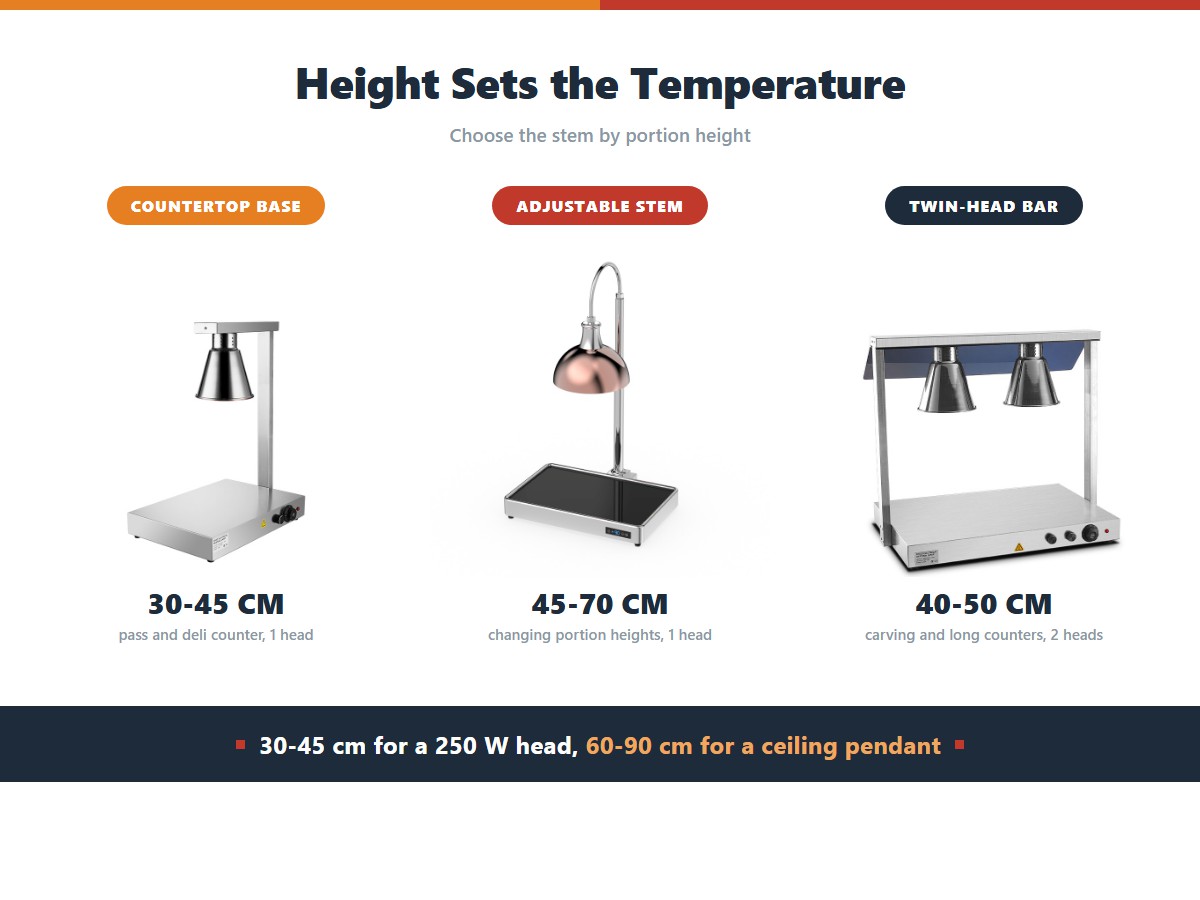
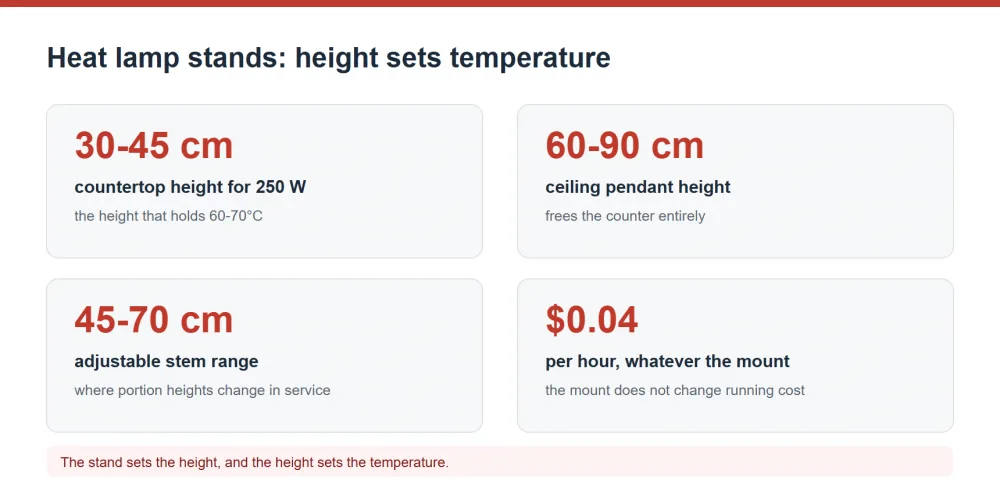
Short answer: the stand sets the height, and height sets the temperature: 30–45 cm for a 250 W head, 60–90 cm for a ceiling pendant. Choose a 45–70 cm adjustable stem where portion heights change through service. Running cost stays near $0.04 per hour. See mounts and stands in our heat lamp range.
Heat lamp effectiveness depends as much on how the lamp is positioned and supported as on the lamp's intrinsic warming capability. A high-output lamp mounted at the wrong height, on an unstable base, or in a configuration incompatible with the service environment will underperform despite its specifications. Food service operators who focus exclusively on lamp wattage and heating performance while neglecting mounting and stand selection often discover that their warming installations deliver disappointing results despite substantial investment in capable lamp heads. Understanding the engineering principles behind stable mounting and the practical requirements of different service environments enables informed selection of stands and mounting options that complement lamp performance rather than limiting it.
The Physics of Heat Lamp Positioning
Height and Warming Coverage
Heat lamp warming effectiveness follows inverse-square relationships with distance, meaning that small changes in lamp height produce substantial changes in the energy reaching food surfaces. A lamp positioned at 12 inches above food delivers approximately four times the surface energy as the same lamp at 24 inches, but creates hot spots directly beneath the lamp while leaving surrounding areas inadequately warmed. The optimal height balances sufficient energy delivery with adequate coverage area, typically falling in the 14 to 22 inch range for standard commercial heat lamps operating at typical food serving temperatures.
The height-adjustable design of the Stainless Steel Heat Lamp-BJ10 accommodates this positioning requirement through its adjustable post that enables precise height matching for specific food configurations and service requirements. The height adjustment mechanism must maintain positioning stability at the selected height, without the gradual drift that inferior adjustment mechanisms exhibit during extended operation. Verify that height adjustment mechanisms provide positive locking at the selected position rather than relying on friction alone.
Stability and Tip Resistance
Commercial food service environments create conditions that challenge equipment stability: busy servers brushing against equipment during rush periods, accidental contact from serving trays and plates, and the vibration from kitchen equipment operating nearby. Heat lamp stands must provide sufficient stability to maintain positioning through these disturbances without tipping, which creates both safety hazards and service interruptions. Stability requirements scale with lamp head size and reach, with multi-head configurations and extended reach designs requiring proportionally more substantial base construction than single compact heads.
Base Design Principles
Effective heat lamp bases achieve stability through a combination of weight, footprint, and low centre of gravity. Weighted cast-iron or heavy-gauge stainless steel bases provide the mass that resists tipping forces, while wide footprint designs increase the torque required to rotate the base around its edge. The Stainless Steel Heat Lamp-BJ10 incorporates a weighted base design that resists tipping from accidental contact, combined with a polished mirror stainless steel finish that adds aesthetic value in visible service positions while maintaining the structural integrity that commercial use demands.
Freestanding Countertop Stands
Countertop vs. Floor Positioning
Freestanding heat lamp stands occupy either countertop surfaces or floor space, with each positioning creating distinct advantages and limitations. Countertop positioning places the lamp at natural serving height without requiring staff to reach up, but consumes valuable counter space that may be needed for food preparation or service activities. Floor positioning leaves counter space available but requires taller stand designs to achieve appropriate lamp heights, with the taller construction creating greater stability challenges that must be addressed through base design.
Single-Head Countertop Designs
Single-head countertop stands provide warming capability with minimal space consumption, making them appropriate for service stations with limited counter space or situations where warming is needed at multiple separate stations. The Stainless Steel Heat Lamp-BJ10 with its single-head variants (BJ10 and BJ101) delivers focused warming capability in a compact footprint that fits on standard commercial countertops without crowding food preparation activities. The polished mirror stainless steel finish adds visual refinement appropriate for front-of-house service positions where equipment appearance matters as much as functionality.
Multi-Head Gantry Configurations
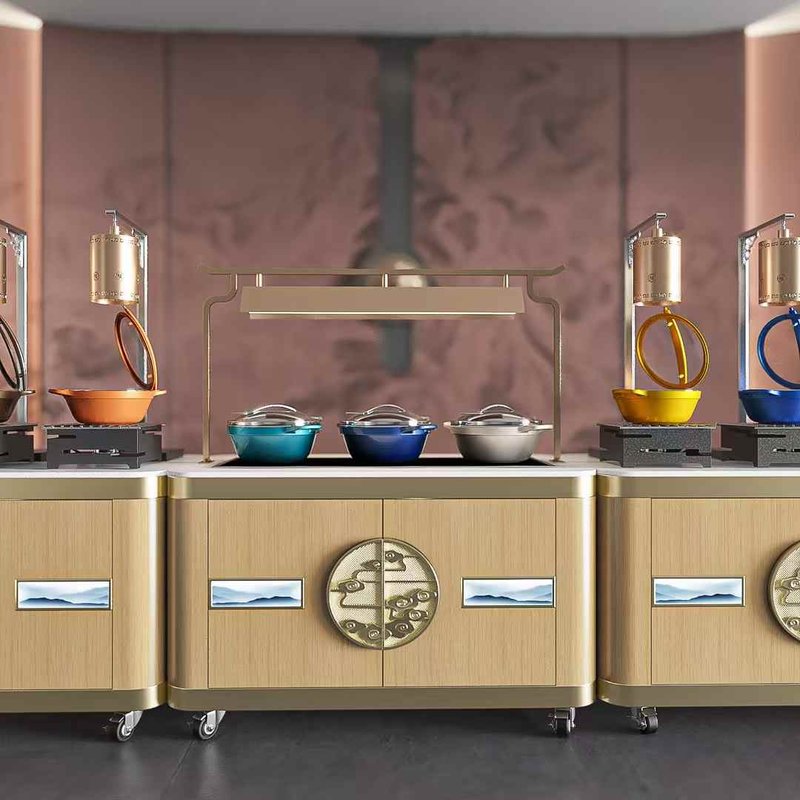
High-volume service stations benefit from multi-head warming configurations that provide multiple independent warming zones from a single support structure, eliminating the separate stands and power connections that multiple single-head units require. The Three-Head Rose Gold Buffet Heat Lamp Station provides three independent warming heads in a linear arrangement supported by a substantial gantry structure, with the Greek key decorative base pattern providing both visual refinement and structural contribution to overall stability. The gantry design enables positioning over standard hotel pan configurations without requiring individual equipment placement for each pan.
Ceiling and Pendant Mounting Systems
Pendant Mount Advantages
Ceiling-mounted heat lamps eliminate all floor and counter space consumption, providing warming capability without compromising the available workspace that kitchen and service operations require. Pendant systems hang from ceiling structures using chains, rods, or coiled cords, with the suspension system providing height adjustment through simple repositioning of the mounting point. This mounting approach suits venues with adequate ceiling height and structural support capable of bearing the lamp weight, particularly situations where counter space cannot accommodate freestanding equipment.
Coiled Cord Height Adjustment
The Ceiling-Mounted Rose Gold Buffet Heat Lamp implements pendant mounting with a coiled cord system that enables precise height positioning without requiring tools or discrete mounting point adjustments. The coiled cord maintains electrical safety while providing the flexibility that service environments demand, absorbing the movement that accidental contact creates without transmitting stress to the electrical connections. The matte black canopy provides clean ceiling-line appearance that integrates with contemporary kitchen designs without the industrial look that conventional pendant hardware often presents.
Structural Requirements for Ceiling Mounting
Ceiling-mounted heat lamp installations require ceiling structures capable of supporting the lamp weight plus appropriate safety margins, typically requiring mounting to structural ceiling members rather than suspended ceiling tiles. The weight of multi-head pendant configurations and the dynamic forces that vibration and accidental contact create require robust mounting hardware and periodic inspection of mounting integrity. Consult with structural engineers or qualified installers when ceiling mounting is being considered for heavy or complex configurations.
Adjustability Requirements for Different Applications
Dynamic Service Environments
Some food service operations require heat lamp positioning that changes throughout the service period, with different menu items requiring different lamp heights or positions as the menu mix changes. Dynamic environments like all-day breakfast operations, continuous service venues, or events with evolving food presentations benefit from quick-adjustment capabilities that enable staff to reconfigure warming positions without tools or service interruption. The height-adjustable post design of the Stainless Steel Heat Lamp-BJ10 addresses these dynamic requirements through adjustment mechanisms that enable reconfiguration without tools while maintaining stable positioning at the selected height.
Fixed Configurations for Consistency
Other operations maintain consistent food presentations throughout service periods, where positioning changes would only introduce unnecessary variability. Fixed-height mounting systems with no adjustment capability provide the ultimate positioning consistency, eliminating the possibility that staff repositioning creates temperature variations across service periods. Fixed configurations suit high-volume operations with standardised menus where the warming requirements remain constant throughout service.
Material Considerations for Commercial Environments
Stainless Steel Construction
Commercial food service environments expose equipment to conditions that consumer products cannot survive: moisture from food service activities, cleaning chemicals, temperature cycling, and physical contact from busy service staff. Stainless steel construction provides the corrosion resistance, structural strength, and durability that commercial food service demands, maintaining appearance and functionality through years of demanding use. The stainless steel construction of the Stainless Steel Heat Lamp-BJ10 and the Three-Head Rose Gold Buffet Heat Lamp Station reflects the material quality appropriate for commercial environments rather than the lighter materials that consumer products employ.
Decorative Finishes
Visible service environments often benefit from decorative finishes that enhance appearance without compromising durability. Rose gold finishes like those on the Three-Head Rose Gold Buffet Heat Lamp Station and Ceiling-Mounted Rose Gold Buffet Heat Lamp provide visual refinement appropriate for hospitality environments where equipment appearance influences customer perceptions of food quality and service standards. Decorative finishes must maintain their appearance through commercial cleaning and use conditions, requiring quality finishing processes that resist scratching, fading, and chemical exposure.
Safety Considerations for Stand Selection
Electrical Safety
Heat lamp stands carry electrical components that create shock and fire hazards if improperly constructed or maintained. All electrical connections must be enclosed within the stand structure with appropriate strain relief that prevents connection stress from movement or repositioning. The CE certification of the Ceiling-Mounted Rose Gold Buffet Heat Lamp indicates compliance with European electrical safety standards that address both shock and fire prevention requirements for commercial food service equipment.
Tip-Over Prevention
Unstable heat lamp stands create both safety hazards and service disruptions when they tip over during busy service periods. Select stands with base mass and footprint appropriate for the lamp configuration they support, considering not just static stability but the dynamic forces that accidental contact and service activities create. Floor-standing configurations require particular attention to base design, as the taller construction creates greater tipping moments for any given horizontal force.
Conclusion
Heat lamp mounting and stand selection determines whether capable lamp equipment delivers its potential warming performance or fails to meet expectations despite adequate lamp specifications. Stable positioning at appropriate heights enables consistent warming across the food surface, while suitable base design prevents the safety hazards and service interruptions that tip-over events create. The three products evaluated above represent distinct mounting approaches suited to different service environments: the freestanding countertop design for space-efficient warming in standard service configurations, the gantry multi-head system for high-volume buffet applications, and the pendant ceiling mount for operations prioritising counter space utilisation.
Stand types and height range
| Type | Height range | Load | Use |
| Fixed countertop base | 30–45 cm | 1 head | Pass, deli counter |
| Adjustable stem | 45–70 cm | 1 head | Changing portion heights |
| Twin-head bar frame | 40–50 cm | 2 heads | Carving, long counters |
| Ceiling pendant | 60–90 cm | 1 head | Buffet islands |
Frequently Asked Questions
Why does the stand matter so much?
Because intensity falls with the square of distance. Ten centimetres of extra height can drop the surface temperature by 8–12°C.
Do I need an adjustable stand?
If portion heights change — a carving board versus a shallow pan, for example. Fixed stands are fine where the pan size never changes.
Can a pendant replace a countertop stand?
Where ceiling height allows 60–90 cm of drop, yes, and it frees counter space. Below that, a countertop unit is the only safe option.
What material should the stand be?
Stainless or powder-coated steel. Chrome pits at the joints in a steam-heavy kitchen, and painted mild steel rusts at the base.
How much weight does a stand carry?
A single head is under 2 kg; a twin bar is 4–6 kg. Check the base plate rating, because a top-heavy stand tips when the cable is pulled.
Related reading
- Food Heat Lamps for Concession Stands: Ideal for Outdoor Vending
- Fixed vs Adjustable Height Heat Lamps: Which to Install
- Commercial Food Heat Lamps: Heavy-Duty Options for Professionals
- Heat Lamp vs Chafing Dish: Which One Does Your Food Need?
- Food Holding Temperature Chart: The 2-Hour Rule You Can't Ignore
- How to Prevent Food from Drying Out with a Heat Lamp