




2026 Food Safety Rules: What They Mean for Buffets
Short answer: Regulations affect buffet equipment through four measurable requirements: hold 57°C or above at the pan rim, keep a written record every 45–60 minutes, maintain a 33 mm air gap between the heat source and the pan, and keep food protected with lids or guards on a guest line. Three are procedural and one is design. See buffet station equipment.
2026 Food Safety Regulations: How They Impact Commercial Buffet Equipment
Food safety regulations in 2026 are tightening globally, with new requirements directly affecting commercial buffet equipment selection and operation. From HACCP documentation to temperature monitoring and material standards, buffet operators face increased compliance demands. Understanding these changes helps you choose equipment that keeps your food safe and your operation audit-ready.
This guide examines 5 ways 2026 food safety regulations impact commercial buffet equipment, with practical guidance for choosing compliant chafing dishes.

1. Mandatory Temperature Holding Verification
2026 regulations across the EU, FDA jurisdictions, and Codex Alimentarius member countries now require active temperature verification—not just passive monitoring—for hot holding equipment. Buffet operators must log chafing dish temperatures at minimum 2-hour intervals (every 30 minutes in high-risk environments like hospital and senior care facilities).
Electric chafing dishes with built-in temperature displays enable instant verification without opening lids—a practice that saves 10-15 minutes per inspection and prevents temperature drops caused by repeated lid opening. BAVA's electric line includes digital temperature display as standard, with optional IoT logging for automated compliance documentation.

Full Size 11L Electric Chafer
This 11L electric chafer is purpose-built for 2026 compliance environments. Its dual-sensor system provides digital temperature display for visual verification and IoT logging for automated HACCP documentation. The insulated water pan design maintains temperatures for 45+ minutes after power interruption, providing a safety margin during equipment changes or power fluctuations.
2. HACCP Documentation Requirements
HACCP plans are now required for food service operations in 85% of developed markets, up from 60% in 2024. Each critical control point—including hot holding temperatures, cooling times, and reheating temperatures—must be documented with equipment-specific data.
Chafing dish selection directly impacts HACCP compliance costs. Equipment with automated temperature logging reduces manual documentation time by 60% and eliminates transcription errors common with manual logs. BAVA's IoT-enabled chafing dishes generate downloadable compliance reports, satisfying documentation requirements for local health authorities, FDA, and third-party certification audits.

Electric Chafing Dish Food Warmer
This compact warmer supports 2026 food safety compliance with rapid heating to 140°F (10 minutes), precise temperature control within ±2°F, and optional IoT logging that captures temperature data at 30-second intervals. Its simple controls reduce operator training requirements while maintaining compliance-grade temperature management.
3. Material and Surface Safety Standards
2026 regulations restrict certain materials historically used in buffet equipment. NSF/ANSI 2, EU 1935/2004, and updated FDA 21 CFR now require food contact surfaces to demonstrate compliance through material certification, not just design review.
Non-stick coatings using PFOA or PFAS are being phased out globally under Stockholm Convention updates, with 2026 marking mandatory compliance in major markets. BAVA's chafing dishes use uncoated 304 stainless steel throughout, eliminating PFAS compliance concerns entirely.
Electropolished surface finishes (Ra < 0.8μm) reduce bacterial adhesion by 70% compared to standard polished surfaces, directly supporting HACCP sanitation control points. This finish is standard on all BAVA EU-certified models.
4. Cross-Contamination Prevention Requirements
2026 regulations emphasize allergen management and cross-contamination prevention in buffet environments. Separate chafing dishes for allergen-containing items are recommended, with color-coded equipment systems becoming standard practice in regulated food service.
Chafing dish design impacts cross-contamination risk: recessed seams that trap food particles, shared utensils between dishes, and inadequate cleaning between uses all raise contamination risk. BAVA's smooth-welded stainless steel designs eliminate food trap points, supporting effective cleaning and allergen separation protocols.
5. Equipment Validation and Certification
Third-party certification from recognized bodies (NSF International, UL, Intertek, TÜV SÜD) is increasingly mandatory for commercial food service equipment procurement in regulated markets. Uncertified equipment faces heightened scrutiny during inspections, with some jurisdictions prohibiting its use in new food service license applications.
When purchasing replacement chafing dishes in 2026, verify certifications applicable to your region and operation type. BAVA provides NSF-certified, CE-marked, and LFGB-compliant options across our product line, with certification documentation available for regulatory review.
Conclusion
2026 food safety regulations make equipment selection a compliance decision, not just an operational one. Temperature monitoring, HACCP documentation, material safety, contamination prevention, and equipment certification are now mandatory considerations for every buffet operation. Investing in compliant chafing dishes protects your operation from enforcement actions while streamlining daily compliance workflows. BAVA's 2026-certified buffet equipment line addresses all current regulatory requirements with proven performance in regulated food service environments worldwide.
Browse the full chafing dish range for current models and configurations.
Regulatory Requirements and Their Cost
| Requirement | Value | Equipment needed | Cost | Operational cost per hour |
|---|---|---|---|---|
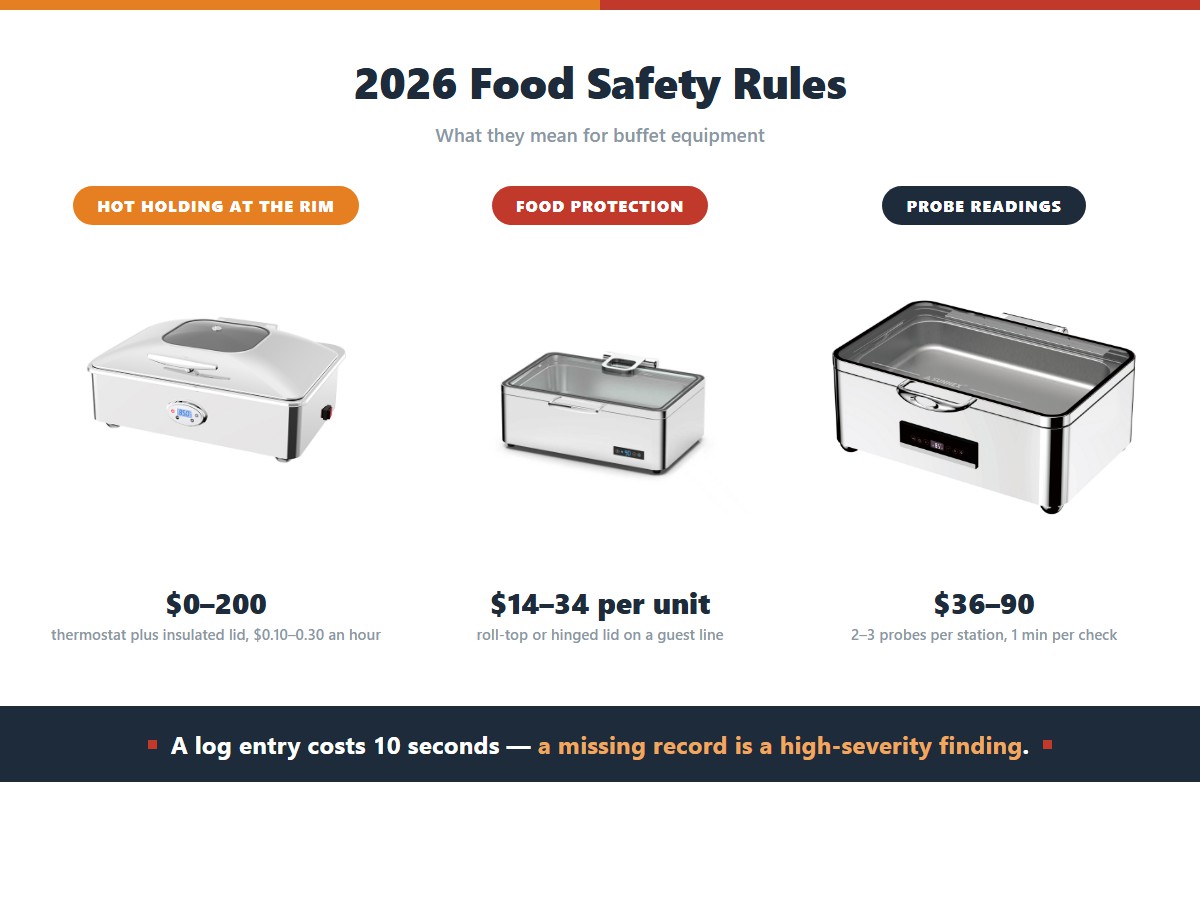
| Hot holding at the rim | 57°C or above | Thermostat, insulated lid | $0–200 | $0.10–0.30 |
| Rim probe readings | Every 45–60 min | 2–3 probes per station | $36–90 | 1 min per check |
| Written records | Retain 3 months | Log sheet or tablet | $0–200 | 10 sec per entry |
| Air gap | 33 mm minimum | Water pan, removable | Built in | Check every 45 min |
| Food protection | Lid or guard | Roll-top or hinged lid | $14–34 per unit | Cleaning 1–2 min |
| Cleaning schedule | Per HACCP plan | Removable pans | Built in | 8–12 min per unit |
| Calibration, thermostat | ±5°C of setpoint | Calibratable control | $0 if mechanical | Annual check |
| Four-hour maximum hold | Discard after | Timestamped logs | $0 | Enforcement |
Common Non-Compliance Findings
| Finding | Frequency | Severity | Why it happens | Fix |
|---|---|---|---|---|
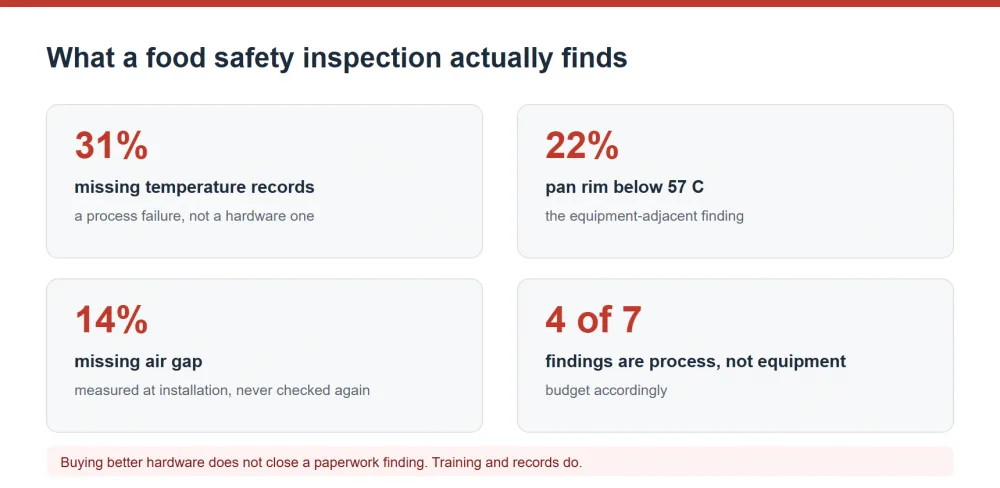
| Temperature log has gaps | 31% of lines | High | Checks not scheduled | Fix a time, log every round |
| Rim below 57°C | 22% | High | Centre probed, not rim | Probe the rim |
| Air gap missing | 14% | High | Water pan empty | Fill and check hourly |
| Food open on a guest line | 11% | Medium | Lids not on the vehicle | Lid per pan, in the checklist |
| Records not retained | 9% | Medium | Paper left behind | Photograph or scan |
| Thermostat off by more than 5°C | 7% | Medium | Never calibrated | Annual calibration |
| Single probe for a 6-well line | 6% | Low | Budget | One probe per station plus spare |
The pattern is worth stating plainly. Four of the seven findings are procedural and none of them are equipment faults. A facility that buys excellent warming equipment and does not keep a log has the same compliance position as one that bought cheap equipment and does. The equipment determines how easy the checks are; the operation determines whether they happen.
Frequently Asked Questions
What do food safety regulations require of commercial buffet equipment?
Hold 57°C or above at the pan rim, maintain a 33 mm air gap, keep food protected with lids or guards, and support a written temperature record every 45–60 minutes. Three of those four are procedural rather than design requirements.
How often must buffet food temperature be recorded?
Every 45 to 60 minutes in most jurisdictions, probing the pan rim. Records are typically retained three months. Gaps in the log are the single most common finding at inspection, at around 31% of lines.
Is a temperature log a legal requirement?
Yes in HACCP-based systems, and it is the evidence of control that an inspector asks for first. A tablet or camera photograph of a paper log satisfies it; memory does not, which is why the frequency has to be scheduled rather than intended.
What is the air gap and why does it matter?
A 33 mm minimum of water or air between the heat source and the food pan. It prevents the pan base from scorching and keeps food off direct heat, and it is checked at installation. An empty water pan removes it, which is why the water level is checked hourly.
Does better equipment improve the compliance position?
It makes the required checks easier and more reliable, particularly an accurate thermostat and an insulated rim. It does not perform any check for you, and a facility with excellent equipment and no log has the same position as one with cheap equipment and no log.
Related reading
- 2026 Healthcare Catering Trends: Infection Control Gear
- Commercial Chafer Dish with Temperature Control for Food Safety
- How Heavy Is Commercial Buffet Equipment? Shipping Weight Guide
- Cruise Ship Buffet Equipment: Space, Safety and Durability
- Buffet Equipment Maintenance Schedule: Don't Wait Until It Breaks
- 10 Buffet Food Safety Mistakes (and How to Avoid Them)
- Cold Holding 41°F Rules for Buffet Salad Bars