


Large Buffet Lines: How Many Stoves per 100 Guests?
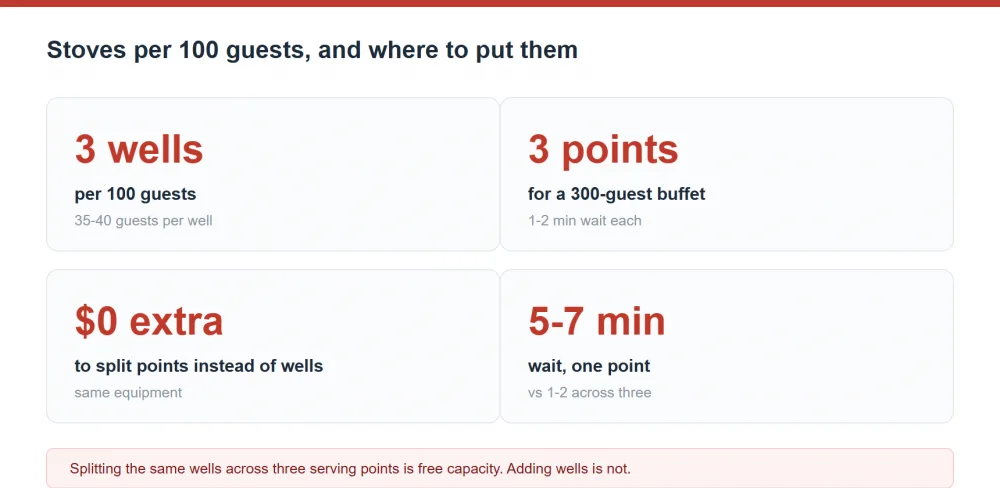
Short answer: Plan one well per 35–40 guests, not per 100. A 300-guest buffet therefore needs 8–9 wells across at least three serving points, costing $1,600–2,600 in equipment and requiring three staff on the line during peak service. Spreading 300 guests across 3 points gives a 2-guest queue; concentrating them on 1 gives a 7-guest queue. See buffet station equipment.
Managing a large buffet—whether for a 500-person wedding, a hotel breakfast service, or a corporate banquet—requires equipment that can handle high volumes, maintain consistent temperatures, and simplify operations for your staff. The wrong heating equipment can lead to cold food, wasted dishes, and chaotic service, while the right buffet stove can turn a high-pressure event into a smooth, profitable operation. Here are the best buffet stoves for managing large buffets with ease, chosen for their capacity, reliability, and ability to scale with your business.
1. Full Size 11L Electric Chafer
For extra-large buffets serving 300+ guests, the Full Size 11L Electric Chafer is a top choice. With 1100W of power, it heats up to optimal temperature in just 12 minutes, and its thermal efficiency of ≥80% keeps food hot for hours without constant adjustments. The 11L GN 1/1 size pan holds enough food for 50+ guests per refill, reducing the frequency of restocking during peak service. Its digital temperature display and Smart Mode let staff set and forget the heat level, while polished stainless steel construction stands up to daily use in busy hotel buffets.

Full Size 11L Electric Chafer
This commercial-grade chafing dish is designed for high-volume catering, with 1100W fast heating, a 12-minute heat-up time, and thermal efficiency ≥80% to cut energy costs. Its 11L capacity (GN 1/1 size) holds large portions of soups, stews, or mains, and the digital temperature display with Smart Mode ensures consistent heating without constant monitoring. Polished stainless steel and tempered glass lid make it durable and easy to clean, while CE certification ensures compliance with global food safety standards.
2. Electric Chafing Dishes-StoveMaster Series
For banquet halls and large event venues, the StoveMaster Series is a flagship solution that combines electric heating plates with 4 alcohol burners for dual-power reliability. This hybrid design means you can use electric power for consistent indoor heating, or switch to alcohol burners for outdoor events or backup during power outages. The dome roll-top lid with glass window lets guests see food without lifting the lid, reducing heat loss, and the rectangular base with rubber feet keeps the unit stable even in high-traffic buffet lines.
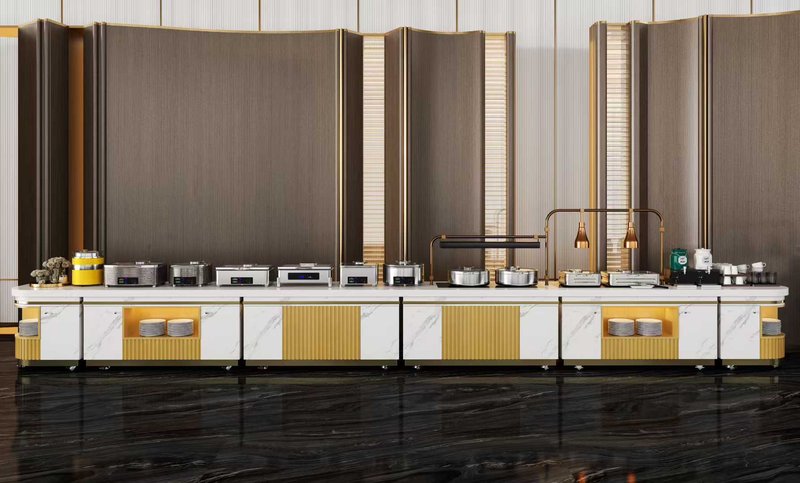

Electric Chafing Dishes-StoveMaster Series
This flagship buffet stove features dual electric heating plates plus 4 alcohol burners for flexible indoor/outdoor use, making it ideal for lobby banquets and large events. The dome roll-top lid with glass window reduces heat loss by letting guests view food without lifting the lid, and the polished stainless steel + tempered glass construction is both durable and visually appealing. Its GN 1/1 size pan fits standard food containers, and CE/ETL certifications ensure it meets commercial safety requirements for high-volume use.
3. Stainless Steel Electric Double Pan Chafing Dish
When you need to serve two different dishes at optimal temperatures simultaneously, the Double Pan Chafing Dish is a space-saving powerhouse. With 800W total power (400W per pan) and independent temperature controls for each GN 1/2 size pan, you can keep soups warm on one side and roasted vegetables on the other. This eliminates the need for two separate units, saving valuable buffet line space for large events. Its 304 stainless steel construction and CE/ETL/RoHS certifications make it a reliable choice for daily use in busy catering operations.
Key Features to Look For in Large Buffet Stoves
When choosing buffet stoves for large operations, prioritize these features: (1) High capacity (10L+ per unit or double/triple pan designs) to reduce refills; (2) Fast heat-up time (≤15 minutes) to speed up setup; (3) Dual-power options (electric + alcohol) for indoor/outdoor flexibility; (4) Digital temperature controls for consistent heating; (5) Durable 304 stainless steel construction for long-term use. All three models above include these features, making them the best choices for managing large buffets with ease.
Comparison: Top 3 Large Buffet Stoves
| Model | Capacity | Power | Heat-Up Time | Key Feature |
|---|---|---|---|---|
| Full Size 11L Electric Chafer | 11L (GN 1/1) | 1100W | 12 minutes | 11L large capacity, ≥80% thermal efficiency |
| StoveMaster Series | GN 1/1 size | Electric + 4 alcohol burners | 10 minutes (electric) | Dual-power flexibility for indoor/outdoor use |
| Double Pan Chafing Dish | 2× GN 1/2 (total 10L equivalent) | 800W (400W per pan) | 8 minutes per pan | Independent temperature controls for two dishes |
Conclusion
Managing large buffets doesn’t have to be chaotic. By investing in high-capacity, reliable buffet stoves like the Full Size 11L Electric Chafer, StoveMaster Series, or Double Pan Chafing Dish, you can streamline setup, reduce staff workload, and keep food at safe serving temperatures throughout even the biggest events. These models are designed to handle high volumes, scale with your business, and deliver consistent performance for years to come. For catering businesses and hotel buffets looking to upgrade their equipment, these are the best buffet stoves for managing large buffets with ease.
Browse the full chafing dish range for current models and configurations.
Stoves per 100 Guests
| Guests | Wells needed | Serving points | Equipment | Queue per point, peak | Staff on line |
|---|---|---|---|---|---|
| 50 | 2 | 1 | $240–320 | 2 guests | 1 |
| 100 | 3 | 1–2 | $420–700 | 2–3 guests | 1–2 |
| 200 | 5–6 | 2 | $900–1,400 | 2–3 guests | 2 |
| 300 | 8–9 | 3 | $1,600–2,600 | 2–3 guests | 3 |
| 500 | 13–15 | 4–5 | $2,400–3,800 | 3 guests | 5 |
| 800 | 20–23 | 6–7 | $4,200–6,100 | 3 guests | 7 |
One Point vs Several Points
| Guests | Setup | Wait time, peak | Guests served per minute | Perceived quality | Equipment |
|---|---|---|---|---|---|
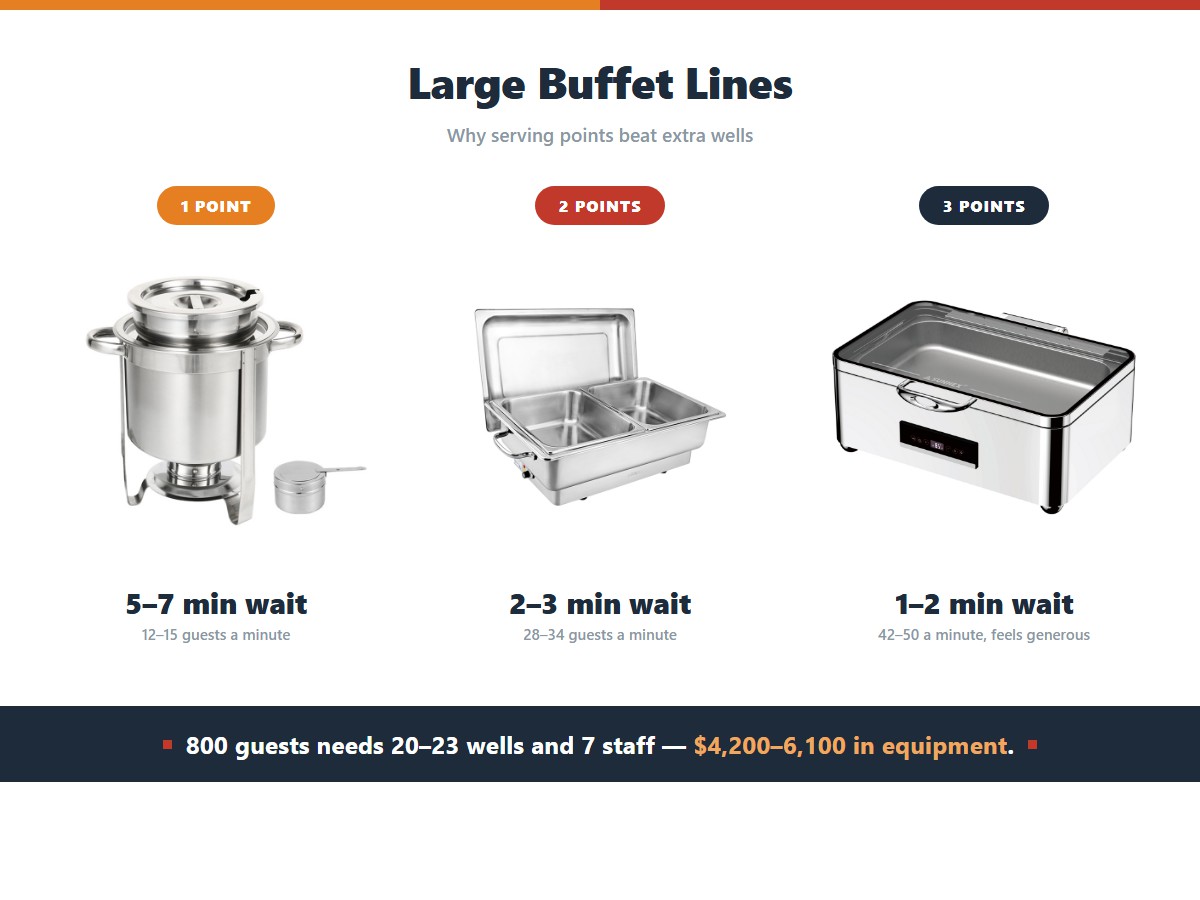
| 200 | 6 wells, 1 point | 5–7 min | 12–15 | Queue visible from the door | $1,050 |
| 200 | 6 wells, 2 points | 2–3 min | 28–34 | Flows, guests spread out | $1,050 |
| 200 | 6 wells, 3 points | 1–2 min | 42–50 | Feels generous | $1,050 |
The table above isolates the important point: the equipment cost is identical in all three rows. Splitting the same six wells across three serving points cuts the peak wait from 5–7 minutes to 1–2 minutes at no additional capital cost. Splitting points is free capacity; adding wells is not.
Frequently Asked Questions
How many buffet stoves per 100 guests?
Roughly three wells per 100 guests, so a 300-guest buffet needs eight to nine. But spread them across three serving points rather than concentrating them on one.
Is it better to have one long line or several small lines?
Several points. The same number of wells split across three points cuts the peak wait from 5–7 minutes to 1–2 minutes, with no extra equipment cost.
How long should the queue be at a buffet?
Under three guests per serving point during peak. Beyond that, guests give up and eat elsewhere, which costs you the cover without ever telling you about it.
Do large buffets need more than one staff member?
Yes, roughly one per 100 guests on the line during peak service. A 300-guest buffet with one person on the line will be well-served and badly managed at the same time.
What is the biggest mistake in sizing a large buffet line?
Sizing on peak guest count and ignoring service points. The equipment number is right but the layout creates a queue that loses you covers.
Related reading
- Do Buffet Stoves Improve Food Presentation? What Guests Notice
- Are Buffet Stoves Worth It? Payback by Event Volume
- Can Buffet Stoves Cut Service Time? 5 Benefits
- Wedding Banquet Buffet Equipment List (100-300 Guests)
- 10 Wedding Buffet Ideas Guests Actually Remember
- Countertop Electric Food Warmer for Restaurant Buffet Lines