


Countertop Electric Food Warmer: Best for Buffet Lines
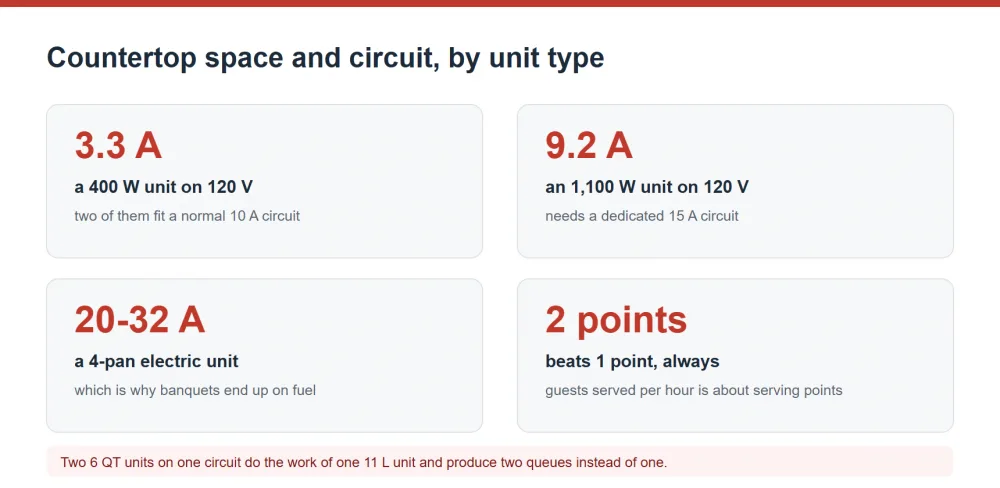
Short answer: Countertop space is the binding constraint, and the three numbers that matter are the unit footprint against the counter depth you actually have, the amperage the unit draws against the circuit on that wall, and the number of guests per hour the pan has to serve. A 400 W unit draws 3.3 A at 120 V and preheats in 12–15 minutes; an 1,100 W unit draws 9.2 A and preheats in 12 minutes. See chafing dish ranges and electrical ratings.
Introduction
Restaurant buffet lines demand food service equipment that maximizes counter space, delivers rapid heating, and maintains consistent temperatures during peak service hours. Countertop electric food warmers have become essential for restaurants with limited kitchen footprint - hotels, casual dining chains, corporate cafeterias, and quick-service restaurants where floor space is premium. Unlike full-size chafing dishes requiring dedicated buffet tables, countertop units integrate seamlessly into existing service lines while delivering professional-grade performance.
Modern countertop electric warmers combine compact design with 400-1100W heating power, achieving optimal serving temperatures in 8-12 minutes. For restaurants serving 200-500 guests daily through buffet lines, these units provide space efficiency, reliability, and food safety compliance that traditional setups cannot match. Digital temperature controls and 80% or higher thermal energy utilization make them indispensable for modern restaurant operations.
1. Space Efficiency: Maximizing Limited Counter Space
Restaurant buffet lines typically operate with 24-36 inches of counter width per serving station. Countertop electric food warmers with compact footprints of 12-18 inches wide fit efficiently into these constrained spaces, allowing restaurants to add more serving stations without expanding their physical footprint.
Unlike traditional chafing dishes requiring separate stands, water pans, and fuel holders, countertop units integrate all components into a single compact housing. This space-saving design enables restaurants to install 30-50% more serving stations in the same counter space, directly increasing revenue per square foot. For urban restaurants with limited dining areas, this efficiency directly impacts profitability and guest throughput.
The low-profile design of 8-12 inches tall maintains clear sightlines across buffet lines, improving guest flow and reducing congestion during peak hours. Restaurant managers report 20-30% faster guest throughput with countertop warmers compared to traditional setups that obstruct traffic flow with bulky equipment.
2. Temperature Control: Precision for Food Safety Compliance
Restaurant buffets must maintain strict food safety standards, with hot foods held at minimum 140 degrees Fahrenheit or 60 degrees Celsius throughout service periods. Countertop electric warmers with digital temperature controls provide precision within 2 degrees Celsius, ensuring compliance with health regulations while preserving food quality and flavor.
The 400-1100W heating elements achieve optimal temperatures in 8-12 minutes, enabling rapid deployment during morning setup and quick recovery after busy periods. The 80% or higher thermal energy utilization rate minimizes electricity consumption, reducing operating costs for restaurants running 12-16 hour daily service. Adjustable thermostats allow staff to match temperatures to specific menu items including soups, sauces, proteins, and vegetables.
Built-in overheat protection and dry-burn prevention eliminate fire risks and equipment damage, critical for restaurants with high staff turnover where operator training may be inconsistent. These safety features reduce liability risks and equipment replacement costs for restaurant operators.
3. Durability: Withstanding High-Volume Restaurant Use
Restaurant buffet lines operate 12-16 hours daily, 7 days a week, with constant refilling, cleaning, and heavy use. Countertop electric food warmers constructed from 304 stainless steel provide corrosion resistance and structural integrity needed for these demanding environments.
Commercial-grade construction withstands daily exposure to food acids, cleaning chemicals, and physical impacts from busy kitchen staff. Restaurants report 8-12 year service life from premium countertop units, compared to 2-3 years for residential-grade alternatives. The polished stainless steel surface resists staining and maintains professional appearance despite constant use and frequent cleaning with commercial sanitizers.
Sealed heating elements and waterproof controls protect against liquid spills and cleaning splashes common in busy restaurant environments. This durability reduces maintenance costs and equipment downtime, ensuring consistent service availability for restaurant guests.
4. Operational Efficiency: Simplifying Restaurant Workflows
Countertop electric warmers simplify restaurant workflows with intuitive controls, rapid heat-up, and minimal maintenance requirements. Staff can operate units with basic training, reducing labor costs and service errors compared to complex chafing dish setups requiring fuel handling and water pan management.
The self-contained design eliminates canned fuel logistics including storage, handling, and disposal that complicate traditional buffet setups. Restaurants save 500-1500 dollars annually per unit in fuel costs while reducing fire hazards and storage requirements. Integrated drip trays and smooth surfaces simplify cleaning, reducing turnaround time between service periods.

5. Cost Efficiency: Strong ROI for Restaurant Operators
Countertop electric food warmers range from 250-700 dollars per unit, significantly lower than full-size chafing dish systems of 500-1200 dollars when factoring in stands, fuel, and installation costs. Restaurants achieve full ROI within 12-18 months through space efficiency, reduced labor costs, and lower energy consumption.
Energy efficiency delivers immediate savings: the 80% or higher thermal utilization rate and rapid heat-up capabilities reduce electricity costs by 30-40% compared to standard warmers. For restaurants operating 10 or more units across multiple buffet stations, these savings accumulate to 2000-5000 dollars annually. Elimination of canned fuel costs of 300-800 dollars per unit annually further improves returns.
Revenue impact is significant: Additional serving stations enabled by space-efficient countertop units generate 5000-15000 dollars additional monthly revenue per restaurant. The compact design allows restaurants to offer more menu items and serve more guests simultaneously, directly impacting top-line growth and profitability.
Conclusion
Countertop electric food warmers represent the optimal choice for restaurant buffet lines prioritizing space efficiency, precise temperature control, durability, operational simplicity, and strong financial returns. The combination of compact design, commercial-grade construction, energy efficiency, and measurable ROI makes these units essential for modern restaurants competing in crowded markets. Investing in premium countertop warmers directly enhances restaurant operational efficiency, guest satisfaction, and long-term profitability.
Browse the full chafing dish range for current models and configurations.
Countertop and Circuit Requirements by Unit Type
| Unit | Footprint | Power | Current at 120 V | Preheat | Dedicated circuit |
|---|---|---|---|---|---|
| 4 QT countertop | 330 × 250 mm | 300–400 W | 2.5–3.3 A | 12–15 min | No, 10 A is enough |
| 6 QT countertop | 360 × 280 mm | 400–500 W | 3.3–4.2 A | 12–15 min | No, 10 A is enough |
| 9 QT round | 430 × 330 mm | 600–800 W | 5.0–6.7 A | 12–16 min | Preferred |
| 11 L full size | 480 × 360 mm | 1,100 W | 9.2 A | 12 min | Yes, 15 A |
| 4-pan rectangular | 550 × 360 mm | 1,400–1,800 W | 11.7–15.0 A | 14–18 min | Yes, 20 A |
| 6-pan rectangular | 800 × 360 mm | 2,000–2,400 W | 16.7–20.0 A | 16–20 min | Yes, 30 A |
| 9-pan rectangular | 1,250 × 360 mm | 2,800–3,600 W | 23.3–30.0 A | 18–24 min | Yes, 40 A |
Guests Served per Hour, by Unit and Pan Count
| Configuration | Serving points | Guests per hour | Service window at 120 guests | Notes |
|---|---|---|---|---|
| 1 × 4 QT | 1 | 30–40 | Needs 3–4 hours | Condiment or side station only |
| 1 × 6 QT | 1 | 40–50 | 2.5–3 hours | One main per point |
| 2 × 6 QT | 2 | 70–90 | 1.5 hours | Minimum viable restaurant line |
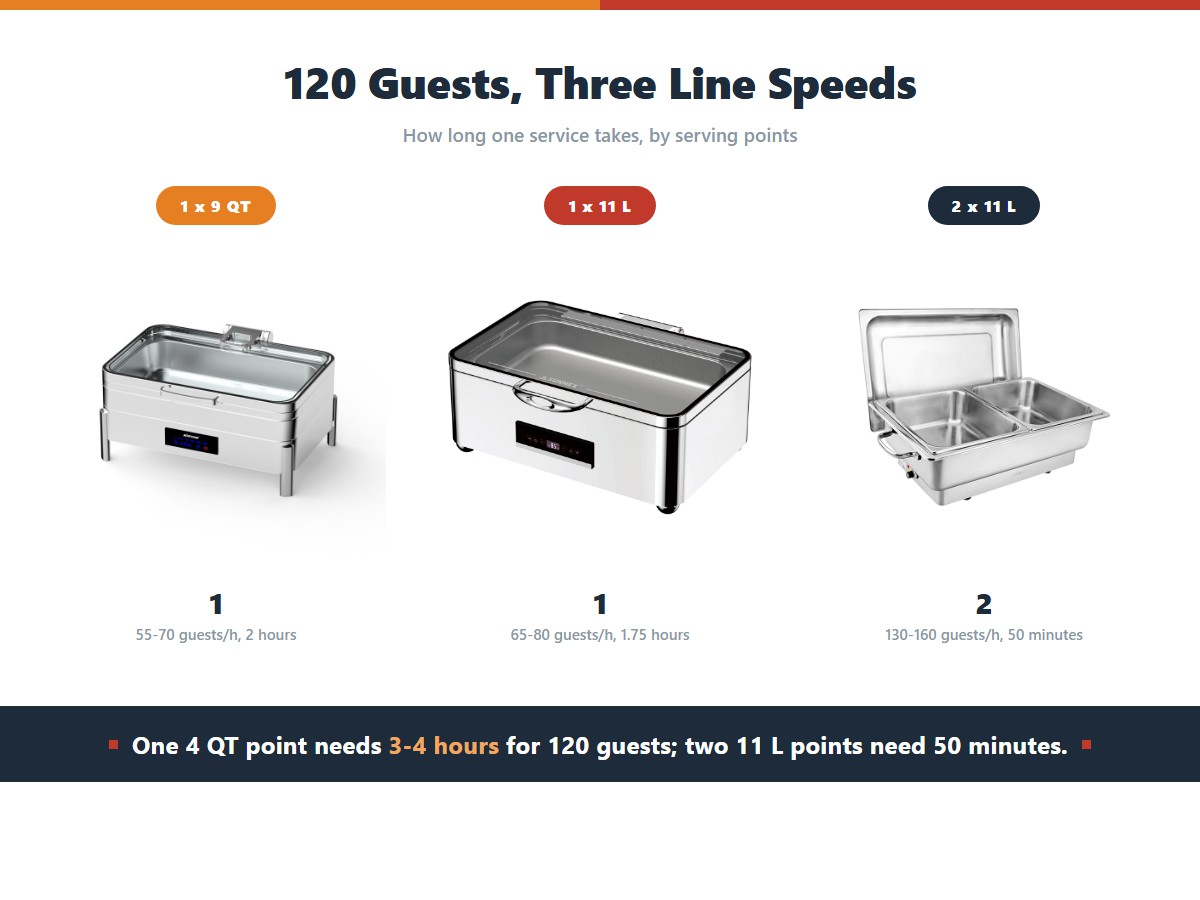
| 1 × 9 QT | 1 | 55–70 | 2 hours | Single-dish service, guests wait |
| 1 × 11 L | 1 | 65–80 | 1.75 hours | Standard full-size round |
| 2 × 11 L | 2 | 130–160 | 50 minutes | Comfortable for 120 guests |
| 1 × 4-pan rectangular | 4 | 120–180 | 45–60 minutes | Long line, one queue |
| 1 × 9-pan rectangular | 9 | 300–420 | 25–35 minutes | High-volume breakfast, one point |
The trap in countertop installation is buying one large unit and putting it on the line, then discovering that a single serving point creates a queue longer than the room can hold. Two 6 QT units on one 10 A circuit do the same work as one 11 L unit and produce two queues, which is the whole point. Guests served per hour is a function of serving points, not of litres.
Frequently Asked Questions
How much counter space does a restaurant buffet line need?
Allow 100 mm behind each unit for cable routing and 150 mm at the end of the line for the attendant to stand. A 6 QT unit occupies 360 × 280 mm of counter, an 11 L unit 480 × 360 mm, and a 4-pan rectangular unit 550 × 360 mm. Counter depth below 600 mm limits you to single-sided round units, because rectangular units need 360 mm plus a 150 mm working gap.
Can I plug several countertop warmers into one outlet?
Up to two 400–500 W units plus lighting on a 10 A circuit, no more. An 1,100 W unit draws 9.2 A on its own, so it needs a 15 A circuit, and two of them on the same 10 A outlet will trip it under load. Running the electric warmers on their own circuit is also what keeps the coffee machine and the dishwasher from a shared nuisance trip during peak service.
How long does an electric food warmer take to reach serving temperature?
A 400 W countertop unit takes 12–15 minutes, an 800 W unit 12–16, and a 1,100 W full-size unit 12 minutes. Plan on 15 minutes of preheat, and fill the water pan with cold water before switching on rather than after. Preheating an empty pan is the single most damaging thing you can do to a stainless unit, and it is what warps a 0.5 mm body permanently.
What temperature should a restaurant buffet hold food at?
57°C or above, 135°F, measured at the pan rim rather than the centre. The rim runs 5–12°C cooler than the middle of the pan once the unit has been on for more than two hours, and the rim is where the food sits that the guest will reach for first. Probe the rim every 45–60 minutes and record it if you are in a jurisdiction that requires it.
Is it better to run one large warmer or several small ones?
Several small ones, on both electrical and service grounds. Two 6 QT units at 500 W each cost $0.09 per hour against $0.16 for one 1,100 W unit, they run on a normal 10 A circuit, and they give you two queues instead of one. The single argument for a large unit is a buffet line with a very long table and no power on the far end.
Related reading
- Electric Buffet Warmer with Adjustable Thermostat for Restaurants
- The Future of Chafing Dishes: Electric & Smart Food Warmers
- Buffet Warmers: Electric vs Fuel Cost per Cover
- Commercial Electric Chafing Dish: What Restaurants Get Wrong
- Sterno vs Gel vs Electric: Does Electric Save $23,000?
- Ceiling-Mounted vs Countertop Food Heat Lamps: Which to Install
- Can Buffet Stoves Reduce Labor Costs in Your Restaurant?