




Buffet Stoves and Menu Design: 4 Ways to Sell More Covers
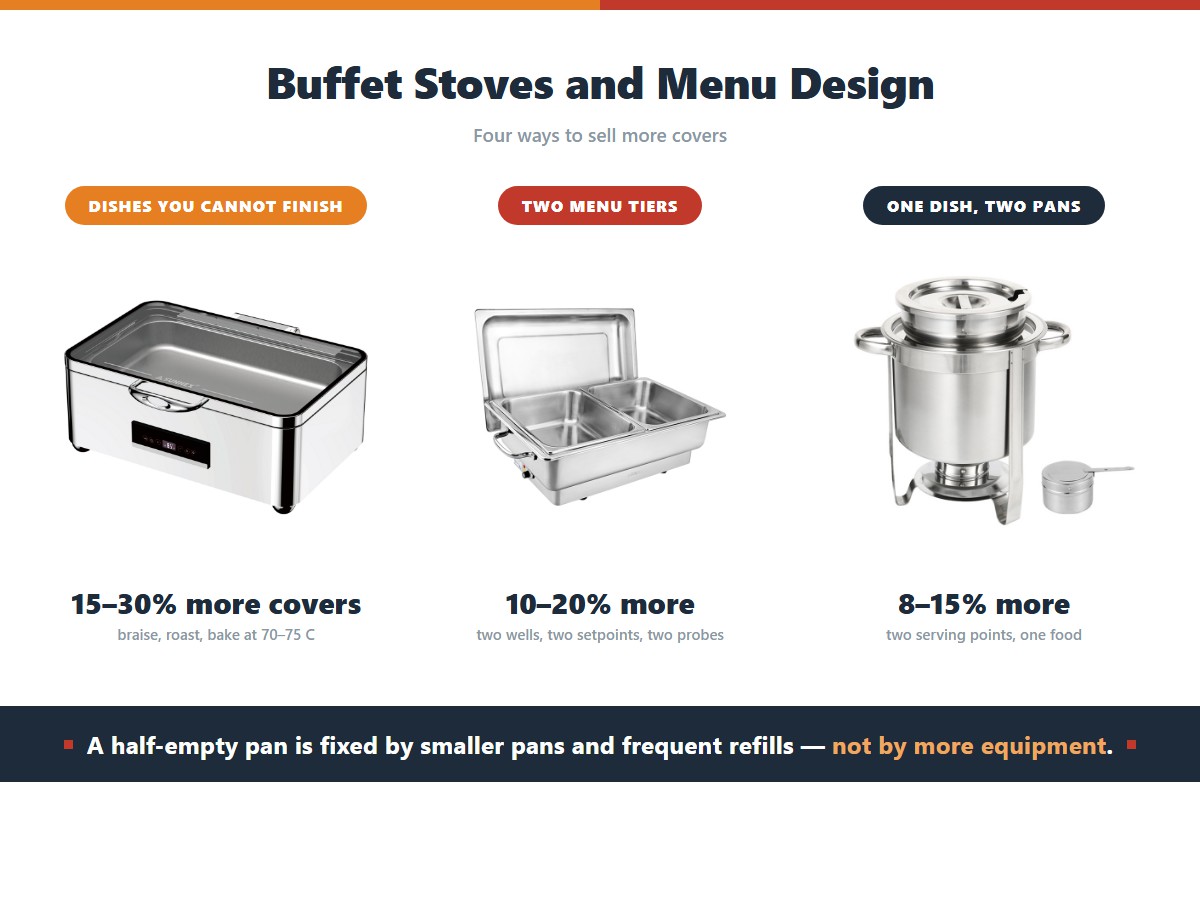
Short answer: Buffet stoves let you widen a menu by removing the equipment constraint, and the four moves that actually increase covers are: offer dishes that cannot be finished to order, use holding to run two menu tiers at once, batch one dish across two pans, and use the equipment to promise a wait time you can keep. Equipment does not create demand. It removes the reason you turn guests away. See buffet station equipment.
Running a successful restaurant means balancing quality, efficiency, and menu innovation. For many establishments, buffet stoves have become indispensable tools—not just for keeping food warm, but for fundamentally expanding what your menu can achieve. If you've been treating your buffet stove as a simple holding device, you're missing out on a range of benefits that can transform your restaurant's menu offering and bottom line. This guide explores how to maximize these benefits, turning a standard piece of equipment into a strategic asset for your business.
Expanding Menu Diversity with Flexible Heating Solutions
One of the most immediate ways buffet stoves boost your menu is by enabling dishes that would otherwise be impractical. Traditional plated service limits you to items that hold well under heat lamps or can be quickly fired to order, but buffet stoves open doors to slow-cooked specialties, temperature-sensitive sides, and extended-service formats. Consider breakfast service: a buffet stove lets you offer made-to-order oatmeal stations with pre-steamed grains, chilled yogurt parfaits alongside warm fruit compotes, and freshly scrambled eggs that stay fluffy for hours. For lunch and dinner, the same equipment supports soup bars with rotating daily specials, braised meat stations where short ribs or pulled pork stay at perfect serving temperature, and vegetable sides that retain their texture and nutrients.
The key is matching your buffet stove's capabilities to your menu's needs. Electric models with precise temperature controls (like the 45–93°C range found in many commercial units) let you experiment with delicate items like poached fish or custards, while high-capacity fuel-powered stoves handle large-batch items for banquets and events. This flexibility means you can introduce seasonal menu changes, test new dishes in a low-risk buffet format, and cater to diverse dietary preferences—all without overhauling your kitchen setup.
Maintaining Consistent Food Quality Across Service
Nothing undermines a restaurant's reputation faster than inconsistent food quality. Buffet stoves with advanced temperature control eliminate the guesswork of manual holding, ensuring every serving meets your standards. Unlike makeshift warming methods that create hot spots or dry out food, commercial-grade buffet stoves maintain a steady environment that preserves moisture, texture, and flavor. For example, a water-bath electric chafer keeps sauces silky and casseroles moist for 8+ hours, while infrared-equipped models prevent the surface drying that ruins carved meats or roasted vegetables.
This consistency extends to customer experience as well. Guests returning for seconds expect the same quality they had initially—buffet stoves deliver that reliability, reducing complaints and encouraging repeat visits. For fine dining establishments adding buffet elements (like pre-dinner appetizer stations), this quality preservation is critical to maintaining brand standards while expanding service models.

Reducing Operational Costs Through Energy Efficiency
Modern buffet stoves are engineered for efficiency, helping you cut costs without sacrificing performance. Electric models with thermal energy utilization rates ≥80% (like BAVA's ) use a fraction of the energy of traditional ovens or range-top holding, while smart modes automatically adjust power based on load. Fuel-powered options have also evolved: clean-burning alcohol gels provide 2–4 hours of consistent heat per can, reducing fuel waste compared to open flames or improvised warmers.
Beyond energy savings, buffet stoves reduce labor costs. A single staff member can manage multiple stations, freeing your team to focus on food prep, customer service, and other high-value tasks. They also minimize food waste: precise temperature control prevents spoilage, and modular designs let you scale portions up or down based on real-time demand. For catering businesses and event venues, this cost efficiency translates directly to higher profit margins on large-scale orders.
Streamlining Service for High-Volume Periods
During peak hours, buffet stoves become force multipliers for your service team. Self-serve stations reduce wait times for made-to-order items, letting guests customize their plates while your kitchen focuses on fresh preparations. For banquets and weddings, multi-unit setups let you serve 500+ guests efficiently, with different stations dedicated to appetizers, mains, and desserts—all maintained at optimal temperatures without constant staff intervention.
The integration of smart features like digital temperature displays and dry-burn protection (standard in many commercial models) further simplifies service. Your team can monitor multiple units at a glance, adjust settings remotely, and avoid costly mistakes like overheating or equipment failure. This reliability is especially valuable for hotels and resorts with 24/7 dining options, where consistent performance is non-negotiable.
Conclusion: Turning Equipment into Competitive Advantage
Maximizing the benefits of buffet stoves isn't just about keeping food warm—it's about reimagining what your menu can offer. By expanding dish variety, maintaining consistent quality, reducing costs, and streamlining service, these versatile tools help you stand out in a competitive restaurant market. Paired with the right commercial-grade equipment (like BAVA's chafing dish collection), you can transform a standard kitchen staple into a driver of growth, customer satisfaction, and long-term success. Whether you're running a hotel buffet, a neighborhood cafe, or a catering business, the strategic use of buffet stoves will help you unlock new possibilities for your menu and your business.
Browse the full chafing dish range for current models and configurations.
Menu Moves That Increase Covers
| Move | What it enables | Equipment need | Covers gained | Risk |
|---|---|---|---|---|
| 1. Dishes that cannot be finished to order | Braise, roast, bake | 1,500 W+ element, 70–75°C | 15–30% more covers | Dries out, needs a probe |
| 2. Two menu tiers running at once | A premium and a standard dish | 2 wells, 2 setpoints | 10–20% | Two probes, two log lines |
| 3. One dish across two pans | Two serving points, one food | Split pans, 2 lids | 8–15% | Second pan cools slower |
| 4. A wait time you can keep | Advertising 3 min, delivering 2 | Buffer wells preheated | 5–12% | Needs a spare unit |
| 5. Soups or sauces alongside mains | Bain-marie for the liquid item | Separate unit, water at 85–90°C | 5–10% | Not a direct-heat unit |
What Equipment Cannot Fix
| Problem | Equipment alone | Also required | Realistic gain |
|---|---|---|---|
| Guests see a half-empty pan | No | Smaller pans, frequent refills | Visible, immediate |
| Queue forms at the end of the line | No | 2–3 serving points | Wait 5–7 min to 1–2 |
| Food past its holding window | No | Wave finishing, smaller batches | 10–20% less discard |
| Guests cannot identify dishes | No | Labels at eye level, allergen list | Fewer questions |
| Food too dry to eat | Partly | Lids, water pans, lower setpoint | 30–60% less moisture loss |
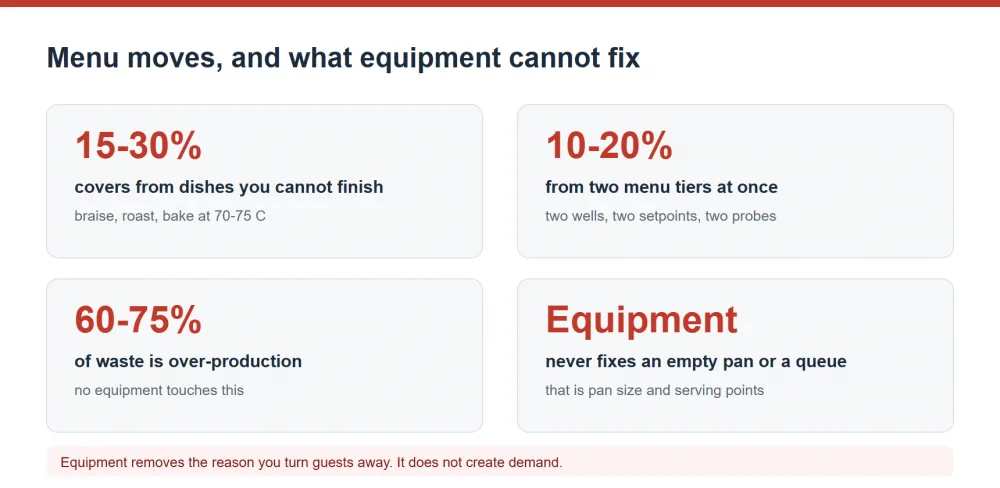
| Overproduction and waste | No | Forecast from a cover count | 60–75% of waste addressed |
The table above is the honest half of this topic. Equipment lets you serve a braised dish that would otherwise be off the menu, and that genuinely increases covers. But the everyday complaints about a buffet, an empty pan at the end, a queue, food past its window, and waste, are not equipment problems. A full line of buffet stoves will not fix a bad cover count, and any supplier who implies otherwise is selling you a solution to a problem you do not have.
Frequently Asked Questions
How can buffet stoves help me sell more covers?
By removing the equipment constraint on dishes that cannot be finished to order, letting two menu tiers run at different setpoints, splitting one dish across two serving points, and keeping a buffer so you can promise a short wait. Realistic gains are 15–30% on the first move and 5–12% on the others.
What dishes can a buffet stove hold that a kitchen cannot?
Braises, roasts, curries and baked items that need 70–75°C held for hours without being finished to order. Anything that must be cooked at a specific moment, or anything that scorches, does not belong on a buffet line regardless of the equipment.
Can buffet stoves run two menu tiers at different temperatures?
Yes, with two wells and two probes. A premium dish holding at 75°C and a standard dish at 70°C is entirely workable, and it is the most profitable menu move available on a buffet line. The cost is discipline: two probes, two log lines, and two checks per hour.
Does equipment alone reduce buffet food waste?
Only 8–18%. Over-production is 60–75% of buffet waste and needs a forecast, and guest portion behaviour needs smaller pans. Equipment prevents the food that falls below 60°C, which is 5–12% of the total.
How many serving points do I need to increase throughput?
One per 30 guests, split from the same pans rather than adding more. Going from one line to two points at 120 guests cuts peak wait from five to seven minutes to one or two, and it costs nothing beyond the second table.
Related reading
- Are Buffet Stoves Worth It? Payback by Event Volume
- 5 Benefits of Buffet Stoves for Catering Businesses
- Serving More Covers Without Dropping Quality
- Banquet Buffet Stoves: Features Worth Specifying
- Buffet Equipment Maintenance Schedule: Don't Wait Until It Breaks
- Commercial Buffet Stove Types Compared: Which Fits Your Menu