


Serve More Covers: How to Keep Quality at Peak
Short answer: Serving more covers without losing quality comes from one number and one habit: 250–350 g per guest per dish, and probing the pan edge hourly. Over-serving is the usual cause of quality collapse, not the cooking. Add a well only after the portion and the probe discipline are already right. See buffet station equipment.
Running a high-volume buffet, catering business, or hotel restaurant comes with a constant balancing act: how do you serve more customers during peak hours without letting food quality slip? Overcooked dishes, cold appetizers, and dried-out main courses can ruin a guest’s experience and damage your reputation. For many operators, the solution lies in upgrading to professional-grade buffet stoves (also known as chafing dishes) designed for high-efficiency, consistent performance. Unlike makeshift warming setups, purpose-built buffet stoves maintain precise temperatures, handle large volumes of food, and free up staff to focus on guest service instead of constant food monitoring.
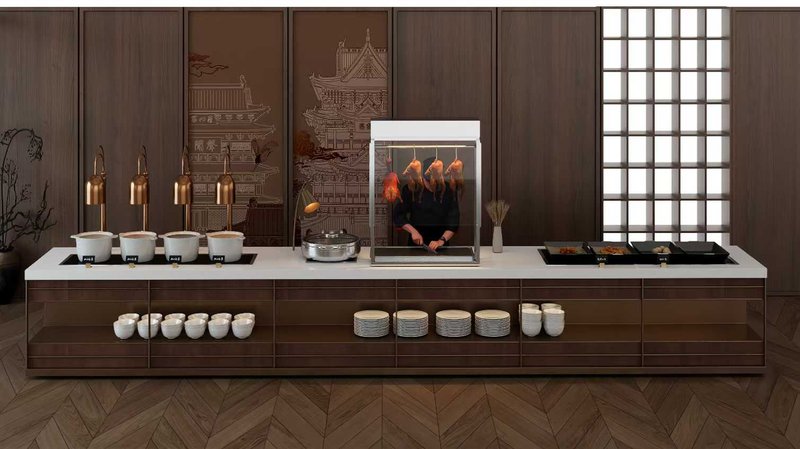
One of the biggest risks of scaling up buffet service is temperature fluctuation. When food sits in underpowered warmers, it can drop below safe serving temperatures (leading to food safety risks) or overcook from uneven heat. Professional buffet stoves solve this with precision temperature control systems. Take the Full Size 11L Electric Chafer from BAVA’s: it features a 1100W heating element that reaches optimal temperature in just 12 minutes, with a thermal efficiency rate of ≥80% and a digital temperature display for real-time monitoring. This ensures soups, sauces, and main dishes stay at the perfect serving temperature for hours, even during back-to-back peak periods.

Full Size 11L Electric Chafer
The BAVA Full Size 11 L Electric Chafer delivers rapid 12-minute heat-up, 80%+ thermal efficiency, and smart digital temperature control. Crafted from polished stainless steel, it is ideal for high-volume hotels and catering operations that require consistent, high-quality food warming for large crowds.
Buffet stoves with larger capacities let you prepare and hold more food in advance, reducing the need for constant batch cooking during service. This is critical for events like wedding banquets, corporate buffets, and weekend brunch rushes where customer volume spikes unexpectedly. The Electric Chafing Dish Food Warmer offers a GN 1/1 size food pan (530x325mm) that holds 11 liters of food, enough to serve 50-80 guests per unit depending on portion size. Its 400W adjustable temperature range (60–93°C) works for everything from delicate pastries to hearty stews, so you can use the same unit for multiple dishes across your buffet spread.
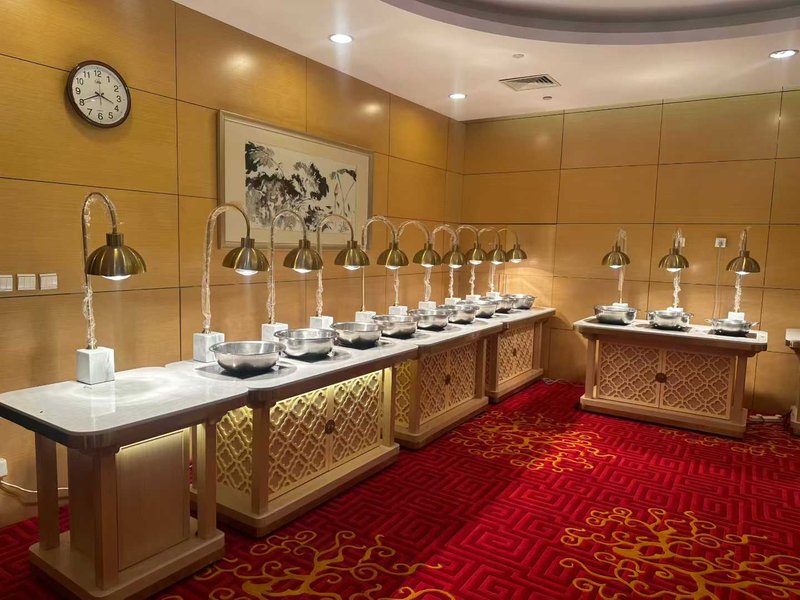

Electric Chafing Dish Food Warmer
This commercial-grade electric chafing dish features 400W fast heating, adjustable digital temperature control, and food-grade 304 stainless steel construction. With CE, ETL, RoHS, and FDA compliance, it is a reliable choice for hotels and restaurants that need to serve high volumes of food without compromising safety or quality.
When staff don’t have to constantly check and reheat food, they can focus on higher-value tasks like refilling drinks, clearing tables, and assisting guests. Modern buffet stoves with smart features like anti-dry burn protection and overheat auto-shutoff reduce the need for constant monitoring. For example, BAVA’s Electric Chafing Dish W07 includes a 900W heating element with intelligent temperature control and an anti-dry heat flash alarm, so staff get an alert if water levels drop too low instead of having to check manually every 15 minutes. This cuts down on labor costs and reduces human error during busy shifts.
Serving more customers doesn’t have to mean skyrocketing utility bills. High-efficiency buffet stoves use advanced heating technology to minimize energy waste. The 11L Electric Chafer mentioned earlier uses 80% of its energy directly for heating food, compared to 50-60% for lower-quality models. Over a year of daily use, this can save hundreds of dollars in electricity costs for a medium-sized restaurant, freeing up budget to invest in higher-quality ingredients or staff training.
For buffet operators, caterers, and hotel managers, the right buffet stove is more than just a warming tool—it’s a key part of maintaining quality while scaling service. By investing in professional-grade units with precise temperature control, high capacity, and labor-saving features, you can serve more customers per shift without compromising the food quality that keeps guests coming back. BAVA’s full line of chafing dishes and buffet stoves is designed specifically for commercial high-volume use, with durable stainless steel construction, global safety certifications, and customizable voltage options to fit your kitchen’s needs.
Browse the full chafing dish range for current models and configurations.
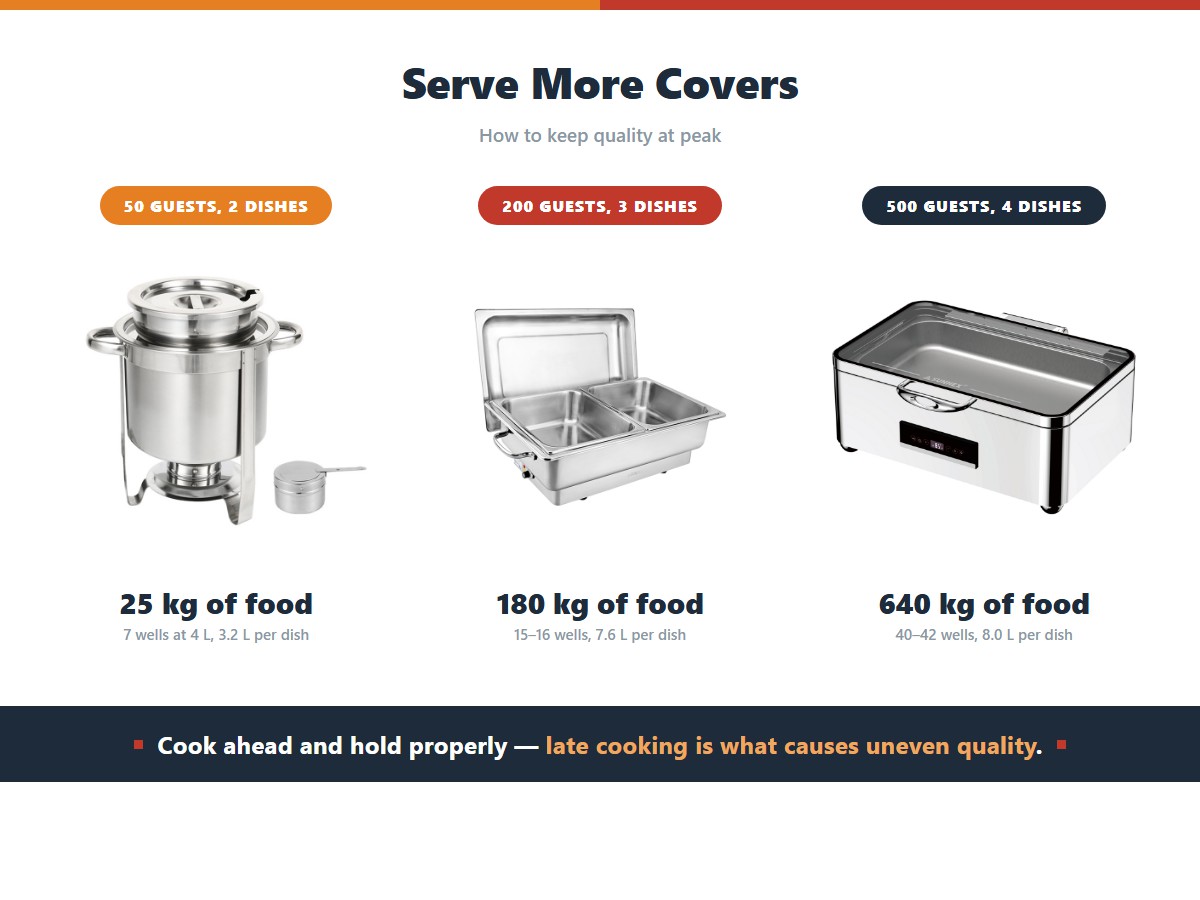
Portion Math by Guest Count
| Guests | Dishes | Per guest, per dish | Total food volume | Wells at 4 L | Pan fill per dish |
|---|---|---|---|---|---|
| 50 | 2 | 250 g | 25 kg | 7 | 3.2 L |
| 100 | 3 | 280 g | 84 kg | 7–8 | 5.3 L |
| 200 | 3 | 300 g | 180 kg | 15–16 | 7.6 L |
| 300 | 4 | 300 g | 360 kg | 22–24 | 7.6 L |
| 500 | 4 | 320 g | 640 kg | 40–42 | 8.0 L |
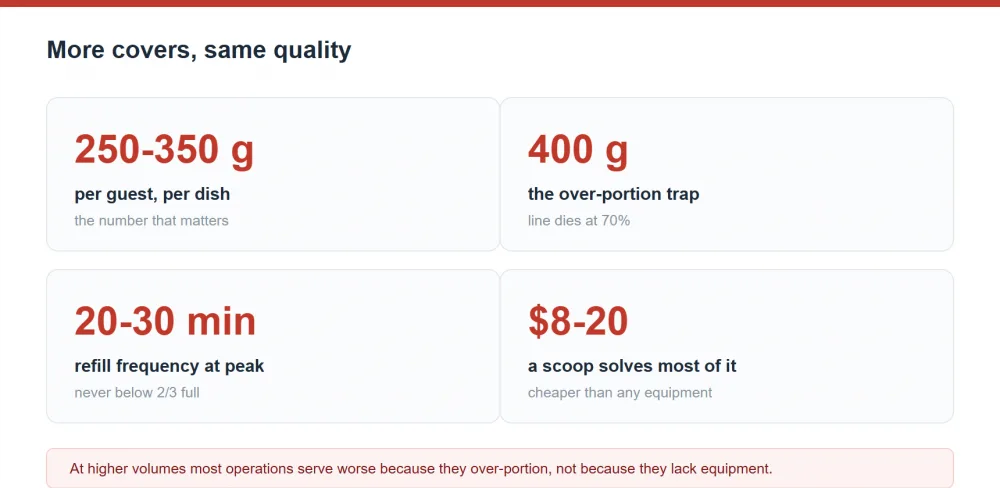
What Actually Drops Quality at Volume
| Cause | Frequency | Effect on quality | Cheapest fix | Cost |
|---|---|---|---|---|
| Over-portioning to appear generous | Very common | Line runs dry, quality collapses at 70% | Fix portions, use a scoop | $8–20 for scoops |
| Probe checks skipped | Common | Edge food below 60°C | Hourly probe, log it | $0 |
| Not enough refill trips | Common | Empty pans on the line | Staff one person on refills | Staff time |
| Late cooking to keep up | Common | Uneven quality, some raw | Cook ahead, hold properly | Planning |
| Too few wells | Occasional | Overfilled pans, poor recovery | Add wells or points | $150–250 |
| Wells at 85°C, no lid | Occasional | Crust within 40 min | Add lids | $25–60 each |
The counter-intuitive finding is that at higher volumes most operations serve worse because they over-portion rather than because they lack equipment. A line portioned at 400 g instead of 300 g looks generous for the first hour and runs out at seventy percent, which is when quality actually falls.
Frequently Asked Questions
How do I serve more covers without dropping quality?
Fix the portion first at 250–350 g per guest per dish, then add hourly probe checks, then assign one person to refills. Over-portioning is the usual cause of quality collapse, not capacity.
How much food do I need per guest?
Roughly 250–350 g per guest for each dish on the line. A 200-cover service with three dishes needs about 180 kg of cooked food, which is 15–16 full 4 L wells.
Should I add equipment or improve portions when running short?
Portions first, every time. Over-portioning looks generous for an hour and then the line runs dry at seventy percent, which is exactly when quality falls.
How often should pans be topped up?
Every 20–30 minutes at peak, never letting a pan go below two-thirds full. An empty-looking pan makes guests stop choosing that dish.
Do lids matter when serving high volumes?
Yes. Without a lid the surface crusts within 40 minutes at service temperature, which on a high-volume line is most of the service. Lids cost $25–60 per well.
Related reading
- Chafing Dish Insulated Covers: Keep Food Warmer Longer
- Rectangular Chafing Dishes: Ideal for Large Food Servings
- Buffet Stoves and Menu Design: 4 Ways to Sell More Covers
- Why Chafing Dish View Windows Matter (And Sell More Food)
- Food Heat Lamp Insulated Covers: Retain Heat Efficiently
- Dual Dry-Wet Heating Chafing Dish: One Dish, Two Modes
- Consistent Food Quality Over a 4-Hour Service