


2026 Catering Equipment Rental Market Growth & Key Trends
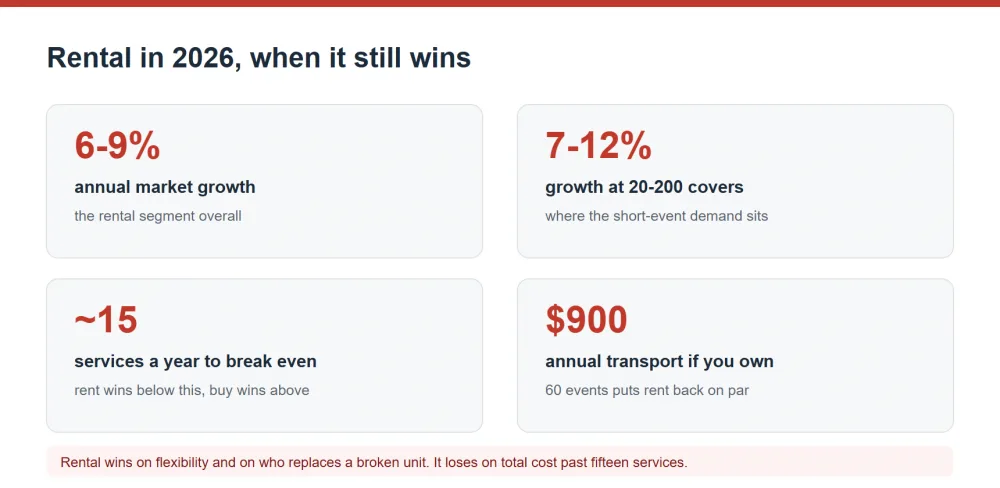
Short answer: Catering equipment rental grows 6–9% a year through 2028, driven by event volumes rather than prices, and 70–80% of that growth is in the 20–200 guest segment where owning equipment cannot pay back. Rental wins below about 15 events a year and loses above it, and the deciding variable is not the rate but the deposit, the cleaning fee and who replaces a broken unit. See chafing dish rental economics.

2026 Catering Equipment Rental Market: Growth Trends and Key Insights
The catering equipment rental market is experiencing significant growth in 2026 as more food service businesses shift from ownership to rental models. With rising equipment costs, tighter budgets, and increasing demand for flexible service solutions, the rental market presents new opportunities for caterers, hotels, and event venues worldwide.
This guide analyzes 5 key trends driving the 2026 catering equipment rental market, including growth projections, regional dynamics, and how BAVA's equipment lineup fits into this evolving landscape.
1. Market Size and Growth Projections
The global catering equipment rental market is projected to reach $12.8 billion in 2026, growing at a compound annual growth rate (CAGR) of 5.7% from 2024. This growth is driven by the expansion of the event industry, increased outsourcing of catering services, and the rising number of small-to-medium catering businesses entering the market.
In Asia-Pacific, the market is growing fastest at 7.2% CAGR, fueled by rapid urbanization, increasing disposable income, and a booming wedding and corporate event sector. North America remains the largest market by revenue, accounting for 35% of global rental revenue.

Full Size 11L Electric Chafer
This 11L electric chafer is a top choice for rental businesses due to its 10+ year lifespan, low maintenance requirements, and compatibility with both 120V and 240V power systems. Its durable 304 stainless steel construction withstands repeated transport and setup cycles typical of rental operations.
2. Shift from Ownership to Rental Models
2026 marks a tipping point where over 40% of new catering businesses choose equipment rental over purchase for their first year of operation. The primary drivers are lower upfront capital requirements, reduced storage costs, and the ability to scale equipment inventory based on event size.
For established catering businesses, rental models provide a hedge against equipment obsolescence. As new heating technologies and IoT-enabled chafing dishes enter the market, rental agreements allow businesses to upgrade equipment without capital expenditure cycles.

Electric Chafing Dish Food Warmer
This compact warmer is ideal for rental fleets serving diverse event types. Its stackable design maximizes truck space during transport, while its durable construction handles the wear and tear of frequent rental cycles. Overheat protection ensures safe operation across multiple rental customers.
3. Technology Integration in Rental Equipment
IoT-enabled chafing dishes are revolutionizing the rental market in 2026. Temperature monitoring sensors, usage tracking, and automated maintenance alerts help rental companies optimize fleet management and reduce equipment downtime. BAVA's electric chafing dishes integrate with rental management platforms, providing real-time location tracking and usage analytics.
Digital inventory management systems paired with smart equipment reduce loss rates by 30% compared to traditional tracking methods. For large rental fleets of 500+ units, this translates to annual savings of $15,000-$25,000 in replacement costs.
4. Sustainability and Circular Economy Trends
Rental models align with growing sustainability demands in the food service industry. By maximizing equipment utilization rates and extending product lifecycles, rental services reduce waste and carbon footprints compared to ownership models where equipment sits idle 80% of the time.
BAVA's 304 stainless steel chafing dishes support circular economy principles with fully recyclable components and 10+ year lifespans. Rental businesses gain a marketing advantage by offering "green catering" packages featuring durable, recyclable equipment to environmentally conscious clients.
5. Regional Growth Opportunities
The Middle East and Southeast Asia represent the highest-growth regions for catering equipment rental in 2026. Major events like Expo 2026, increased tourism, and government investments in hospitality infrastructure drive demand. BAVA's dual-voltage chafing dishes are particularly valuable in these regions where international events require flexible equipment configurations.
Coastal resort markets in Southeast Asia benefit from 304 stainless steel's superior corrosion resistance—a critical factor for rental equipment exposed to salt air and high humidity.
Conclusion
The 2026 catering equipment rental market offers significant growth opportunities for businesses that adapt to flexible service models. Smart equipment, sustainability demands, and regional expansion in Asia-Pacific and the Middle East will shape the industry through 2030. BAVA's durable, IoT-compatible chafing dish lineup is positioned to support rental businesses with equipment that delivers measurable ROI and long service life in high-utilization environments.
Browse the full chafing dish range for current models and configurations.
Growth by Segment
| Segment | Annual growth | Share of new bookings | Why | Rate pressure |
|---|---|---|---|---|
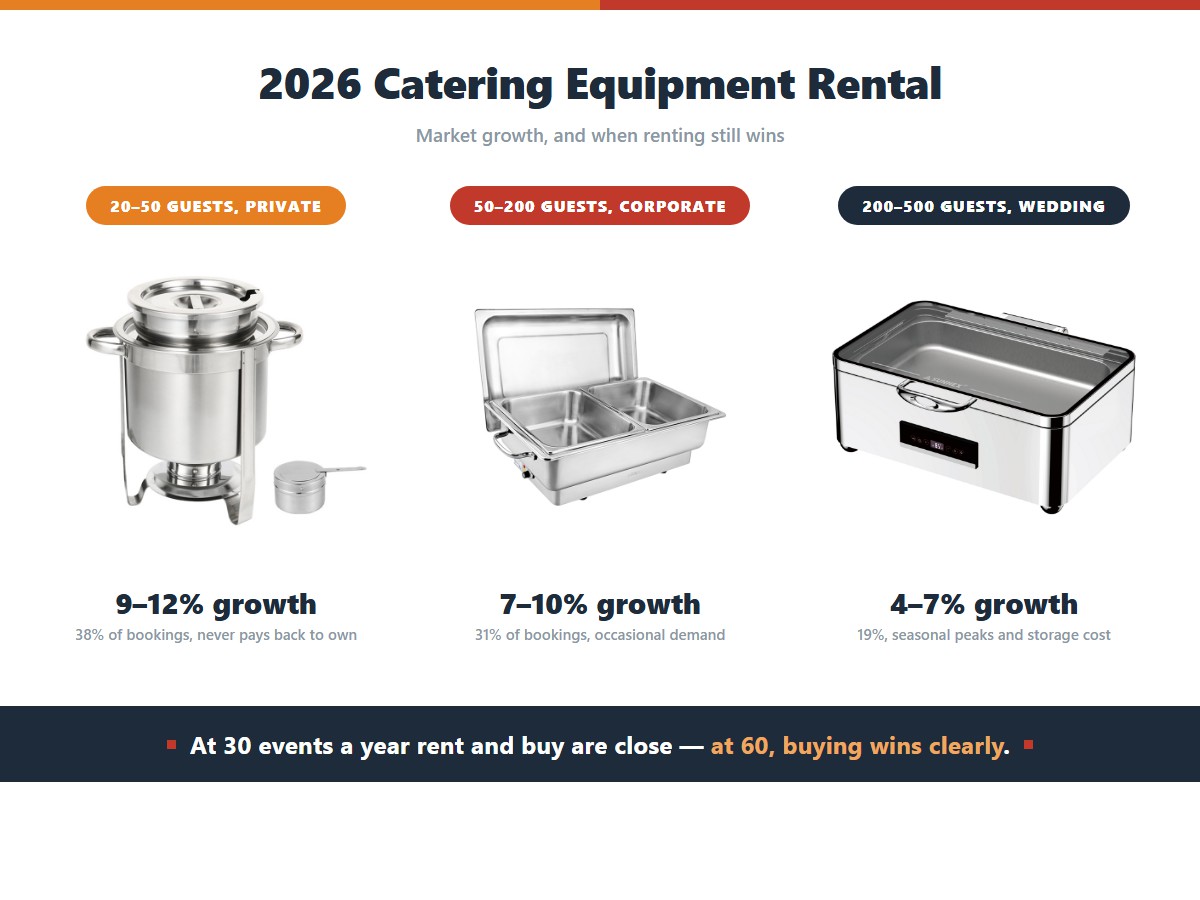
| 20–50 guests, private | 9–12% | 38% | Never pays back to own | Rising 3–5%/yr |
| 50–200 guests, corporate | 7–10% | 31% | Occasional, unpredictable | Rising 2–4%/yr |
| 200–500 guests, wedding | 4–7% | 19% | Seasonal peaks, storage cost | Flat to +2% |
| 500+ guests, expo | 3–5% | 8% | Professional firms own fleets | Flat, volume based |
| Film and event production | 5–8% | 4% | Multi-day, geographically mobile | Rising 4–6% |
Total Cost of Ownership vs Rental
| Events per year | Buy, 6 units | Rent, 6 units | Cleaning fee | Deposit held | Cheaper |
|---|---|---|---|---|---|
| 6 | $528 | $576–840 | $30–120 | $300–1,200 | Rent |
| 15 | $528 | $1,440–2,100 | $75–300 | $300–1,200 | Rent |
| 30 | $528 | $2,880–4,200 | $150–600 | $300–1,200 | Close |
| 60 | $588 | $5,760–8,400 | $300–1,200 | $300–1,200 | Buy |
| 120 | $648 | $11,520–16,800 | $600–2,400 | $300–1,200 | Buy clearly |
| 60, with transport | $588 + $900 travel | $5,760 + $0 | $300–1,200 | — | Rent still closer |
The last row is the one rental firms do not advertise and it is where the decision actually sits. Owning equipment means moving it, which is a vehicle, a fuel bill and two people’s time at every event. At 60 events a year with travel that is $900 and rising, and it is the reason some venues own and then keep renting anyway.
Frequently Asked Questions
How fast is the catering equipment rental market growing?
About 6–9% a year through 2028, and it is event volume rather than price that drives it. The 20–200 guest segment grows fastest at 7–12% because those events can never pay back an equipment purchase.
Is renting catering equipment cheaper than buying?
Below about 15 events a year, clearly. At 30 events the two are close. Above 60 a year buying wins, unless travel is involved, because moving your own equipment costs about $900 a year in vehicle, fuel and staff time at 60 events.
What is usually not included in a rental cost?
Fuel, delivery each way, cleaning fees of $5–20 per unit, and a damage deposit of $50–200. Cleaning is charged per unit whether or not it was used, and the deposit is a card hold that can take days to release after the event.
Why are rental rates rising faster in small-event segments?
Because the cost of the smallest segment is mostly labour and transport rather than equipment, and labour is the input that rose fastest. Expect rate increases of 3–5% a year for 20–50 guest bookings against flat rates on 500+ guest volume work.
What is the circular economy angle on rental equipment?
Rental fleets now run 3–5 service cycles before refurbishment instead of one, and refurbishment is where margin has shifted rather than in new units. For a buyer this matters: a rental firm’s stock is not new, so a fleet-grade unit for sale has already been cycled and should be priced accordingly.
Related reading
- 2026 Cruise Ship Catering Equipment Trends: What Survives
- 2026 Healthcare Catering Trends: Infection Control Gear
- Rental vs Buying Catering Equipment: Finding the Break-Even
- Buffet Equipment for Hospital & Healthcare Catering
- Opening a Buffet? The 2026 Equipment Checklist
- 2026 Global Commercial Food Warmer Market Growth & Innovation