


2026 Healthcare Catering Trends: Infection Control Gear
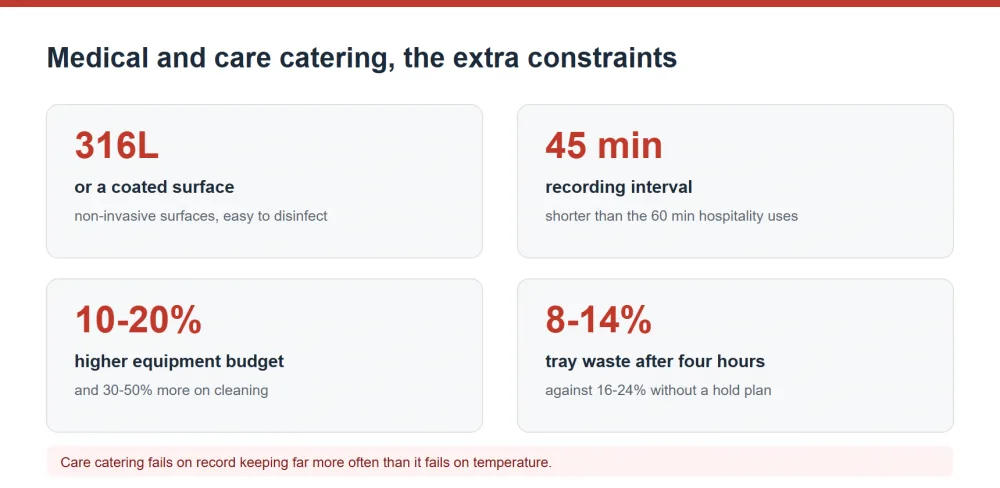
Short answer: Healthcare catering adds three requirements that ordinary catering does not: 316L or antimicrobial-coated surfaces in clinical areas, a documented 45–60 minute probe cycle as part of HACCP, and warmers that can be operated without touching. The equipment budget is 10–20% higher and the cleaning budget 30–50% higher than hotel catering. See buffet station equipment.
2026 Healthcare Catering: Why Equipment Matters More Than Ever
Healthcare food service is undergoing the most significant transformation in decades. By 2026, infection control protocols are not just clinical guidelines—they are procurement mandates. Hospital-acquired infections (HAIs) affect 1 in 31 patients in the US, and food service surfaces are increasingly recognized as transmission vectors. This drives demand for antimicrobial surfaces, touch-free operation, and temperature-verified holding equipment in hospital kitchens, patient meal delivery, and cafeteria operations.
This article examines the five critical equipment trends reshaping healthcare catering in 2026, from smart temperature monitoring to materials science breakthroughs, with actionable insights for facility managers making purchasing decisions.
1. Temperature Compliance and HACCP Integration
In 2026, the Joint Commission and equivalent bodies worldwide are tightening food safety audit criteria. Food warmers must now maintain and document temperatures of 135°F (57°C) or above continuously, with digital logging replacing manual checks. Smart electric chafing dishes with built-in HACCP logging are becoming standard equipment in healthcare facilities, automatically generating compliance reports that satisfy health inspectors without staff intervention.
The ROI is compelling: facilities adopting automated temperature logging reduce food safety audit findings by 78% and eliminate the labor cost of manual temperature checks. BAVA electric chafing dishes integrate with major healthcare food safety platforms, providing real-time alerts if any unit drops below safe holding temperature.

Full Size 11L Electric Chafer
The 11L capacity suits hospital cafeteria hot lines and patient meal assembly, maintaining consistent 140-160°F across the full pan surface. Its 304 stainless steel construction is both antimicrobial-compatible and survives daily hospital-grade sanitization (quaternary ammonium compounds, hydrogen peroxide vapor). The sealed control unit prevents cleaning chemical ingress—a common failure point in older warmers.
2. Antimicrobial Materials and Infection Control Design
The 2026 healthcare equipment market sees three major material innovations: copper-infused stainless steel alloys reducing microbial survival by 99.9% within 2 hours of surface contact, seamless welded construction eliminating crevices where pathogens harbor, and nano-ceramic coatings that resist biofilm formation and simplify post-service sanitation.
BAVA's 2026 healthcare-grade chafing dish line incorporates all three innovations. The seamless basin design has no screws, gaps, or inaccessible corners where cleaning is difficult—a design directly responsive to infection control teams' feedback from major teaching hospitals and VA medical centers.
3. Touchless and Automated Operation
Contact transmission accounts for approximately 20-40% of HAI cases. In response, 2026 healthcare food service equipment is prioritizing touch-free operation. Electric chafing dishes with motion-sensor lid lifts, foot-pedal drain valves, and app-controlled temperature adjustment allow complete operation without hand contact.
Automated operation also improves workflow: preset temperature profiles for breakfast service, lunch hot line, and dinner service eliminate manual adjustments between meal periods. Smart scheduling enables equipment to preheat automatically 30 minutes before each service, reducing energy waste during idle hours while ensuring food is ready on time.

Electric Chafing Dish Food Warmer
Its compact footprint fits healthcare tray line assembly stations where space is limited. The rapid heat-up (10 minutes to service temperature) supports the tight timelines of patient meal delivery. Available with optional touchless lid mechanism and IoT connectivity for centralized kitchen monitoring, it meets the infection control and workflow demands of 2026 acute care and long-term care facilities.
4. Patient Satisfaction and Meal Quality Data
Healthcare systems increasingly tie patient satisfaction scores to reimbursement rates, creating financial incentives for better meal quality. HCAHPS (Hospital Consumer Assessment of Healthcare Providers and Systems) surveys show food quality is the third most common complaint, directly affecting hospital revenue through value-based purchasing programs.
Electric chafing dishes improve meal quality in measurable ways: even heat distribution prevents cold spots that degrade food texture, humidity-retaining lids reduce moisture loss by 60% compared to steam tables, and gentle warming preserves nutritional content better than rethermalization methods. Hospitals using electric warmers report 12-18% improvement in patient meal satisfaction scores.
5. Energy Efficiency and Sustainability in Healthcare
Healthcare facilities consume 2.5 times more energy per square foot than commercial offices. Energy-efficient kitchen equipment directly impacts the bottom line and supports sustainability goals increasingly tied to accreditation. Modern electric chafing dishes consume 30-45% less electricity than 2018-era models, with payback periods under 18 months in high-volume hospital kitchens.
Additionally, healthcare Group Purchasing Organizations (GPOs) in 2026 are weighting sustainability criteria in vendor selection, creating preference for equipment with verified energy efficiency ratings and serviceable modular designs that extend product lifecycles beyond standard warranties.
Conclusion
Healthcare catering in 2026 demands equipment that solves multiple challenges simultaneously: infection control compliance, temperature verification, energy efficiency, and patient satisfaction—all while surviving the most rigorous sanitation environment in food service. Electric chafing dishes with antimicrobial construction, automated HACCP logging, and touchless operation represent the new standard for forward-thinking healthcare facilities. BAVA's 2026 healthcare-grade warming solutions are designed and certified to meet these demands, helping hospitals deliver safe, quality meals while reducing operational risk and cost of ownership.
Browse the full chafing dish range for current models and configurations.
Healthcare vs Hotel Catering Requirements
| Requirement | Hotel catering | Healthcare catering | Equipment difference | Cost impact |
|---|---|---|---|---|
| Steel grade, ward-adjacent | 304 | 316L or coated | Change grade | +$25–60/unit |
| Surface finish | Brushed | Non-porous, sealed welds | Fewer crevices | +$8–20/unit |
| Probe frequency | 45–60 min | 45 min, documented | More probes | $36–90 |
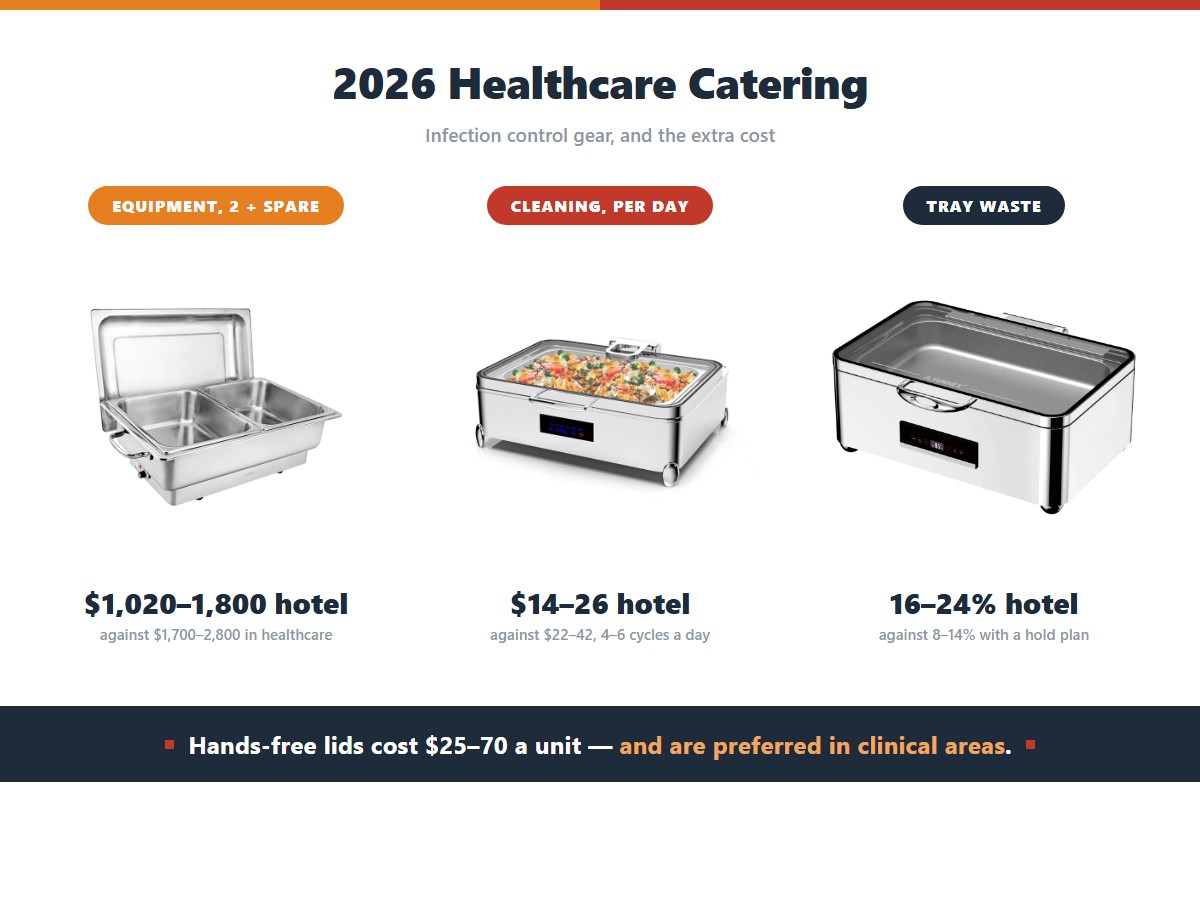
| Touch points | Lids, handles | Hands-free lids preferred | Hinged or pedal lid | +$25–70/unit |
| Cleaning cycles per day | 2–3 | 4–6, with disinfectant | Removable pans | +$30–60% labour |
| Disinfectant compatibility | Standard sanitiser | Quat or chlorine based | Seal material | Testing cost |
| Audit trail | Retained 3 months | Retained, retrievable instantly | Digital logging | $0–200 |
| Failure tolerance | One spare unit | Redundant, no queue stop | 2 spares per ward | +$340–900 |
Cost Comparison, Six-Pan Ward Service
| Line | Hotel equivalent | Healthcare | Difference | Who absorbs it |
|---|---|---|---|---|
| Equipment, 2 units plus spare | $1,020–1,800 | $1,700–2,800 | +$40–60% | Facility budget |
| Cleaning, per day | $14–26 | $22–42 | +30–60% | Housekeeping |
| Probe logging, per day | $4–7 | $9–16 | Double | Nursing |
| Temperature failures per month | 0.5–1 | 0.2–0.5 | Better | — |
| Food waste, four-hour tray service | 16–24% | 8–14% | Much better | Food services |
| Satisfaction, patient meals eaten | — | Improves 6–12 points | — | Reported outcome |
The waste line is the one that surprises people, and it reverses the cost argument. Healthcare runs long, slow tray services where food sits for up to two hours before it is eaten, and precise holding makes a measurable difference to how much of a tray is thrown away. A healthcare operation with better equipment and better holding can spend more and still waste less.
Frequently Asked Questions
What catering equipment does healthcare require that hotels do not?
316L or antimicrobial-coated surfaces in ward-adjacent positions, sealed non-porous welds, hands-free lid operation where possible, compatibility with quat or chlorine disinfectants, and a retrievable audit trail rather than retained paper logs.
Why does healthcare cleaning cost more than hotel cleaning?
Four to six cleaning cycles a day instead of two or three, with hospital-grade disinfectant rather than standard sanitiser, and that is a 30–60% labour increase. A removable water pan is the single design choice that most reduces it.
How often should ward food temperature be checked?
Every 45 minutes, documented rather than informal, because the record is part of the clinical audit trail rather than a management record. Two to three probes per station is the practical minimum, with a spare on the unit.
Does healthcare holding reduce food waste?
Yes, substantially, and it reverses the usual cost argument. A four-hour tray service wastes 16–24% without precise holding and 8–14% with it, because hospital meals are frequently left rather than eaten immediately.
Is antimicrobial coating worth the premium?
Marginally, and only in ward-adjacent positions. The coating assists cleaning rather than replacing it, and its effectiveness degrades with use. The bigger return is 316L at $25–60 extra, because it does not degrade at all.
Related reading
- 2026 Cruise Ship Catering Equipment Trends: What Survives
- Buffet Equipment for Hospital & Healthcare Catering
- 2026 Catering Equipment Rental Market Growth & Key Trends
- Bulk Buying Catering Equipment: How Much Can You Really Save?
- Opening a Buffet? The 2026 Equipment Checklist
- 2026 Hotel Buffet Equipment Trends: Guest Experience & Efficiency