


2026 FDA Compliance Updates for Commercial Food Service Equipment
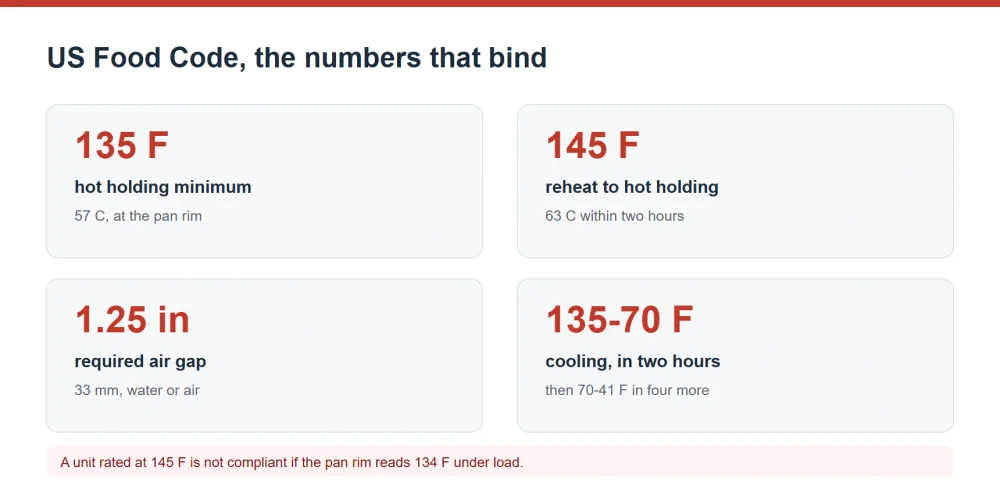
Short answer: The US Food Code provisions that affect commercial buffet equipment are four: hot holding at 57°C or above (135°F), a cooking temperature of 63°C for reheating, a cooling curve from 57°C to 21°C within two hours, and a required air gap between the heat source and the food pan. Equipment that cannot hold 135°F at the pan rim under load is not compliant in practice regardless of its rating. See buffet station equipment.

2026 FDA Compliance Updates for Commercial Food Service Equipment
The FDA's Food Safety Modernization Act (FSMA) and updated Food Code continue to reshape compliance requirements for commercial food service equipment in 2026. Chafing dishes and buffet equipment used in restaurants, hotels, and catering operations must meet updated standards for materials, temperature control, and cleanability. Staying compliant protects your business from inspections failures, fines, and reputational damage.
This guide covers 5 critical FDA compliance updates for 2026, what they mean for food service operators, and how BAVA's certified equipment meets or exceeds evolving federal standards.
1. Updated Food Code Temperature Control Requirements
The 2022 FDA Food Code (adopted by most states in 2026) mandates that hot food holding equipment maintain foods at 135°F (57°C) or above. Chafing dishes must demonstrate consistent temperature maintenance during extended holding periods, with the 2026 update adding requirements for heating recovery time after lid opening.
Electric chafing dishes must now include calibrated temperature displays or sensors readable without opening the lid, reducing temperature abuse during service. BAVA's electric chafing dishes feature LED temperature indicators meeting the new readability requirement, with overheat protection that automatically cuts power above 165°F.

Full Size 11L Electric Chafer
This 11L electric chafer exceeds 2026 FDA temperature control requirements with dual-sensor monitoring—one sensor displays the current temperature on the unit, while a secondary IoT sensor logs readings every 30 seconds for HACCP documentation. The unit recovers to 135°F within 8 minutes of lid closure after service interruption.
2. Food Contact Material Safety Standards
FDA Regulation 21 CFR 177.2600 updated its requirements for stainless steel used in food contact applications. All food contact surfaces must be made from FDA-compliant grades (304 stainless steel minimum for commercial applications), with documentation required for imported equipment under the Foreign Supplier Verification Program (FSVP).
Importers of commercial chafing dishes must now maintain Supplier's Declarations of Conformity (SDoC) and be prepared to provide FDA with batch-level testing documentation during inspections. BAVA provides complete FDA-compliant documentation packages including mill certifications, leaching test reports, and FSVP compliance letters for US importers.

Electric Chafing Dish Food Warmer
This compact warmer uses FDA-compliant 304 stainless steel for all food contact surfaces, with documentation available for import compliance verification. Its enclosed heating element design prevents direct food contact with electrical components, meeting FDA isolation requirements for warmers used in self-service buffets.
3. Cleanability and Sanitization Standards
FDA inspectors increasingly focus on equipment cleanability during health department inspections. The 2026 update to NSF/ANSI 2 standard requires food service equipment to demonstrate cleanability through validated cleaning protocols, not just design review. Chafing dishes with hard-to-reach seams, decorative ridges, or non-removable components face heightened scrutiny.
Commercial chafing dishes must be cleanable using standard three-compartment sink sanitizing procedures without disassembly beyond what is described in the manufacturer's cleaning instructions. BAVA's chafing dishes feature smooth-welded seams, removable water pans, and lift-out food pans that simplify cleaning and meet the updated cleanability standard.
4. Labeling and Allergen Control Requirements
The 2026 FDA Food Code adds labeling requirements for equipment used with common food allergens. Chafing dishes used for allergen-sensitive items (peanuts, shellfish, milk, eggs, fish, wheat, soybeans, tree nuts) must be cleanable to the point where allergen cross-contact is prevented, with cleaning verification documentation recommended.
Equipment used exclusively for allergen-containing foods should be identified with color-coded labels or dedicated stations. BAVA's chafing dishes are compatible with allergen management programs through their easy-clean design and compatibility with color-coded buffet station configurations.
5. Inspection Readiness and Documentation
The 2026 FDA update emphasizes proactive inspection readiness. Food service operators should maintain organized documentation including equipment specification sheets, cleaning logs, temperature monitoring records, and training documentation for all equipment operators.
Digital inspection management systems are increasingly adopted by chain restaurants and hotel groups, enabling real-time compliance monitoring across multiple locations. BAVA's IoT-enabled chafing dishes integrate with major food safety management platforms, automatically logging temperature data and generating inspection-ready reports.
Conclusion
The 2026 FDA compliance updates for commercial food service equipment focus on temperature control accuracy, food contact material documentation, cleanability validation, allergen management, and inspection readiness. Operators using outdated equipment risk inspection failures, operational shutdowns, and liability exposure. BAVA's certified chafing dish lineup meets or exceeds all 2026 FDA requirements, providing compliant equipment that supports clean inspections and protects your business reputation.
Browse the full chafing dish range for current models and configurations.
Food Code Temperature Requirements
| Action | Required | Metric | Appliesto | Verification method |
|---|---|---|---|---|
| Hot holding | 57°C or above | 135°F | Every pan on the line | Probe at the pan rim, hourly |
| Reheating for hot holding | 63°C within 2 hr | 145°F | Cook-chill food loaded hot | Probe, record time |
| Cooking, poultry | 74°C | 165°F | Not typically a buffet item | Probe in the thickest part |
| Cooling, cooked | 57°C to 21°C in 2 hr | 135°F to 70°F | Cook-chill operation | Two probes, timed |
| Cooling, further | 21°C to 5°C in 4 hr | 70°F to 41°F | Cook-chill operation | Two probes, timed |
| Air gap | 33 mm min, water or air | 1.25 in | Under a hot food pan | Measure at installation |
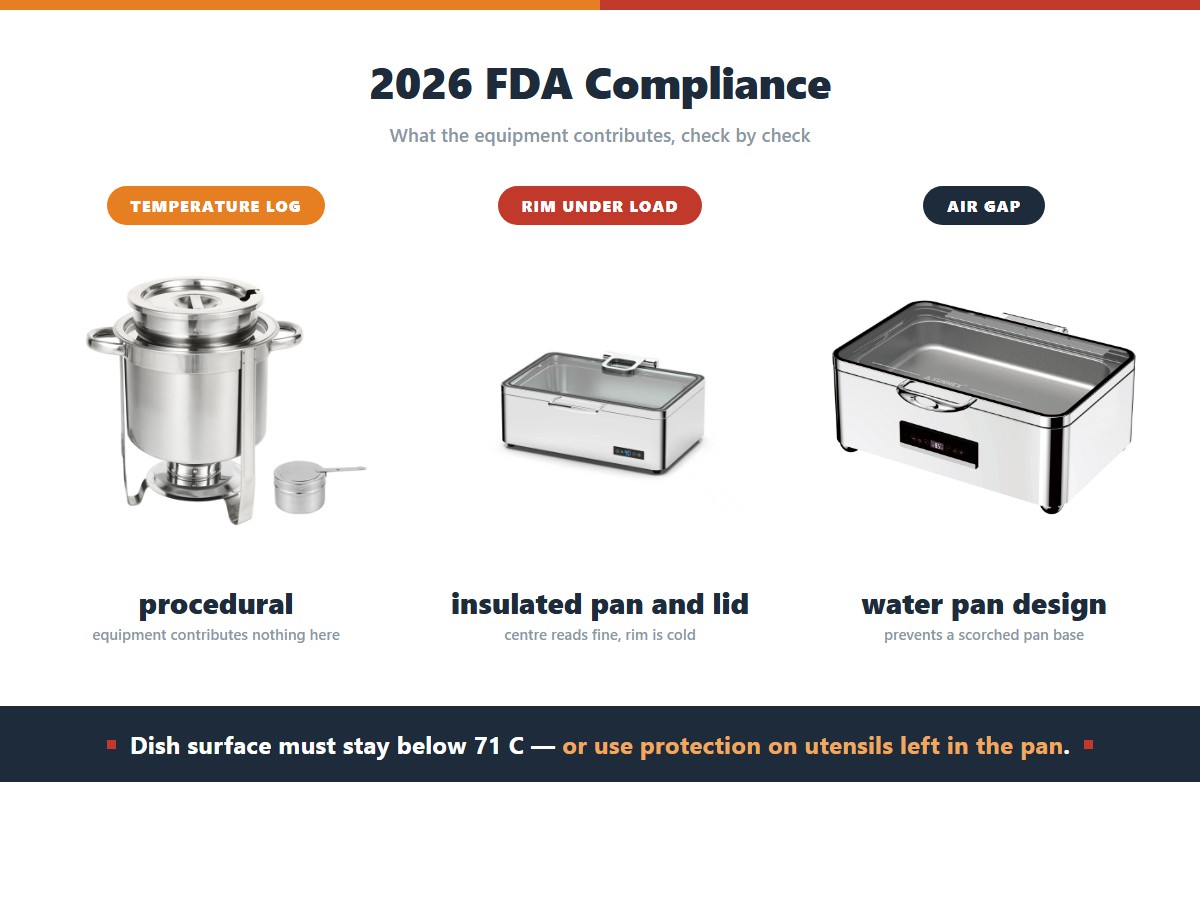
| Dish surface temp | Below 71°C, or use protection | 160°F | Utensils left in the pan | Probe or visual |
| Recontamination | No bare hand contact | — | Serve utensils, covers | Manager observation |
What Inspectors Actually Check First
| Check | Why it matters | Most common failure | Equipment contribution |
|---|---|---|---|
| Temperature log completeness | Evidence of control | Gaps, unsigned entries | None, procedural |
| Rim temperature under load | 57°C at the edge, not the centre | Centre reads fine, rim is cold | Insulated pan and lid |
| Air gap present | Prevents a scorched pan base | Water pan empty or missing | Water pan design |
| Thermostat accuracy | Setpoint must mean something | Off by more than 5°C | Calibrated thermostat |
| Probe availability | Checks must be possible | No probe on the line | None, procedural |
| Dish sanitiser concentration | Related but separate | Untested strips | None |
| Cleaning and sanitising records | Sanitiser logs | Not kept | Removable pan helps |
| Food protected during service | Sneeze guards, lids | Open pans on a guest line | Lids and guards |
Five of those eight checks have an equipment component and three are purely procedural, which is the correct balance for anyone planning a compliance budget. A unit with an accurate thermostat, a proper air gap, an insulated rim and a removable water pan makes five of the eight checks straightforward; none of it matters if the log is not kept.
Frequently Asked Questions
What temperature must buffet food be held at in the US?
57°C or above, which is 135°F. In practice the working target is 70–75°C because the legal minimum leaves no margin, and the pan rim runs 5–12°C below the centre.
What is the air gap requirement for hot food pans?
At least 33 mm, or 1.25 inches, of water or air between the heat source and the food pan. It is what prevents a scorched pan base, and inspectors check it at installation rather than during service.
What reheating temperature applies to buffet food?
63°C, or 145°F, reached within two hours. Cook-chill food loaded onto a buffet line is the common case, and it is the point where a line that is already at 57°C can fail on the first service.
Do I need a probe thermometer for compliance?
Yes, and it has to be on the line rather than in a drawer. Verification is done by probing at the pan rim, and the reading has to be recorded. A $12 probe is the cheapest compliance item in any kitchen.
Does equipment certification make a buffet line compliant?
No. Certification applies to the unit as delivered; compliance applies to the operation, and it is mostly about temperature logs, rim checks and the air gap. Equipment makes the checks easy, but it does not perform them.
Related reading
- 2026 EU LFGB Compliance Updates for Imported Catering Equipment
- How Heavy Is Commercial Buffet Equipment? Shipping Weight Guide
- 2026 Food Safety Rules: What They Mean for Buffets
- How Much Does a Commercial Chafing Dish Cost? 2026 Price Ranges
- Opening a Buffet? The 2026 Equipment Checklist
- FDA Food Code 135°F Hot Holding: What Caterers Must Do