


Marine-Grade Chafing Dish: Why Cruise Ships Spec It
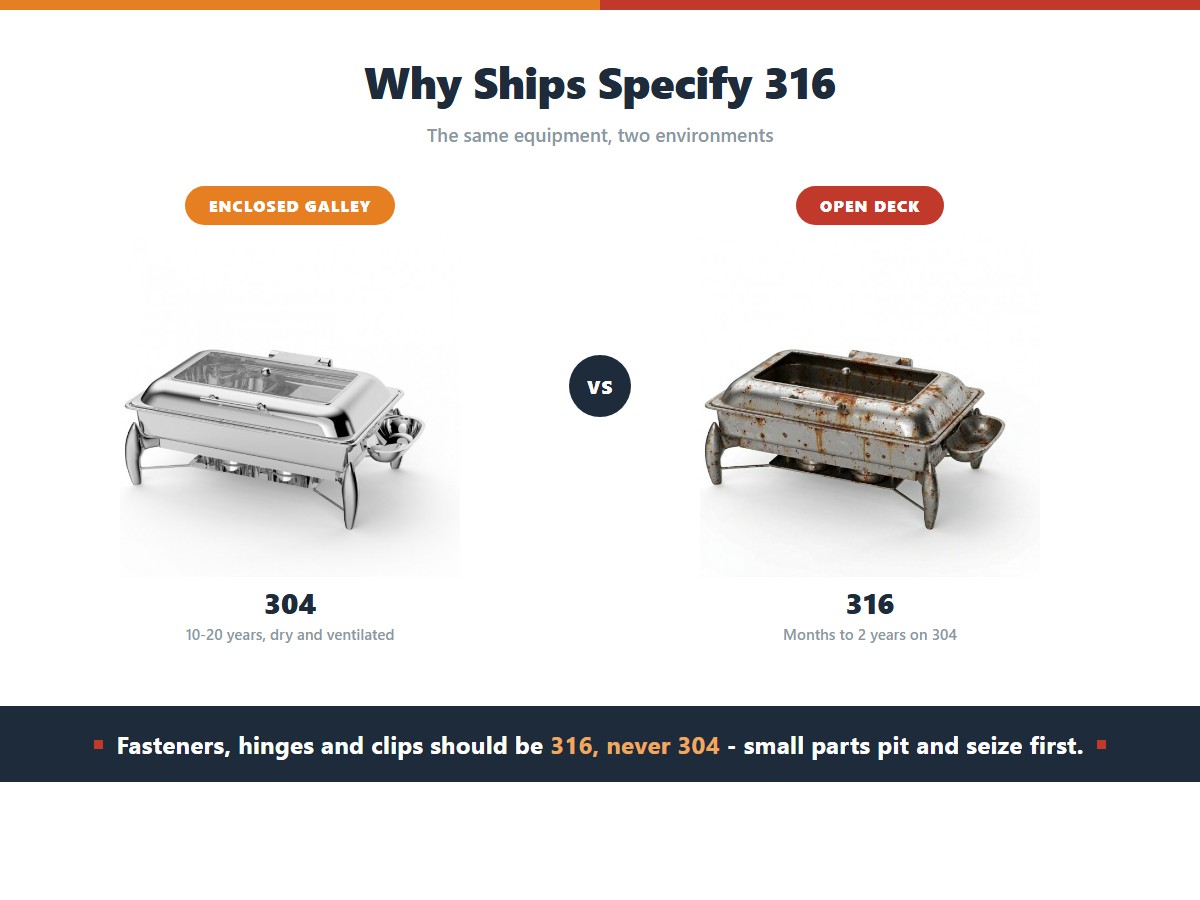
Short answer: for buffet equipment on a ship, specify 316 stainless steel for anything on an open deck or in a splash zone, and 304 for enclosed galley and dining-room service. 316 contains 2% molybdenum, which is what resists chloride pitting, and it costs roughly two to four times 304. The other half of the answer is operational: a weekly rinse with fresh water does more for survival than any alloy, because no stainless steel resists salt indefinitely. See marine-grade chafing dish builds and 304 vs 201 stainless for the general alloy comparison.
Why marine service is different
A land kitchen sees tap water and a dry atmosphere. A ship sees salt in the air, salt in the condensation, salt on every surface that is wiped down with seawater, and a constant cycle of heat and humidity. The environment is the problem, and the material choice only buys you time.
| Condition | Land | Ship | Effect on the equipment |
|---|---|---|---|
| Chloride in the air | Negligible | 1–5% at sea, highest on open decks | Pitting corrosion of 304 within months |
| Cleaning water | Fresh tap | Often seawater or brackish | Chlorides deposited on every surface |
| Humidity | 40–60% | 70–90% in the galley | Constant condensation on cold surfaces |
| Vibration | Minimal | Continuous from engines and sea motion | Loose fittings, fatigued welds, cracked elements |
| Temperature swing | Stable | Hot galley, cold stores, sun deck | Thermal fatigue and scaling |
| Maintenance access | At the dock | At sea, or in port weeks apart | Failures cannot be fixed on a schedule |
Choosing the alloy by location
| Location | Recommended material | Service life | Reason |
|---|---|---|---|
| Enclosed dining room | 304 stainless | 10–20 years | Dry, ventilated, no salt deposition |
| Galley and servery | 304 stainless, sealed seams | 8–15 years | High humidity but protected from spray |
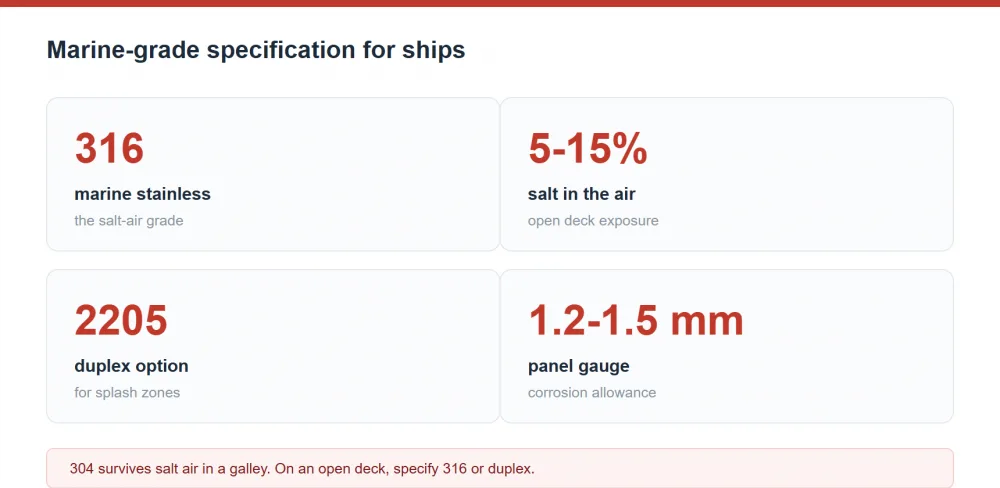
| Pool deck, open deck | 316 stainless | 8–15 years with rinsing | Direct salt and chlorinated splash exposure |
| Splash zone, galley wash | 316 or 2205 duplex | 15–25 years | Constant wetting with chlorinated water |
| Structural brackets, frames | 316 or coated 316 | 10–20 years | Crevice corrosion where salt collects |
| Fasteners, hinges, clips | 316, never 304 | — | Small parts pit and seize first |
Note the last row, which is the one that is most often missed. Fasteners are the failure point. A 304 hinge pin in a 316 frame will pit, seize and then snap, and the replacement part has to be ordered from overseas. Specify 316 for every fastener, every clip, every spring and every screw on a marine installation, and use 316 for the wiring and cable clips as well.
Specification details that matter at sea
- Corrosion allowance in the gauge. Specify 1.2–1.5 mm for panels and a stated corrosion allowance in the purchase specification, not just a thickness. Ships are classed, and the class society will ask for the allowance explicitly.
- Welds and seams. Continuous TIG welds, ground flush and passivated, with no crevices where salt can sit. A folded-and-seamed pan collects salt at the fold and rusts from the inside out.
- Passivation. Every stainless component should be pickled and passivated after fabrication, and the passivation process should be certified. Fabricated 316 that has not been passivated will pit in the first season.
- Isolation. Electric chafing dishes should have a marine-rated IP rating, at least IP55 in the galley and IP65 in splash zones, with a certified cable gland rather than a standard one.
- Vibration isolation. Rubber-mounted elements and lock-washers on every fastener, because the failure mode on a ship is vibration loosening, not corrosion.
- Documentation for class survey. Material certificates, welding procedures and the class approval have to exist before the equipment is accepted, and that process takes weeks, so it goes into the order rather than after it.
The maintenance routine that decides survival
No alloy survives continuous salt exposure indefinitely. The routine below is the difference between equipment that lasts three years and equipment that lasts ten.
- Weekly: rinse every stainless surface with fresh potable water, including the underside of pans and the frame base, then dry. This is the single most effective measure and it takes minutes.
- Weekly: check hinge pins, fasteners and clips for the first sign of corrosion or movement, and replace anything that has started to pit.
- Monthly: clean the water pan and the fuel holder, and check the silicone seals for the hardening and splitting that salt and UV accelerate.
- Quarterly: check the electrical connections, the cord and the plug for corrosion, and verify the earth continuity on any unit that has been exposed to spray.
- At every service: check the water level and the temperature, and record it. The temperature log applies at sea exactly as it does ashore, and a failed element discovered in port rather than in service is worth the entire cost of the equipment.
Power on a ship
Shipboard power is nominally 220 V / 60 Hz, but the reality is that it is generated, and generated power varies. That has two practical consequences for electric buffet equipment.
| Issue | What happens | Specification to require |
|---|---|---|
| Voltage fluctuation | Generators start and stop, so voltage can swing 10% either way | Wide input range, typically 180–240 V |
| Frequency variation | 60 Hz nominal, occasionally 58–62 Hz | Motor and element tolerant of 50–60 Hz |
| Load balancing | Adding 20 x 1,100 W units to one bus overloads it | Distribute across three-phase supply |
| Grounding | Ship grounding is different from land grounding | Marine-rated earth and RCD protection |
| Surge and transients | Switching generators causes transients | Surge protection on the distribution |
Honest limits
Two things are worth being straight about. First, 316 equipment costs two to four times 304, and on a large installation with 40 units that difference is substantial, which is why the right answer is usually 304 in the dining room and 316 only where the exposure demands it. Second, marine specifications add real lead time, because class approval and material certification cannot be compressed. If you are specifying for a new build, the specification has to be settled at the design stage; retrofitting a compliant unit onto a ship after installation is an expensive and sometimes impossible exercise.
Frequently Asked Questions
Is 316 stainless steel worth the extra cost on a ship?
On an open deck or in a splash zone, yes, because 304 will pit there within months and 316 will last years. In an enclosed dining room, no, because 304 performs perfectly and 316 is pure cost. The right approach is to specify by location rather than upgrading the whole vessel, which typically cuts the material premium by half while keeping the exposed parts protected.
Can I use 201 stainless on a ship?
No. 201 has less chromium and essentially no molybdenum, so it has no chloride resistance, and it will show rust staining within a season in any marine environment. This is the one place where the usual argument for 201, which is cost, does not apply, because the cost of replacing the equipment every two years exceeds the material premium on 316 many times over.
What is duplex stainless and when do I need it?
Duplex grades such as 2205 combine roughly equal parts of austenitic and ferritic structure, which gives them both higher strength and better chloride resistance than 316. They are specified in splash zones, on hull structures and in marine atmosphere boxes. For buffet equipment they are overkill unless the units sit in a wash-down area, and 316 is generally the sensible specification.
How do I prevent salt damage to electrical connections?
Use marine-rated IP-rated enclosures, IP65 or better in any area exposed to spray, with certified cable glands and a drip loop on every cable entry. Specify the plugs and sockets as marine-grade with stainless contacts, not plastic. Then check them quarterly, because the failure usually starts as a corroded earth connection, and that is a safety issue rather than a cosmetic one.
Does the food safety requirement change at sea?
It does not. The 135°F hot holding and 41°F cold holding limits apply, and in practice the ship environment is harder: a galley runs hot, service is interrupted by weather, and a broken element may not be replaceable for weeks. That argues for spares on board, including a spare thermostat, a spare element and a spare set of gaskets, and for temperature logging that does not depend on a network connection. See HACCP for Buffet Lines.
How long does marine equipment actually last?
With 316 in exposed areas and a weekly freshwater rinse, 8–15 years is realistic for the body and frame, with consumables replaced far more often. With 304 in exposed areas and no rinse routine, expect to see pitting in 12–24 months and significant corrosion within five years. The rinse routine matters more than the grade, which is the least comfortable conclusion for anyone trying to save money on the order.
Marine-Ready Models From the BAVA Range
These three are the configurations we ship into shipboard and coastal installations. All bodies are 304 stainless as standard, with 316 available on request for open-deck and splash-zone positions. Ask for the material certificate with your order.

Full Size 11L Electric Chafer
BAVA Full Size 11 L Electric Chafer. 1100W with 12-minute rapid heat-up, digital temperature display, polished stainless steel body. The 11 L capacity handles a full breakfast and dinner service from one unit, and the enclosed element compartment has no exposed wiring, which is what class survey asks for. Specify 316 body panels and 316 fasteners for any position exposed to salt spray.

Electric Chafing Dish Food Warmer
400W electric chafing dish with digital temperature control and a visual glass lid. The lower wattage suits a shipboard servery with a limited generator load, and the visual lid lets staff check levels without opening it, which keeps the salt-laden air out of the pan. Confirm the IP rating and the cable gland specification for the position it is installed in.
For a smaller line, the Electric Chafing Dish-W07 is 900W with a 45–89°C adjustable range and an anti-dry-boil alarm, which is the protection a shipboard unit needs when the water level is checked less often than it would be ashore.
Related reading
- Stainless Steel Grades Explained: 201 vs 304 vs 316 for Buffets
- How to Clean and Maintain a Stainless Steel Chafing Dish
- 304 vs 201 Stainless Steel: Which Alloy for Buffet Equipment?
- 201 vs 304 Stainless Steel: Chafer Durability Test
- Chafing Dish Noise Ruining Your Event? Silent Stainless Steel Solution
- Best Stainless Steel Chafing Dishes for Commercial Use