


Insulated Food Warmer: 4-Hour Holding Without Refuel
Short answer: An insulated food warmer is not a chafing dish with a cover, it is a different appliance, and the number that decides it is the hold time without power: a single-wall insulated warmer holds 57°C for 2–3 hours, a double-wall vacuum-insulated unit holds it for 4–6 hours, and a unit with a hot pack holds 6–8 hours. Anything sold for a long-duration event should be specified on hours of hold time at 57°C, not on wattage. See chafing dish heat and holding options.

Long-duration catering covers the events where a chafing dish is the wrong answer: a wedding breakfast that starts at 06:00 and the guests arrive at 09:00, a convention hall where the food must be ready before the doors open, a corporate function where the room sits on the floor for four hours, a hospital meal round that runs on a fixed schedule rather than a service window. In all of these the problem is not heat generation, it is heat retention over a period when nobody is standing at the unit to manage it.
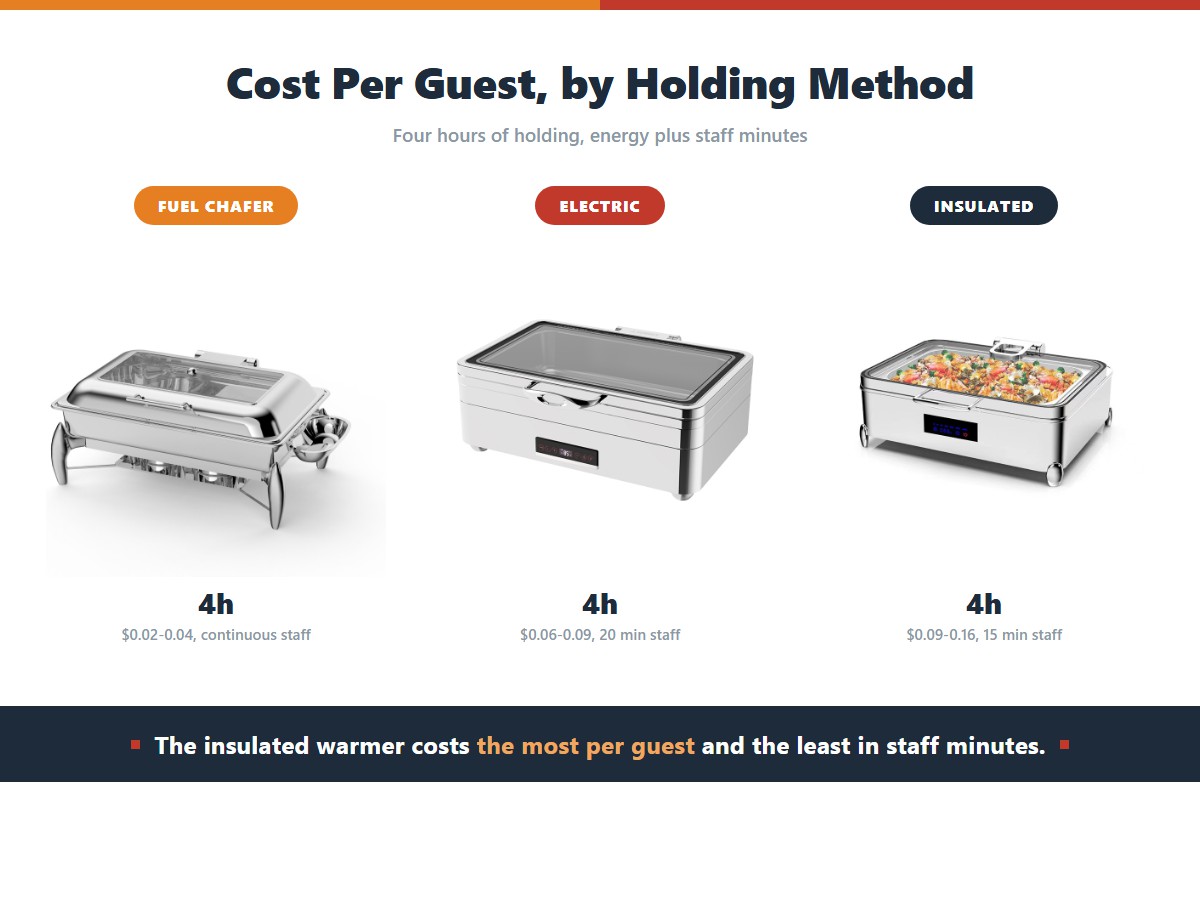
Hold Time at 57°C, by Insulation Type
| Construction | Hold time at 57°C | Pre-heat required | Power needed | Typical price | Where it fits |
|---|---|---|---|---|---|
| Single-wall, foam lined | 2–3 hours | 45–60 min | 1,100 W, 20 min | $90–$160 | Short events, backup duty |
| Double-wall, vacuum insulated | 4–6 hours | 60–90 min | 1,100 W, 25 min | $220–$420 | Half-day and full-day service |
| Double-wall with hot pack | 6–8 hours | 60–90 min | 1,100 W, 25 min | $280–$500 | No power at the venue |
| Double-wall, no power source | 4–6 hours | 60–90 min | None at venue | $240–$430 | Off-grid, pre-plated service |
| Fuel chafing dish, covered | 2.5–3.5 hours | 8–10 min | Fuel cans | $45–$120 | Where staff can tend it |
| Insulated transport box | 4–7 hours | 60 min | None at venue | $70–$160 | Transit, not service |
Long-Duration Event Timeline
| Time | Action | Target | Who does it | Common failure |
|---|---|---|---|---|
| T−3 h | Fill hot pack, preheat insulated body | Body above 80°C | Kitchen | Late start, no preheat |
| T−2 h | Cook and load food at 85°C | Two thirds full, level | Kitchen | Loading at 95°C, which dries the surface |
| T−1 h | Seal and move to venue | Probe reads 72°C or above | Transport | Opening the lid in transit |
| T−30 min | Position, leave closed | Do not open | Setup crew | Opening it to check, losing 5–8% |
| T | Doors open, brief check only | 57°C or above at the rim | Attendant | Full lid removal every 20 minutes |
| T+1 h | Probe the rim, log it | 57°C or above | Attendant | Probing the centre, which is always hotter |
| T+2 h | Probe again, serve from front | 57°C or above | Attendant | Letting a front pan empty and back it up |
| T+3 h | Final check | Above 57°C | Attendant | Running out of food at 3.5 hours |
The most common failure in a long-duration event is not the equipment, it is the lid. A unit that is opened every twenty minutes to check loses 5–8% of its heat each time, and over four hours that is most of the reserve. The single instruction to give the setup crew is that the unit is not opened until the doors open, and the single instruction to give the attendant is to probe the rim rather than lift the lid.
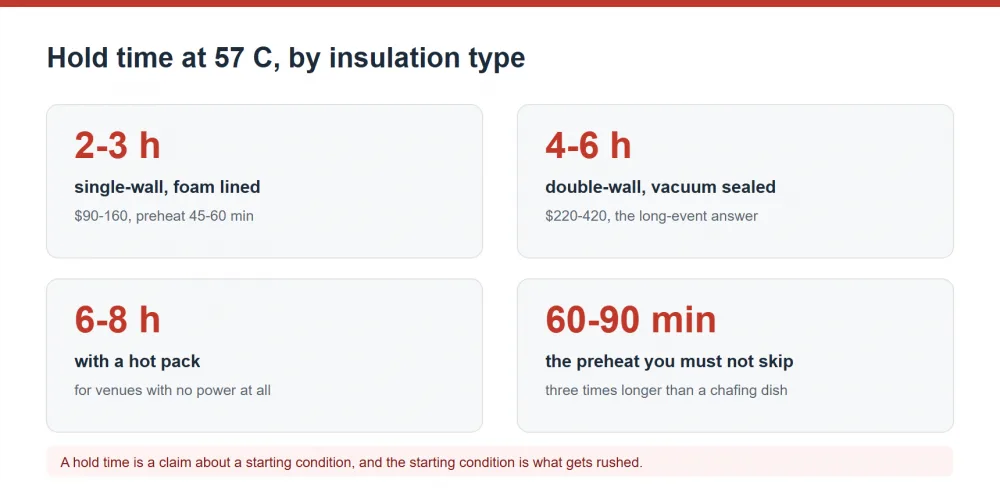
What a Long-Duration Warmer Costs Over an Event
| Cost line | Insulated double-wall | Fuel chafing dish | Electric chafing dish | Who pays |
|---|---|---|---|---|
| Unit purchase | $280–$500 | $45–$120 | $110–$220 | Caterer |
| Pre-heat energy, 90 min | $0.17 | 0 | $0.17 | Caterer |
| Hold energy, 4 h | $0.09 | 0 | $0.64 | Caterer |
| Fuel, 2 cans | 0 | $5–$9 | 0 | Caterer |
| Staff attention, 4 h | 15 min total | Continuous | 20 min total | Caterer |
| Risk of a food safety failure | Low | Medium | Low | — |
| Risk of a service failure | Low, no fuel logistics | Medium, cans run out | Low, needs a circuit | — |
| Cost per guest served | $0.09–$0.16 | $0.02–$0.04 plus staff | $0.06–$0.09 | — |
Read the staff attention row before the fuel row. A fuel chafing dish looks cheaper on paper until you price the person standing next to it for four hours, and in a long event that person cannot do anything else. This is the same crossover that decides electric against fuel in a restaurant, but it lands harder in an event, because in an event the staff are already stretched across a fixed window.
Trade-offs and Common Mistakes
The honest weakness of an insulated warmer is the preheat. It takes 60 to 90 minutes against 12 for a chafing dish, so the kitchen has to start an hour earlier, and a team that is running two events in a day will get this wrong at least once. The second weakness is weight: a double-wall unit loaded with food is awkward to move, which is why the hot pack version exists and why the insulated transport box is a separate purchase rather than an accessory.
There is also a limit worth stating plainly. Vacuum insulation holds heat, it does not create it. If the food is loaded at 70°C instead of 85°C, the unit will hold a marginal temperature for its stated time and the record will show it. A hold time specification is a claim about a starting condition, and the starting condition is the part that gets compromised when the kitchen is in a hurry.

Frequently Asked Questions
How long can an insulated food warmer hold food without power?
Four to six hours for a double-wall vacuum-insulated unit, and six to eight if it is preheated with a hot pack. Single-wall foam-lined units hold for two to three hours, which is usually not enough for an event where the food must be ready before the doors open. Always ask a supplier for the hold time at 57°C, and ask what the starting food temperature was, because a hold time is a claim about a starting condition.
What is the difference between an insulated warmer and a chafing dish?
A chafing dish generates heat and holds food at 70°C or above while someone tends it. An insulated warmer stores heat and holds food at 57–60°C for hours with no power and no attendant. For a four-hour wedding breakfast that starts before the guests arrive, the insulated warmer is the right tool; for a two-hour service with staff present, a chafing dish gives a better result and costs less.
Do I need to preheat an insulated food warmer?
Yes, for 60 to 90 minutes with cold water in the water pan, and the food goes in at 85°C. This is the main weakness of the appliance and the reason it fails in practice: the preheat is three times longer than a chafing dish, so a kitchen running two events in a day gets it wrong at least once. If the preheat is skipped, the unit holds a marginal temperature for its stated time and the temperature record will show it.
How do I keep the food from drying out over a long event?
Load at 85°C rather than 95°C, fill the pan two thirds rather than to the rim, and keep the lid closed. Opening the lid loses 5–8% of the pan heat each time, so a lid opened every twenty minutes will exhaust the reserve before the fourth hour. If the service exceeds three hours, add an insulated cover, which cuts the moisture loss roughly in half.
Is a fuel chafing dish cheaper than an insulated warmer for a long event?
On consumables, yes, by a few dollars. On labour, no. A fuel unit needs a person standing next to it for the whole service, at $25 to $35 an hour, and in a long event that person cannot do anything else. The insulated warmer needs about fifteen minutes of attention in total, and it is the only one of the two that will hold temperature for four hours without a full-time watch.

Electric Chafing Dish Food Warmer
Commercial Hotel Electric Visual Buffet Chafing Dish with 400W fast heating, stainless steel body and digital temperature control. A glass window lets staff check food level without lifting the lid, which is the single behaviour that decides whether a long service holds temperature. The 304 stainless steel body and removable water pan suit a unit that is preheated once and then left alone for four hours.

Stainless Steel Electric Buffet Warmer with Visible Window
Stainless Steel Electric Buffet Warmer with Visible Window, built for commercial catering, weddings and events. The visible window removes the temptation to lift the lid during a long hold, and the 304 stainless steel body holds its shape through repeated preheat cycles in a way that a 0.5 mm body does not. Suited to paired with an insulated cover for services beyond three hours.
Browse the full chafing dish range for current models and configurations.