


Switching From Fuel to Electric Chafers: Worth It at Your Volume?
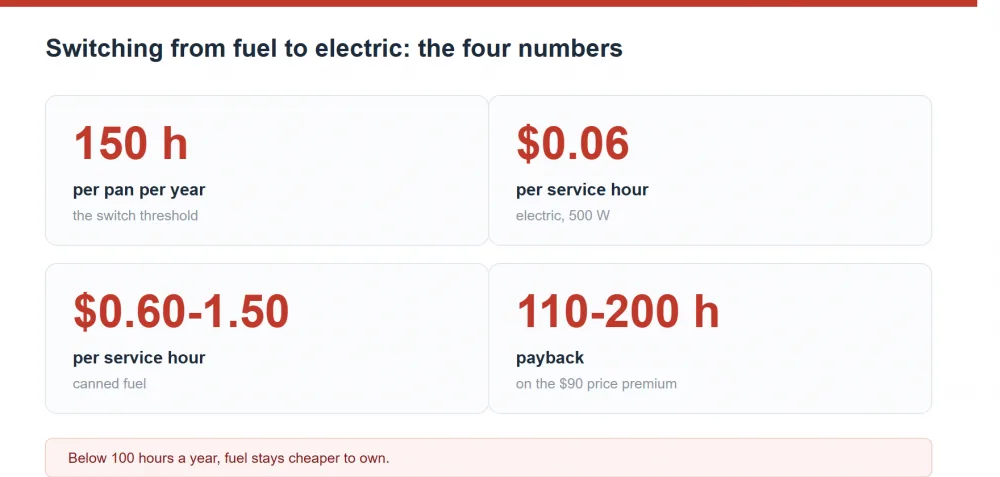
Short answer: switch from fuel to electric when a pan runs more than about 150 service hours a year and there is a socket within 2 m of the station. Payback on the $60-120 price premium arrives at 110-200 hours; below that, fuel is cheaper to own. Electric costs about $0.06 per hour against $0.60-1.50 for canned fuel. Browse electric models in our chafing dish collection.
Three numbers decide it
Forget the sticker price. The decision runs on three inputs, and you can collect all of them in an afternoon:
| Input | How to measure | Threshold |
| Service hours per pan per year | Hours per service x services per week x 50 | Under 150 h: stay on fuel |
| Distance to a socket | Tape measure, along the guest route | Over 3 m: cable becomes a trip hazard |
| Staff minutes per service | Time a refill and a can swap | Over 2 min per pan: electric pays back faster |
The payback arithmetic
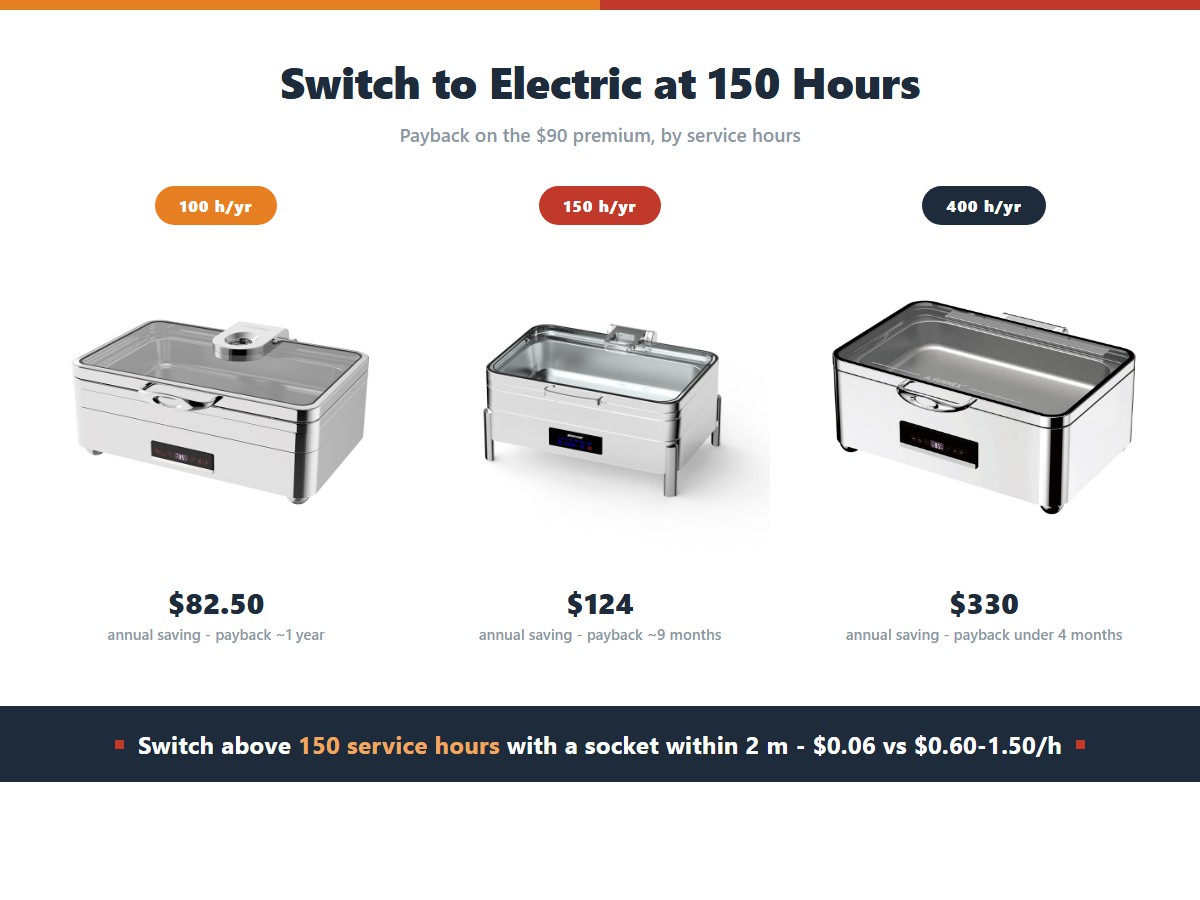
| Service hours per year | Fuel cost | Electric cost | Annual saving | Payback on $90 premium |
| 100 | $90 | $7.50 | $82.50 | Just over one year |
| 150 | $135 | $11 | $124 | About 9 months |
| 400 | $360 | $30 | $330 | Under 4 months |
| 1,000 | $900 | $75 | $825 | 6 weeks |
These figures use $0.90 per service hour for fuel and $0.075 per hour for a 500 W electric unit at $0.15/kWh. Change either price and the crossover moves, but it stays in the 100-200 hour band for most commercial tariffs.
What actually changes on the line
- Preheat: electric takes 12-18 minutes with hot water, fuel 15-25. Start time moves earlier, not later.
- Attention: a thermostat holds temperature; nobody swaps cans mid-service.
- Fire risk: no open flame, no hot can handling, no invisible gel flame in daylight.
- Storage: no pallet of cans, no disposal, no spill clean-up.
- Cables: the new problem. Route them behind the line, never across guest paths.
When you should not switch
Keep fuel if any of these is true: the station moves between rooms, the venue bans nothing but has no spare circuits, service runs outdoors in wind, or the pan is used fewer than 100 hours a year. In those cases the electric premium never earns back and the cable adds a real hazard. See the full cost comparison and outdoor catering setups.
A migration checklist that avoids downtime
- Count sockets and check the breaker size before ordering — two 500 W units on one 16 A circuit is fine.
- Order units with replaceable elements so a failure is a 10-minute fix.
- Keep one fuel frame per station as a blackout backup.
- Retrain staff on thermostat settings: maximum is not the default service setting.
- Label each cable run so cleaners do not unplug the line.
The mistake most operators make
They switch every unit at once, discover that one corner of the room has no socket, and end up running extension leads across a guest route. Do the power audit first: count sockets, note which breaker each one sits on, and check the cable route at floor level. If a station needs more than 3 m of cable, it stays on fuel — a trip hazard in a buffet line is a liability claim waiting to happen, not a saving.
A second common error is assuming the thermostat can replace attention entirely. It cannot. Someone still has to check water level hourly, stir sauces and confirm the food surface is above 57°C. Electric removes the flame, not the supervision.
Frequently Asked Questions
How much does it cost to run an electric chafer for 8 hours?
At 500 W and $0.15/kWh, about $0.60. A fuel chafer running the same 8 hours burns four cans, roughly $4.80-12.00.
Can I run an electric chafer on a generator?
Yes if the generator delivers a clean 500 W per unit plus margin. Check the plate voltage: 120 V units on a 240 V supply need a transformer, not just an adapter.
Do electric chafers heat as evenly as fuel?
More evenly, because the element sits flat under the water pan. Fuel concentrates heat at the centre, which is why edges cool first on a windy day.
What is the lifespan of an electric chafer element?
Typically 2-4 years at daily use. Buy a model with a replaceable element and keep one spare per five units.
Is switching worth it for a 60-seat restaurant?
Only if the line runs daily. At 300 hours a year the saving is about $250 per pan, which pays back the premium in the first year.