




Commercial Electric Chafing Dish: What Restaurants Get Wrong
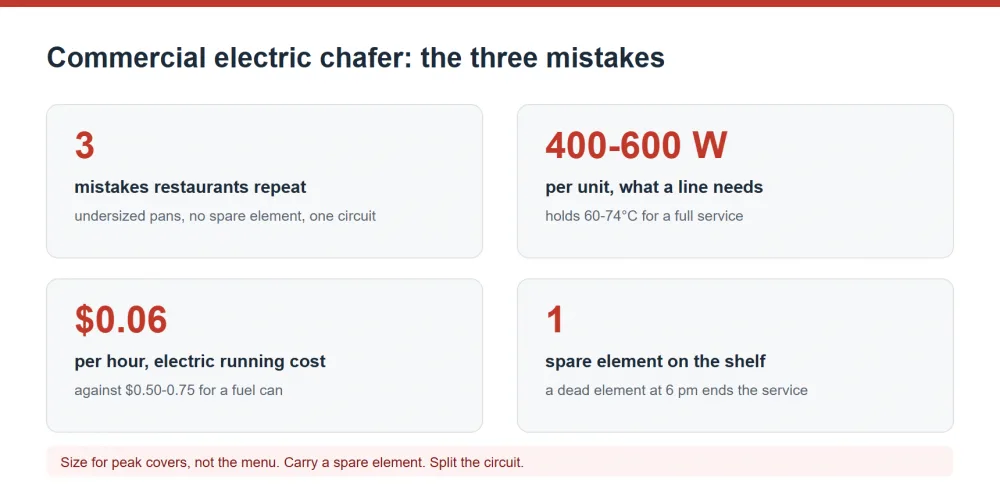
Short answer: restaurants get three things wrong with commercial electric chafers — undersized pans for the cover count, no spare element, and the whole line on one circuit. Fix those and a 400–600 W unit holds 60–74°C for a full service at about $0.06 per hour. See commercial units in our chafing dish range.
Mistake one: sizing by menu, not by peak
Menus are planned on average covers; chafers are loaded at peak. A restaurant serving 200 covers between 19:00 and 20:30 needs pans sized for that ninety minutes, not for the evening total. The rule is one full-size 8 qt pan per 25–30 guests at peak, plus a spare frame per station.
The symptom of undersizing is familiar: a pan that is scraped empty at 19:40, a queue that stalls while staff fetch a refill, and a surface temperature that drops below 57°C while the lid is off.
Mistake two: a sealed element
A sealed element turns a $15 failure into a scrapped unit and a station that is out of service for a week. Commercial units should have a replaceable element wired to a terminal block, and the kitchen should hold one spare per five units. The swap is a ten-minute job with a screwdriver.
Mistake three: one circuit for the line
Six 500 W chafers draw 3 kW, or 25 A at 120 V. Put them on one 15 A circuit and the breaker trips at the start of service, every service. Plan two units per 15–16 A circuit and keep the carving station or induction hob on its own breaker.
What the specification should say
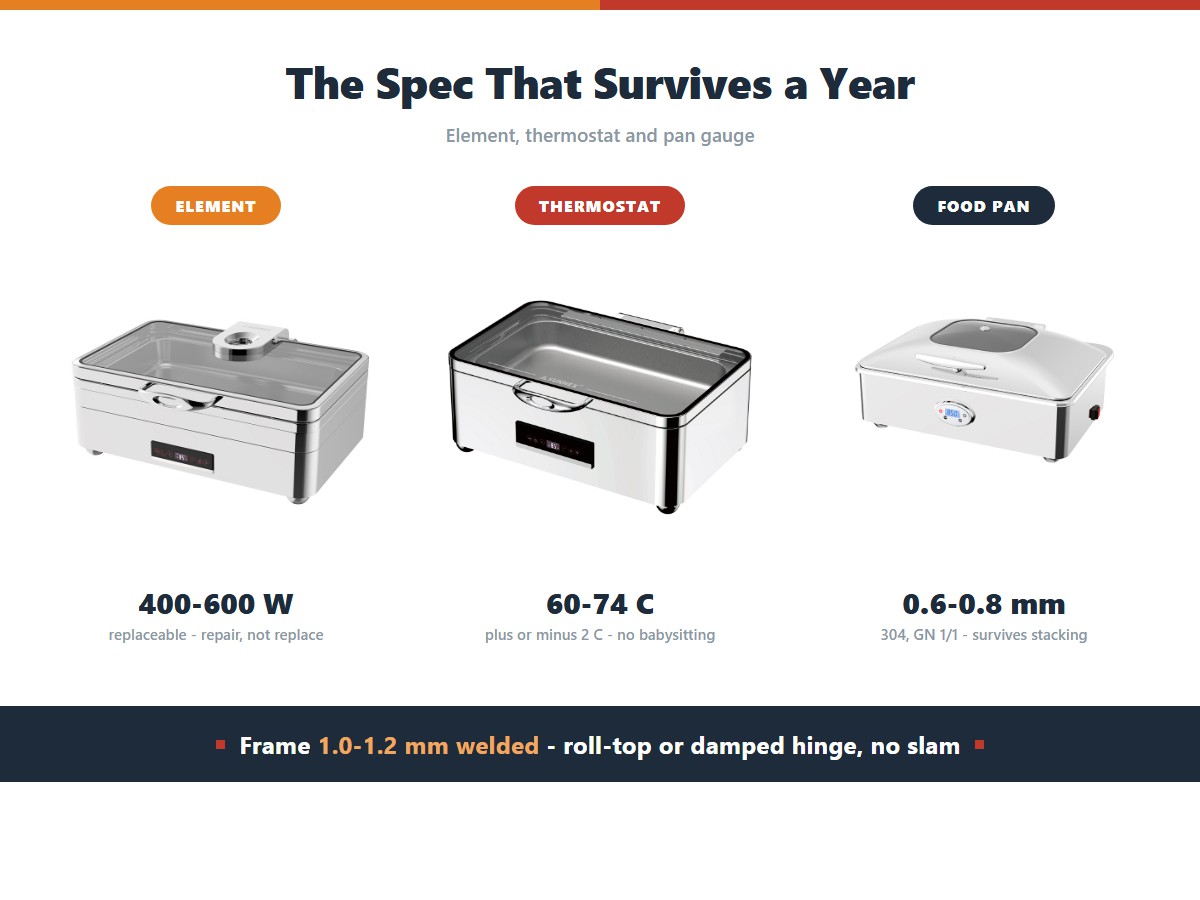
| Spec | Target | Why |
| Element | 400–600 W, replaceable | Repair instead of replace |
| Thermostat | 60–74°C, ±2°C | Holds without babysitting |
| Food pan | 304, 0.6–0.8 mm, GN 1/1 | Survives stacking and washing |
| Frame | 1.0–1.2 mm, welded | No wobble after a year |
| Lid | Roll-top or damped hinge | One-hand service, no slam |
What it costs to run
A 500 W unit on an eight-hour service uses 4 kWh — about $0.60 at $0.15 per kWh. Ten units running daily cost roughly $2,200 a year in electricity; the same ten on fuel cost $12,000–30,000. The energy is not where the money goes; the labour and the consumables are.
The fourth mistake: no temperature log
Most restaurants probe food, but few write it down. An inspector asks for a record, not a recollection, and a log is also the cheapest way to catch a failing thermostat — a unit that used to sit at 65°C and now reads 58°C at the same dial setting is drifting, long before it fails outright.
Keep it simple: one line per service, per station, with the time, the reading and the initials. At the end of the week the numbers show which unit is working hardest and which one needs an element. Restaurants that log consistently report two things — fewer cold-food complaints, and a spare-parts order that is based on evidence rather than guesswork.
What to fix this week
Count the pans against your busiest ninety minutes and add a spare frame if the count is short. Check whether every element can be replaced from the base, and order one spare per five units. Split the line across at least two circuits and label which unit runs on which. Then start the log: time, reading, initials, one line per service. None of these costs more than a few hundred dollars, and together they remove the three failure modes that actually stop a buffet.
Frequently Asked Questions
How many chafers for 200 covers?
Six to eight full-size pans at peak, plus a spare frame per station. If service is spread over three hours, four to five is enough with refills.
Is 400 W enough for a full-size pan?
Yes, with hot water and a lid. 500–600 W preheats faster and holds better in a cool room.
Can two units share a circuit?
Yes on a 15–16 A circuit at 120 V. Three will trip it at preheat.
What breaks first?
The element, then the hinge. Both should be replaceable, and both should have a spare on the shelf.
Does a thermostat save money?
Yes, 20–30% of energy, because the element cycles instead of running flat out. It also stops the food drying, which saves food cost.
Related reading
- Full size electric chafing dish: does temperature control matter?
- Why does my electric chafing dish trip the breaker?
- How many chafing dishes per 50 guests
- How to choose a chafing dish
- Sterno vs Gel vs Electric: Does Electric Save $23,000?
- Electric Chafing Dish Thermostat Not Working: Diagnosis and Fixes