




Commercial Chafing Dishes: Which Tier Fits Your Business in 2026?
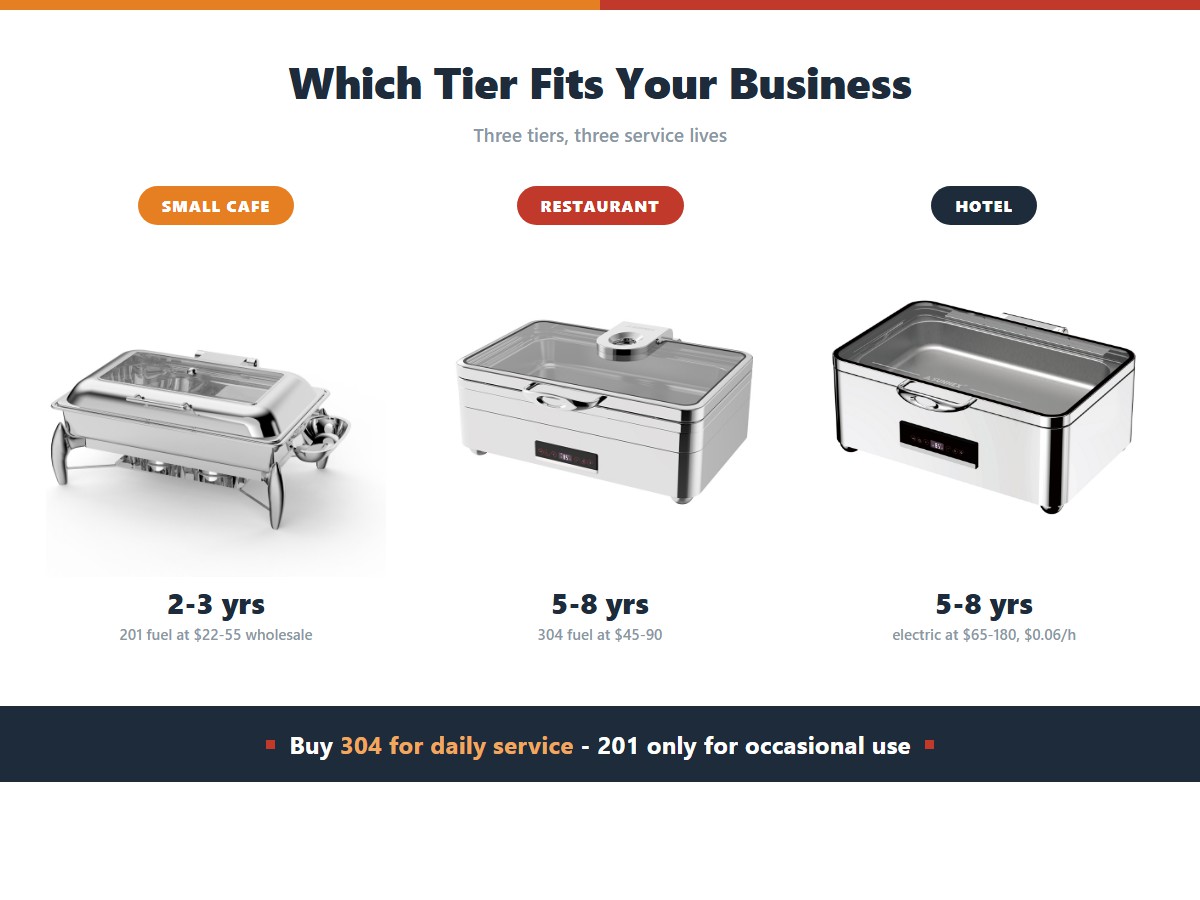
Short answer: three tiers cover most businesses — 201 fuel at $22–55 wholesale (2–3 years), 304 fuel at $45–90 (5–8 years), and electric at $65–180 (5–8 years, about $0.06 per hour to run). Buy 304 for daily service, 201 only for occasional use. See the range at chafing dishes.
Starting a restaurant? Outfitting a catering business? You need commercial chafing dishes. But which tier? Fuel or electric? How much should you spend?
Here's the 2026 buying guide. Three tiers. Three price points. Pick the one that matches your business.
PRO TIP: Buy 304 stainless, not 201.
201 stainless is cheaper but rusts faster. 304 stainless lasts 5+ years. See our stainless grades guide. The $20 saving per dish isn't worth it.
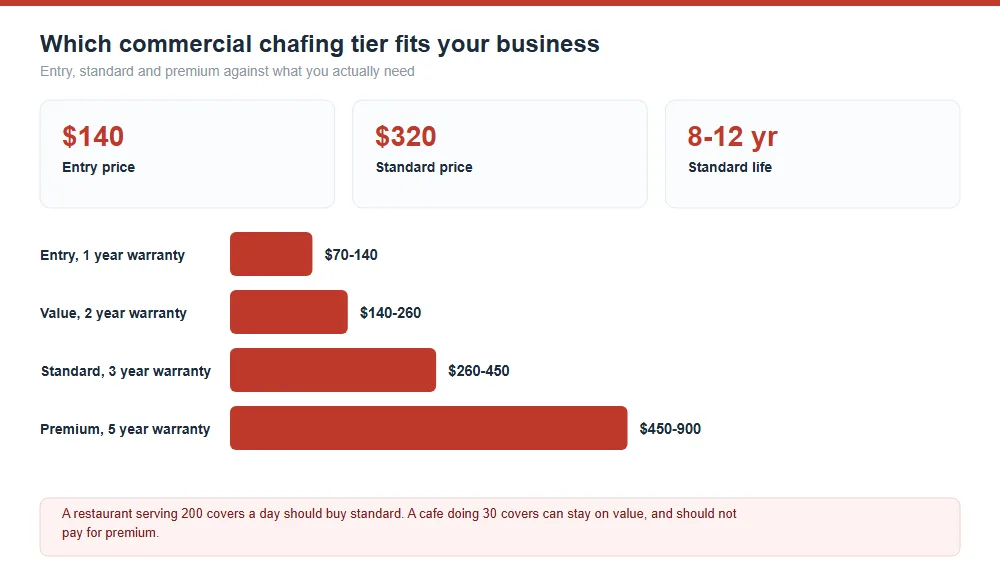
KEY TAKEAWAY: Three tiers: $80-150 entry, $150-300 mid, $300-600 premium.
Cafes = entry. Restaurants = mid. Hotels/caterers = premium. Match the tier to your volume and budget.
The Three Tiers
| Tier | Price | Features |
|---|---|---|
| Entry | $80-150 | Fuel can, solid lid, 201 stainless |
| Mid | $150-300 | Fuel or electric, view window, 304 stainless |
| Premium | $300-600 | Electric, thermostat, dual mode, 3-layer base |
Who Buys What?
| Business Type | Tier | Why |
|---|---|---|
| Small cafe / coffee shop | Entry | Low volume. Budget matters. |
| Full-service restaurant | Mid | Daily use. Need 304 stainless. |
| Hotel / catering company | Premium | High volume. Electric saves on fuel. |
Buying Checklist
- 304 stainless - Not 201. See grades guide.
- View window lid - Guests see food. No heat loss.
- CE / NSF certified - Food safety compliance.
- Adjustable thermostat - If electric. Dial in 140F.
- 3-layer base - Even heat. No hot spots.
See our catering startup checklist for what to buy first.
Commercial Chafing Dish Terms to Know
- commercial chafing dishes for restaurants
- stainless steel grades
- catering startup checklist
- bulk chafing dish supplier
- importing from China
The Bottom Line
Entry tier for small cafes. Mid tier for restaurants. Premium tier for hotels and caterers. Always buy 304 stainless. Always get a view window lid. For high-volume venues, electric pays for itself in fuel savings. Buy in sets, not pieces. Saves 20-30%.
Looking for Commercial Chafing Dishes?
BAVA manufactures commercial chafing dishes in all three tiers. CE/FDA certified, OEM/ODM available, factory-direct pricing.
Who buys which tier
Occasional users — a hall, a club, a home entertainer — buy 201 fuel because it is cheap and sits in a cupboard between events. Restaurants and hotels buy 304 electric because the unit runs daily and the running cost matters more than the purchase price. Caterers buy 304 fuel because the station moves and often has no power.
The mistake is buying 201 for daily service. It tea-stains within a year in a humid room, the thin pan dents in transport, and the replacement cycle eats the saving twice over.
Ask for the gauge before discussing price. Two quotes at the same tier can differ by 0.2 mm on the food pan and 0.4 mm on the frame, which is the difference between a unit that survives stacking and one that dents on the first van trip.
What separates the tiers in practice
The differences are invisible in a photograph. The 201 unit has a thinner food pan, a plastic socket on electric models, and often a riveted frame. The 304 unit has a welded frame, a ceramic socket, and a pan that holds its shape after a hundred washes. Ask for the gauge of the food pan and the frame, the socket material, and whether the element is replaceable — those four answers separate the tiers faster than any price list.
Frequently Asked Questions
Which tier for a restaurant?
304 electric. Daily service means the running cost and the service life both matter.
Which tier for a caterer?
304 fuel, plus two electric frames for venues that ban flame but have power.
Is 201 ever the right choice?
For under about 100 uses a year, yes — it is a reasonable occasional-use tier.
How much does a tier cost per year?
Divide price by life: $22–55 over 2.5 years is $9–22 a year; $45–90 over 6.5 is $7–14.
What about the pan gauge?
Even within a tier, 0.6–0.8 mm food pans outlast 0.4–0.5 mm by years. Ask for the number.
Related reading
- Commercial Chafing Dishes Wholesale: Bulk Buying Guide
- Commercial Grade Chafing Dish Set for Event Rental Companies
- How to Choose Chafing Dish for Catering Business
- Commercial Chafing Dish for Professional Catering Use
- Why Chefs Hate Roll-Top Chafing Dishes (And What They Use Instead)
- Best Chafing Dishes 2026: Which Type Fits Your Buffet?