




Infrared Heat Lamps: Why Fried Food Goes Under Them (Not Chafers)
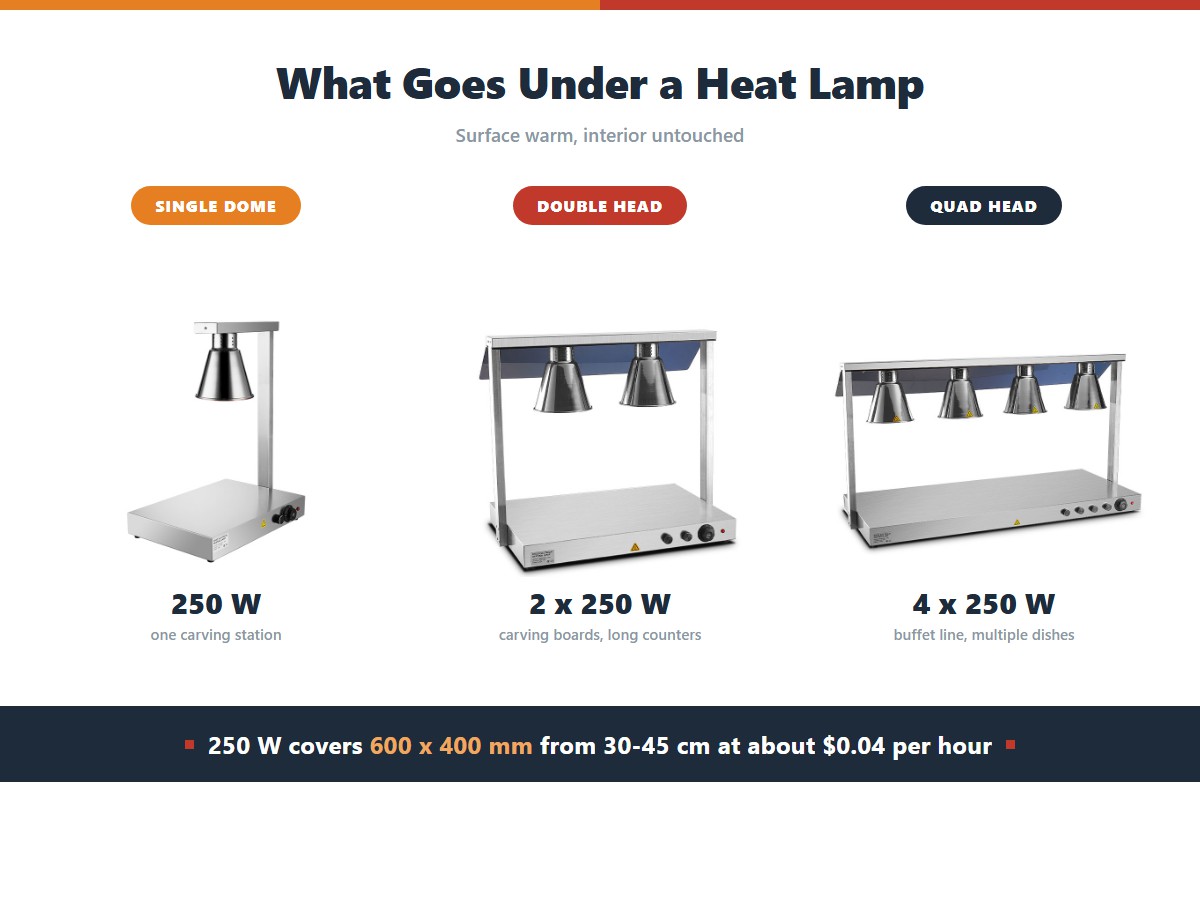
Short answer: infrared heat lamps emit more than 90% of their output as infrared in the 0.7–3 µm band — non-ionizing, so it warms the food surface without cooking the interior. A 250 W lamp covers about 600×400 mm from 30–45 cm and costs roughly $0.04 per hour. Browse units in our heat lamp range.
Fried chicken on the buffet. It needs to stay crispy. A chafing dish would steam it into sogginess. That's what infrared heat lamps are for.
No steam. No moisture. Just radiant heat that keeps the outside crispy and the inside hot.
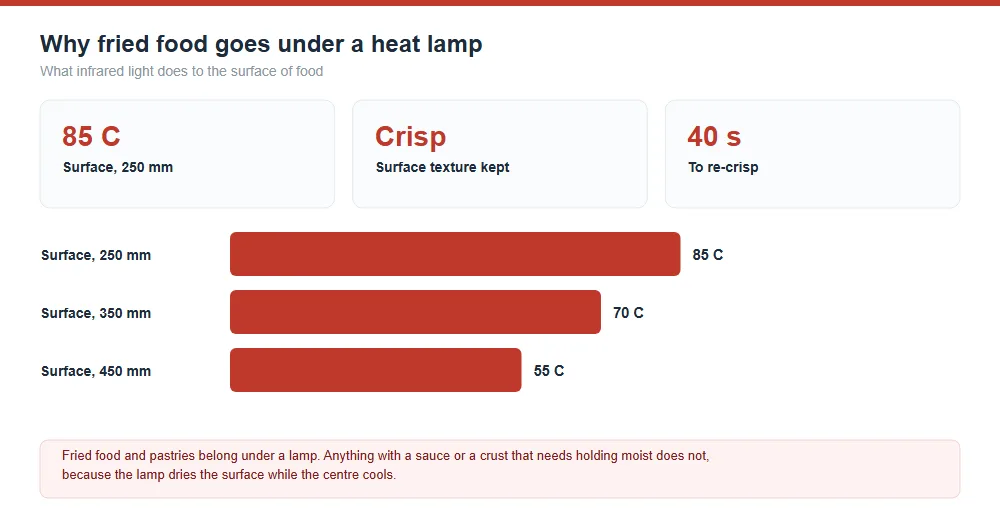
PRO TIP: Mount 30-45cm above the food.
Too close (under 20cm) = burns the food surface. Too far (over 60cm) = no heat reaches it. 30-45cm is the sweet spot. See our fixed vs adjustable guide.
KEY TAKEAWAY: Infrared = radiant heat = crispy food. No steam.
Heat lamps use infrared radiation. The heat hits the food directly. No water, no steam. Crispy stays crispy. That's why fried food goes under a lamp, not in a chafing dish.
How It Works
- Infrared bulb (usually 250W) emits radiant heat.
- Heat waves travel downward and hit the food surface.
- Food stays hot on the outside without steaming.
- No moisture added = crispy texture preserved.
The 3 Types
| Type | Description | Best For |
|---|---|---|
| Bulb lamp (250W) | Single dome, overhead | Single dish carving station |
| Strip warmer | Linear, covers long area | Buffet line, multiple dishes |
| Flexible arm | Adjustable position | Carving stations, made-to-order |
Best Food for Heat Lamps
| Food | Why |
|---|---|
| Fried chicken | Stays crispy. No sogginess. |
| Fries / roasted potatoes | Crunchy outside. |
| Bread / pastries | Keeps crusty. |
| Carved meats | Surface stays warm. |
See our heat lamp buying guide and heat lamp mistakes for more.
Infrared Heat Lamp Terms to Know
- infrared food heat lamp
- choose heat lamp
- heat lamp mistakes
- commercial food warmer lamp
- heat lamp vs chafing dish
The Bottom Line
Infrared heat lamps use radiant heat. No steam. No moisture. Fried food stays crispy. Mount 30-45cm above the food. Use for crispy items. Use chafing dishes for moist food. Together, they cover every buffet station.
Looking for Heat Lamps?
BAVA manufactures commercial infrared heat lamps for buffet lines and carving stations. All products CE/FDA certified, OEM/ODM available.
Why bulb choice changes the effective output
Two 250 W lamps can behave very differently. A clear bulb radiates from a small filament, so the energy concentrates in a tight spot and the edges of the pan run cooler. A frosted or hard-glass bulb spreads the same wattage over a wider area, which suits a 600 × 400 mm pan better than a narrow hot spot.
The colour of the envelope matters too. Red-tinted bulbs flatter cooked meat and hide browning unevenly; clear bulbs show the food as it is, which is what a deli counter wants. Neither changes the wattage, but both change how the food reads to a guest standing two metres away.
Wattage is only half the calculation: a 250 W lamp at 30 cm delivers far more heat to a pan than the same lamp at 45 cm, which is why commissioning should always finish with a surface-temperature reading rather than a tape measure alone.
Frequently Asked Questions
Does infrared cook the food?
No. It heats the surface, and the energy is absorbed in the first 2–5 mm, so the interior stays at holding temperature rather than climbing.
Is infrared radiation dangerous?
Not at these wavelengths. An infrared photon carries 0.9–1.6 eV against the ~10 eV needed to ionize. The real hazards are burns from a 250–400°C bulb and broken glass.
What food suits an infrared lamp?
Fried and breaded items, pastries, carved meat and anything where surface crispness matters. Saucy dishes and rice dry out within 15–30 minutes.
How far should the lamp be from the food?
30–45 cm for a 250 W single head, 45–60 cm for a 275 W bar. Closer is not better: it dries the surface and risks a burn.
Which bulb type should I buy?
A 250 W infrared E27 bulb rated for 5,000 hours or more. Hard-glass versions survive splashes and last longer on high-use counters.
Related reading
- Infrared Food Heat Lamps: Top Picks for Efficient Food Warming
- Infrared vs. Halogen Food Heat Lamps: Which Is Better?
- Food Heat Lamps for Hospitality: Elevate Guest Dining Experience
- Food Heat Lamps for Concession Stands: Ideal for Outdoor Vending
- 6 Heat Lamp Mistakes That Dry Out Your Food
- Do Heat Lamps Improve Restaurant Efficiency? 5 Reasons