




Best Chafing Dish Brands: Are Expensive Ones Actually Worth It?
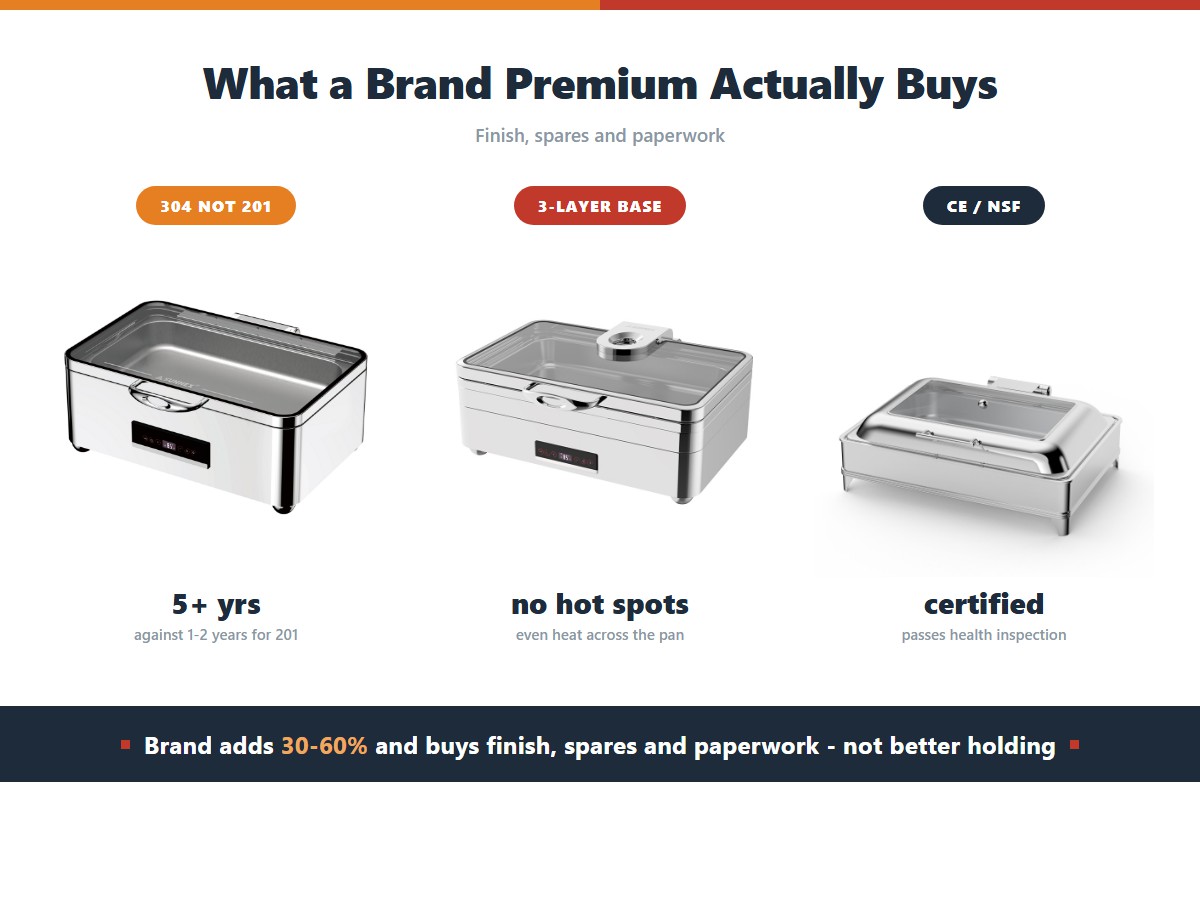
Short answer: brand adds 30–60% to the price and buys finish consistency, spare-part availability and documentation, not better holding. A 304 pan in a welded frame performs the same whatever the badge. Ask for alloy, gauge, socket material and a parts list — if a brand cannot answer, the premium is marketing. See ours at chafing dishes.
You've seen the brands on restaurant supply shelves. Some cost $100. Some cost $800. What's actually different? Is the expensive one worth it?
Here's the truth about chafing dish brands: most are made in the same factories. You're paying 2-3x for the logo.
PRO TIP: Ask the factory who they make for.
Many Chinese factories produce for European and American brands. Same product, different box. You can buy direct for 50-70% less. See our import from China guide.
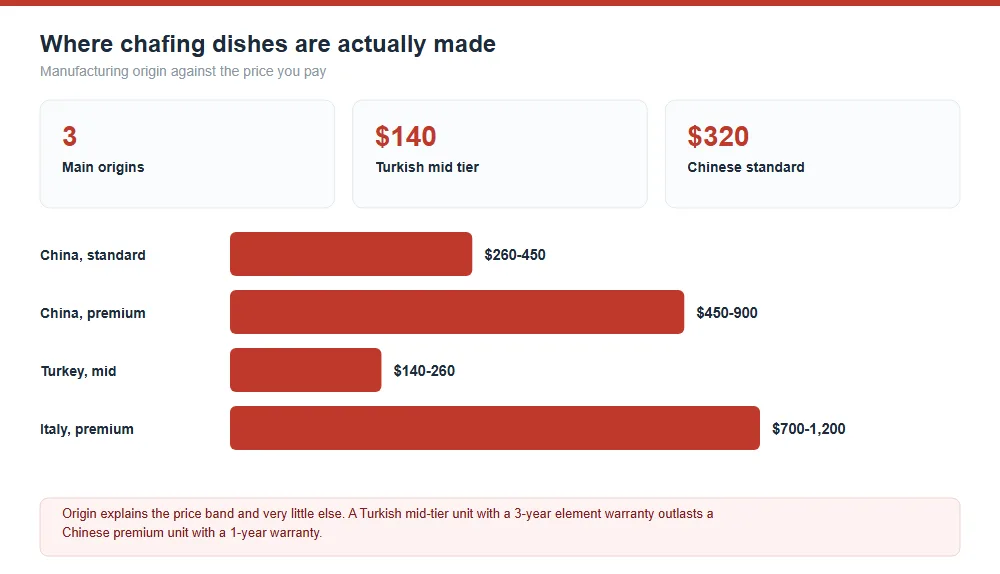
KEY TAKEAWAY: China = $80-300, Turkey = $150-400, Italy = $400-1000+.
Same 304 stainless. Same construction. The price difference is branding and distribution, not quality.
Brands by Origin
| Origin | Price Range | Strengths |
|---|---|---|
| China (BAVA etc) | $80-300 | Best value, wide range, OEM/ODM |
| Turkey | $150-400 | Good build, regional supply (Europe/Mid East) |
| Italy / Europe | $400-1000+ | Premium design, heritage brands, showroom quality |
What Actually Matters
| Feature | Why It Matters |
|---|---|
| 304 stainless (not 201) | Lasts 5+ years vs 1-2 years. See grades guide. |
| View window lid | Guests see food. No heat loss. |
| 3-layer base | Even heat. No hot spots. |
| CE / NSF certified | Food safety. Passes health inspection. |
Buying Direct vs Through Brands
| Option | Price | Best For |
|---|---|---|
| Buy from local supplier | Full retail | Small orders. Need warranty locally. |
| Buy direct from factory | 50-70% less | Bulk orders (10+ units). Restaurants/hotels. |
See our import from China guide and origin comparison for more.
Chafing Dish Brand Terms to Know
- best chafing dish brands
- chafing dish origin comparison
- importing from China
- commercial chafing dish manufacturer
- stainless steel grades
The Bottom Line
Chinese factories make for European brands. Same product. 2-3x price difference. For bulk orders, buy direct. For 1-2 pieces, buy locally. The brand matters less than the specs: 304 stainless, view window, 3-layer base, CE certified. Don't pay for the logo.
Looking for Factory-Direct Pricing?
BAVA manufactures commercial chafing dishes at factory-direct prices. Same quality as European brands, 50-70% less. OEM/ODM available.
What the premium actually buys
Three real things: consistency (every unit arrives with the same finish and the same pan fit), spares (a socket or hinge available two years later), and paperwork (certification, and a mill certificate for the steel). For a hotel buying twenty units, those matter more than the price of one.
What it does not buy is heat. Two 500 W units at the same height hold the same temperature whether the badge is famous or not. If a salesperson talks about heat and the spec sheet does not state the alloy, you are paying for a logo.
How to compare two quotes
Put four numbers side by side: food pan gauge, frame gauge, socket material and the price of a replacement pan. A quote that is 40% cheaper often has 0.45 mm pans and a plastic socket, and its replacement pans cost more than the competition because they are a non-standard size.
Then divide price by expected life. A $220 unit that lasts eight years is $27 a year; a $95 unit that lasts two is $47. The cheaper quote loses on the only number that matters.
Where the money actually goes
Retail markup runs 2.5–3.5 times wholesale, and most of that is distribution rather than build. Buying direct at 50+ units cuts the middle layer; below that, freight and duty eat the difference. The brand on the box rarely changes the steel inside it, and the spec sheet is what tells you which steel you are getting.
Frequently Asked Questions
Are expensive chafers better?
They are more consistent and better supported, but they do not hold temperature better than a spec-matched cheaper unit.
What should I ask before paying a premium?
Alloy and gauge, socket material, element replaceability, spare-parts availability and certification.
Is buying direct from a factory cheaper?
Usually 50–70% below retail at volume, with a 25–30 day lead time. Below 50 units, retail is simpler.
Do cheap units last?
Two to three years in daily service, against five to eight for a 304 build.
What is the best value tier?
304 stainless with a replaceable element, from a supplier that publishes a parts list.
Related reading
- Cheap vs. Expensive Chafing Dishes: Is It Worth the Upgrade?
- Buffet Stoves for Small Restaurants: What Actually Fits
- Electric Chafing Dish Buffet Set: What Caterers Actually Use
- Buffet Stove Energy Tips That Actually Pay
- Best Chafing Dish Brands in 2026: China, Turkey, Italy Compared
- Buffet Stove Brands 2026: Who's Worth the Premium?