




Cereal Dispensers for Hotel Breakfast: What to Specify
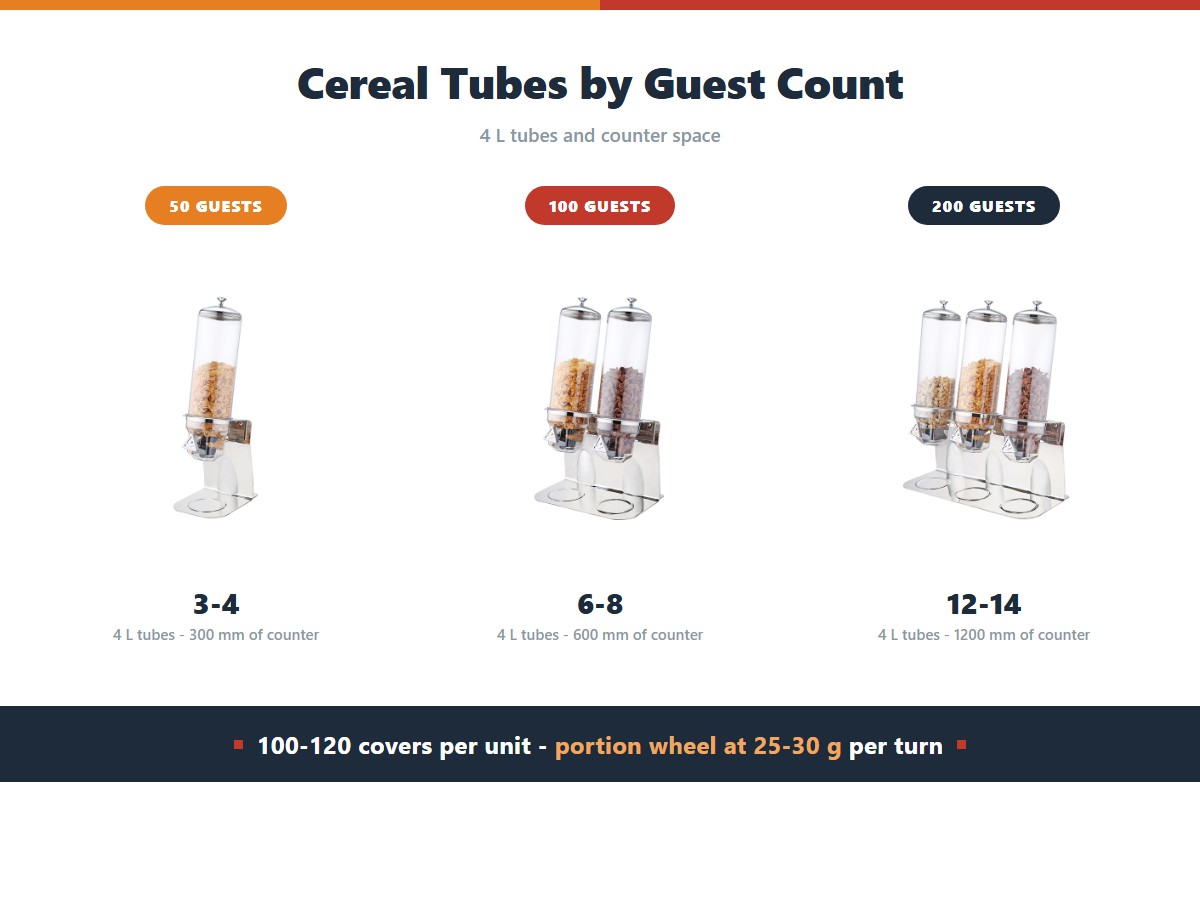
Short answer: for a 100-guest hotel breakfast, specify 6–8 four-litre tubes or three seven-litre units, a portion wheel at 25–30 g per turn, and food-grade acrylic. That covers about 600 mm of counter and delivers 100–120 covers per unit. See models in our cereal dispenser range.
Hotel breakfast buffets face a unique challenge: serving hundreds of guests over a concentrated time window while maintaining food quality and presentation standards. Commercial cereal dispensers solve this challenge elegantly, providing self-service stations that keep cereals fresh, accessible, and visually appealing throughout the entire breakfast service. The right cereal dispenser transforms a potential bottleneck into a smooth, efficient service point that guests appreciate for its hygiene, convenience, and consistent quality.

Why Cereal Dispensers Matter in Hotel Breakfast Service
Traditional cereal service using pre-portioned cups or scoop-and-serve stations creates several operational problems: inconsistent portions, cross-contamination risks from shared serving utensils, and constant refilling interruptions that burden staff during peak service hours. Commercial cereal dispensers address all three issues simultaneously. The sealed, portion-controlled dispensing mechanism ensures each guest receives a consistent amount of cereal while eliminating direct hand contact with the food. This matters enormously in hotel environments where food safety regulations are strict and guest expectations for hygiene are elevated.
Beyond hygiene benefits, cereal dispensers reduce food waste significantly. Traditional service methods often result in guests taking more cereal than they can eat, contributing to substantial waste. Portion-controlled dispensers release a pre-measured amount per activation, matching portions to actual consumption patterns and reducing waste by 20-30% in typical hotel buffet environments. This waste reduction translates directly to cost savings that often offset the initial equipment investment within the first few months of operation.
Key Features to Evaluate in Cereal Dispensers
Capacity and Refilling Frequency
Cereal dispenser capacity directly affects how frequently staff need to refill during service. Larger capacity units reduce refill interruptions but require more storage space and can lead to extended product sitting time that might affect freshness. Smaller capacity units need more frequent refilling but maintain fresher product rotation. For most hotel breakfastbuffets serving 100-300 guests, dispensers in the 3-4 liter range per container provide the best balance between refill frequency and product freshness.
Material and Construction Quality
Commercial cereal dispensers are typically constructed from either polycarbonate plastic or stainless steel, each with distinct advantages. Polycarbonate dispensers are lighter, less expensive, and provide good visibility of product levels through transparent containers. Stainless steel dispensers offer superior durability, a more premium aesthetic, and resistance to scratches and clouding over extended use. For hotel environments where equipment sees continuous daily use, stainless steel construction often provides better long-term value despite the higher initial investment.
Drip Tray Design and Cleanup
Maintenance and cleaning efficiency differentiate quality dispensers from inferior units. Well-designed drip trays capture overflow without requiring constant attention, reducing staff workload during service. Removable drip trays simplify end-of-service cleaning, which matters in high-turnover hotel breakfast environments. Look for trays with adequate depth and drainage capability that can handle overflow from multiple simultaneous activations without overflowing.
Dispensing Mechanism Durability
The dispensing mechanism experiences continuous use in commercial environments and must be engineered for thousands of activations without degradation. Quality mechanisms provide smooth, consistent portion release while resisting the jamming that can occur with certain cereal types. Avoid dispensers with complex mechanisms that require specific alignment or delicate handling — hotel breakfast staff need equipment that performs reliably regardless of how quickly they activate the dispenser.

Installation and Setup Considerations
Proper installation affects both the functionality and longevity of cereal dispensers. Counter-mounted dispensers require adequate counter depth to prevent tipping, with minimum depth requirements varying by model. Freestanding units need stable bases that prevent tipping during normal use. Consider the flow of your breakfast service when positioning dispensers — placing them in logical sequence with related items (milk dispensers, fruit stations) creates intuitive self-service flow that guests navigate without staff direction.
Conclusion
Commercial cereal dispensers represent one of the highest-ROI investments for hotel breakfastbuffets. The combination of improved food safety, reduced waste, enhanced presentation, and decreased staff workload delivers measurable operational benefits from day one. When selecting dispensers, prioritize durability and ease of maintenance over initial cost, and choose capacity matched to your actual guest volume rather than maximum theoretical capacity. The right cereal dispensers support a breakfast service that guests remember positively and return to on future visits.
Browse the full cereal dispenser range for current models and configurations.
Cereal Dispenser Sizing by Guest Count
Hotel breakfast demand is front-loaded: 70% of covers arrive in the first 45 minutes, and a tube that jams at that moment stops the whole line. Size for the peak, not the average.
| Guests | 4 L tubes | 7 L units | Counter space | Covers per unit |
|---|---|---|---|---|
| 50 | 3-4 | 1-2 | 300 mm | 100-120 |
| 100 | 6-8 | 3 | 600 mm | 100-120 |
| 200 | 12-14 | 5-6 | 1200 mm | 100-120 |
| 300 | 18-20 | 8-9 | 1800 mm | 100-120 |
| 500 | 28-32 | 13-15 | 3000 mm | 100-120 |
Frequently Asked Questions
How many tubes for 100 guests?
Six to eight 4 L tubes across two stations, or three 7 L units with one refill round.
What portion size should the wheel give?
25–30 g per turn. That is the range that cuts cereal waste 15–25% against open bowls.
Acrylic or polycarbonate?
Food-grade acrylic for clarity and display; polycarbonate if the unit gets knocked. Both are dishwasher-safe at low temperature.
How much cereal per guest?
Plan 40–60 g of dry cereal per guest, more for muesli and granola by weight.
Where should the unit sit?
At the entrance side of the line, so guests browse before they queue for hot food.
Related reading
- Triple Cereal Dispensers & Dry Food Stations for Hotel Buffets
- Cereal Dispenser Capacity Guide: 1L vs 4L vs 7L for Hotel Buffets
- Wall-Mounted vs Countertop Cereal Dispensers: Which Fits Your Room
- How to Choose a Cereal & Dry Food Dispenser
- Hotel Breakfast Buffet on a $5,000 Budget: Exact List
- Return on Investment of a Hotel Breakfast Buffet