




Wall-Mounted vs Countertop Cereal Dispensers: Which Fits Your Room
Short answer: A wall-mounted cereal dispenser saves 400–500 mm of counter length and a countertop one costs about $120–$260 less to install, and the deciding factor is the refill route: a wall-mounted unit is refilled by ladder or by taking it down, so it works only if the hopper is refilled from the same side the food comes out of, or if you accept a daily top-up. See cereal dispensers for the range.
Installing cereal dispensers in your buffet? Should you mount them on the wall, or put them on the counter?
Wall-mounted saves counter space. Countertop is easy to install. Which fits your room?
Here's the comparison.
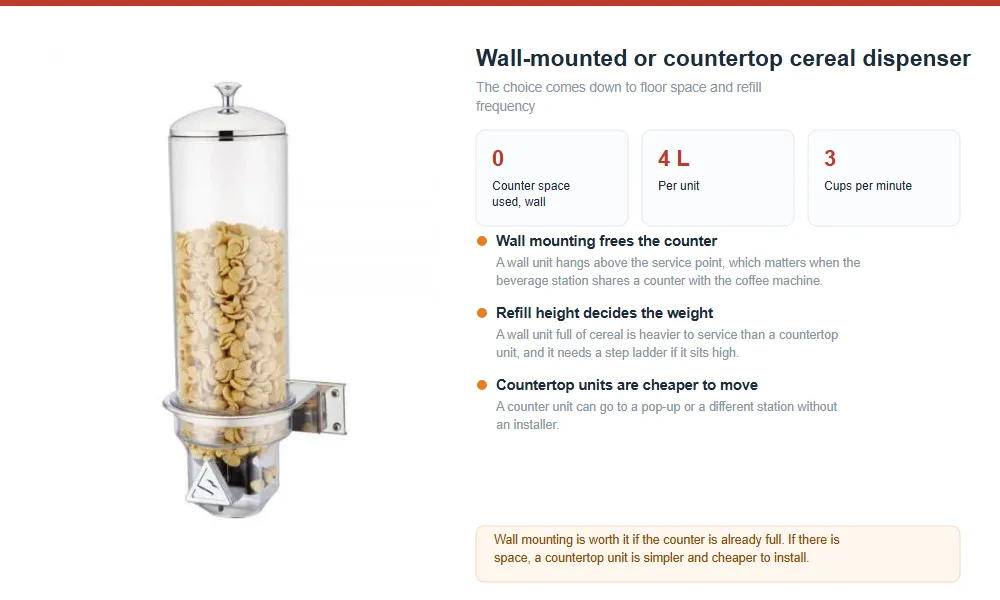
PRO TIP: Wall-mounted saves 0.5m of counter space.
A 3-head cereal dispenser takes up about 0.5m of counter space. Wall-mounted frees that up. Use it for plates, cups, or other stations.
KEY TAKEAWAY: Small counter space? Wall-mount. Plenty of space? Countertop.
Wall-mounted = saves space, professional look, but needs drilling. Countertop = easy install, moveable, but takes up counter space. Choose based on how much counter space you have.
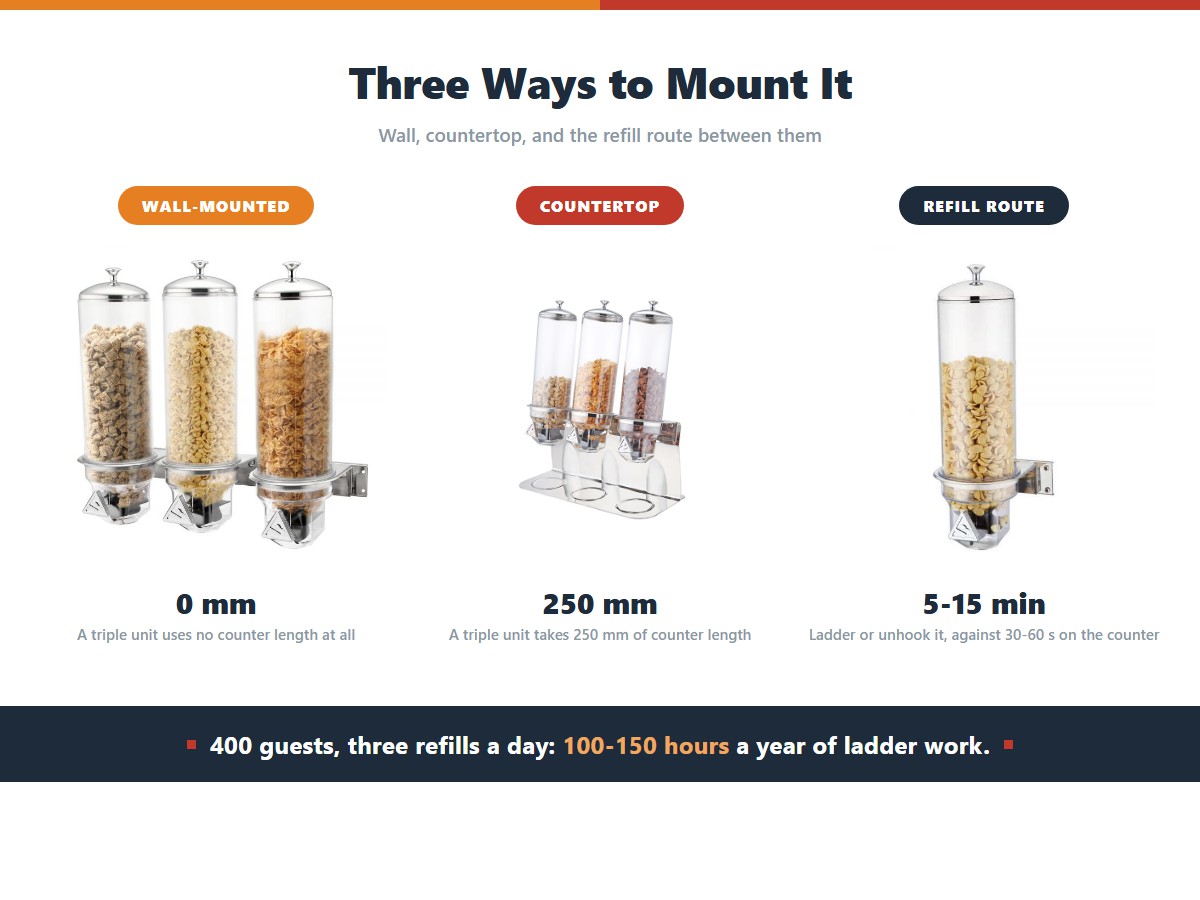
Quick Answer: The Comparison
| Factor | Wall-Mounted | Countertop |
|---|---|---|
| Counter Space | Saves 0.5m | Takes up 0.5m |
| Installation | Needs drilling | Just set it on the counter |
| Flexibility | Fixed position | Moveable anywhere |
| Visual Look | Professional, integrated | Good, but freestanding |
| Best For | Small counter space | Plenty of counter space |
Wall-Mounted Cereal Dispensers
Wall-mounted dispensers bolt to the wall. No counter space needed.
Pros:
- Saves counter space — frees up 0.5m
- Professional, integrated look
- Better visibility — at eye level
- Cleaner — no countertop clutter
Cons:
- Needs drilling — permanent installation
- Can't move or reconfigure
- Harder to refill (need a step ladder)
- Wall must be sturdy
Best for: Small buffets. Permanent installations. Hotels with limited counter space.
See our wall-mounted dispenser collection.
Countertop Cereal Dispensers
Countertop dispensers sit on the counter. No installation needed.
Pros:
- Easy install — just set it on the counter
- Moveable — reconfigure anytime
- No drilling needed
- Easier to refill — at counter level
Cons:
- Takes up counter space
- Less integrated look
- Can be knocked over
Best for: Catering events. Venues with plenty of counter space. Multi-use rooms that reconfigure.
See our countertop dispenser collection.
How to Choose
| Your Situation | Choose |
|---|---|
| Small counter space, permanent buffet | Wall-mounted |
| Plenty of counter space | Countertop |
| Catering, moveable | Countertop |
| Hotel breakfast, professional look | Wall-mounted |
See our buffet layout mistakes for space planning tips.
Dispenser Installation Terms to Know
- wall-mounted vs countertop cereal dispenser
- buffet layout mistakes
- portable vs built-in buffet stations
- commercial cereal dispenser
- buffet equipment checklist
The Bottom Line
Wall-mounted dispensers save counter space and look professional — but need drilling and are fixed. Countertop dispensers are easy to install and moveable — but take up counter space. Small buffet? Go wall-mounted. Plenty of space? Go countertop. Choose based on how much room you have.
Looking for Cereal Dispensers?
BAVA manufactures commercial cereal dispensers in both wall-mounted and countertop styles. All products CE/FDA certified, OEM/ODM available.
Browse the full cereal dispenser range for current models and configurations.
Wall-Mounted Against Countertop
| Factor | Wall-mounted | Countertop | Difference | Verdict |
|---|---|---|---|---|
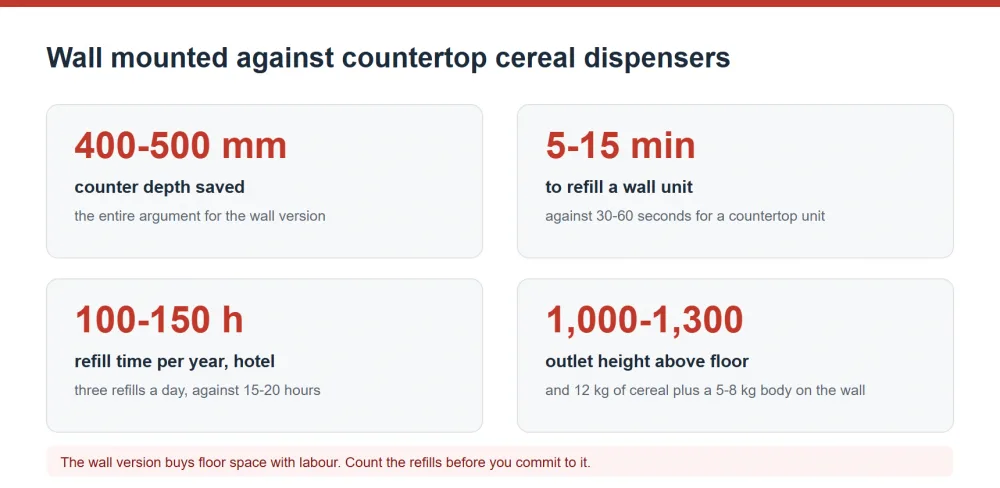
| Counter length used | 0 mm | 180–250 mm per unit | 400–500 mm for a triple | Wall wins on space |
| Installation cost | $180–$460 with the bracket | $0, it stands | $180–$460 | Countertop wins |
| Refill method | Ladder, or unhook and bring down | Lift the lid off | Major | Countertop wins decisively |
| Refill time | 5–15 min with a ladder | 30–60 sec | 10–20× | Countertop wins |
| Working height for guests | 1,000–1,300 mm, comfortable | 900–1,100 mm, comfortable | Both fine | Even |
| Accessibility | Good for wheelchair users | Good, if 900 mm | — | Even |
| Child safety | Out of reach, good | At hand, a spill risk | — | Wall wins |
| Capacity, triple unit | 3 × 4 L, 12 L | 3 × 4 L, 12 L | Same | Even |
| Height above the floor | Fixed at install | Adjustable by moving it | — | Countertop wins |
| Cleaning the glass | Needs the ladder | On the counter | Minor | Countertop wins |
Refill Route: The Deciding Factor
| Situation | Refill frequency | Time per refill | Annual labour, 300 days | Recommended |
|---|---|---|---|---|
| Hotel breakfast, 400 guests | 2–3 times a day | 1 min | 15–20 hours | Countertop |
| Hotel breakfast, 400 guests, wall | 2–3 times a day | 10 min with a ladder | 100–150 hours | Only with a step stool on site |
| Office pantry, 40 staff | Weekly | 1 min | Under 1 hour | Either |
| Supermarket, 1,200 guests a day | 4–6 times a day | 1 min | 30–40 hours | Countertop, staffed |
| School canteen, 300 pupils | 3 times a day | 1 min | 15 hours | Countertop |
| Self-service, no staff present | Daily | 5–10 min | 30–60 hours | Wall, if a step is available |
The labour column is the whole answer. A wall-mounted unit in a hotel that is refilled three times a day at ten minutes a time is 100 to 150 hours a year of somebody on a ladder, and the alternative is a unit on the counter that takes a minute. The wall mount saves 400 to 500 mm of counter and costs 100 to 150 hours of labour a year, which at $22 to $35 an hour is $2,200 to $5,250. Wall mounting is worth it when the refill route is short or the labour is already there, and it is a mistake in a hotel breakfast with a three-times-a-day refill.
Counter Space, Recovered and Spent
| Room | Counter available | Units needed | Countertop length used | Length left | Wall mount viable? |
|---|---|---|---|---|---|
| Hotel breakfast, 1.2 m sideboard | 1,200 mm | 1 triple | 250 mm | 950 mm | Yes, comfortably |
| Cafe counter, 900 mm | 900 mm | 1 triple | 250 mm | 650 mm | Possible but tight |
| Supermarket juice island | 1,600 mm | 2 triples | 500 mm | 1,100 mm | Yes |
| Office pantry, 600 mm | 600 mm | 1 triple | 250 mm | 350 mm | Preferred |
| Small deli, 400 mm | 400 mm | 1 triple | 250 mm | 150 mm | Preferred |
Note the last row. A 400 mm deli counter with a triple dispenser leaves 150 mm, which is not enough to put anything else on, and a customer standing there blocks the working area behind it. That is the case where wall mounting is not a preference but a necessity, and the same is true of the 600 mm office pantry where the alternative is putting the cereal somewhere that is not a cereal station.
Frequently Asked Questions
Should a hotel install wall-mounted cereal dispensers?
Only if the refill route is short. A hotel breakfast refilled three times a day costs 10 to 15 minutes per refill with a ladder, which is 100 to 150 hours a year against 15 to 20 hours for a countertop unit. In a large hotel the labour cost of the wall mount exceeds the value of the counter space it frees, so a countertop unit on a shorter run is usually the better decision.
How much counter space does a wall-mounted dispenser save?
400 to 500 mm of counter length for a triple-head unit, which is 180 to 250 mm per unit on the counter. That is the difference between a 400 mm deli counter being usable and not, and it is the decisive case for wall mounting in a small space.
How high should a wall-mounted cereal dispenser be installed?
The discharge chute at 1,000 to 1,300 mm from the floor, which puts it in the comfortable reach band for an adult and for a wheelchair user, and it keeps the top of the unit above head height for anyone walking past. Below 900 mm it becomes awkward for a standing adult and a problem for a child who cannot reach it at all, which defeats the point of a self-service station.
Is a wall-mounted dispenser more expensive to install?
Yes, by $180 to $460 including the bracket and the fixing, and you also need a wall that will take the load. A full hopper adds 12 kg and the unit itself 5 to 8 kg, so a solid brick or block wall is fine and a plasterboard partition is not without a stud or a batten behind it.
What is the right material for the dispenser tube?
Acrylic for dry cereal, because it is lighter, cheaper and lets the customer see the product, and stainless steel where the tube is washed hard or where the product is sticky. Acrylic scratches rather than clouds if it is cleaned properly, and the difference is entirely in the cleaning method: soft cloth, warm water, no abrasives, no solvents. See our guide on why acrylic dispensers turn cloudy.
Related reading
- Cereal Dispensers for Hotel Breakfast: What to Specify
- Triple Cereal Dispensers & Dry Food Stations for Hotel Buffets
- How to Choose a Cereal & Dry Food Dispenser
- Cereal Dispenser Capacity Guide: 1L vs 4L vs 7L for Hotel Buffets
- Acrylic Dispensers Look Cheap — How to Make Them Look Premium
- Wall-Mounted Buffet Stove: Saving 35 cm of Depth