


Chafing Dish Rental for Weddings: Packages & Pricing
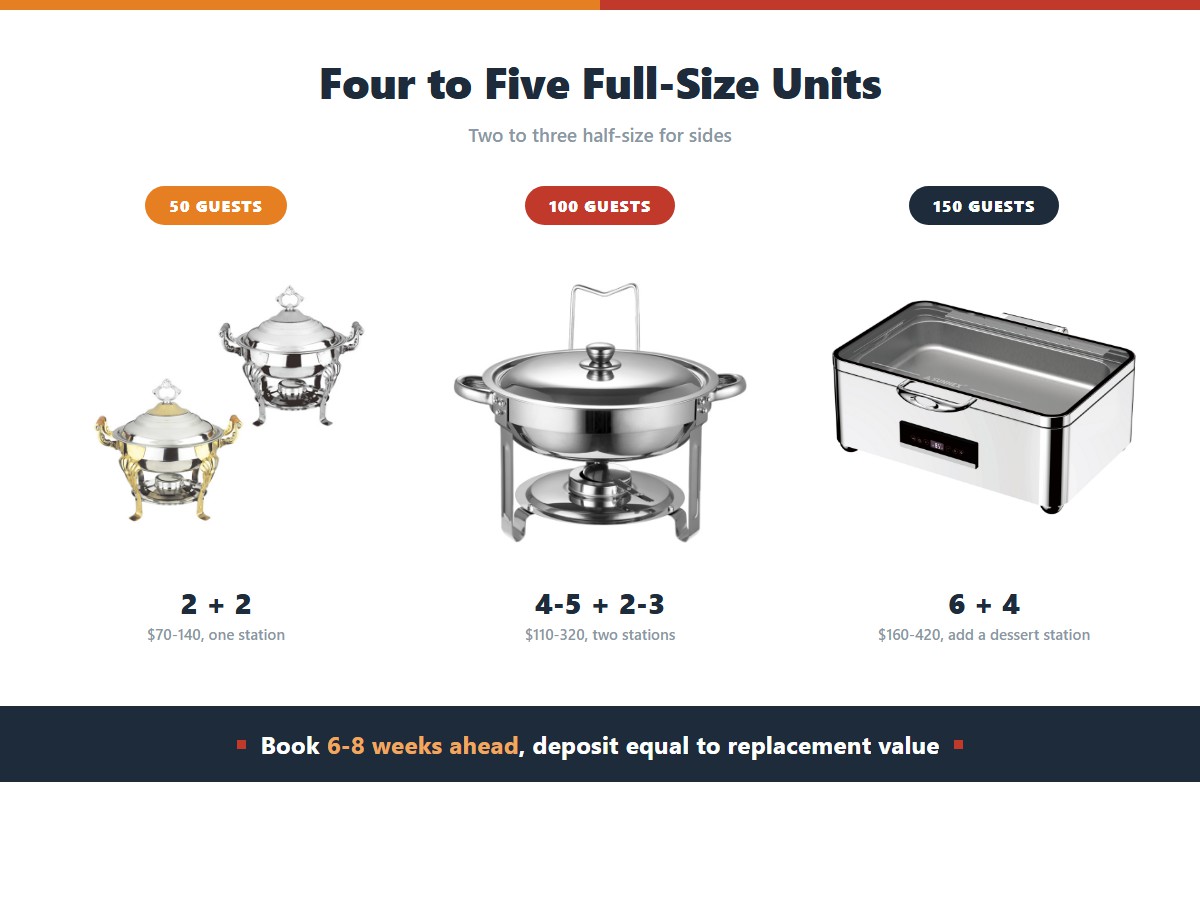
Short answer: Budget four to five full-size chafing dishes and two to three half-size units for 100 wedding guests, at $20–50 per full-size unit for the day. Book 6–8 weeks ahead, confirm the collection time fits your venue's load-out, and expect a deposit equal to replacement value. See chafing dishes to compare buying.
Wedding catering presents unique challenges that standard event planning approaches cannot fully address, with expectations for presentation quality, service reliability, and attention to detail running higher than most other event types. Chafing dish rental for weddings requires supplier relationships that understand these elevated expectations and provide service quality matching the significance that wedding celebrations carry. Understanding how wedding-specific rental packages address these requirements helps couples and their planners access equipment that supports the experience their guests deserve.
Understanding Wedding Catering Equipment Needs
Wedding food service typically spans multiple service components that each carry their own equipment requirements, from appetizer reception through main course service to dessert presentation. The duration and complexity of wedding catering differs significantly from brief business events, with service periods extending across multiple hours that test equipment capacity and reliability. Planning for these extended service windows affects both equipment quantity and quality selection.
Guest count variability at weddings creates equipment planning challenges that require flexibility in quantity and configuration. RSVP fluctuations that affect guest counts may require equipment adjustments even during final planning stages, with suppliers who accommodate these changes providing valuable flexibility that rigid rental arrangements cannot match. The ability to adjust equipment quantities without penalty supports the planning uncertainty that wedding events inevitably involve.
Presentation standards at weddings exceed those of most other event types, with aesthetic considerations affecting equipment selection beyond functional requirements alone. Equipment that performs adequately may create visual discord with wedding styling that affects the cohesive atmosphere couples work to create. Understanding how equipment appearance integrates with wedding design helps ensure that catering equipment supports rather than undermines the visual impact that celebrations require.

Wedding Rental Package Structures
Basic wedding rental packages typically include equipment quantities scaled to common wedding sizes, with per-unit pricing that reflects the premium service and reliability that wedding suppliers guarantee. These packages provide predictable costs that simplify wedding budgeting, with included services that address standard wedding catering requirements without requiring extensive customization. The package approach works well for weddings with straightforward catering arrangements.
Premium wedding packages extend beyond basic equipment provision to include styling consultation, on-site setup supervision, and dedicated service staff during the event. These comprehensive arrangements address the elevated service expectations that weddings create, with supplier personnel present throughout catering operations to ensure quality maintenance and rapid problem resolution. The premium pricing reflects both the additional equipment and the service commitment that these arrangements require.
Custom wedding configurations accommodate unique venue constraints, unusual guest counts, or specialized menu requirements that standard packages cannot address. Working with suppliers to develop custom configurations requires earlier engagement to allow adequate planning time, with the flexibility to accommodate requirements that package structures would not support. Custom arrangements work best when wedding complexity or uniqueness justifies the additional planning investment.
Pricing Factors for Wedding Rentals
Equipment quality tier selection significantly affects wedding rental pricing, with premium equipment commanding substantially higher rates than economy alternatives. The quality difference manifests both in visual presentation and functional performance, with professional-grade equipment providing more reliable service and better appearance throughout extended wedding catering operations. The premium quality investment often proves worthwhile when equipment problems would disrupt celebrations that cannot be repeated.
Service duration pricing varies based on whether suppliers charge flat rates for defined rental periods or hourly rates that scale with actual service time. Weddings with extended catering periods may face substantial cost differences between rate structures, making it important to understand how supplier pricing aligns with actual event requirements. Calculating expected service duration enables accurate cost comparison between different pricing approaches.
Delivery and setup fees for wedding rentals often exceed standard event rates due to the elevated service expectations and coordination requirements that wedding suppliers accommodate. Venue access timing, setup access restrictions, and coordination with other vendors create complexity that affects delivery logistics, with these factors reflected in service pricing. Understanding the complete cost structure beyond base equipment rates ensures accurate wedding budget planning.
Supplier Selection for Wedding Rentals
Wedding experience distinguishes suppliers who understand the elevated expectations and coordination requirements that wedding celebrations create. Suppliers with established wedding portfolios demonstrate both the equipment quality and service capabilities that wedding reliability demands, with references available from previous wedding engagements. Evaluating supplier wedding experience through portfolio review and reference conversations reveals the track record that quality-focused couples require.
Coordination capabilities affect how effectively rental suppliers integrate with the broader wedding vendor ecosystem that each celebration involves. Suppliers who understand wedding vendor coordination protocols communicate effectively with caterers, venue coordinators, and other service providers, reducing the friction that misaligned expectations create. This coordination capability often distinguishes professional wedding suppliers from those whose primary business lies elsewhere.
Contingency planning capabilities determine how effectively suppliers respond when unexpected situations arise during wedding celebrations. Equipment failures, weather complications, or guest count changes require rapid adaptation that only well-prepared suppliers can provide. Understanding supplier contingency approaches before commitment ensures that emergency response capability matches the reliability requirements that wedding celebrations demand.
Timing and Planning Considerations
Booking timeline for wedding rentals should occur as early as venue booking, with popular wedding dates and venues creating equipment demand that can exhaust supplier availability. Premium suppliers book months in advance for peak wedding seasons, making early engagement essential for couples with specific supplier preferences. The advance booking investment protects access to quality equipment that last-minute arrangements would not guarantee.
Site visits with rental suppliers enable venue-specific planning that addresses the particular challenges and opportunities each location presents. Walk-through assessments reveal access constraints, setup locations, and service flow considerations that affect equipment selection and positioning. This site-specific planning investment ensures that equipment deployment supports both functional requirements and aesthetic integration with wedding design.
Final coordination meetings in the weeks before weddings align expectations between rental suppliers, caterers, and couples regarding setup procedures, service timing, and contingency protocols. These coordination sessions surface potential conflicts before they become problems during the celebration itself, enabling resolution through planning rather than crisis response. The coordination investment reduces day-of surprises that could affect celebration quality.
Protecting Your Wedding Investment
Written agreements that clearly specify equipment, services, and contingency protocols protect wedding investments against the misunderstandings that complex arrangements can create. Detailed contracts that address equipment specifications, delivery timing, setup requirements, and problem resolution procedures provide the clarity that both parties need for successful engagement. The contract investment reduces the risk exposure that verbal agreements cannot address.
Insurance coverage for rental equipment protects against the financial consequences that damage or loss would create, with damage waiver options providing protection that reduces personal liability exposure. Understanding exactly what coverage different waiver options provide enables informed decisions about whether waiver investment justifies the protection it purchases for specific wedding circumstances.
Post-event feedback to suppliers helps improve future wedding services while building relationships that benefit subsequent engagements. Constructive communication about both successes and shortcomings provides suppliers with the information they need for continuous improvement, while demonstrating your engagement with service quality that encourages continued priority treatment. The feedback relationship investment pays returns across all future wedding vendor interactions.
Browse the full chafing dish range for current models and configurations.
Wedding Package by Guest Count
| Guests | Full size | Half size | Rental estimate | Notes |
|---|---|---|---|---|
| 50 | 2 | 2 | $70–140 | One station, single queue |
| 100 | 4–5 | 2–3 | $110–320 | Two stations to split the queue |
| 150 | 6 | 4 | $160–420 | Add a dessert station |
| 200 | 8 | 5 | $220–560 | Staggered service recommended |
Wedding quotes carry more than the unit rate: delivery to a marquee, collection after midnight, and a damage waiver are commonly itemised separately. Ask for the all-in number before comparing suppliers.
Frequently Asked Questions
How many chafing dishes do I need for a wedding?
Four to five full-size and two to three half-size units for 100 guests, arranged across two stations. One long line is what creates the queue, and a wedding queue is more visible than a restaurant one because everyone is photographing it.
How much does chafing dish rental cost for a wedding?
Roughly $110–320 in unit rental for 100 guests at $20–50 per full-size unit, before delivery and collection at $30–80. Damage waiver, late collection and marquee delivery are the items that move the total most.
How far ahead should I book wedding equipment rental?
Six to eight weeks minimum, and earlier for peak Saturdays in summer. Fleets are finite and shared across every wedding in the region, so late booking means either a premium or a mixed set from two suppliers.
What if the venue will not allow open flame?
Then you need electric units, and the venue must confirm circuit capacity: two 500 W units per 15 A circuit at 120 V. Ask the question at booking, not at load-in, because a flame ban discovered on the day has no workaround.
Should I rent or buy for a wedding?
Rent if it is a single event, since buying ten units for one day leaves you storing them afterwards. Buy if the family business caters regularly, or if the same units will serve several events in the same season.
Related reading
- Chafing Dish Rental for Weddings: Packages, Pricing, Pitfalls
- 2026 Catering Equipment Rental Market Growth & Key Trends
- Rental vs Buying Catering Equipment: Finding the Break-Even
- Commercial Grade Chafing Dish Set for Event Rental Companies
- 5 Chafing Dish Hacks That Cut Fuel Cost by Half
- Chafing Dishes for Weddings: Rent, Don't Buy (Here's Why)