


Chafing Dish Set for Rental Companies: 5 Specs That Matter
Short answer: A rental company should specify on the durability side, not on the price side, and the four numbers that decide the fleet are: 0.6–0.8 mm body thickness, a published spare-part price list, a fuel-holder and hinge that are both replaceable in under ten minutes, and a pan size that nests with the other units in the same van. A unit that fails on hour nine of a two-day wedding is a refund and a second truck, not a spare part. See chafing dish material specifications.
Introduction
Event rental companies operate on thin margins with high equipment utilization rates—chafing dishes may be rented out 50-100 times per year across weddings, corporate events, festivals, and private parties. Commercial grade chafing dish sets must withstand this heavy use cycle while maintaining professional appearance and reliable performance. Unlike catering companies that own equipment for internal use, rental businesses face unique challenges: frequent transport, diverse user skill levels, harsh cleaning chemicals, and constant risk of damage from inexperienced operators.
A well-curated rental fleet of commercial grade chafing dishes directly impacts customer satisfaction, repeat business, and equipment replacement costs. Sets that combine durability, standardized configurations, easy maintenance, and cost efficiency become the backbone of successful event rental operations. For companies managing 500-2000 rental events annually, equipment choices directly affect profitability and market reputation.
1. Durability: Designed for High-Cycle Rental Use
Rental chafing dishes endure far harsher conditions than owner-operated equipment: repeated loading/unloading, stacking in rental trucks, exposure to amateur users, and aggressive cleaning with industrial sanitizers. Commercial grade sets constructed from 304 stainless steel provide the corrosion resistance and structural integrity needed for 5-10 year service life in rental fleets.
The reinforced corners, double-wall construction, and scratch-resistant finishes of premium rental-grade chafers withstand the dents, scratches, and wear that plague lighter-duty models. Rental companies report 60% lower replacement costs with 304 stainless steel sets compared to aluminum or coated alternatives. The polished surface resists staining from food acids and cleaning chemicals, maintaining professional appearance even after 100+ rental cycles per year.
Interchangeable parts—lids, pans, heating elements—reduce long-term maintenance costs for rental fleets. When a single component fails, rental companies can replace it instead of retiring the entire unit, extending equipment life and improving ROI. This modularity proves particularly valuable for rental businesses operating on tight margins with high equipment turnover.
2. Standardized Sets: Streamlining Rental Operations
Event rental companies thrive on standardization: matching equipment across the fleet simplifies inventory management, staff training, and customer support. Commercial grade chafing dish sets with consistent dimensions, heating elements, and operational controls reduce rental preparation time by 30-40% compared to mixed equipment fleets.
Standardized GN 1/1 compatible pans allow rental companies to use common food pans across all chafing dish models, reducing inventory costs and simplifying kitchen workflow for clients. Rental staff can prepare sets quickly without referencing model-specific instructions, while clients receive familiar equipment regardless of which set they rent. This consistency improves customer satisfaction and reduces support calls from confused operators.
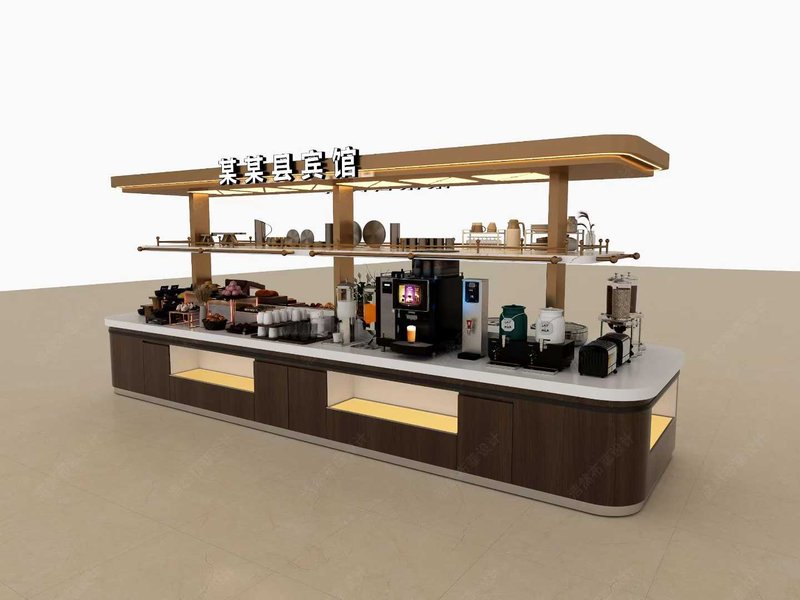
3. Portability and Storage: Maximizing Rental Fleet Efficiency
Rental companies require equipment that stacks efficiently in delivery trucks, minimizes storage space, and enables rapid deployment at event venues. Commercial grade chafing dish sets feature stackable designs, integrated handles, and lightweight construction (12-15kg per unit) that maximize vehicle payload and storage density.
Nesting designs allow 10-15 units to stack in the space of 3-4 non-stackable models, reducing warehouse storage costs by 40-50%. For rental companies operating from urban warehouses with limited space, this density directly impacts overhead costs. Integrated transport cases (optional) provide additional protection during transit while maintaining stackability for efficient truck loading.
The self-contained design eliminates loose parts—detachable handles, separate fuel holders, or modular components that get lost during rentals. Rental companies lose 5-10% of equipment value annually to missing parts; commercial grade sets minimize this loss through integrated, durable designs that survive repeated rentals.
4. Cost Efficiency: Rental Fleet ROI Analysis
Commercial grade chafing dish sets range from $300-800 per unit, significantly higher than residential-grade alternatives ($50-150). However, rental companies achieve full ROI within 12-18 months through extended service life, reduced replacement costs, and higher rental rates for premium equipment.
Replacement cost analysis: Residential-grade units last 6-12 months in rental fleets (3-5 replacements over 5 years = $150-750 total cost). Commercial grade units last 5-7 years ($300-800 one-time cost). The long-term savings are substantial, particularly for companies with 50+ units in their fleet. Energy-efficient models with ≥80% thermal utilization reduce electricity costs for electric units, further improving ROI.
Rental rate premiums: Customers willingly pay 20-30% more for commercial grade equipment that performs reliably and looks professional. For rental companies charging $30-50 per day per chafer, this premium generates $6-15 additional daily revenue per unit, accelerating ROI and improving profit margins.
Conclusion
Commercial grade chafing dish sets represent the optimal investment for event rental companies prioritizing fleet durability, operational efficiency, and long-term profitability. The combination of 304 stainless steel construction, standardized configurations, space-efficient design, and strong ROI makes these sets indispensable for rental businesses competing in crowded markets. Investing in premium rental-grade equipment reduces replacement costs, improves customer satisfaction, and delivers measurable financial returns within 12-18 months of deployment.
Browse the full chafing dish range for current models and configurations.
What a Rental Fleet Specification Should Contain
| Specification | Minimum | Why it matters to a rental company | Failure if ignored |
|---|---|---|---|
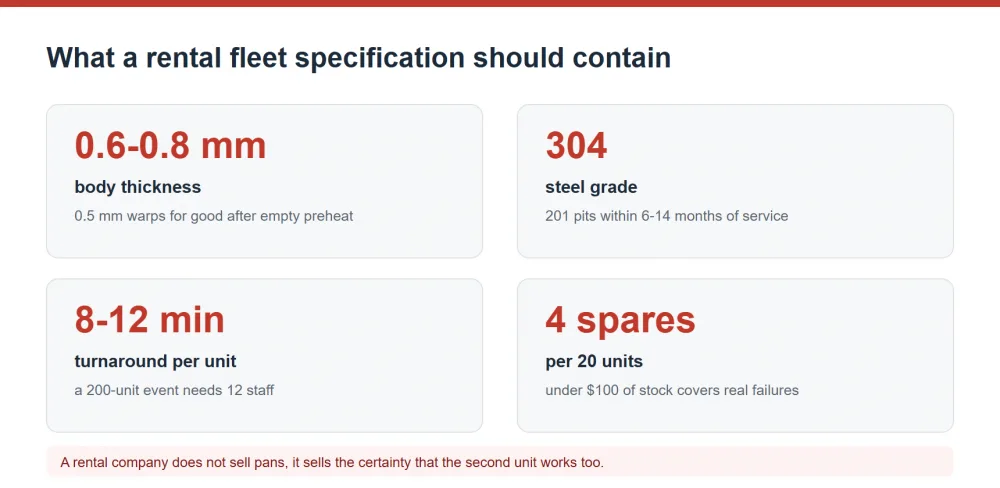
| Body thickness | 0.6–0.8 mm | 0.5 mm warps permanently after 20–40 minutes of empty preheat | Unit written off after 3–6 hires |
| Steel grade | 304 | 201 pits in 6–14 months, which is 1–2 rental seasons | Visible pitting, refund demand |
| Fuel holder | Replaceable, published part number | Fuel holders deform and are the most common failure | Whole-unit replacement, $60–160 |
| Hinge | Replaceable, published part number | Hinges fail from drop handling, not from heat | Unit out of service, $16–38 each |
| Water pan | Removable, seamless | Seamed pans trap scale and leak | Slow turnaround between hires |
| Pan interchange | Round 9 in or 11–13 in | Round and rectangular pans do not share a kitchen set | Two inventories, double spend |
| Turnaround time | 8–12 min per unit | A 200-unit event needs 12 staff on a 90-minute changeover | Paid staff hours overrun the quote |
| Stack height | 5 units or fewer | Vans are loaded to 6 tiers; more than 5 risks damage | Broken lids, reshuffling at the venue |
| Warranty | 2 years, parts available 5 years | Parts availability matters more than the term | Unit retired at 4 years |
| Power | Both 120 V and 240 V stock | Fuel units cover venues with no circuit, electric ones cover long service | Refusal to supply half the bookings |
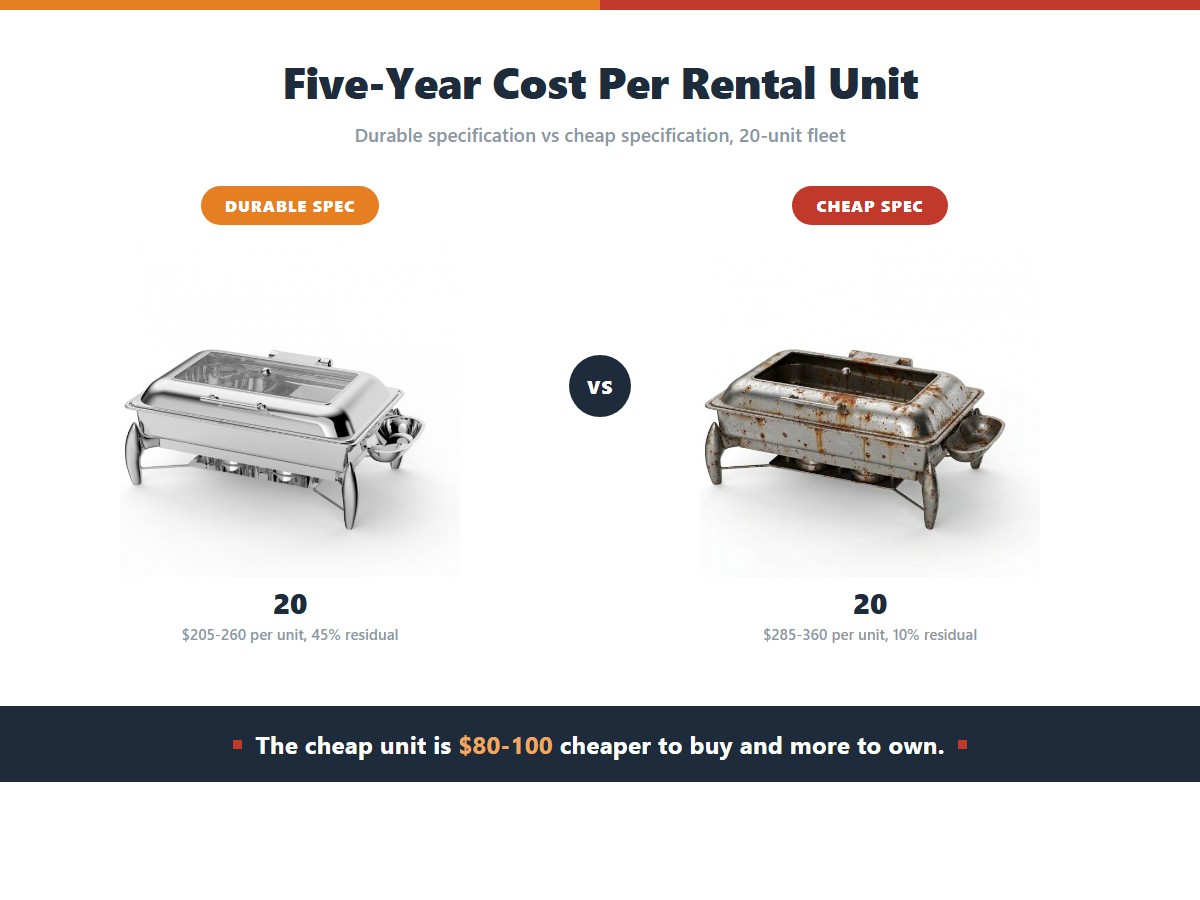
Five-Year Cost of Ownership, per 20-Unit Fleet
| Cost line | Budget unit | Durable specification | Cheap specification | Difference |
|---|---|---|---|---|
| Purchase | 20 units | $2,400–$3,200 | $1,200–$1,600 | $1,200–$1,600 |
| Refurbishment, year 1 | Whole fleet | $120 | $540 | $420 |
| Refurbishment, year 2–5 | Per year | $180 | $780 | $600 |
| Fuel holders, 5 years | Replacements | 4 units, $28 each | 14 units, $28 each | $280 |
| Hinges, 5 years | Replacements | 5 units, $22 each | 16 units, $22 each | $242 |
| Warranty claims paid | Cash cost | 2 claims, $300 each | 9 claims, $600 each | $4,800 |
| Downtime, event refunds | Per year | 1 event, $800 | 4 events, $800 | $2,400 |
| Residual value at year 5 | Fleet resale | 45%, $1,080–$1,440 | 10%, $120–$160 | $960–$1,280 |
| Five-year total | Per unit | $205–$260 | $285–$360 | $80–$100 cheaper to buy, more to own |
The row that decides it is the warranty claims line, not the purchase price. A durable fleet generates two claims in five years; a cheap fleet generates nine, and each claim is paid in cash at the counter, in front of the client, at the worst possible moment. The purchase saving of $1,200 to $1,600 across twenty units is real, but it is consumed by the first bad event season. A rental company does not sell pans, it sells the certainty that the second unit works too.
Frequently Asked Questions
What makes a chafing dish suitable for event rental use?
Four things: 304 stainless steel rather than 201, 0.6–0.8 mm body thickness, replaceable fuel holders and hinges with published part numbers, and pans that nest with the rest of the fleet. Rental units get dropped, stacked and cleaned by whoever is on shift, so consumable parts must be replaceable without a workshop.
How many chafing dish units does a 200-guest event need?
Four units, on the basis of one unit per 30 guests per hour of service, plus one spare. For a 200-guest event with a 90-minute service window, three units serve comfortably and four keeps the queue moving without refilling a pan twice. Most rental companies quote one unit per 50 guests and then send the units back needing a third of them filled twice.
How often should a rental fleet be replaced?
Durable 304 units with published spare parts last five to seven years in fleet service. Cheap 201 units with no parts availability are effectively retired at three to four years, because the fuel holder and hinge fail first and nobody stocks them. Replacing the whole fleet at year four is more expensive than replacing parts across year one to five.
What should a rental company stock alongside the units?
Four spares per 20 units is the working figure: one fuel holder, one hinge, one water pan and one element. At $22–28 per part, that is under $100 of stock covering the failures that actually stop a unit from working. Stocking complete units instead of parts is the classic mistake, because it ties up capital and still leaves the shift without a part.
Is it worth offering electric units in a rental fleet?
Yes, for events over four hours. Fuel units suit short events and venues with no dedicated circuit; electric units suit long service, indoor venues and clients who dislike the smell of burning fuel. A mixed fleet covers both. Note that a 4-pan electric unit needs a 20–32 A dedicated circuit, which not every venue has, so confirm the power before quoting.
Related reading
- Commercial Grade Chafing Dishes: Durable for Restaurant Use
- Chafing Dish Rental Cost: How Much for a 100-Guest Event?
- How Heavy Is Commercial Buffet Equipment? Shipping Weight Guide
- Chafing Dish Rental for Weddings: Packages, Pricing, Pitfalls
- Catering Event Timeline: From Setup to Takedown
- Marine-Grade Stainless Steel Chafing Dish for Cruise Ships