


Chafing Dish Rental Terms: Deposits, Damage and Late Fees
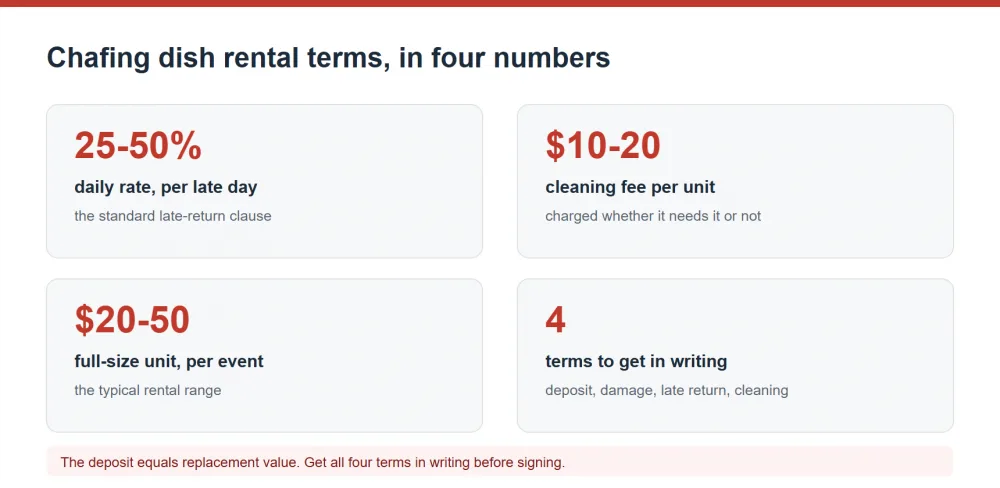
Short answer: Expect a deposit equal to the replacement value of the units, damage charged at repair cost or replacement less depreciation, late returns billed at 25–50% of the daily rate per extra day, and cleaning fees of $10–20 per unit. Get all four in writing before signing. Typical full-size rental is $20–50 per event. See chafing dishes if you would rather own.

What a rental agreement actually covers
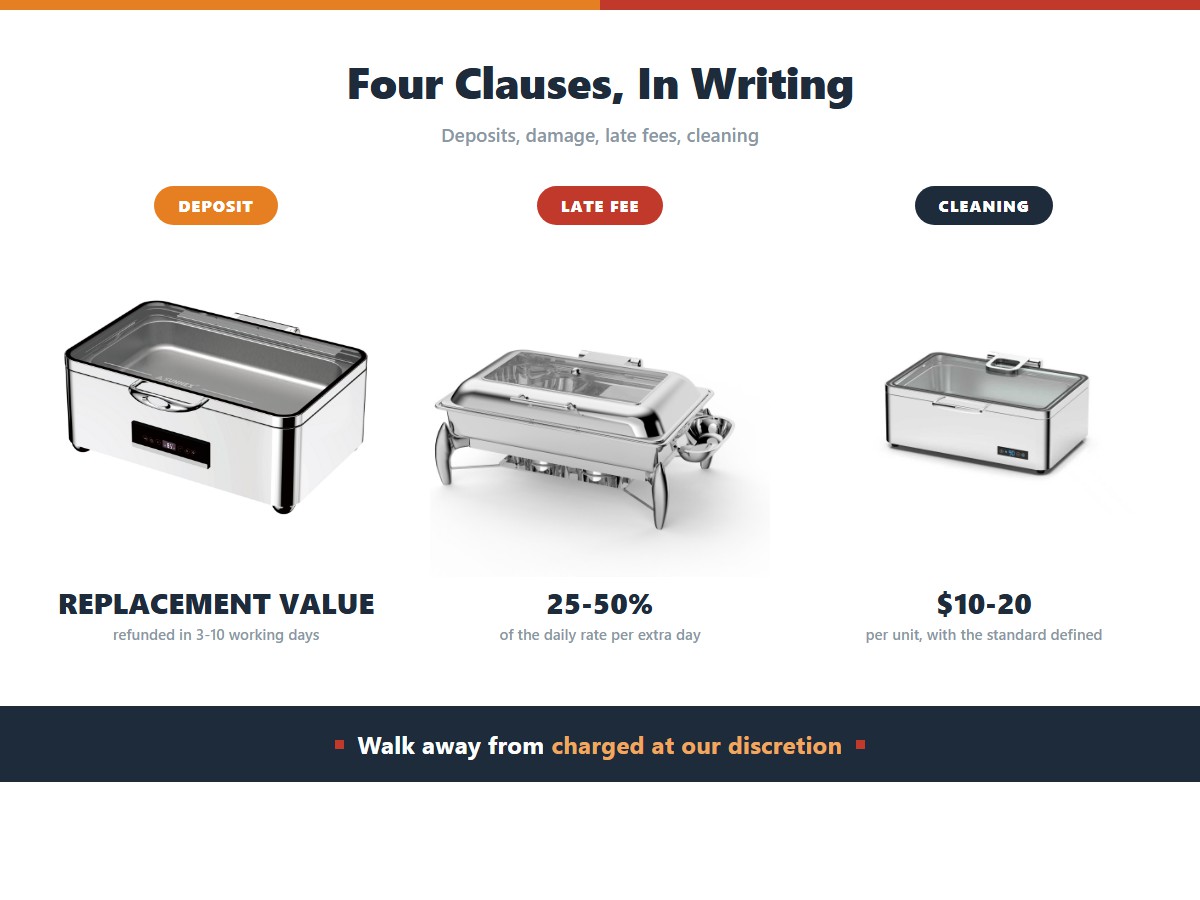
A chafing dish rental contract is four numbers and one schedule: the rate, the deposit, the damage table and the return deadline. Everything else is standard terms. Read those four before you compare suppliers on price, because a cheap rate with an aggressive damage schedule is the more expensive contract.
Ask for the agreement by email rather than agreeing at the counter. The clause that matters is almost always the one nobody reads aloud, and a written copy is what settles a dispute after the event instead of during it.
How the deposit is calculated
Most suppliers set the deposit at the replacement value of the equipment, not at a flat fee. That means a $180 stainless unit attracts a $180 deposit, while a $70 budget unit attracts $70. Large orders are sometimes capped at 20–30% of the order value.
| Order | Typical deposit basis | Amount | Refund timing |
|---|---|---|---|
| 2 full-size units | Replacement value | $160–400 | 3–10 working days |
| 10 units, one event | Replacement value or 30% cap | $600–2,000 | 5–14 working days |
| Seasonal contract | Negotiated, often 20% | Varies | End of contract |
| Corporate account | Waived or invoiced | $0 up front | Not applicable |
Two things to confirm: whether the deposit is held on a card or charged outright, and how many days the refund takes. A supplier who holds funds for three weeks is effectively charging you interest on equipment you already returned.
Damage and loss: what you actually pay
Damage is normally charged at repair cost where repair is possible, and at replacement value less depreciation where it is not. The distinctions that cause arguments are small: a bent frame is usually "damage", a missing fuel holder is usually "loss", and a scorched base is often excluded from both.
- Fair wear — water marks, light scratches, dulled polish. Should not be charged.
- Damage — dents, bent frames, cracked lids, broken hinges. Charged at repair or replacement.
- Loss — missing pans, lids, fuel holders, tongs. Charged at replacement value with no depreciation.
- Negligence exclusions — food burnt onto a pan, units returned with fuel residue, scorching from a unit placed on a hotplate.
Photograph every unit at collection and again at return, with a timestamp. It takes four minutes and it is the only evidence that settles a damage claim without negotiation.
Late returns, cleaning and restocking
Late fees are typically 25–50% of the daily rate per additional day, sometimes rising to a full day's rate after the first 24 hours. Cleaning is charged at $10–20 per unit when food residue is left, and restocking fees appear when equipment is returned in the wrong case or mixed with another order.
The trap is the collection window. If collection is "next working day before noon" and your event finishes at 23:00, you are paying for a day you cannot use. Confirm whether an evening drop-off is possible, or whether the next-day window can start at opening time.
Damage waiver versus insurance
A damage waiver costs roughly 8–12% of the rental and covers accidental damage, but almost never covers loss, negligence or missing parts. Event insurance is broader and more expensive. For a single small event the waiver is usually the pragmatic choice; for a season of work, check whether your business policy already covers hired-in equipment.
Contract checklist before signing
| Clause | What good looks like | Walk away if |
|---|---|---|
| Deposit | Replacement value, refunded in 5 working days | Flat fee above replacement value |
| Damage schedule | Itemised repair and replacement prices | "Charged at our discretion" |
| Late fee | 25–50% of daily rate per day | Full replacement charged on day two |
| Cleaning | $10–20 per unit, standard defined | Cleaning fee with no stated standard |
| Collection window | Named times, evening drop-off allowed | Window shorter than your event |
| Substitution | Equivalent or better if a unit is unavailable | Supplier may substitute "similar" items |
Negotiating the terms
The rate is rarely negotiable; the terms usually are. Ask for the cleaning fee to be waived if you return units spotless, for the deposit to be held rather than charged, and for a weekend rate that covers Friday to Monday. Suppliers protect margin on paper, so concessions usually appear in clauses rather than in price.
Frequently Asked Questions
How much deposit is normal for chafing dish rental?
The replacement value of the units, or 20–30% of a large order. Two full-size stainless units typically attract $160–400, refunded within 3–10 working days of return. A deposit that exceeds replacement value is not a deposit, it is a penalty.
What counts as damage on a returned chafing dish?
Dents, bent frames, cracked or warped lids, broken hinges and scorched bases. Water marks, light scratches and dulled polish are fair wear and should not be charged. If the contract does not define the difference, ask for the definition in writing.
How much is a late fee?
Usually 25–50% of the daily rate for each extra day, sometimes escalating to a full day's charge after 24 hours. The realistic risk is a collection window that does not fit your event, so confirm the timing before you sign rather than after.
Is a damage waiver worth buying?
For a single event with expensive units, often yes at 8–12% of the rental. Read the exclusions first: most waivers exclude loss, negligence and missing parts, which are the three things most likely to happen on a busy load-out.
Can I get the deposit back if I cancel?
Depends on the notice period, typically 48–72 hours before delivery. Inside that window suppliers usually retain part of the deposit because the fleet was reserved. Ask for the cancellation terms at booking, not when you need to cancel.
Related reading
- 2026 Catering Equipment Rental Market Growth & Key Trends
- Chafing Dish Rental for Weddings: Packages, Pricing, Pitfalls
- Rental vs Buying Catering Equipment: Finding the Break-Even
- Commercial Grade Chafing Dish Set for Event Rental Companies
- 5 Chafing Dish Hacks That Cut Fuel Cost by Half
- Chafing Dish Wholesale: MOQ, Lead Time and Payment Terms