




Chafing Dish Rental for Parties: Cost and What's Included
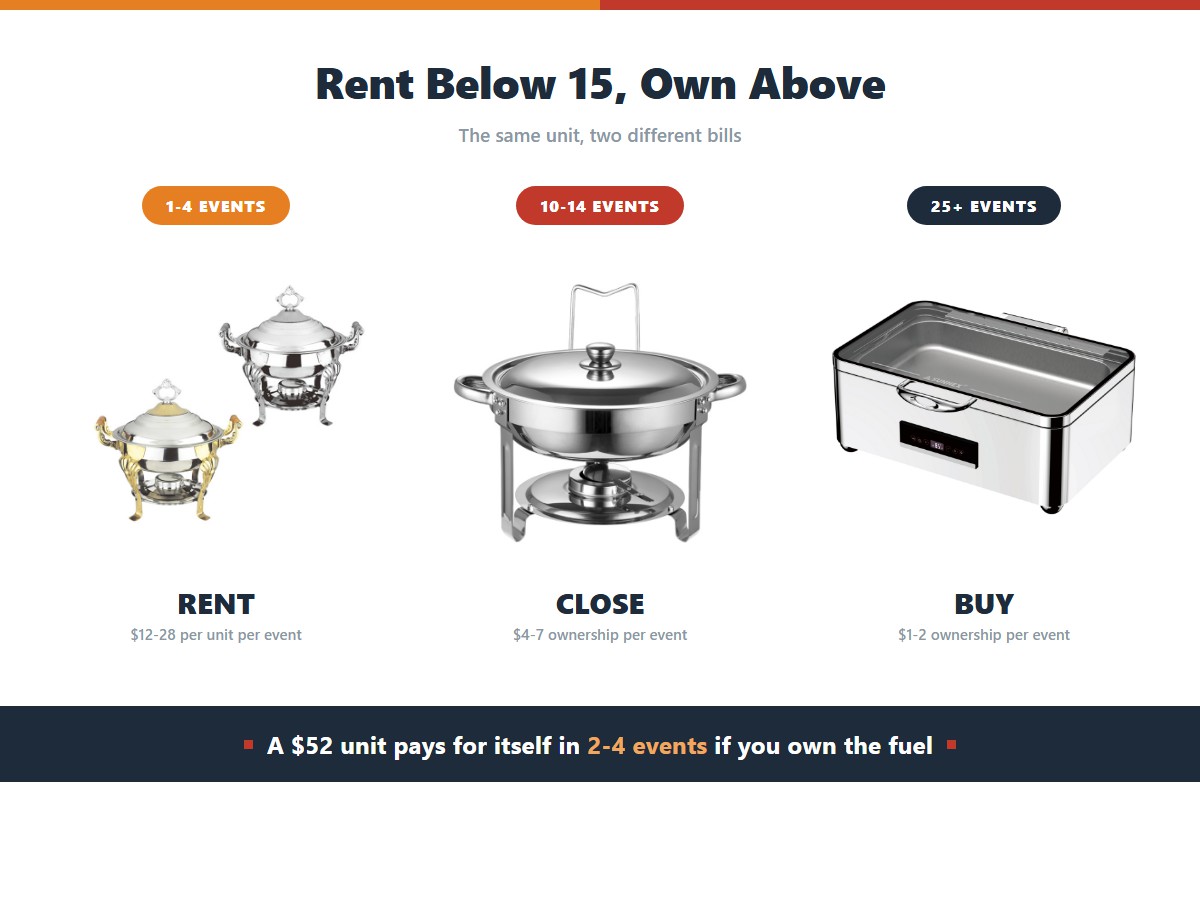
Short answer: Renting a chafing dish costs roughly $12–28 per unit per event, which makes it rational below about 15 events per year. A $52 unit bought outright pays for itself in 2–4 events if you also own a fuel supply and a transport case. Rental usually includes the dish, fuel holders and fuel; it commonly excludes fuel, delivery, cleaning fees and damage liability. See chafing dish ranges to price the ownership side.
Renting chafing dishes for parties provides professional food presentation without the investment that purchasing requires, making rental an attractive option for occasional entertaining and special events. Understanding local rental options, pricing structures, and service quality enables informed decisions that ensure successful events while controlling costs. Rental services offer flexibility and professional quality that home equipment cannot match.
Rental Service Types
Party rental companies specialize in event equipment with chafing dishes among their core offerings, providing professional-grade equipment maintained in excellent condition. Party rental specialists understand event needs. Rental companies serve various events.
Catering supply rental services focus on professional food service equipment, offering commercial-quality items that meet health department requirements and professional standards. Catering suppliers serve professionals. Commercial equipment meets standards.
Full-service catering companies may rent equipment separate from catering services, providing access to professional equipment without full catering packages. Full-service companies offer equipment access. Caterers provide standalone rentals.
Rental Benefits
Cost savings for occasional events make rental more economical than purchasing equipment that would sit unused between events. Rental makes economic sense for infrequent use. Occasional use favors rental.
Professional quality equipment enhances food presentation beyond what consumer-grade equipment provides, with rental inventory typically featuring commercial construction. Professional equipment improves presentation. Rental offers commercial quality.
Rental Pricing
Daily rates provide straightforward pricing for single-day events, with costs per chafing dish typically ranging from fifteen to forty dollars depending on quality and local market. Daily pricing suits single events. Per-day rates offer simplicity.
Weekend rates offer better value for multi-day events, with pricing structures that make extended rental economical compared to daily rates. Weekend packages provide savings. Multi-day pricing favors extended use.
Package pricing may include multiple chafing dishes and accessories at discounted rates compared to individual item rentals. Packages offer bundled savings. Multi-item discounts add value.
Service Elements
Delivery and pickup services add convenience and reduce transport challenges, with full-service rental companies handling logistics that self-service options require customers to manage. Delivery services add convenience. Full-service handles logistics.
Setup assistance helps ensure proper equipment arrangement and operation, with professional setup avoiding common mistakes that affect food service. Setup services ensure proper installation. Professional help prevents problems.
Fuel supplies may be included with rental or available as add-on purchases, with adequate fuel essential for successful hot food service. Fuel availability matters for service. Consumables need planning.
Equipment Selection
Size options include full-size, half-size, and round chafing dishes for different menu items and presentation styles, with rental inventory typically offering variety. Size selection matches menu needs. Various sizes available.
Style choices range from classic rectangular designs to elegant round options, with selection affecting presentation and serving efficiency. Style affects presentation quality. Aesthetic choices matter.
Lid types include roll-top convenience and dome elegance, with different lid styles suiting different service situations and menu items. Lid style affects operation. Cover type influences service.
Reservation Process
Advance booking ensures availability during peak seasons when demand exceeds supply, with early reservations providing better equipment selection. Early booking guarantees availability. Peak seasons require planning.
Deposit requirements protect rental companies against damage and loss, with deposits typically refundable upon equipment return in good condition. Deposits protect rental companies. Refundable with good returns.
Contract terms specify rental duration, pricing, damage liability, and return requirements that renters should understand before committing. Contracts define responsibilities. Terms require understanding.
Return Requirements
Cleaning expectations vary by rental company, with some requiring basic cleaning while others provide full cleaning services regardless of return condition. Cleaning policies vary by provider. Understand cleaning requirements.
Damage liability includes responsibility for equipment damage beyond normal wear, with contracts specifying damage assessment and repair or replacement charges. Damage responsibility affects costs. Liability terms need attention.
Timing requirements specify return deadlines that affect rental duration and potential late fees, with prompt return avoiding additional charges. Return timing affects costs. Late returns incur fees.
Quality Assessment
Equipment inspection before accepting delivery ensures items meet expectations and function properly, with damaged or worn items replaced before event use. Pre-event inspection prevents problems. Check equipment before accepting.
Cleanliness standards should meet food service requirements, with rental equipment expected to arrive clean and ready for food contact. Cleanliness matters for food safety. Equipment should be clean.
Functionality testing confirms that lids, handles, and fuel holders operate correctly, with malfunctions addressed before event day. Function testing prevents failures. Test equipment operation.
Finding Local Rentals
Online search identifies local rental companies with party and catering equipment, with reviews indicating service quality and equipment condition. Search finds local options. Reviews indicate quality.
Event planners and caterers can recommend reliable rental services based on professional experience, with industry referrals often identifying quality providers. Professional referrals provide guidance. Industry recommendations help.
Venue recommendations from event locations identify rental companies that regularly serve those venues, with venue familiarity ensuring smooth coordination. Venue referrals ensure compatibility. Venue recommendations add reliability.
Browse the full chafing dish range for current models and configurations.
Rental Cost Breakdown
| Component | Typical cost | Usually included? | Common surprise |
|---|---|---|---|
| Round chafing dish, 11 in | $12–28 per event | Yes | Multi-day events charged as several |
| Rectangular 4-pan unit | $38–75 per event | Yes | Minimum 2–3 day booking |
| Fuel (Sterno cans) | $3–6 per can | Sometimes | Charged per can, not per unit |
| Delivery and pickup | $25–60 each way | No | Two fees, not one |
| Cleaning fee | $5–20 per unit | No | Applied even if unused |
| Damage deposit | $50–200 | Refunded | Card hold, takes days to release |
| Late return fee | 30–50% of rental | — | Per 24 hours, not per hour |
Rent or Buy, by Events Per Year
| Events per year | Ownership cost per event | Rental cost per event | Cheaper option | Also consider |
|---|---|---|---|---|
| 1–4 | $0 once bought, but $52 outlay | $12–28 | Rent | Storage and cleaning overhead |
| 5–9 | $6–11 | $12–28 | Rent | Rental firms run out of stock |
| 10–14 | $4–7 | $12–28 | Close | Shipping a damaged unit is painful |
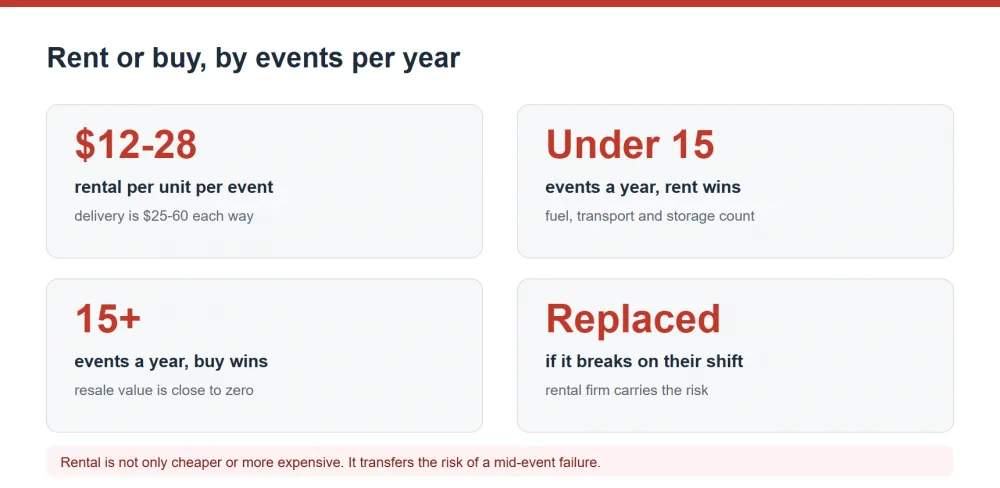
| 15–24 | $2–4 | $12–28 | Buy | Resale value is close to zero |
| 25+ | $1–2 | $12–28 | Buy | Buy a spare unit too |
Rental is not just a cheaper way to get equipment, it is a way to avoid a specific failure. A rental firm replaces a unit that breaks during your event, because it is their asset and their liability. Owned equipment that fails on a Saturday evening is your problem, and a $28 replacement part plus a 40-minute hunt is the real cost of ownership that the purchase price does not include.
Frequently Asked Questions
How much does it cost to rent a chafing dish for a party?
Roughly $12–28 per round unit per event, and $38–75 for a rectangular multi-pan unit. Add $25–60 for delivery each way and $3–6 per fuel can if fuel is not included, so a realistic total for four units with delivery is $180–320.
Is it cheaper to rent or buy chafing dishes?
Below about 15 events a year, rental is usually cheaper once fuel, transport and storage are counted. Above that, buying wins clearly, and the break-even point is 2–4 events of pure purchase cost before you add the hidden costs of ownership.
What is usually not included in a chafing dish rental?
Fuel, delivery, pickup, cleaning fees and damage liability. Cleaning fees are the most annoying because they are charged per unit whether or not you used it, and damage deposits are typically released days after the event rather than immediately.
What happens if a rented chafing dish breaks during my event?
The rental firm replaces it, because it remains their asset. This is the practical argument for renting that is rarely mentioned in price comparisons, and it is worth more than the unit price difference on a wedding or a corporate dinner.
How far in advance should I book chafing dishes?
Four to eight weeks for a wedding or a large corporate event, and two weeks for a smaller booking. Rental firms run out of stock in peak season, and a shortage is usually worse than a slightly higher price at a second-choice supplier.
Related reading
- Chafing Dish Rental for Parties: Affordable Options
- 2026 Catering Equipment Rental Market Growth & Key Trends
- Rental vs Buying Catering Equipment: Finding the Break-Even
- Commercial Grade Chafing Dish Set for Event Rental Companies
- Best Chafing Dish Brands in 2026: China, Turkey, Italy Compared
- Chafing Dish Rental Cost: How Much for a 100-Guest Event?