


Chafing Dish Buying Guide: Every Budget, One Checklist
Short answer: Four budget tiers cover almost every use: under $40 for occasional home events, $40–90 for a single working unit, $90–200 for a full 4–8 pan line, and $200–400 for electric units with thermostats. The tier that fails most often is the middle one, because $60–80 buys a thin 201 steel body with no spare parts. See chafing dish ranges by price.
Budget significantly influences chafing dish options, with each price tier offering distinct advantages and limitations that buyers should understand before purchasing. Whether outfitting a catering business, planning occasional entertaining, or stocking a commercial kitchen, this guide helps navigate purchasing decisions across all budget levels. Understanding what each price range delivers prevents disappointment while ensuring money spent aligns with actual needs.
Understanding Price Tiers
Chafing dishes range from budget-friendly options under fifty dollars to premium professional equipment exceeding three hundred, with prices reflecting material quality, construction durability, and feature complexity. Price tiers reflect quality differences. Understanding tiers enables informed selection.
Manufacturers design products for specific markets, with consumer-grade units prioritizing affordability while professional equipment emphasizes durability and performance. Market positioning affects product design. Different buyers have different priorities.
Recognizing what features matter most helps allocate budget effectively, with strategic spending delivering better value than uniform budget allocation across all equipment. Strategic spending improves value. Prioritizing features guides allocation.
Budget Tier: Under $50
Entry-level chafing dishes provide functional equipment at accessible prices, suitable for occasional use where equipment longevity matters less than initial affordability. Budget options serve occasional needs. Low prices enable access.
Materials in this tier typically include aluminum or thin-gauge stainless steel, with lighter construction reducing cost while affecting heat distribution and durability. Light materials reduce cost. Aluminum construction serves basic needs.
Simple designs in budget units minimize component complexity, with fewer features reducing both price and potential failure points. Simple design reduces price. Fewer components mean fewer problems.
Budget Tier: $50-$100
Mid-budget options provide improved quality without premium pricing, offering better materials and construction than entry-level units. Better materials justify higher prices. Improved construction increases durability.
Thicker gauge stainless steel appears more frequently in this tier, with better heat distribution and corrosion resistance than budget alternatives. Gauge affects performance. Better steel serves longer.
Premium Tier: $100-$200
Professional-grade equipment emerges in this tier, with construction quality suitable for regular commercial use in catering and banquet operations. Professional quality serves commercial needs. Regular use demands better construction.
Full stainless steel construction with substantial gauge provides durability that justifies higher prices through years of reliable service. Heavy construction ensures longevity. Investment pays over time.
Superior heat distribution across the entire water pan surface prevents hot spots that affect food quality and safety during extended service. Even heat distribution protects food quality. Consistent warmth serves safely.
Professional Tier: $200 and Above
Premium chafing dishes deliver exceptional quality for operations requiring the best equipment available, with prices reflecting superior materials and construction precision. Premium prices reflect quality. Exceptional materials demand investment.
Lifetime warranties available on premium units protect long-term investments, with manufacturer confidence in construction quality backing comprehensive coverage. Warranty coverage protects investment. Manufacturer confidence indicates quality.
Commercial certification in this tier ensures equipment meets professional standards, with certification providing assurance of professional-grade performance. Certification ensures standards. Professional performance meets demanding needs.
Budget Allocation Strategies
Assessing actual usage frequency guides appropriate budget allocation, with occasional users benefiting from moderate spending while daily professional use justifies premium investment. Usage frequency guides budget. Daily use demands durability.
Prioritizing quality in most-used equipment while accepting budget options for backup units creates efficient budget allocation across entire inventories. Strategic allocation maximizes value. Quality where it matters most.
Considering total cost including accessories, fuel, and maintenance reveals true equipment economics beyond initial purchase price. Total cost exceeds purchase price. Complete economics guide decisions.
Hidden Costs to Consider
Fuel costs accumulate significantly over equipment lifetime, with fuel-efficient designs reducing ongoing expenses that cheap equipment cannot offset through lower purchase prices. Fuel costs add up over time. Efficiency reduces operating expense.
Maintenance and replacement parts factor into lifetime equipment costs, with quality designs having readily available affordable parts versus proprietary expensive components. Maintenance affects total cost. Parts availability matters.
Equipment lifespan differences between budget and premium units affect per-use costs significantly, with durable equipment lasting years longer than economy alternatives. Lifespan affects per-use cost. Durability reduces annual expense.
Making the Final Decision
Comparing specific models across price tiers reveals surprising value in unexpected ranges, with some mid-tier products offering premium features at budget prices. Specific comparisons reveal value. Mid-tier often offers best balance.
Reading professional reviews provides insight beyond marketing claims, with experienced user feedback revealing real-world performance differences. Professional reviews reveal truth. User experience guides selection.
Understanding return policies enables confident purchasing, with reasonable return periods allowing equipment evaluation without permanent commitment. Return policies enable evaluation. Testing ensures satisfaction.
Specialty Budget Considerations
Rental equipment may serve occasional needs more economically than purchasing, with rental costs sometimes below storage and maintenance costs for rarely-used items. Rental suits occasional needs. Rental avoids storage costs.
Used equipment from reputable sources offers significant savings with careful selection, with inspection preventing problems from unseen defects. Used equipment provides savings. Careful inspection prevents problems.
Package deals combining multiple units often provide better per-unit pricing than individual purchases, with bundle opportunities available through many suppliers. Package deals improve pricing. Volume discounts reduce cost.
Conclusion
Budget considerations matter in chafing dish purchasing, with each tier serving different needs effectively when selected appropriately. Occasional entertainers benefit from budget options while professional caterers should prioritize quality construction. Understanding budget tiers and assessing actual needs ensures purchasing decisions that deliver appropriate value without overspending on unnecessary features or underspending on critical durability requirements.
Browse the full chafing dish range for current models and configurations.
What Each Price Tier Actually Buys
| Tier | Price | Steel and thickness | Pan size | Included | Honest verdict |
|---|---|---|---|---|---|
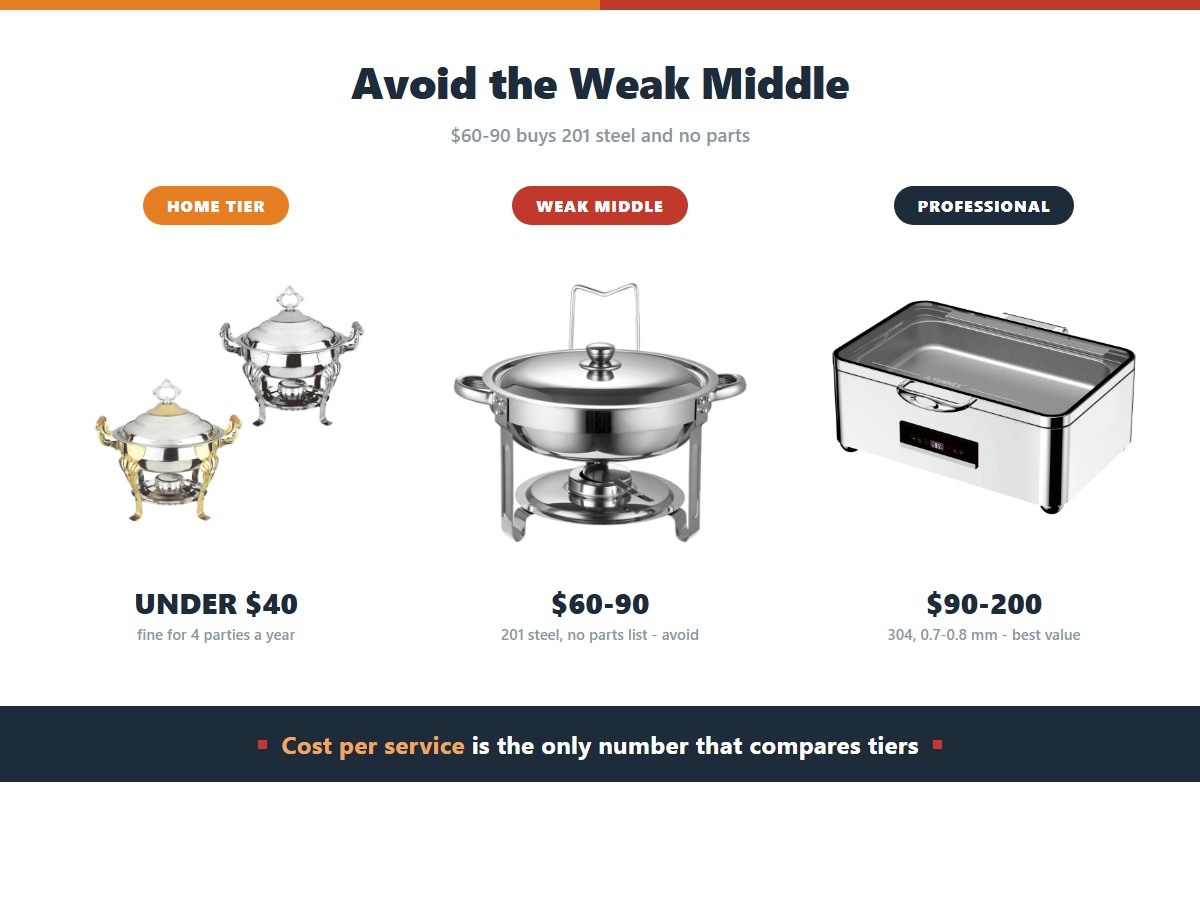
| Home tier | Under $40 | 201, 0.4–0.5 mm | 9 in | 1–2 holders | Fine for 4 parties a year |
| Entry working | $40–90 | 201, 0.5–0.6 mm | 9–11 in | 2–4 holders | Fine for occasional work |
| Weak middle | $60–90 | 201, 0.5 mm, no parts list | 11 in | Varies | Avoid |
| Professional fuel | $90–200 | 304, 0.7–0.8 mm | 11–13 in | 4 holders, lid | The best value tier |
| Electric entry | $120–200 | 304 body, on/off switch | 4–5 pan | Cord, no thermostat | Acceptable for low duty |
| Electric with thermostat | $200–400 | 304, element 1,500–1,800 W | 4–8 pan | Thermostat, 2–3 yr warranty | Best for daily service |
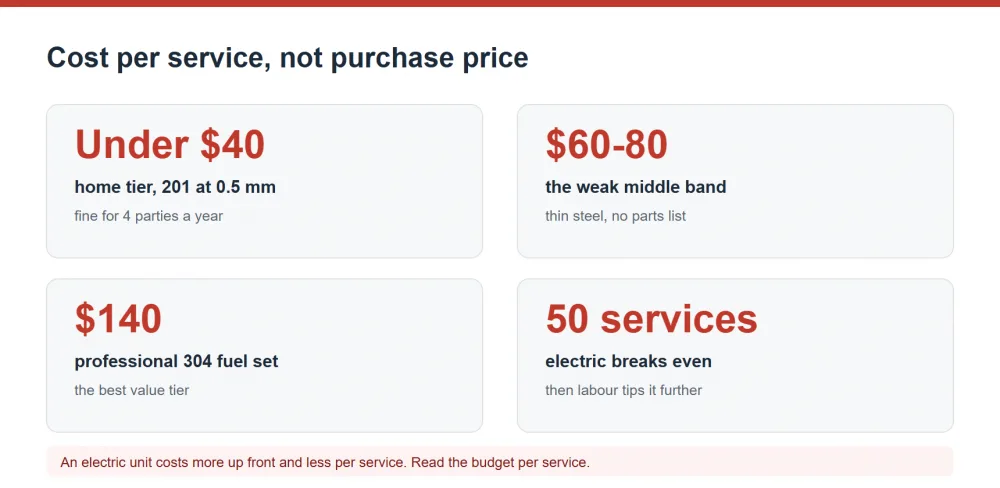
Five-Year Total Cost by Tier
| Tier | Purchase | Fuel or energy, 300 services | Parts and failures | Five-year total | Cost per service |
|---|---|---|---|---|---|
| Home tier, 4 events a year | $32 | $60 | $0 | $92 | $4.60 |
| Entry working, 4 a year | $65 | $180 | $40 | $285 | $14.25 |
| Weak middle, 20 a year | $78 | $900 | $320 | $1,298 | $12.98 |
| Professional fuel, 20 a year | $140 | $900 | $90 | $1,130 | $11.30 |
| Electric with thermostat, 60 a year | $280 | $370 | $150 | $800 | $2.67 |
| Electric with thermostat, 120 a year | $280 | $740 | $220 | $1,240 | $2.07 |
The useful way to read a budget is cost per service, not purchase price. An electric unit with a thermostat costs more up front and less per service, and it breaks even against a fuel unit at roughly 50 services a year. Below that, the fuel unit wins on money and loses on labour, because somebody has to watch the cans and the flame.
Frequently Asked Questions
How much should I spend on a chafing dish?
About $40–90 for a single working round unit, $90–200 for a professional 304 steel set, and $200–400 for an electric unit with a thermostat. Spending under $40 is fine for a handful of home events and is a mistake for regular use, because the body is 201 steel at 0.4–0.5 mm.
Is a $60 chafing dish bad?
It can be. The $60–80 band is where thin 201 steel with no published spare parts sits, and it looks identical on a listing to a proper 304 unit. Check the steel stamp and ask for a part number before buying, because this band is the most common place to overpay for the wrong product.
Is electric cheaper than fuel for a chafing dish?
Per hour of energy, no. Fuel costs $0.75–1.60 per can-hour, while electric runs about $0.20–0.40 for a similar holding period. Per service including labour, electric wins above about 50 services a year, because a fuel line needs someone watching the cans and the flame.
Is it worth buying a chafing dish set or single units?
Single units until you have a reason to match them. Matching pans look better on a line and spare parts interchange, but a set of mismatched pans from different suppliers will not stack or nest properly, which matters more in transport than it does on the table.
What is the most important thing to check before buying?
Whether the supplier can give you a spare-parts part number for the fuel holder, hinge and lid, and whether the pan is 304 stainless. Those two answers decide whether the unit exists in year four, and they matter more than any feature on the box.
Related reading
- Food Holding Temperatures: The Safe Zones Every Caterer Must Know
- 5 Buffet Stove Buying Mistakes (and the Cheap Fix)
- Chafing Dish Rental: When It Beats Buying (and When It Doesn't)
- Best Chafing Dishes for Small Businesses: Budget-Friendly Picks
- Best Chafing Dish Brands in 2026: China, Turkey, Italy Compared
- Dual Dry-Wet Heating Chafing Dish: One Dish, Two Modes