


Commercial Buffet Warmers: What Hotels Actually Use
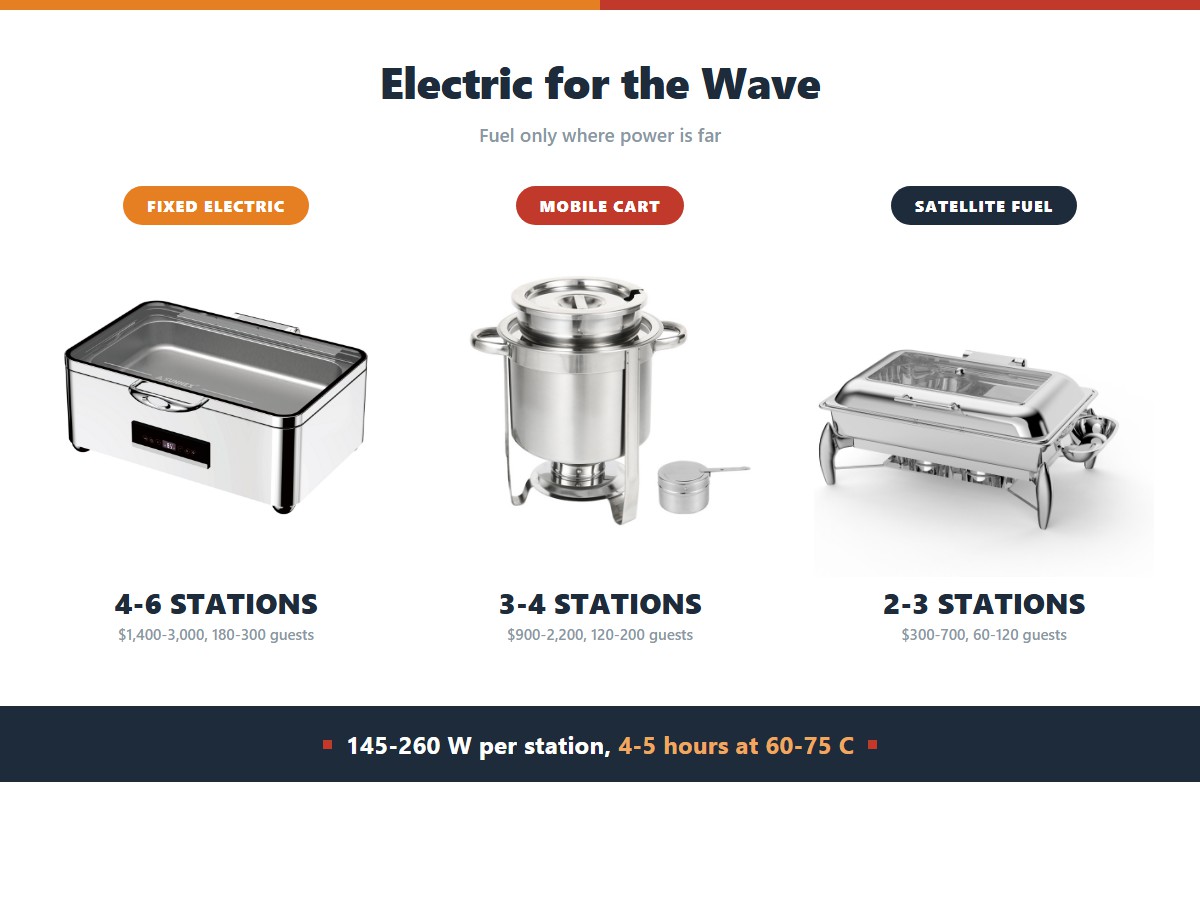
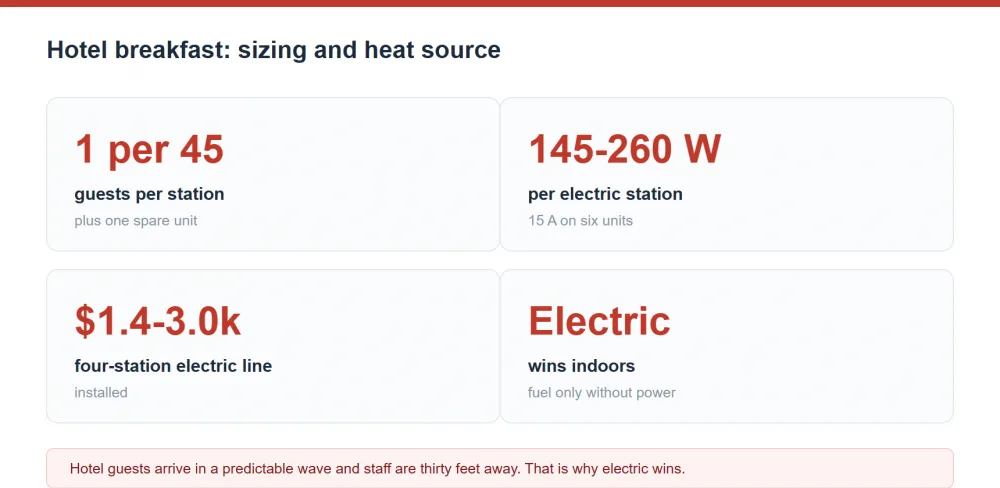
Short answer: Hotel breakfast service runs on electric units at 145–260 W per station, because guests arrive in a predictable wave and staff can supervise a corded connection. A four-station electric line costs $1,400–3,000 installed and holds 4–5 hours at 60–75°C. Fuel units only earn their place at satellite buffets with no power within 3metres. See commercial buffet equipment for the current models.
Hotel food and beverage operations place demands on buffet equipment that are fundamentally different from those of standalone restaurants or occasional catering events. A hotel breakfast buffet may run for four hours every morning, serving hundreds of guests with minimal staff intervention. A hotel banquet may require dozens of chafing dishes operating simultaneously for a single event. Equipment that works adequately in a low-volume café can fail rapidly under hotel conditions, creating both operational problems and guest dissatisfaction that directly affects the hotel's reputation.

What Makes a Buffet Warmer "Commercial Grade" for Hotels?
The term "commercial grade" is frequently used in equipment marketing, but it has specific meaning in the context of hotel operations. Commercial-grade buffet warmers are built with heavier-gauge stainless steel that resists denting and maintains its appearance through years of daily use and frequent transport. They use heating elements or fuel systems designed for continuous operation over extended periods — four-hour breakfast service, for example — without performance degradation or safety risks.
Durability is only part of the picture. Commercial-grade units also incorporate design features that make them easier to clean, safer for self-service guests, and more compatible with standard food pans and buffet accessories. In a hotel environment where equipment is often shared across departments and used by staff with varying levels of training, these design details have a direct impact on daily operations.
Electric vs Fuel-Based: Which Hotels Need Which?
One of the most important decisions in specifying buffet warmers for a hotel is choosing between electric and fuel-based systems. Electric warmers provide consistent, adjustable temperature control and eliminate the ongoing cost of fuel refills. For hotels with reliable power infrastructure and fixed buffet locations — a breakfast room with dedicated power outlets at each station, for example — electric warmers are usually the better choice. They are also preferable in venues where open flames are restricted by fire code or insurance requirements.
Fuel-based chafing dishes remain relevant even in well-equipped hotels. They are essential for outdoor events, mobile catering from the hotel kitchen to off-site locations, and banquet setups where running power cables to every chafing dish would create trip hazards or visual clutter. Many hotels maintain a mixed fleet, using electric warmers for daily breakfast service and fuel-based units for events and outdoor functions.
Sizing and Capacity for Hotel Buffets
Hotel buffets typically operate at larger scale than restaurant buffets, and the capacity of individual warmers matters accordingly. Full-size chafing dishes (holding a standard full-size food pan, approximately 12 by 20 inches) are the workhorses of hotel buffet service, suitable for main dishes, large-format sides, and high-volume items. Half-size and third-size pans allow more granular menu planning but require adapter bars and careful planning to avoid uneven heating across the water pan.
For continuous-service buffets — common in resorts and full-service hotels — warmers with larger water pans and more powerful heating elements reduce the frequency of refills and temperature checks. The goal is to minimize staff intervention during service without compromising food safety, and appropriately sized equipment is central to achieving that balance.
Key Features to Look for in Hotel Buffet Warmers
Several features distinguish warmers that perform well in hotel environments from those that create ongoing problems. Adjustable temperature control is valuable for hotels serving diverse menus — delicate items that should be held at lower temperatures, and hot dishes that require aggressive holding temperatures, can be managed with the same equipment when temperature is adjustable. Water-level indicators help staff quickly assess whether a warmer needs refilling without removing lids or disrupting service.
Lid design also matters more in hotels than in many other settings. Roll-top lids that allow guests to serve themselves while keeping most of the food covered reduce heat loss and improve food safety in high-traffic buffets. Dome lids are acceptable for lower-volume service, but roll-tops are worth the additional investment for hotels where buffet stations are heavily used for extended periods.
Integration with Hotel Food Safety Protocols
Hotels are subject to stricter food safety oversight than many independent restaurants, particularly those with room service, room delivery, and large-scale catering as part of their operations. Buffet warmers should integrate smoothly with the hotel's food safety protocols, including temperature logging, safe-holding-time limits, and staff training requirements.
Some electric warmers include digital temperature displays that simplify compliance documentation. Even without built-in displays, choosing warmers with predictable, consistent heat output makes it easier for staff to maintain safe temperatures without constant monitoring. Fuel-based units with reliable, wind-protected burners are particularly important for hotels that cater outdoor events where temperature stability is more difficult to maintain.
Staff Training Considerations
Even the best equipment performs poorly if staff are not trained to use it correctly. Hotel buffet warmers should be simple enough that staff can operate them confidently after brief training, and clear enough in their operation that mistakes are obvious and correctable. Electric warmers with intuitive controls, fuel holders that are clearly marked for safe filling, and lids that are easy to remove and replace all contribute to safer, more efficient daily operation.
Training should also cover cleaning and maintenance. Buffet warmers that are difficult to clean thoroughly tend to accumulate buildup in corners and water pans, creating food safety risks and shortening equipment lifespan. Choosing warmers with smooth interior surfaces, accessible water pans, and minimal crevices makes training more effective and cleaning more reliable.
Conclusion
The best commercial buffet warmers for hotels are those that combine durability, consistent performance, and ease of use in a form factor that integrates smoothly with the hotel's existing buffet infrastructure. Electric warmers are generally preferable for daily breakfast and lunch service in fixed locations, while fuel-based units provide essential flexibility for events and outdoor service. Mixed fleets that include both types give hotels the widest range of options across their varied service environments.
When evaluating specific products, prioritize heavy-gauge stainless steel construction, predictable temperature performance, and compatibility with standard food pans and buffet accessories. Equipment that meets these criteria will perform reliably through years of daily hotel use, supporting both operational efficiency and guest satisfaction — the two metrics that ultimately determine whether a buffet equipment investment was worthwhile.
Explore our full range of commercial chafing dishes designed for demanding hotel and catering environments.
Browse the full chafing dish range for current models and configurations.
Hotel Breakfast Warming Configurations
| Service model | Stations | Equipment cost | Guest capacity | Best fit |
|---|---|---|---|---|
| Fixed electric line | 4–6 | $1,400–3,000 | 180–300 | Resort and full-service hotel breakfast |
| Mobile electric cart | 3–4 | $900–2,200 | 120–200 | Boutique hotel with one dining room |
| Satellite fuel units | 2–3 | $300–700 | 60–120 | Pool deck, lounge, no power nearby |
| Hybrid, main electric plus fuel backup | 5–7 | $2,100–4,000 | 240–360 | Large banquet floor with power redundancy |
Electric vs Fuel for Hotel Use
| Factor | Electric | Fuel |
|---|---|---|
| Capital cost per station | $190–420 | $95–220 |
| Running cost per hour | $0.14–0.30 | $0.45–0.75 |
| Temperature consistency | Thermostatic, holds within 3°C | Declines after 3 hours without a tray check |
| Staff involvement | Low, dial and forget | Medium, 3-minute swap every 2 hours |
| Where it works | Anywhere within cord reach | Anywhere, including outdoors |
| Guest-facing noise | Silent | Audible burner hiss |
Hotel operators consistently under-budget for the electrical side. A six-station electric line at 200 W each pulls about 15 amps, which means a dedicated 20 A circuit rather than a shared wall outlet behind the coffee machine, and that cable routing is the part that costs money in a finished room.
Frequently Asked Questions
What is the best warmer type for a hotel breakfast buffet?
Electric, in almost every case. Service times are predictable, staff are within thirty feet, and a thermostatic dial holds food within the safety band without mid-service intervention. Fuel only makes sense where there is no power within a few metres.
How many warming stations does a hotel breakfast need?
One station per 40–50 guests per service. A 200-room hotel with a 150-cover breakfast therefore needs four to six stations, plus one spare unit on standby because that spare is what saves a service when a unit fails mid-meal.
Can I mix electric and fuel units on one buffet?
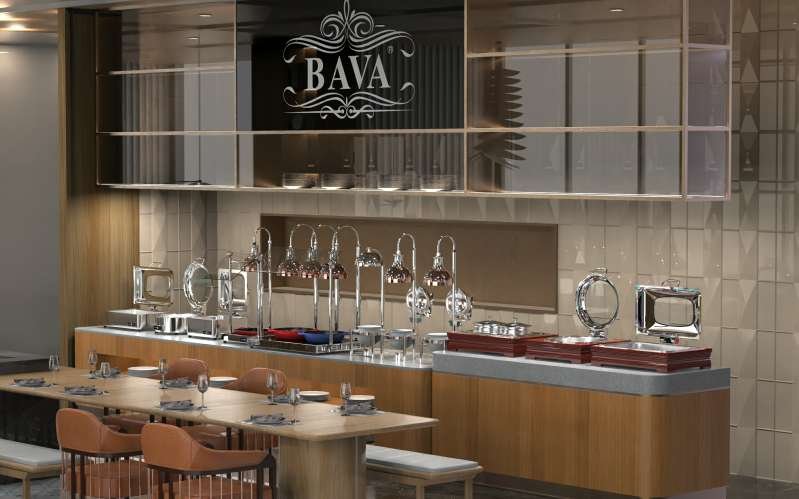
Yes, and many hotels do. The practical rule is to put fuel units at the far ends of the line, where there is no power, and electric in the middle where staff can supervise. Visually it reads as one continuous line.
What power supply do electric buffet warmers need?
Each 200 W unit draws roughly 0.9 amps at 240 V. Four stations need a dedicated 20 A circuit, and a six-station line should not share a circuit with dishwashers, coffee urns or refrigeration compressors.
How often should hotel buffet equipment be replaced?
Electric elements last three to five years in commercial duty with daily service and quarterly descaling. Fuel burners and cast frames can run a decade. Replace elements on a planned schedule rather than on failure, because a failed element usually means a failed service.
Related reading
- Types of Commercial Food Warmers: A Complete Overview
- Commercial Grade Chafing Dish Set for Event Rental Companies
- Chafing Dish Pans: Replacement Pans for Food Warmers
- Best Stainless Steel Chafing Dishes for Commercial Use
- Free Buffet Setup Checklist (Printable PDF)
- Food Heat Lamps for Hotels: Buffet & Room Service Essentials
- Buffet Stove vs Traditional Warmers: Honest Comparison