


Cleaning a Buffet Stove: 20 Minutes a Day
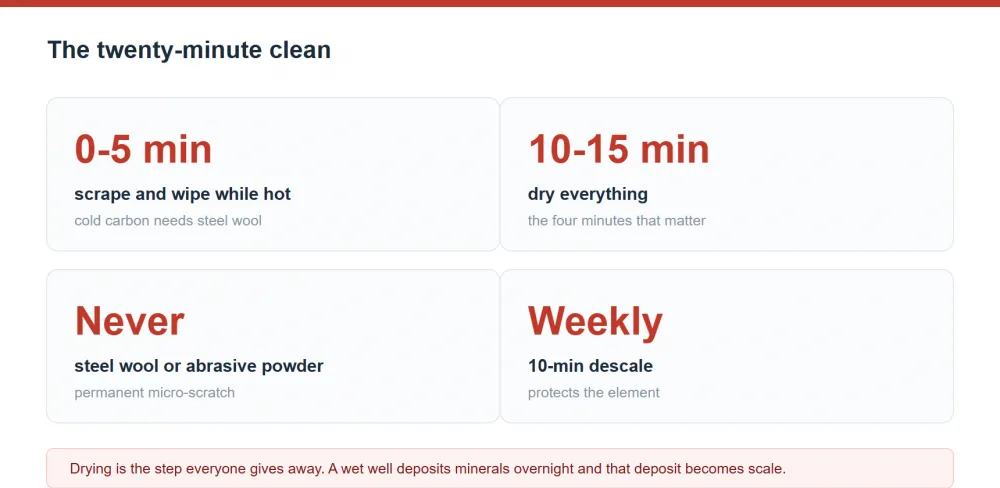
Short answer: Twenty minutes a day is enough: 5 minutes to scrape and wipe while hot, 5 to wash the well and pans, 5 to dry everything completely, and 5 to check the element and thermostat. Skipping the drying step is what causes the scale and pitting that shortens element life. A weekly 10-minute descale completes the cycle. See buffet station equipment.
Commercial buffet stoves are a significant investment for any high-traffic restaurant, hotel, or catering business. With proper cleaning and maintenance, these units can last 5-10 years, compared to 2-3 years for neglected equipment. For establishments serving 500+ guests daily, a single buffet stove breakdown during peak service can cost thousands in lost revenue and rush replacement fees. This guide outlines a proven maintenance routine to extend your buffet stove's lifespan and protect your bottom line.
Daily cleaning is the most critical step in buffet stove maintenance. After each service period, unplug the unit and let it cool completely before cleaning. Wipe down all exterior surfaces with a mild detergent and soft cloth to remove food splatters and grease buildup. For BAVA models like the Electric Chafing Dish-W07, the food pans and water bath are fully detachable for quick, thorough cleaning — a design feature that reduces daily cleaning time by 40% compared to fixed-pan models.

Electric Chafing Dish-W07
This 900W electric chafing dish features detachable food pans and water baths for easy daily cleaning. Its 304 stainless steel construction resists corrosion from cleaning chemicals, and the anti-dry heat alarm prevents damage from accidental empty operation. Simple design reduces maintenance time by 40% for busy kitchen staff.
Weekly deep cleaning prevents long-term damage from grease and mineral buildup. Disassemble all removable parts (pans, lids, seals) and wash them in a commercial dishwasher or with hot soapy water. For water bath models, descale the heating element monthly using a 1:10 white vinegar and water solution to remove mineral deposits that reduce heating efficiency. The table below compares common cleaning methods for buffet stove components:
| Component | Manual Cleaning | Commercial Dishwasher | Self-Cleaning Mode (BAVA Select Models) |
|---|---|---|---|
| Food Pans | 5-10 minutes per pan, scrub with non-abrasive sponge | 2-minute cycle, high heat kills bacteria | N/A (no self-clean for detachable pans) |
| Water Bath | 15 minutes, requires descaling monthly | Not recommended (water damage risk) | 30-minute automatic descaling cycle |
| Exterior Surfaces | 3-5 minutes, wipe with mild detergent | Not recommended (electrical components) | Steam clean cycle for stainless steel |
| Heating Element | 10 minutes, gently brush with soft brush | Not recommended (damage risk) | Auto-burnoff residue removal |
Monthly maintenance checks catch small issues before they become costly repairs. Inspect door hinges and lid seals for wear — BAVA buffet stoves undergo 20,000 cycle lid tests, but regular lubrication of hinges extends lifespan further. Check temperature accuracy using a calibrated food thermometer: if the stove reads 60°C but the thermometer shows 55°C, recalibrate per the manufacturer's instructions. For high-volume venues, schedule professional maintenance every 6 months to inspect electrical components and heating elements.

Full Size 11L Electric Chafer
The 11L electric chafer features polished 304 stainless steel that resists fingerprints and grease buildup, reducing weekly cleaning time. Its sealed heating element prevents water ingress during cleaning, and the digital display alerts staff to descaling needs. Durable construction withstands daily deep cleaning for 5+ years of commercial use.
Avoid these common maintenance mistakes that cut equipment lifespan by 50%: First, never use abrasive scrubbers or steel wool on stainless steel surfaces — they scratch the finish and trap bacteria. Second, never submerge electrical components (power cords, control panels) in water. Third, skip descaling at your peril: mineral buildup can reduce heating efficiency by 30% in 6 months. Finally, never ignore small issues like loose hinges or flickering displays — these are early warning signs of larger failures.

Proper cleaning and maintenance are not just about extending equipment life — they also ensure food safety compliance. Grease buildup can harbor bacteria that contaminate food, leading to health code violations and guest illnesses. A 2025 study found that buffet stoves with daily cleaning routines had 80% fewer bacterial contamination incidents than those cleaned weekly. For high-traffic venues, this compliance is non-negotiable to protect your business's reputation and license.
By following this daily, weekly, and monthly maintenance routine, you can extend your buffet stove's lifespan by 3-5 years, saving $2,000+ per unit in replacement costs. BAVA's purpose-built commercial buffet stoves are designed for easy maintenance, with detachable parts, corrosion-resistant materials, and smart alerts for descaling and upkeep. Invest in a proper maintenance routine today to protect your equipment investment and keep your buffet service running smoothly for years to come.
Browse the full chafing dish range for current models and configurations.
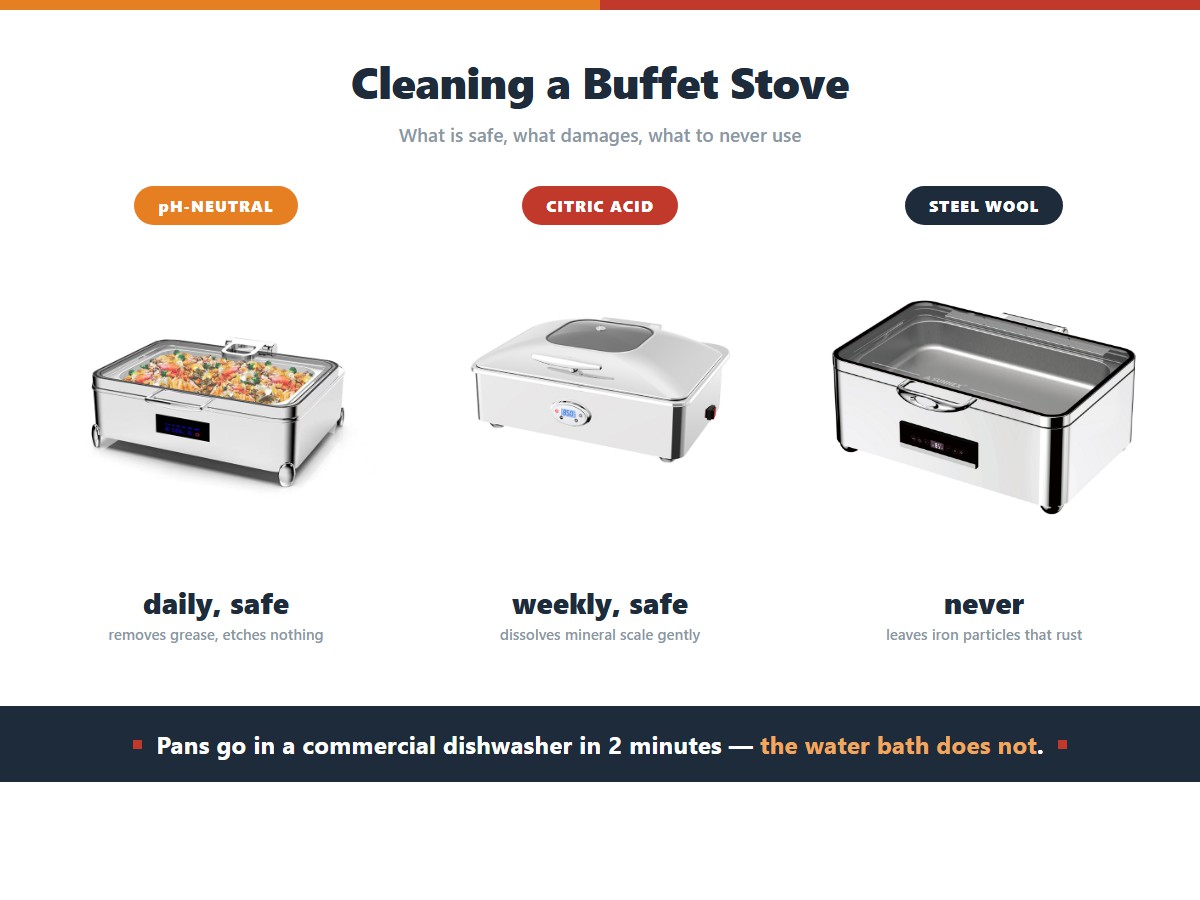
The Twenty-Minute Breakdown
| Minutes | Task | When | Method | Skip it and |
|---|---|---|---|---|
| 0–5 | Scrape and wipe | Immediately after service, hot | Plastic scraper, damp cloth | Carbon crusts permanently |
| 5–10 | Wash well and pans | While still warm | Neutral degreaser, non-abrasive pad | Acid etch, pitting |
| 10–15 | Dry everything | Same session | Air dry, then wipe | Scale and rust start here |
| 15–20 | Check element and thermostat | Last step | Look, listen for cycling, test once | Failure found during service |
What to Use and What to Avoid
| Product | Safe | Why | What it damages | Frequency |
|---|---|---|---|---|
| pH-neutral degreaser | Yes, daily | Removes grease without etching | Nothing | Daily |
| Citric acid descaler | Yes | Dissolves mineral scale gently | Nothing | Weekly |
| Diluted bleach | Occasionally | Works, but must rinse well | Chloride residue pits steel | Monthly at most |
| Stainless polish | Monthly | Restores finish | Nothing | Monthly |
| Steel wool | Never | Leaves iron particles that rust | Stainless surface, permanently | — |
| Abrasive powder | Never | Micro-scratches, traps soil | Finish and hygiene | — |
The four minutes most often given away are the drying ones, and they are the four that matter most. A wet well put away overnight will mineral-deposit by morning, that deposit becomes scale, and scale traps heat above the water line until the element cooks itself from the inside.
Frequently Asked Questions
How long does it take to clean a buffet stove?
About 20 minutes: 5 to scrape and wipe while hot, 5 to wash the well and pans, 5 to dry completely and 5 to check the element and thermostat. Weekly descaling adds 10 minutes.
Should I clean a buffet stove while it is hot?
Scrape and wipe while warm but not scorching. Hot enough to move grease, cool enough that you are not steaming yourself or shocking the glass of a light cover.
Can I use steel wool on a stainless buffet stove?
No. It leaves iron particles that rust and permanently pits the surface. A non-abrasive pad with a neutral degreaser is the correct tool and lasts longer.
Why does my buffet stove pit and stain?
Usually standing water left in the well overnight, or bleach residue not rinsed thoroughly. Both create the conditions for mineral deposit and then corrosion, and both are preventable by drying.
Do I need to descale a dry-heat buffet stove?
Not the cooking surface, since it has no water pan. But the element terminals and the underside of the top still collect carbon and mineral film, and both reduce heat transfer.
Related reading
- Are Buffet Stoves Worth It? Payback by Event Volume
- Outdoor Catering: Buffet Stoves That Survive Wind
- 5 Benefits of Buffet Stoves for Catering Businesses
- Automatic Heating on Buffet Stoves: How It Works
- 5 Beverage Dispenser Cleaning Mistakes That Cause Cloudy Tanks
- Beverage Dispenser Cleaning & Sanitation Checklist