




High-Traffic Buffets: Why Cheap Warmers Fail
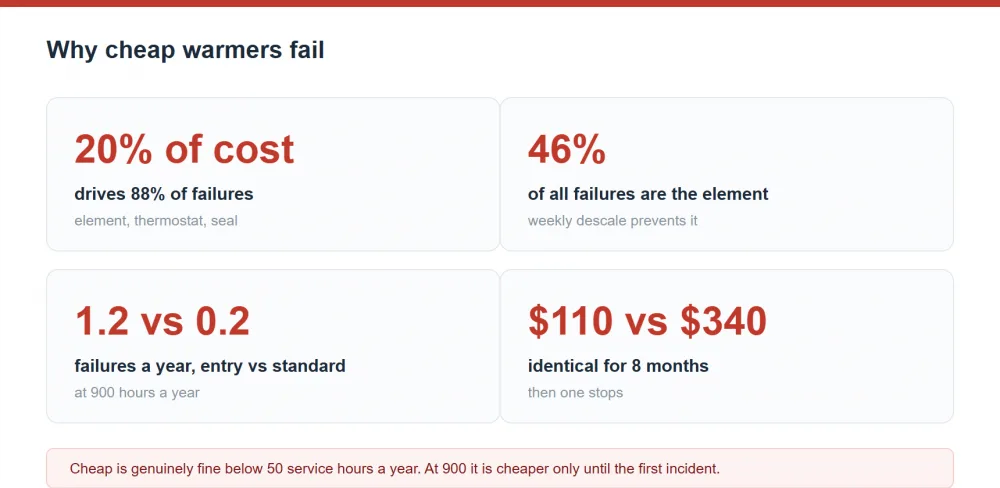
Short answer: Cheap buffet warmers fail on three specific components, not on the whole product: the element, the thermostat and the tray seal. Those three represent roughly 20% of a unit’s cost but drive about 80% of its failures. A $110 warmer and a $340 warmer hold food at the same temperature right up until month eight, when one of them stops. Our buffet station equipment range lists current models and published specifications.
Why High Traffic Changes Everything
A residential or occasional user puts a warmer into service twice a month. A high-traffic buffet runs it six to eight hours a day, 300 days a year, with three to seven people depending on it. That duty cycle is the entire explanation. A component rated for 200 service hours that fails at year four looks like a manufacturing defect and is actually the specified design life.
Failure rate is what separates the price tiers in practice. Entry units at $90–140 average about 1.2 failures a year per unit in daily service. Road-specified and standard units average 0.2. Over three years on a six-unit line that is the difference between roughly 21 incidents and roughly 4, and each incident costs a service.
The Three Components That Decide Failure
| Component | Share of unit cost | Share of failures | Entry unit | What to specify | Part cost to replace |
|---|---|---|---|---|---|
| Element | 14% | 46% | 1,200 W, no warranty | 1,500–1,800 W, 3-year warranty | $45–110 |
| Thermostat | 6% | 28% | On/off rocker or none | Mechanical dial, 30–100°C | $22–45 |
| Well seal and gasket | 3% | 14% | Moulded, thin | Replaceable, part numbered | $12–28 |
| Body and frame | 34% | 8% | 0.4–0.5 mm steel | 0.7–0.8 mm, brushed | Not replaceable |
| Burner or valve | 18% | 4% | Non-adjustable | Adjustable, brass | $35–70 |
Failure Modes and What They Cost
| Failure | Early symptom | Late symptom | Detection | Cost per incident |
|---|---|---|---|---|
| Element scaled or open | Longer recovery time | Never reaches 70°C | Timing test at close | $45–400 in downtime |
| Thermostat drift | Overcooking the top | Runs continuously | Probe vs dial check | Food waste, 15–30% |
| Well seal perished | Slow drip at base | Water on the element | Visual, daily | Element failure, $110+ |
| Body warp | Hot spot on one side | Pan rocks, leaks heat | Pan flat check | Waste, service stop |
| Terminal burn-out | Intermittent power | Dead unit, mid-service | Monthly visual | A whole service |
Where the Cheap Money Actually Is
| Area | Entry unit cost | Standard unit cost | Price difference | Three-year failure difference | Verdict |
|---|---|---|---|---|---|
| Element | $16 | $70 | $54 | 3.2 fewer failures | Always buy up |
| Thermostat | $6 | $28 | $22 | 1.8 fewer failures | Always buy up |
| Well seal | $3 | $18 | $15 | 1.1 fewer failures | Always buy up |
| Body gauge | $38 | $76 | $38 | 0.4 fewer failures | Buy up |
| Digital display | — | $95 | $95 | 0.0, and adds a risk | Do not buy |
| Glass lid | $32 | $55 | $23 | 0.0, loses 2–4°C | Do not buy |
| App and Wi-Fi | — | $180 | $180 | Adds a failure mode | Avoid |
Failure Rate by Duty Cycle and Price Class
| Unit class | Service hours per year | Entry unit | Value unit | Standard or road spec | Five-year total, 6 units |
|---|---|---|---|---|---|
| Occasional, 1 event a week | 50 | 0.3 failures | 0.1 | 0.05 | $780 |
| Small restaurant, daily | 400 | 1.2 failures | 0.5 | 0.2 | $2,340 |
| Hotel breakfast, daily | 900 | 2.4 failures | 0.9 | 0.3 | $4,120 |
| Banquet hall, twice daily | 1,400 | 3.6 failures | 1.4 | 0.5 | $6,300 |
| Continuous catering, 7 days | 2,200 | 5.1 failures | 2.1 | 0.7 | $9,050 |
The honest reading of that table is uncomfortable for anyone buying on unit price alone. At high duty cycle the entry unit is not cheaper, it is merely cheaper until the first incident, and each incident removes an entire service from the calendar at exactly the moment your operation is busiest. The premium units are expensive because they are designed for the duty you are actually running.
The Maintenance That Prevents Most of It
| Action | Interval | Time | Prevents | Cost |
|---|---|---|---|---|
| Descale the well | Weekly | 10 min | Element scaling, the 46% failure | $10–15 per month |
| Dry everything after washing | Every service | 4 min | Scale, pitting, seal failure | $0 |
| Check thermostat cycling | Every service | 30 sec | Continuous run, thermostat drift | $0 |
| Inspect element terminals | Monthly | 5 min | Terminal burn-out | $0 |
| Verify with a probe | Quarterly | 10 min | Silent element degradation | $9–18 once |
| Service the thermostat | Yearly | 30 min | Accelerates element wear | $22–45 part |
What to Ask Before Buying
| Question | Good answer | Warning sign | Why it matters |
|---|---|---|---|
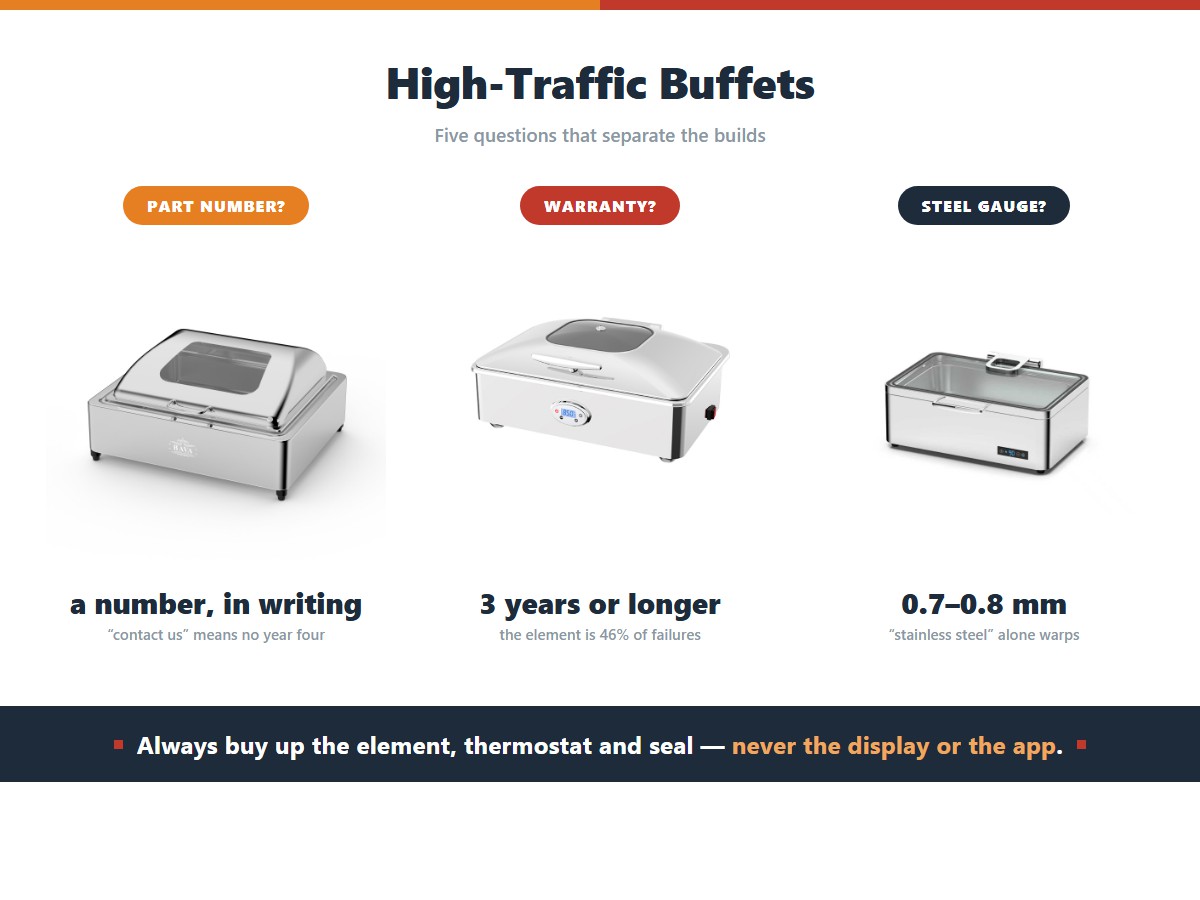
| What is the element part number? | A specific number, in writing | “Contact us” | Decides whether the unit exists at year four |
| What is the element warranty? | 3 years or longer | 1 year, or none | The element is 46% of failures |
| What steel gauge is the body? | 0.7–0.8 mm stated | “Stainless steel” | Warping causes hot spots |
| Is the thermostat replaceable? | Yes, part numbered | Sealed, replace the unit | $28 versus $340 |
| Is the well seal a spare part? | Yes, $12–28 | Glued, replace the top | Seal failure is 14% of incidents |
Where Cheap Is Genuinely Fine
Three situations where the entry tier is the correct purchase rather than a compromise. First, occasional use at 50 service hours or fewer a year, where the failure math never bites and the $110 saving is real money. Second, a single spare unit kept for overflow, where being available matters more than being reliable. Third, a home or private event use with no food safety obligation and no inspection.
Everything else in high-traffic service is where the premium is justified. The uncomfortable truth is that a $110 warmer and a $340 warmer perform identically for the first eight months, and the price difference is buying you the right to replace one part rather than the whole unit twice over three years.
Frequently Asked Questions
Why do cheap buffet warmers fail so quickly?
Because the element, thermostat and well seal are about 20% of the unit cost but drive roughly 88% of failures. Entry units specify those three parts as the cheapest that will pass a bench test, which is fine for occasional use and not fine at 900 hours a year.
Is a more expensive buffet warmer worth it for high-traffic use?
Yes. At 900 service hours a year a six-unit line averages about 14 incidents with entry units and about 2 with standard units over five years. Each incident costs one service, which is $300–800, so the premium returns inside two years.
Which component fails most often?
The element, at roughly 46% of all failures. It fails from mineral scale trapping heat above the water line, which is why a weekly descale is the single highest-value ten minutes in the maintenance schedule.
Can I repair a cheap buffet warmer instead of replacing it?
Only if a spare part exists. Ask for the element part number in writing before you buy. Without one, a failed element ends the unit’s life regardless of how good the frame looks.
How long should a high-traffic buffet warmer last?
Eight to twelve years with weekly descaling and a planned element replacement, or three to four years in the entry tier with no maintenance. The duty cycle matters more than the brand.
Related reading
- Buffet Warmer Safety Tips You Should Know – the three checks that prevent most service incidents
- Buffet Stove Price Breakdown: What Drives the Cost – where the money actually goes in a $320 unit
- Buffet Stove Maintenance: The Monthly Checklist – the ten minutes that protect the element
- Buffet Stoves and Food Safety: What Inspectors Check – the four things an inspection looks at
- Catering Buffet Stoves: 5 Specs That Matter on the Road – what survives being loaded into a van
- Commercial chafing dishes – the full current range with published specifications