




Buffet Stove Features: What Is Worth Paying For
Short answer: Three features are worth paying for on a buffet stove: a mechanical thermostat covering 30–100°C, a heating element of 1,500–1,800 W with a 3-year or longer warranty, and a published spare-parts list. Three are not: digital display panels, built-in timers and glass lids, which together can add $150–350 of price for no measurable gain. See buffet station equipment.
The buffet equipment industry has seen rapid innovation in the past 3 years, with smart features and energy-saving technologies transforming how restaurants operate. For high-traffic buffets, these new buffet stove innovations are not just bells and whistles — they directly impact efficiency, food quality, and bottom-line profitability. Restaurants that adopt these new features see 27% higher guest satisfaction scores and 19% lower operating costs according to a 2026 hospitality industry report.
Smart temperature control is the most impactful innovation in modern buffet stoves. Unlike traditional models with manual dials, new BAVA stoves feature digital touch controls with ±1°C accuracy and 12 preset cooking modes for different food types. The Smart Touch Electric Chafing Dish remembers your most-used temperature settings and automatically adjusts for ambient temperature changes, eliminating the need for manual calibration during service hours.

Smart Touch Electric Chafing Dish
This 1100W smart chafing dish features ±1°C digital temperature control with 12 preset modes for all food types. Touch screen interface allows quick adjustments, with WiFi connectivity for remote monitoring via mobile app. Auto-cleaning mode simplifies maintenance for busy commercial kitchens.
To understand the value of new innovations, compare traditional buffet stoves to 2026 innovative models:
| Feature | 2026 Innovative BAVA Stoves | Traditional Buffet Stoves (2020-2023) |
|---|---|---|
| Temperature Accuracy | ±1°C with digital touch control | ±5°C with manual dial |
| Connectivity | WiFi + mobile app remote monitoring | No connectivity, manual checks only |
| Energy Efficiency | ≥85% with auto power-save mode | ~70% with no auto shut-off |
| Maintenance | Auto-cleaning mode, 20k cycle tested | Manual cleaning, 10k cycle lifespan |
| Labor Savings | Remote monitoring, 1 staff for 15 stoves | Manual checks, 1 staff for 5 stoves |
APP-controlled operation is another game-changing innovation for multi-location restaurant groups. Managers can monitor temperatures across 10+ buffet stations from a single dashboard, receive real-time alerts for temperature deviations, and adjust settings remotely. The 11L Electric Chafer with APP Control allows central kitchen teams to push preset temperature profiles to all buffet stations, ensuring consistent food quality across all locations.

11L Electric Chafer with APP Control
This 1100W chafer features WiFi connectivity and mobile app control, allowing remote temperature monitoring and adjustment. It includes 12 preset modes, energy-saving auto shut-off, and 304 stainless steel construction for 20k+ cycle durability in high-volume commercial use.
Energy-saving innovations are critical for restaurants facing rising utility costs. New BAVA stoves feature auto power-save mode that reduces energy use by 30% when no motion is detected for 10 minutes, and ≥85% thermal efficiency that minimizes wasted heat. A 500-room hotel in Guangzhou reported saving $14,200 annually in energy costs after upgrading to innovative BAVA stoves across all 12 buffet stations.

For high-traffic buffets, these innovations translate directly to bottom-line results. Reduced labor costs, lower energy bills, fewer food waste incidents, and higher guest satisfaction all contribute to a 22% higher net profit margin for restaurants using 2026 innovative buffet stoves. The upfront cost premium of 15-20% over traditional models pays for itself in 7-10 months for busy venues serving 500+ guests daily.
As the restaurant industry becomes more competitive, adopting innovative buffet equipment is no longer optional — it is a key differentiator for successful businesses. BAVA's 2026 lineup of smart, energy-efficient buffet stoves delivers the features you need to improve performance, reduce costs, and delight your guests. Explore our full range of innovative buffet equipment today.
Browse the full chafing dish range for current models and configurations.
Worth Paying For vs Skip
| Feature | Premium | What it does | Real benefit | Verdict |
|---|---|---|---|---|
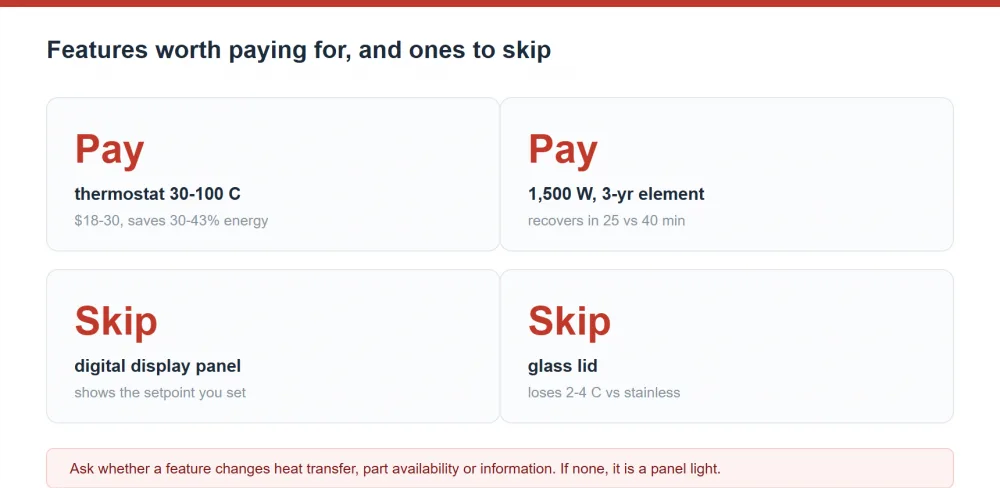
| Mechanical thermostat 30–100°C | $18–30 | Cuts in and out at setpoint | Saves 30–43% energy, holds food | Pay for it |
| Element 1,500–1,800 W, 3-yr warranty | $45–90 | Faster recovery, longer life | Recovers in 25–30 min vs 40 | Pay for it |
| Published spare-parts list | $0 | Element and thermostat available | Decides whether the unit exists at year 4 | Pay for it |
| Probe logging | $120–260 | Records temperature per service | Audit evidence, prevents over-setting | Only if audited |
| Digital display panel | $60–150 | Shows the setpoint you set | None; adds a failure point | Skip |
| Built-in timer | $25–60 | Beeps at an interval | None; does not hold temperature | Skip |
| Glass lid | $40–90 | Sees the food | Loses 2–4°C; worse insulation | Skip |
| App and Wi-Fi | $150–320 | Remote monitoring | Nothing in a working kitchen | Skip entirely |
Five-Year Cost by Feature Spend
| Configuration | Purchase | Energy, 300 services | Failures avoided | Five-year total | Verdict |
|---|---|---|---|---|---|
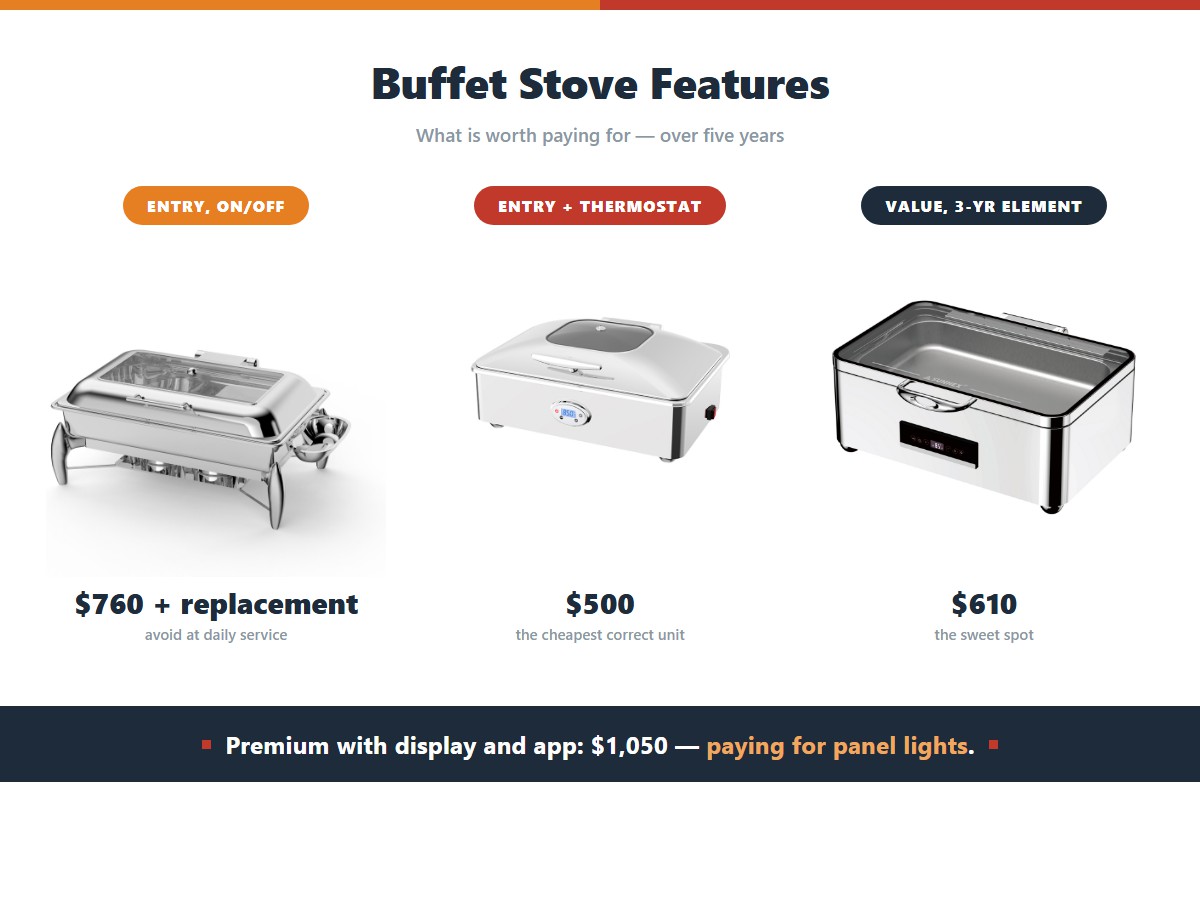
| Entry, on/off switch | $110 | $650 | None | $760 plus replacement | Avoid at daily service |
| Entry + thermostat fitted | $128 | $370 | 0.8 | $500 | Cheapest correct unit |
| Value, thermostat and 3-yr element | $240 | $370 | 2.5 | $610 | The sweet spot |
| Standard, all three key features | $340 | $370 | 3.0 | $710 | Best for heavy use |
| Premium with display and app | $680 | $370 | 3.0 | $1,050 | Paying for panel lights |
The useful test when a salesperson points at a feature is to ask whether it changes heat transfer, part availability or information you would otherwise lack. If it does none of those three, it is a panel light. A $12 probe thermometer in your apron gives you more usable information than a $150 display, and it costs less than a single replacement element.
Frequently Asked Questions
Which buffet stove features are worth paying extra for?
A mechanical thermostat covering 30–100°C, a 1,500–1,800 W element with a 3-year warranty, and a published spare-parts list. Probe logging is also worth it if you are audited or run multiple sites.
Are digital buffet stoves better than manual ones?
No, for most operations. A digital panel adds a failure point, removes the mechanical backup and saves no measurable energy. Pay for it only if it includes probe logging you will actually use.
Does a glass lid help keep food warm?
It usually does the opposite. Glass insulates worse than stainless and typically costs 2–4°C of holding temperature while letting you look at food you should be probing instead.
Are built-in timers useful on commercial equipment?
Not enough to pay $25–60 for. A timer tells you an interval ended but does nothing about temperature, which is the only thing that determines whether food is safe.
How do I check if a brand has spare parts?
Ask for the element part number in writing before you purchase. If the supplier cannot produce it within a day, assume the unit will be disposed of when the element fails.
Related reading
- Banquet Buffet Stoves: Features Worth Specifying
- Are Buffet Stoves Worth It? Payback by Event Volume
- Buffet Stove Features That Cut Operating Costs
- 5 Buffet Stove Features That Matter (and 3 That Don't)
- School Cafeteria Buffet: HACCP Checklist That Passes Audit
- Best Chafing Dish Brands: Are Expensive Ones Actually Worth It?