




Standard vs Commercial Buffet Stove: What Changes
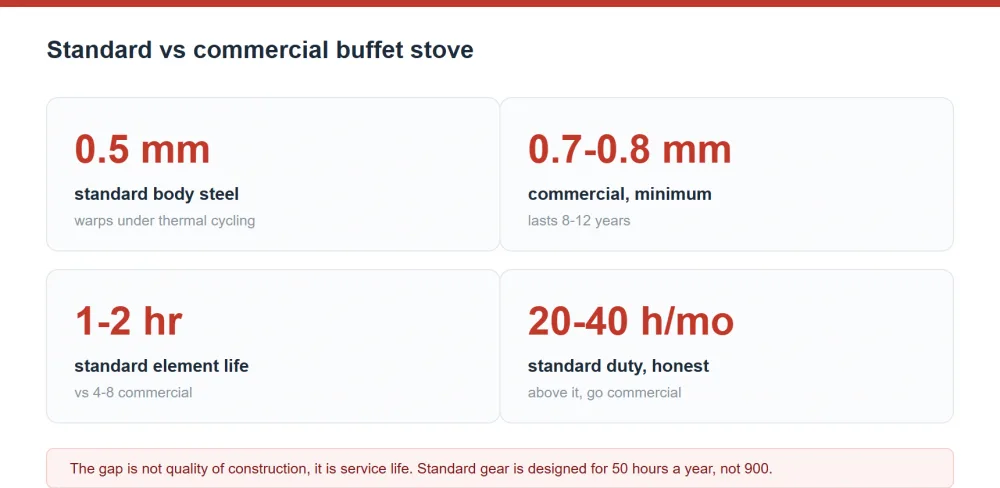
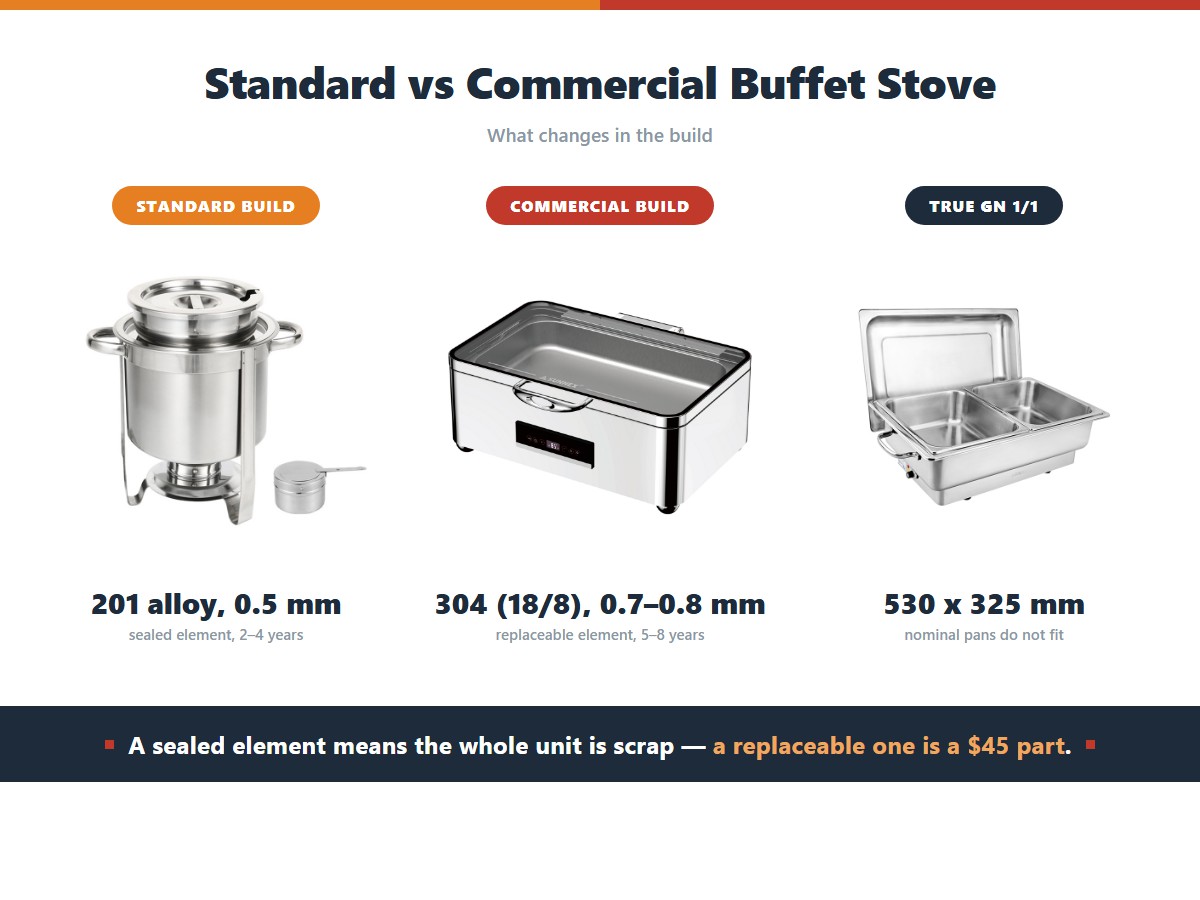
Short answer: a commercial buffet stove uses 304 (18/8) stainless with a 0.6-0.8 mm food pan and a 1.0-1.2 mm frame, a replaceable 400-600 W element and GN 1/1 pans. A standard unit typically runs 201 alloy at 0.4-0.5 mm with a sealed element, and lasts 2-4 years against 5-8. See both builds in our commercial chafing dish range.
The five differences that matter
| Part | Standard buffet stove | Commercial buffet stove |
| Alloy | 201 stainless | 304 (18/8) stainless |
| Food pan gauge | 0.4-0.5 mm | 0.6-0.8 mm |
| Frame gauge | 0.8 mm, riveted | 1.0-1.2 mm, welded |
| Heating element | Sealed, non-replaceable | Replaceable, wired terminal block |
| Pan standard | Nominal, often non-GN | True GN 1/1, 530 x 325 mm |
Why 201 stains and 304 does not
Both are stainless, but 201 carries manganese instead of some nickel. In a humid buffet room or a coastal venue, 201 develops tea-coloured staining within 12 months and pitting within three years, while 304 keeps its finish. The price gap is small per unit and large per replacement cycle. Our 304 vs 201 comparison has the full breakdown.
Gauge: what a difference of 0.2 mm buys
A 0.4 mm pan dents on the first transport and warps the first time it boils dry. A 0.7 mm pan absorbs the same abuse and stays flat, which matters because a warped pan no longer sits level in the water bath — and an uneven bath is what scorches food at one edge.
| Gauge | Behaviour under daily use | Typical life |
| 0.4 mm | Dents, warps when dry | 1-2 years |
| 0.5 mm | Dents at the rim | 2-3 years |
| 0.6-0.8 mm | Holds shape, resists dry firing | 5-8 years |
Replaceable elements change the repair maths
A sealed element turns a $15 failure into a scrapped unit. On a replaceable design, a technician swaps the element in about 10 minutes with a screwdriver and two spade connectors. Keep one spare element per five units and the line never stops for a heating fault.
How to tell them apart before you buy
- Ask for the spec sheet with alloy and gauge for pan, water pan and frame. A supplier who cannot state it is selling the thinner build.
- Weigh the unit. A full-size commercial frame with a 0.7 mm pan is noticeably heavier than a 0.45 mm equivalent.
- Check the corners. Welded and polished corners are commercial; rivets and sharp edges are not.
- Look for a terminal block. Visible wiring with spade connectors means the element can be replaced.
- Test the pan fit. A true GN 1/1 pan drops in without rocking.
Is the commercial build always worth it?
Not always. For a home buffet server used ten times a year, a standard unit is rational. For anything that runs weekly — a restaurant, a hotel breakfast, a catering company — the commercial build pays back inside the first replacement cycle, and the replaceable element keeps paying after that.
How to write the spec into your purchase order
Most quality failures start as an ambiguous order. Put these lines in the PO and there is nothing left to interpret:
- Food pan: 304 stainless, 0.7 mm, GN 1/1, 65 mm deep.
- Water pan: 304 stainless, 0.7 mm, welded corners.
- Frame: 304 stainless, 1.0 mm minimum, welded and polished joints.
- Element: replaceable, 500 W, 120 V or 240 V as specified, with spare element.
- Lid: roll-top, stainless, with damper and serviceable hinge.
- Warranty: 12 months frame and element, spare parts list attached.
A supplier who quotes "high quality stainless steel" without numbers is quoting the cheapest build that satisfies the sentence. The written spec is the only thing that separates a five-year unit from an eighteen-month one.
Frequently Asked Questions
Can I use a standard pan in a commercial frame?
Sometimes, but the depths differ and the pan may sit too low, leaving the rim in the water. Always match the pan to the frame's stated GN size and depth.
Is 201 stainless safe for food?
Yes, it is food-safe. The problem is durability and staining in humid or coastal conditions, not safety.
How can I check the gauge without a caliper?
Compare weight and rim stiffness against a known 0.7 mm pan. A cheap caliper costs less than one wrong order and removes the guesswork.
Do commercial buffet stoves use more power?
No. Most commercial units draw 400-600 W, similar to standard models. Better insulation and a tighter lid keep the duty cycle lower.
What warranty should a commercial unit carry?
Twelve months on the frame and element is standard; some suppliers offer 24 months on the frame. Get it in writing with the spare parts list.