


Buffet Stove Features: 5 That Cut Operating Costs
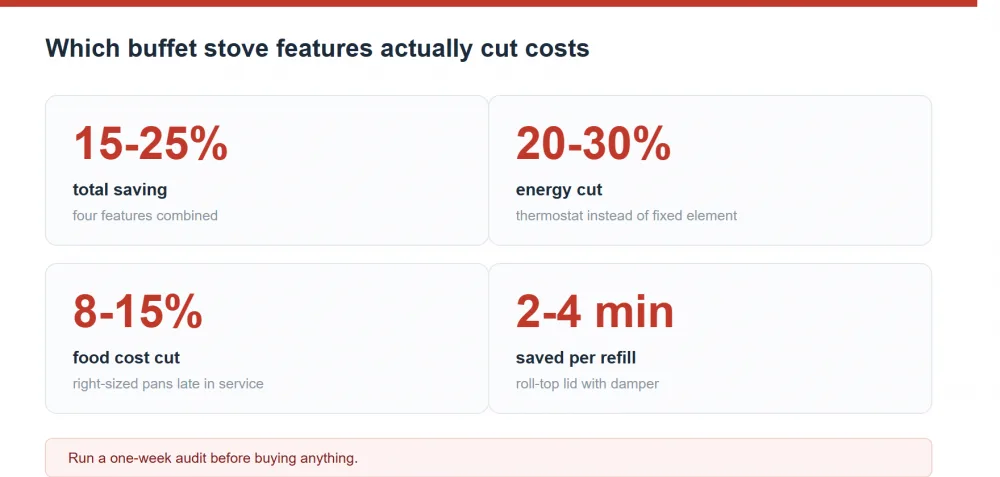
Short answer: four features carry most of the operating saving — a thermostat instead of a fixed element, an insulated or double-wall lid, right-sized GN pans, and a roll-top lid with a damper. Together they cut energy and labour by 15-25% on a busy line. See the models in our chafing dish range.
Features ranked by what they actually save
| Feature | What it saves | Typical annual value |
| Thermostat control | Runs at holding temperature, not full power | $30-60 per unit in electricity |
| Double-wall or insulated lid | Fewer reheats, less condensation drip | 10-15% of energy use |
| Correct GN pan size | Less over-production and waste | 8-15% of food cost |
| Roll-top lid with damper | Faster service, shorter lid-open time | 2-4 staff minutes per service |
| Replaceable element | Avoids scrapping the unit | $150-200 per avoided replacement |
Thermostats: the difference between holding and boiling
A fixed element runs flat out until the water boils, then keeps boiling. A thermostat holds the bath at 140-160°F (60-71°C), which is all a hot-holding pan needs. The energy difference is 20-30% on a unit that would otherwise cycle at full power for four hours.
Lids do more work than elements
Heat leaves a pan through the lid, not the base. A single-wall lid with a loose fit loses enough heat to force a higher setting; a double-wall or insulated lid keeps the surface above 60°C with a lower duty cycle. It also reduces condensation dripping onto food, which is a quality complaint as much as a cost one.
Pan sizing: the cheapest saving available
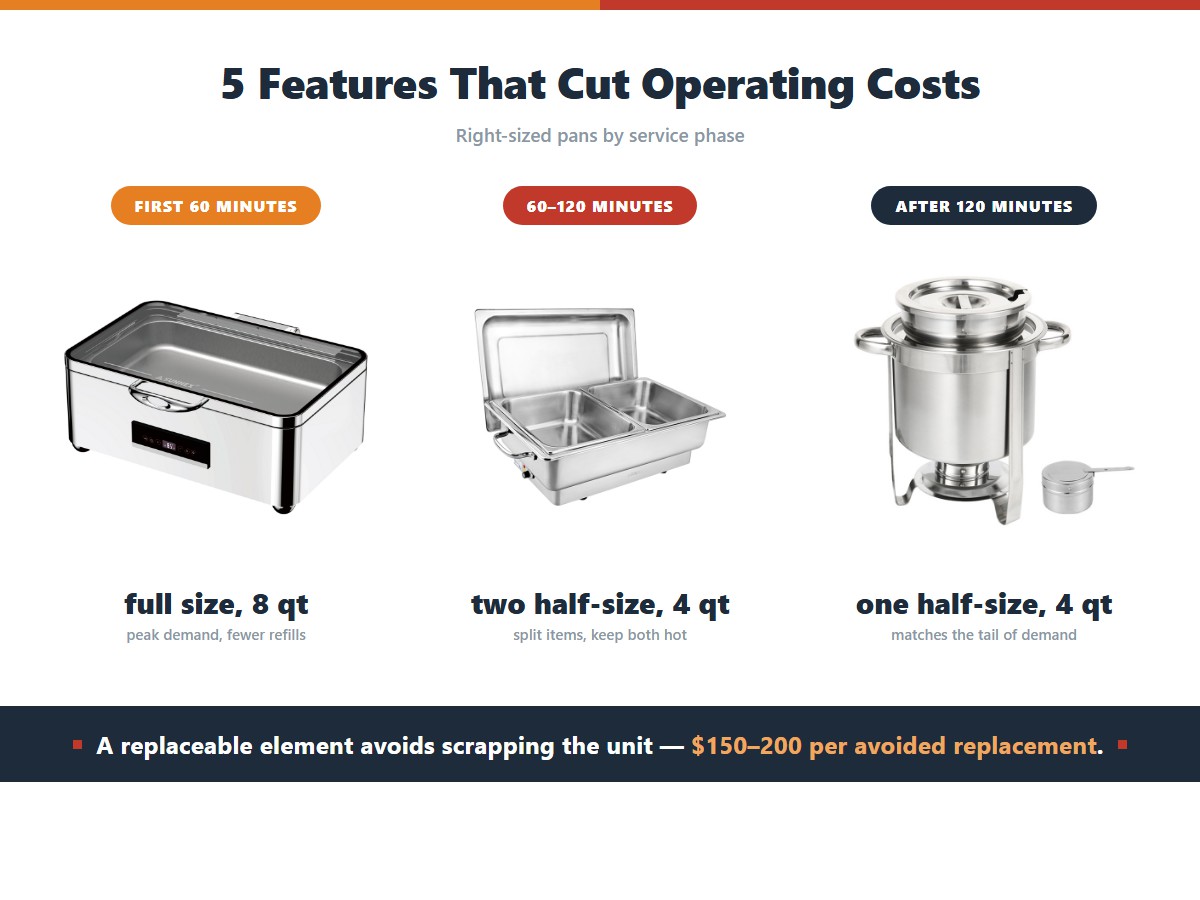
Oversized pans are the most common cost leak in a buffet. A 9 qt pan filled one third of the way for the last two hours of service wastes food and heat at the same time. Switch to a half-size pan for the tail of service:
| Service phase | Pan to use | Why |
| First 60 minutes | Full size 8 qt | Peak demand, fewer refills |
| 60-120 minutes | Two half-size 4 qt | Split items, keep both hot |
| After 120 minutes | One half-size 4 qt | Matches the tail of demand |
What does not save money, despite the brochure
- Higher wattage. A 900 W element heats faster but costs twice as much to hold the same temperature.
- Extra features with no function. Digital displays and decorative trim add failure points, not savings.
- Cheaper steel. A 201 pan that stains in year one costs more than the electricity it ever used.
How to check the claim before you buy
- Ask for the rated wattage and the recommended holding setting.
- Run one service with a plug-in energy meter — a $15 device settles the argument.
- Compare kWh per cover, not kWh per unit. That is the number that scales.
- Check that the thermostat range includes 140-165°F (60-74°C), not just maximum.
A one-week audit you can run yourself
Before buying anything, measure what the current line actually does. It takes one week and a $15 plug-in energy meter:
- Meter one full-size unit for a complete service and note kWh.
- Record how many times a lid is opened and how long it stays open.
- Weigh the food discarded from each pan at close.
- Time one refill round, from picking up the pan to closing the lid.
Most operators find three things: lids stay open far longer than staff believe, one or two pans are consistently overfilled, and the element is running at full power long after the bath reached temperature. Fixing those three costs nothing and typically recovers half of the 15-25% saving before a single new unit is bought.
Frequently Asked Questions
Does a thermostat really cut electricity use?
Yes. A fixed element runs continuously; a thermostat cycles on and off around the set point, typically cutting consumption by 20-30% over a four-hour service.
Are double-wall lids worth the extra cost?
For daily service, yes — the energy saving and the reduction in condensation pay back within a year. For occasional use, a single-wall lid is fine.
What wattage should I choose?
400-600 W for a full-size pan. Higher wattage only shortens preheat; it does not improve holding.
Do pan lids need to be vented?
A small vent reduces condensation dripping onto food. Fully sealed lids collect water and drip when opened.
How much does one buffet stove cost to run per service?
About $0.25 for a four-hour service at 500 W and $0.15/kWh, assuming a 30% duty cycle. Fuel for the same service costs $2.40-6.00.
Related reading
- Fuel vs electric cost per service hour
- Buffet stove energy use: where the watts go
- Counter space a buffet line needs
- How much water goes in a water pan
- 7 Buffet Layout Mistakes That Waste 30% of Your Space
- 5 Buffet Stove Features That Matter (and 3 That Don't)
- Can Buffet Stoves Reduce Labor Costs in Your Restaurant?