


Buffet-Style Restaurant: Which Stove to Buy
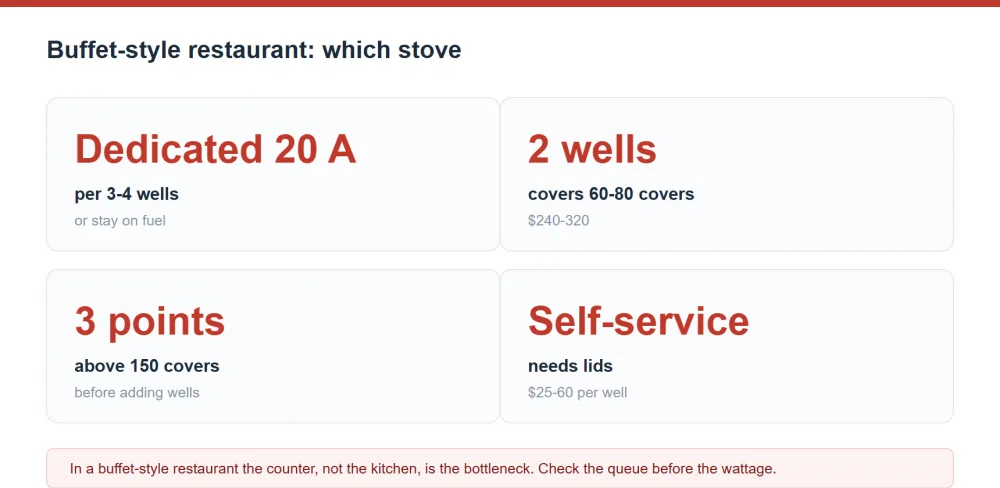
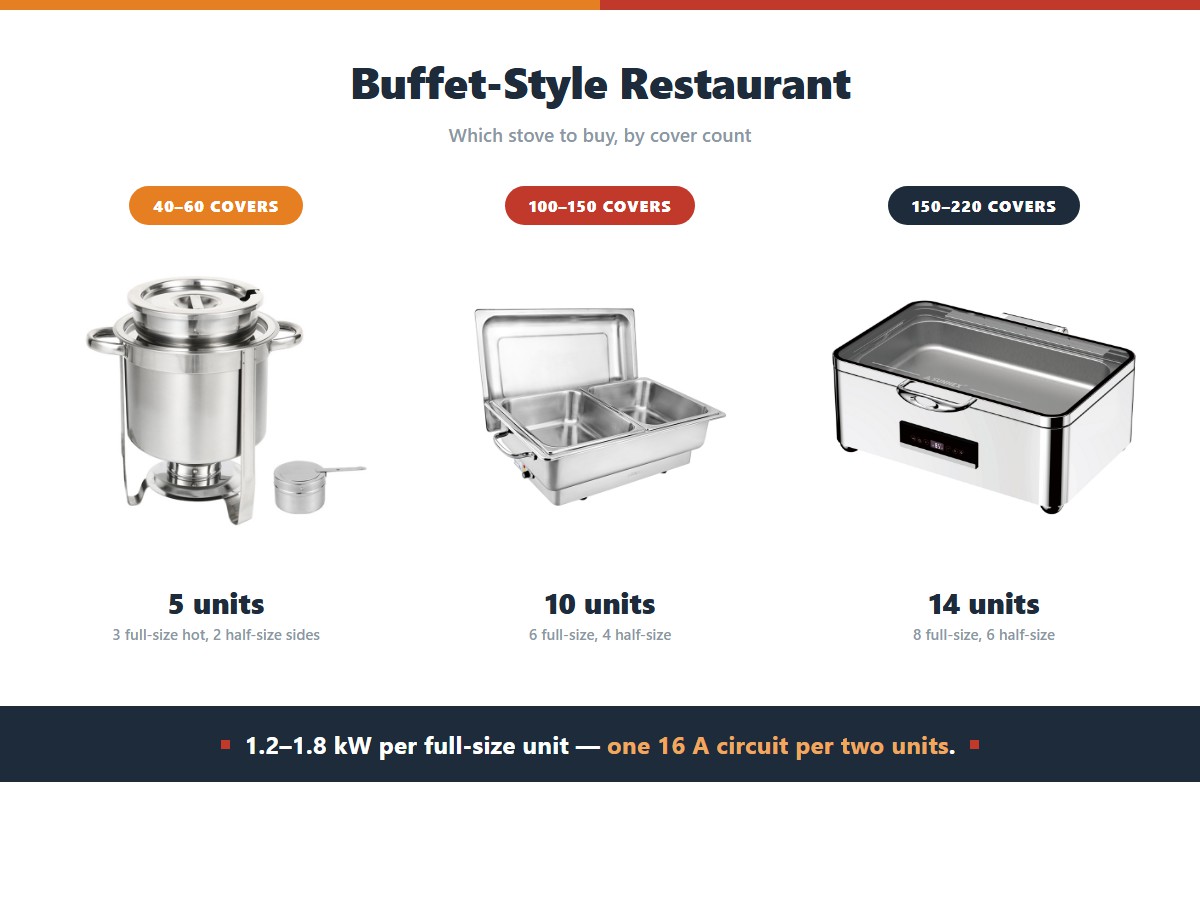
Short answer: a buffet-style restaurant serving 150-300 covers a day needs 4-6 full-size (8-9 qt) buffet stoves for hot entrées, 2-3 half-size units for sides, and one spare frame kept ready. Plan 1.2-1.8 kW of connected load per full-size electric unit and one 16 A circuit per two units. Compare configurations in our commercial chafing dish range.
Size to the half-hour, not to the day
Daily covers tell you how much food to cook. Peak covers per 30 minutes tell you how many pans have to be hot at the same time — and that is the number that decides your equipment count.
| Covers in the busiest 30 min | Full-size hot pans | Half-size side pans | Total units |
| 40-60 | 3 | 2 | 5 |
| 60-100 | 4 | 3 | 7 |
| 100-150 | 6 | 4 | 10 |
| 150-220 | 8 | 6 | 14 |
| 220+ | 10+ | 8 | 18+ |
Add one spare frame per station. A buffet with no spare stops serving the moment a thermostat fails, and a service interruption costs more than the extra unit ever will.
Four stations, four different jobs
- Hot entrées: full-size 8-9 qt pans, roll-top lids, electric if the line has power.
- Sides and vegetables: half-size pans at 4 qt; they refill faster and waste less late in service.
- Carving or live cooking: a full-size frame plus a heat lamp overhead, not a deeper pan.
- Dessert and breakfast items: round 4 qt units or tiered stands; they read better and take less counter length.
Electric or fuel for a fixed restaurant line
For a restaurant that serves the same room every day, electric wins on three counts: the thermostat holds 140-165°F (60-74°C) without attention, there are no cans to store or dispose of, and running cost is roughly $0.06 per hour against $0.60-1.50 for canned fuel. Fuel stays useful for terrace service, pop-ups and any station that moves. The full cost comparison is in fuel vs electric running costs.
What separates a buffet stove from a catering chafer
| Specification | Restaurant buffet stove | Mobile catering chafer |
| Steel | 304 (18/8), 0.6-0.8 mm food pan | Often 201, 0.4-0.5 mm |
| Frame | 1.0-1.2 mm, welded corners | 0.8 mm, riveted |
| Element | Replaceable, 400-600 W | Sealed or none (fuel) |
| Lid | Roll-top with damper or soft-close | Lift-off, lighter gauge |
| Service life | 5-8 years at daily use | 2-4 years |
If a quote does not state alloy and gauge, assume the thinner option. That is the single most common reason restaurant chafers fail in year two.
Cost per cover beats cost per unit
A $40 cheaper pan that dents in month three costs more than the $180 unit that lasts five years. Work the number per cover instead:
| Item | Cheap unit | Commercial unit |
| Purchase price | $95 | $210 |
| Replacement cycle | 2 years | 6 years |
| Cost per year | $47.50 | $35 |
| Cost per 1,000 covers | $7.90 | $5.80 |
Five mistakes that shorten service life
- Running the water pan dry — warps a thin pan within minutes.
- Stacking frames without lid rests — bent hinges are the first failure.
- Using abrasive pads on brushed steel — scratches trap food soil and rust.
- Putting all units on one circuit — nuisance trips at peak, every service.
- Buying pans that are not GN 1/1 — replacement pans then cost double.
What a 200-cover dinner actually looks like
Numbers on a spec sheet are abstract; a service is not. Take a 200-cover restaurant dinner with a 90-minute window and a four-item hot line:
- Two 8 qt pans hold the entrée at peak, refilled twice — four pan-loads in 90 minutes.
- Four half-size pans carry the sides, refilled once each.
- One full-size pan covers the vegetarian option at roughly half the volume.
- Total: seven frames, eleven pans, two refill rounds, one attendant.
That configuration runs comfortably on two 16 A circuits and leaves one frame spare. If the same room serves 200 covers in 30 minutes instead of 90, the pan count rises to nine and the refill rounds double to four — which is exactly why sizing to the half-hour matters more than sizing to the day.
Frequently Asked Questions
How many buffet stoves do I need for 200 covers?
Plan 6-8 full-size units and 5-6 half-size units if most of the 200 arrive within one hour. If service is spread over three hours, 4-5 full-size units are enough because pans can be refilled between waves.
Can I mix electric and fuel units on one line?
Yes, and many restaurants do: electric on the fixed wall, fuel on the movable island. Keep the fuel units out of guest walkways and store cans away from heat.
Do buffet stoves need a dedicated circuit?
Two 400-600 W units can share a 16 A circuit. Keep the carving station or induction hob on its own breaker, because it draws 2-3 kW by itself.
What pan depth should I choose?
65 mm for entrées and sides, 100 mm for sauces and stews. Deeper pans slow refills and hold heat unevenly at the edges.
How often should I replace a buffet stove?
With 304 steel and daily use, 5-8 years. The frame usually outlives the element, so buy a model with a replaceable element and keep one in stock.