


2026 Hotel Buffet Equipment Trends: Guest Experience & Efficiency
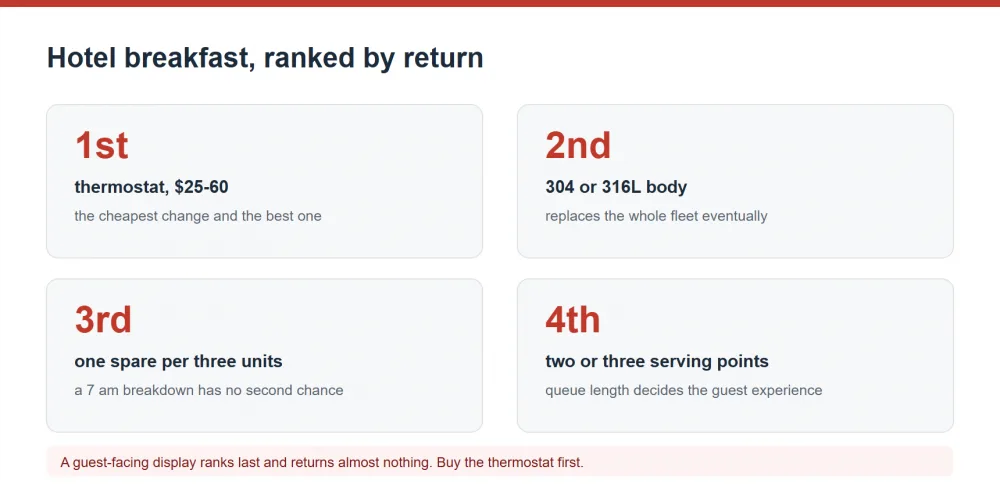
Short answer: The hotel buffet decisions that matter in 2026 are four: a mechanical thermostat rather than a display, a 316L or 304 body rather than 201, one spare unit per three in service, and 2–3 serving points rather than one long line. Guest-facing presentation technology is the least valuable of the five trends being sold. See buffet station equipment.

2026 Hotel Buffets: Where Experience Meets Efficiency
Hotel buffets in 2026 face a dual mandate: deliver Instagram-worthy guest experiences while maximizing operational efficiency. With guest satisfaction scores directly impacting ADR (Average Daily Rate) and RevPAR, hotels are investing heavily in equipment that enhances food presentation, maintains precise temperatures, and reduces labor costs through automation.
This analysis covers the five equipment trends defining successful hotel buffets in 2026, from guest-facing innovations to back-of-house efficiency gains that protect margins in an increasingly competitive hospitality market.

1. Guest-Facing Food Presentation Technology
In 2026, 73% of hotel guests research dining options online before booking. Buffet presentation directly influences booking decisions, driving demand for equipment that keeps food visually appealing throughout service. Modern electric chafing dishes with uniform heat distribution prevent "cold spots" that make food look unappetizing, while humidity-controlled lids maintain food texture and color for 4+ hours without drying.
Leading hotels report that upgrading to precision-controlled electric warmers increased guest satisfaction scores by 15-22% within 6 months, with the biggest gains in "food quality" and "freshness" categories of post-stay surveys.

Full Size 11L Electric Chafer
With 11L capacity covering standard hotel half-pan and full-pan configurations, this unit maintains ±3°F temperature precision across the entire surface. The brushed stainless finish photographs well for social media, while the rapid heat recovery (under 90 seconds after lid opening) ensures food stays presentation-ready even during peak service periods when lids are frequently lifted.
2. Labor Cost Reduction Through Automation
Hotel F&B labor costs reached 38% of revenue in 2025, up from 28% pre-pandemic. Equipment automation is a primary strategy to reverse this trend. Smart electric chafing dishes with preset temperature profiles eliminate manual adjustments between breakfast, lunch, and dinner service. IoT-connected units alert kitchen staff only when intervention is needed, reducing buffet monitoring labor by 40%.
Automation extends to HACCP compliance: instead of hourly manual temperature checks, smart warmers log temperatures automatically and generate audit-ready reports. Hotels using automated logging reduce F&B labor costs by $18-25 per guest room annually while improving compliance scores.
3. Energy Efficiency and Sustainability Goals
Major hotel brands (Marriott, Hilton, Hyatt) have committed to 50% carbon reduction by 2030, making energy-efficient buffet equipment a procurement priority. Modern electric chafing dishes consume 30-45% less electricity than 2018 models through improved heating element design and superior insulation.
The ROI timeline is compelling for high-volume hotels: a 300-room property with daily breakfast, lunch, and dinner buffet service typically recovers the equipment investment in 14-18 months through energy savings alone, before factoring in labor reductions.

Electric Chafing Dish Food Warmer
Its compact footprint fits hotel suite catering, VIP lounge service, and small-batch buffet stations. The dual-voltage design (120V/240V) supports international hotel chains standardizing equipment across regions. Energy Star certification and modular serviceable design align with hotel sustainability and lifecycle cost requirements.
4. Health-Conscious Buffet Trends
Post-pandemic guest preferences permanently shifted toward health-conscious dining. Hotel buffets in 2026 emphasize: separate serving utensils for each dish (reducing cross-contamination), clear nutritional labeling at each station, dedicated gluten-free and vegan stations with color-coded equipment, and touchless serving options including motion-sensor dispensers and app-ordering for made-to-order stations.
Electric chafing dishes support these trends with precise temperature control for delicate items (seafood, plant-based proteins) that require tighter temperature ranges than traditional buffet fare. The ability to maintain 140-150°F without overcooking extends the presentation window for health-focused menu items.
5. Integration with Hotel Management Systems
2026 hotel buffet equipment increasingly integrates with property management systems (PMS) and kitchen display systems (KDS). Smart warmers with occupancy sensors adjust temperature profiles based on real-time guest count from the PMS, reducing energy waste during low-occupancy periods. Integration with inventory management systems triggers automatic reordering when buffet consumption patterns indicate supply shortfalls.
Data-driven buffet management is becoming a competitive differentiator: hotels using smart equipment report 12% higher F&B revenue per guest through optimized menu planning, reduced waste (18% improvement), and dynamic pricing for premium buffet experiences during high-demand periods.
Conclusion
Hotel buffets in 2026 succeed by balancing two priorities: creating memorable guest experiences through superior food presentation and temperature precision, while maximizing operational efficiency through automation and energy savings. Electric chafing dishes with smart controls, uniform heating, and hotel management system integration deliver on both fronts. BAVA's 2026 hotel-grade warming solutions are engineered for the demanding environment of modern hospitality, helping hotels protect margins while delighting guests and driving repeat bookings.
Browse the full chafing dish range for current models and configurations.
Hotel Buffet Trends, Ranked by Return
| Trend | Claimed value | Actual return | Cost | Payback | Rank |
|---|---|---|---|---|---|
| Mechanical thermostat | Consistent food | 30–43% energy, 3–5°C hold | $25–60 | 2–5 months | 1 |
| 304 or 316L body | Durability | 5–8 years vs 1–2 | $18–45 | First replacement | 2 |
| Spare unit per 3 in service | Resilience | Avoids a failed service | $340–900 | Insurance | 3 |
| 2–3 serving points | Guest experience | Wait 5–7 min to 1–2 | $0–340 | Immediate | 4 |
| Guest-facing display or scale | Presentation | Mostly cosmetic | $120–320 | Never | 5 |
| Mobile ordering at the line | Speed | Slows the line 10–20 s | Subscription | Never | 6 |
| PMS integration for equipment | Efficiency | No kitchen effect | Integration cost | Never | 7 |
| Plant-based menu section | Guest preference | Real, if small pans | Equipment-neutral | — | — |
Breakfast Buffet, 200 Covers
| Line | Minimum | Standard | High volume | Note |
|---|---|---|---|---|
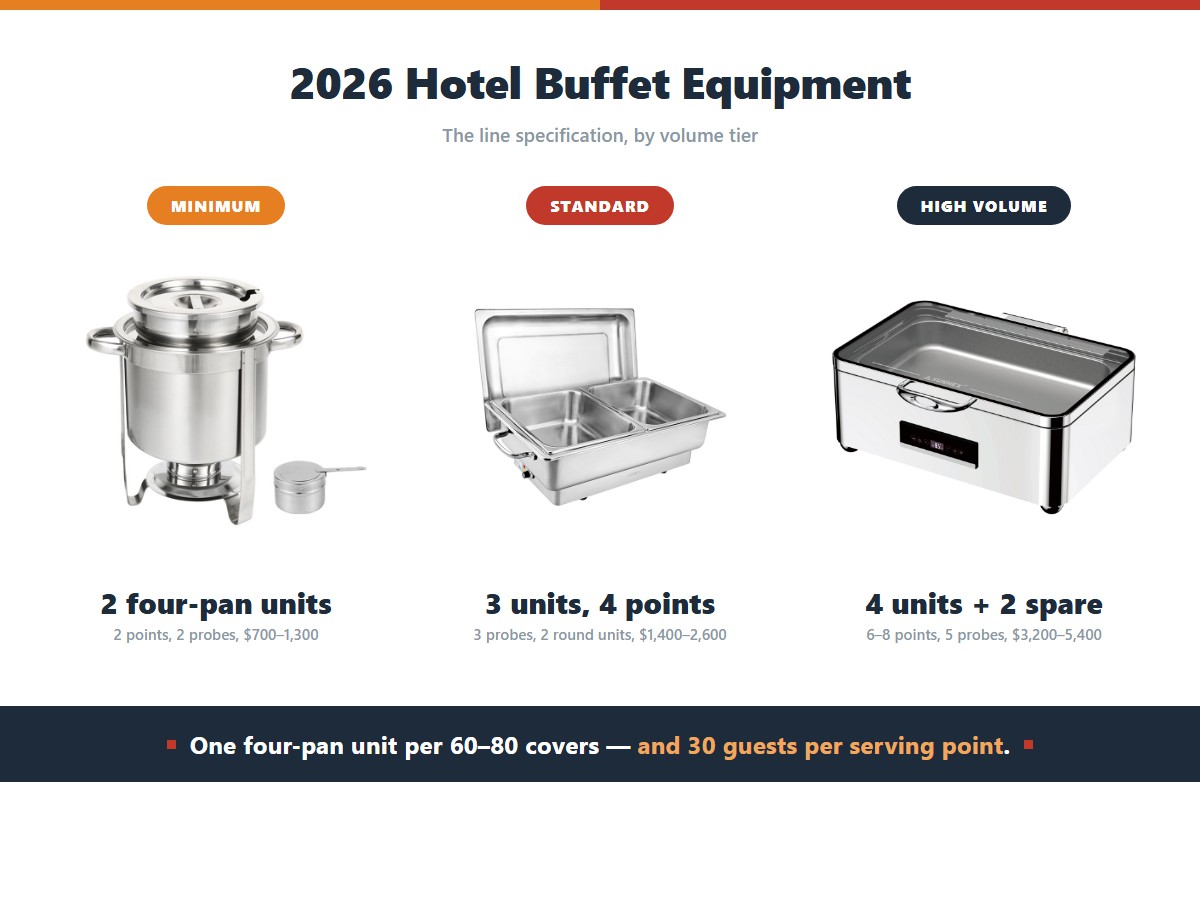
| 4-pan units | 2 | 3 | 4 plus 2 spare | One per 60–80 covers |
| Serving points | 2 | 4 | 6–8 | 30 guests per point |
| Round units at edges | 0 | 2 | 4 | Split points, not one line |
| Probe thermometers | 2 | 3 | 5 plus spare | One per station |
| Spare element and cord | 1 each | 2 each | 3 each | 5–14 day lead time |
| Bain-marie | 0 | 1 | 2 | For yogurt, porridge, sauces |
| Equipment cost | $700–1,300 | $1,400–2,600 | $3,200–5,400 | Excludes installation |
| Daily cleaning, 3 units | — | 30–45 min | 60–90 min | The staffing constraint |
Two patterns hold across this batch. First, the decisions with a measurable payback are all unglamorous: a thermostat, a body grade, a spare unit and a proper serving point layout. Second, the technology that vendors lead with, displays, apps and property-system integration, has no measurable effect on food temperature, energy cost or throughput. Buying decisions ranked by return puts all four of the first group above all four of the second.
Frequently Asked Questions
What matters most in a hotel buffet equipment decision?
A mechanical thermostat at 30–43% energy saving, a 304 or 316L body for a 5–8 year life, one spare unit per three in service, and 2–3 serving points. Those four outrank every technology trend currently being sold.
How many serving points for a 200-cover hotel breakfast?
Four, at 30 guests per point. Three 4-pan units split across four points, plus two round units at the edges. Peak wait falls from five to seven minutes to one or two at almost no equipment cost.
Do guest-facing displays improve the buffet experience?
Marginally and only cosmetically. They cost $120–320 and change nothing about temperature, energy or throughput. A $12 probe and a properly positioned line produce a visible improvement for a tenth of the price.
How many spare units should a hotel buffet keep?
One spare per three units in service, so two for a six-unit standard breakfast line. A failed element cannot be sourced locally in most hotels, and the breakfast service cannot wait five days for a delivery.
Is integrating buffet equipment with the hotel PMS worth it?
Rarely. It shows temperatures to a property system nobody reads during service, and the integration cost is $120–320 per unit. The same money buys a thermostat, which reduces the energy bill every single day.
Related reading
- 2026 Cruise Ship Catering Equipment Trends: What Survives
- Wedding Banquet Buffet Equipment List (100-300 Guests)
- 2026 Healthcare Catering Trends: Infection Control Gear
- 2026 Catering Equipment Rental Market Growth & Key Trends
- Hotel Breakfast Buffet on a $5,000 Budget: Exact List
- Hotel Breakfast Buffet Equipment: What 100 Rooms Really Need