




Lift-Off Lid Chafing Dish: Faster Buffet Service, Fewer Fumbles
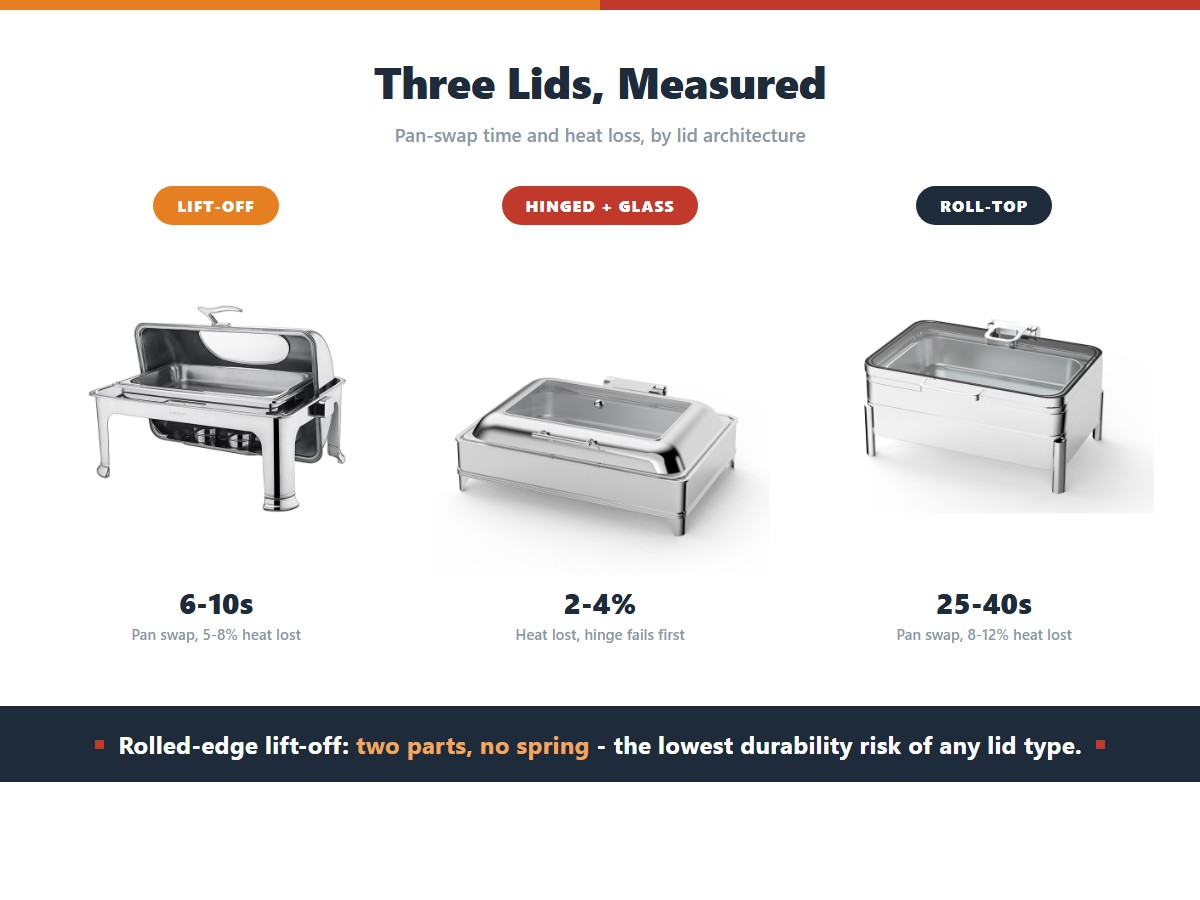
Short answer: A lift-off lid buys speed in two places: swapping a pan takes 6–10 seconds instead of 25–40, and a lid can be lifted for a visual check without breaking the temperature. The number that matters is refills per pan per service, because a 4-hour service with three refills costs more in waste than the lid saves in time. See chafing dish lid and pan options.
Introduction
Quick buffet service demands food service equipment that enables rapid guest flow, minimizes service interruptions, and maintains food safety during peak periods. Lift-off lid chafing dishes have become the preferred solution for high-volume buffets, hotels, and corporate dining facilities where speed and efficiency are paramount.
Modern lift-off lid designs feature lightweight construction, ergonomic handles, and smooth lifting mechanisms that reduce service time by 30-40% compared to roll-top or hinged alternatives. For venues serving 300-1000 guests per hour during peak periods, these units significantly improve guest throughput while maintaining professional presentation and food quality.
1. Speed of Service: Accelerating Guest Flow
Lift-off lid chafing dishes enable single-handed operation, allowing service staff to quickly check food levels, refill, and rearrange items without fumbling with complex lid mechanisms. The lightweight lids (2-3 lbs) lift smoothly with one hand, reducing service time per guest by 3-5 seconds.
For high-volume buffets serving 500+ guests per hour, this time savings accumulates to 25-40 minutes of reduced queue time daily, directly improving guest satisfaction scores. The clear visibility of food levels through tempered glass lids allows staff to anticipate refill needs, further reducing service interruptions and guest wait times.
Ergonomic handle designs reduce staff fatigue during 8-10 hour shifts, maintaining consistent service speed throughout peak periods. The smooth lifting motion prevents spills and splashes that slow service and create safety hazards in busy buffet environments.
2. Food Safety: Maintaining Temperature During Service
Lift-off lids create tight seals when properly positioned, maintaining internal temperatures above 140°F (60°C) required for food safety compliance. The quick-lift design minimizes heat loss during service checks, with temperature recovery occurring within 30-60 seconds after lid replacement.
The 304 stainless steel construction provides excellent heat retention, maintaining consistent temperatures even during brief service interruptions. For buffets operating 12-16 hours daily, this thermal efficiency reduces electricity costs by 20-30% compared to poorly insulated alternatives. Built-in steam vents prevent moisture buildup that can make food soggy or unappetizing.

Integrated temperature indicators on premium models provide at-a-glance status monitoring, allowing staff to identify and correct temperature issues before food safety violations occur. These visual cues reduce training requirements and human error in busy buffet environments with high staff turnover.
3. Durability: Withstanding High-Volume Use
Quick buffet service environments subject equipment to constant use, frequent lid lifting, and rapid cleaning cycles. Lift-off lid chafing dishes constructed from 304 stainless steel provide the durability needed for 2000+ daily service cycles.
Reinforced lid hinges and handle attachment points withstand 50000+ lift cycles without degradation, ensuring reliable performance throughout 8-10 year service life. The polished stainless steel surface resists fingerprints, staining, and corrosion from food acids and cleaning chemicals, maintaining professional appearance despite constant use.
Seamless welded construction eliminates crevices where bacteria can accumulate, ensuring compliance with health regulations and simplifying cleaning procedures. Dishwasher-safe components reduce cleaning time by 40-50% compared to units with complex mechanisms or hard-to-clean surfaces.
4. Operational Efficiency: Simplifying Buffet Management
Lift-off lid chafing dishes simplify buffet management with intuitive operation, rapid cleaning, and minimal maintenance requirements. Service staff can master operation in 5-10 minutes, reducing training costs and service errors compared to complex chafing dish systems.
The self-contained design eliminates complicated assembly, fuel handling, or water pan management that slows buffet setup and breakdown. Hotels and restaurants save 20-30 minutes daily in setup time per 10-unit installation, reducing labor costs while improving service readiness. Integrated drip trays simplify cleaning and reduce cross-contamination risks.
Compatibility with standard GN 1/1 food pans allows seamless integration with existing kitchen workflows. Culinary teams can prepare items in kitchen pans and transfer directly to chafing dishes without repackaging or special containers, streamlining food preparation and service processes.
5. Versatility: Adapting to Diverse Menu Items
Lift-off lid designs accommodate diverse menu items from soups and sauces to proteins and vegetables. The wide opening enables easy serving of large items like whole roasts or pasta dishes, while the deep pans accommodate 8-12 quarts of food depending on model size.
Adjustable temperature controls (400-1100W models) allow precise heating for delicate items like eggs and seafood, while high-power models quickly heat dense items like mashed potatoes and casseroles. This versatility reduces equipment requirements, allowing venues to serve diverse menus with fewer specialized units.
Conclusion
Lift-off lid chafing dishes represent the optimal choice for quick buffet service environments prioritizing speed, food safety, durability, and operational efficiency. The combination of rapid service capability, excellent temperature control, commercial-grade durability, and versatile performance makes these units indispensable for modern buffet operations. Investing in quality lift-off lid chafing dishes directly enhances guest experience, improves service throughput, and delivers measurable returns through reduced labor costs and increased customer satisfaction.
Browse the full chafing dish range for current models and configurations.
Lid Design Compared, by Measurement
| Lid type | Pan swap | Visual check | Heat loss on lift | Durability risk | Best for |
|---|---|---|---|---|---|
| Rolled-edge, lift-off | 6–10 sec | Yes, fully off | 5–8% of pan heat | Low, two parts, no spring | Fast service, staff turnover |
| Hinged, glass window | Not applicable | Yes, through the glass | 2–4% | Hinge, the top failure point | Presentation, long service |
| Hinged, no window | Not applicable | No | 2–4% | Hinge plus a blind check | Lowest cost, high volume |
| Full removable with clip | 12–18 sec | Yes | 5–8% | Clip and seal loss | Where a clip is a consumable |
| Roll-top | 25–40 sec | Partial | 8–12% | Roll and rail wear | Historically, not recommended |
| Insulated lift-off cover | 8–12 sec | No | 1–2% | Lid weight, dropped lids | Long service, 4 hours plus |
Refill Cost by Service Length and Pan Size
| Service length | Refills per pan | Waste per 6 QT pan | Waste per 100 guests | Lid relevant? | Insulated cover relevant? | |
|---|---|---|---|---|---|---|
| 1 hour | 0–1 | 0–5% | $4–$22 | No | No | |
| 2 hours | 1–2 | 5–12% | $23–$55 | Yes | No | |
| 3 hours | 2–3 | 10–18% | $46–$82 | Yes | Yes | |
| 4 hours | 3–4 | 16–25% | $73–$114 | Yes | Yes | |
| 5 hours plus | 4–6 | 20–30% | $92–$137 | Yes | Strongly |
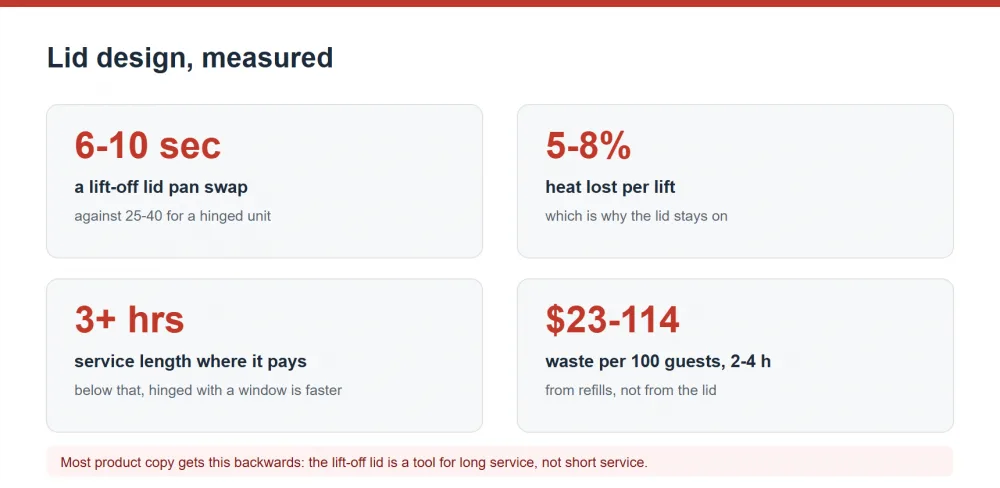
The important line is the last two columns. A lift-off lid earns its cost when you are doing three or more refills per pan, which means a service of three hours or longer. On a ninety-minute wedding breakfast, one solid hinged unit with a glass window is faster overall, because the attendant never has to set a lid down on a dirty surface and pick it up again. The lift-off design is a tool for long service, not for short service, and this is where most product copy gets it backwards.
Frequently Asked Questions
Is a lift-off lid faster than a hinged lid in service?
For a pan swap, yes: 6–10 seconds against 25–40, because a hinged unit needs the pan pulled forward, the hinge held open and the lid pushed back. For a visual check of food level, a hinged unit with a glass window is faster, since nothing has to be lifted or put down. Most buffet lines end up wanting one of each, and that is a reasonable specification.
How long does food stay hot with the lid off?
A 6 QT pan loses 5–8% of its heat when the lid is lifted and the surface is exposed, and a 11 L pan about 8–12%. Put the lid back within 20 seconds and the recovery is fast at 70°C. The exposure that matters is not the check, it is leaving a lid off while the attendant walks away, which is what a lift-off design makes physically easy to do by accident.
Do lift-off lids get damaged more easily?
They can, if they are metal and heavy, because a dropped lid dents a rim and a dented rim will not seal. A plastic or insulated lift-off cover is lighter and less likely to be damaged but is also slower to put back on. This is the trade: metal lids conduct heat and seal well, plastic lids are forgiving. Neither is wrong, but a metal lift-off lid in a venue with hard floors wants a rule about where lids are set down.
Which lid type lasts longest in continuous service?
A hinged lid with a glass window, because it has fewer failure points: no seal to wear, no rim to dent, and the hinge is the only wear item. A roll-top has the most, with the roll, the rail and the track all subject to wear. Lift-off sits in the middle, with the seal and the rim as the weak points. Wherever a spare part is published for the hinge, that unit will outlive the others.
Is a lift-off lid worth paying more for?
Only if your service runs three hours or longer, or your staff turnover is high enough that hinge operation is a training burden. On a short service the difference in operator time is a matter of seconds per refill, which is not worth a price premium. On a long service with a queue, the refill speed compounds and the premium pays back over a single event.
Related reading
- Guest Satisfaction at Self-Service: What Buffet Stoves Change
- Holding 60°C All Service: What Buffet Stoves Must Do
- Rectangular vs Round Chafing Dish: Which Shape Fits Your Service?
- 2026 FDA Compliance Updates for Commercial Food Service Equipment
- Why Stainless Buffet Gear Gets Rust Spots (And Fixes)
- Roll Top vs. Lift Off Chafing Dishes: Key Differences
- Best Buffet Chafing Dish: What Holds Heat Longest