




Wall-Mounted Buffet Stove: Saving 35 cm of Depth
Short answer: A wall-mounted buffet stove gives back 350 mm of counter depth, and the four numbers that decide whether that space is actually usable are the load capacity of the shelf, the clearance above the unit for the lid, the service height of the pan, and whether the wall can take the fixings. A 350 mm saving is worthless if the pan sits at 1,050 mm and the attendant is serving guests at chest height all evening. See chafing dish installation options.

Counter depth is the constraint nobody designs around until they run out of it. A 600 mm deep counter with a 480 mm unit on it leaves 120 mm behind, which is not enough for a cable, a drip tray or the hand of a person who needs to get behind the unit to switch it on. Taking the appliance off the counter entirely and putting it on the wall is the obvious answer, and it is the reason wall-mounted units exist. The execution is where it gets interesting, because the space saved has to be replaced by something that works.
Counter Depth Recovered, by Configuration
| Configuration | Counter depth used | Depth recovered | Counter left free | Install complexity | Verdict |
|---|---|---|---|---|---|
| Floor-standing 11 L unit | 480 mm | 0 | 120 mm on a 600 mm counter | None | Baseline |
| Wall-mounted shelf, single | 0 mm | 350 mm | 480 mm | Medium, structural | The standard answer |
| Wall-mounted shelf, double | 0 mm | 700 mm | 480 mm at two heights | Medium | High volume |
| Wall-mounted with side bracket | 120 mm | 230 mm | 250 mm | High, cantilever | Not recommended |
| Under-counter recessed | 0 mm | 350 mm | 480 mm | High, needs a cabinet void | For new builds only |
| Table-mounted over a service gap | 180 mm | 170 mm | 300 mm | Low | Reasonable compromise |
Shelf Load and Fixing Requirements
| Unit on the shelf | Loaded weight | Shelf rating needed | Wall substrate | Fixing | Verdict |
|---|---|---|---|---|---|
| Mini 4 QT unit | 7–9 kg | 15 kg minimum | Solid brick or block | 4 × M8 anchors | Simple |
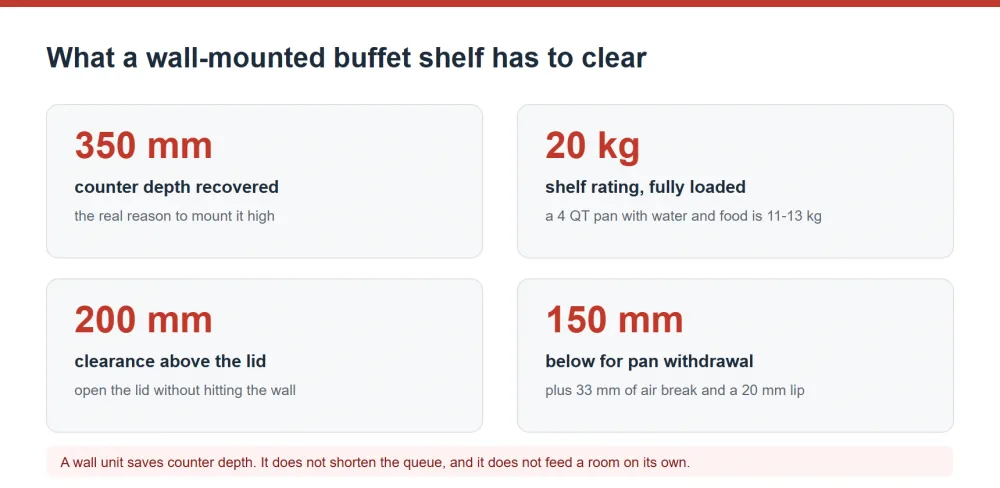
| Mini 4 QT plus water | 11–13 kg | 20 kg | Solid brick | 4 × M8 anchors | Simple |
| 6 QT unit | 11–14 kg | 25 kg | Brick or reinforced | 4 × M10 anchors | Fine |
| 11 L electric unit | 16–20 kg | 35 kg | Reinforced only | 6 × M10 into a beam | Needs a check |
| 11 L plus two 7 L pans | 24–28 kg | 50 kg | Structural engineer | Continuous angle bracket | Do not improvise |
| Triple-head heat lamp | 14–18 kg | 30 kg | Reinforced | 4 × M10 into a beam | Fine |
The row that catches people is the loaded weight rather than the unit weight. A 4 QT unit is light, but a 4 QT unit with a full water pan and a full food pan on the shelf above is 11 to 13 kg, and a shelf rated for the appliance is not a shelf rated for the appliance plus its contents. The rule is to rate the fixing for the loaded weight with a safety factor of at least two, and to be honest about whether the wall is masonry or a partition. A plasterboard partition with a 20 kg unit on it is a problem that will be discovered by someone else.
Working Height and Guest Service
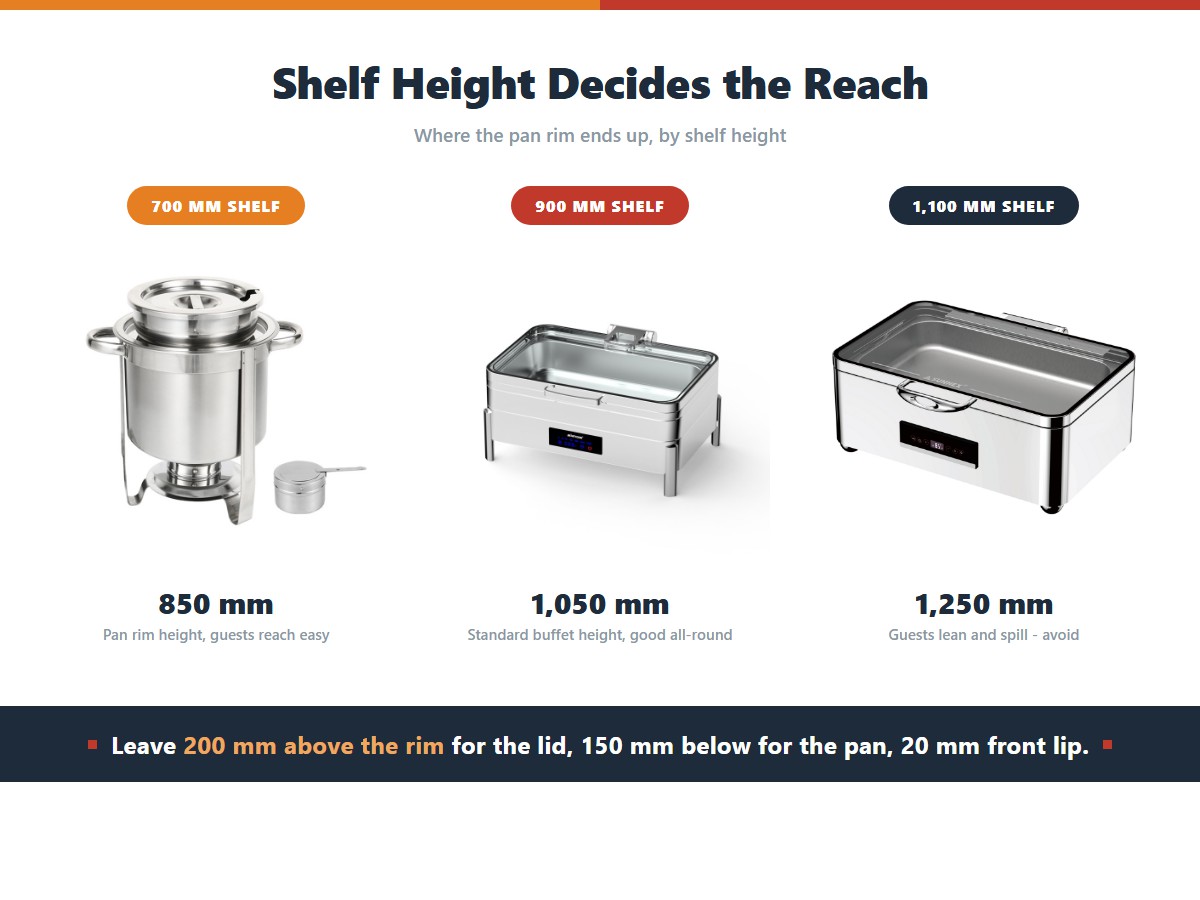
| Shelf height | Pan rim height | Guest reach | Attendant reach | Service result | Verdict |
|---|---|---|---|---|---|
| 700 mm | 850 mm | Easy | Good | Comfortable, fast | Best for a service counter |
| 900 mm | 1,050 mm | Comfortable | Good | Standard buffet height | Good all-round choice |
| 1,100 mm | 1,250 mm | Reaching | Shoulder height | Guests lean, spill | Avoid |
| 1,300 mm | 1,450 mm | Impossible | Overhead | Food is served down | Wrong |
| 500 mm | 650 mm | Easy | Bending | Attendant cramps | Fine for a condiment station |
900 mm is the number to design around. It puts the pan rim at roughly 1,050 mm, which is the conventional buffet height that guests and staff already know, and it is high enough that a person standing at the counter can work under the unit without stooping. Wall mounting that pushes the pan above 1,200 mm saves the same 350 mm of counter while making the food harder to see and harder to serve, and the guests will not notice that decision until the queue at the far end is three deep.
Lid Clearance and the Air Gap
| Issue | Requirement | Why | If you get it wrong |
|---|---|---|---|
| Lid lift clearance | 200 mm above the pan rim | The lid comes off vertically | Lid hits the shelf above, or a cabinet |
| Air gap under the unit | 33 mm minimum | A water or air gap is a regulatory requirement | Non-compliant, and the finding is on the record |
| Service clearance below | 150 mm | To insert and remove a pan | Attendant lifts pans out over the counter |
| Cable route | Behind the shelf, not across it | So the plug is reachable without unloading | Unit is unplugged and forgotten |
| Drip tray access | Removable, reachable from the front | Spillage behind a wall shelf is invisible | Water sits against the wall and rusts it |
| Shelf lip | 20 mm front lip | Stops a pan sliding off | Pan falls, and it is 1.4 m up |
A 33 mm air gap is the requirement that gets missed, because a wall shelf naturally sits flush against the wall and the unit sits flush on the shelf. The gap has to be built in with spacers, and it has to be visible from the front so an inspector can see it. The front lip is the other one that matters: a pan sliding off a shelf at 1,050 mm is a serious accident, and a 20 mm lip costs almost nothing.
What Wall Mounting Does Not Solve
| Problem | Does wall mounting fix it? | Actual fix | Cost |
|---|---|---|---|
| Not enough serving points | No | Add units, not shelves | $110–$220 each |
| Long queue | No | Two or three points | Same |
| Food drying out | No | Hold at 70–75°C, add covers | $25–$50 each |
| Cold food at the end of service | No | Probe the rim, use a thermostat | $25–$60 |
| Dirty counter | No, it makes it worse | Drip tray, removable water pan | Included on good units |
| Unit on a hot pass | Partly, if the shelf is steel | Insulate the shelf | $20–$40 |
| No power at the wall | No | Route a circuit, or use fuel | $150–$600 |
Wall mounting is a spatial fix and nothing else. It is worth doing when the counter is genuinely the binding constraint, and it is worth avoiding when the real problem is that one serving point creates a queue. A wall-mounted unit that still only serves one queue has converted a floor problem into a wall problem without improving throughput at all.
Frequently Asked Questions
How much counter space does a wall-mounted buffet stove save?
350 mm of depth on a standard installation, which turns a 600 mm counter into a 250 mm working ledge with the unit entirely off it. On a 700 mm counter it is 350 mm of clear working surface, which is enough for a full plating and garnish station in front of the unit.
What height should a wall-mounted chafing dish be installed at?
900 mm for the shelf, which puts the pan rim at about 1,050 mm. That is the conventional buffet height, and it is high enough for an attendant to work underneath without stooping. Above 1,100 mm the food is served at shoulder height and guests have to reach for it, which shows up as a slower line and more spillage.
Can I mount a chafing dish on a plasterboard partition?
Not without checking what is behind it. A loaded 11 L unit is 24 to 28 kg including the pans, and a partition is not rated for that. A solid brick or block wall with M8 or M10 anchors is fine for a 4 or 6 QT unit. Anything heavier, or any wall you are not certain about, needs a continuous angle bracket fixed into a structural member, and that is a job for someone who can see the structure.
What clearance does a wall-mounted chafing dish need above the lid?
200 mm above the pan rim so the lid lifts straight off, plus 150 mm below for the attendant to slide a pan in and out, plus the 33 mm air gap under the unit for regulatory compliance. A shelf with a cabinet above it usually fails the lid clearance, and that is the reason a wall shelf is usually open above the unit rather than a closed cabinet.
Is wall mounting cheaper than a floor unit?
No, it costs more once the shelf and the fixings are counted. A shelf with a lip, a structural bracket and the labour to install it is $150 to $600 on top of the unit, and if a circuit has to be run to the wall that is more again. The saving is in floor space and in counter working room, not in money.

Mini Individual Buffet Chafing Dish
Mini individual buffet chafing dish, sized for a wall shelf or a condiment run rather than a main line. A loaded weight of 11 to 13 kg with the water pan and food pan full is well within a 20 kg shelf rating, which makes it the practical unit for a wall-mounted installation where a full-size chafer would need structural work.

Alcohol Heated Gold-Plated Stainless Steel Buffet Chafing Dish
Alcohol heated gold-plated stainless steel buffet chafing dish. Fuel heat means no electrical circuit is needed at the wall, which removes the single biggest obstacle to wall mounting a unit in an older building, and the gold-plated finish suits a guest-facing counter where the appliance is on show.
Browse the full chafing dish range for current models and configurations.
Related reading
- Saving Time at Peak: What Buffet Stoves Change
- Are Buffet Stoves Worth It? Payback by Event Volume
- Outdoor Catering: Buffet Stoves That Survive Wind
- Buffet Stove Price Breakdown: What Drives the Cost
- 10 Wedding Buffet Ideas Guests Actually Remember
- Wall-Mounted vs Countertop Cereal Dispensers: Which Fits Your Room