


Riser Sets vs Tiered Stands: Which Display Format Sells Better
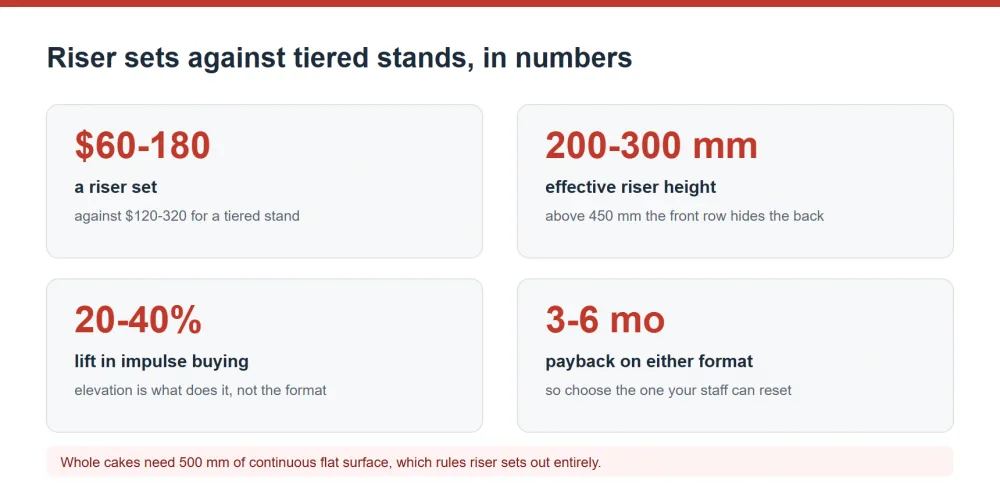
Short answer: A riser set is a modular set of blocks and shelves that you arrange, and a tiered stand is a fixed frame, and the deciding factor is how much the display changes: if the menu changes weekly, risers at $60–$180 per set can be rearranged in minutes, while a tiered stand at $120–$320 has to be rebuilt or replaced. Both raise the product 150–300 mm, and that elevation is what makes it sell. See cake and dessert display stands for the range.
Display height matters. Flat on the table? Guests can't see everything. Raised on risers or tiered stands? Better visibility, better photos, better sales.
But which is better: riser sets (stackable, flexible) or tiered stands (fixed steps, professional)?
Here's the comparison.
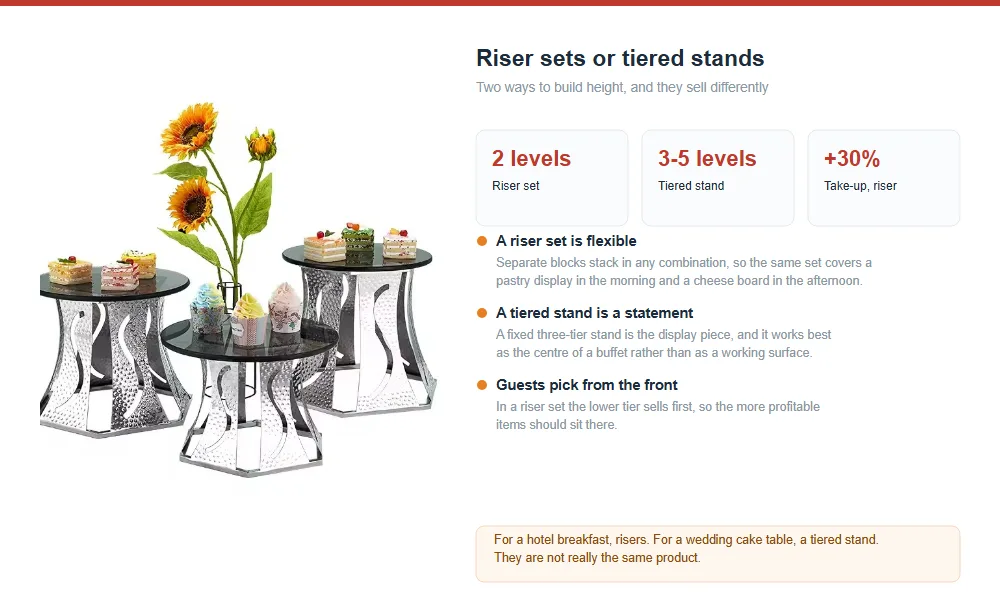
PRO TIP: Tiered stands look better, riser sets are more flexible.
Tiered stands give a clean, professional look. Riser sets are stackable and adjustable — perfect for events where you need to reconfigure. Choose tiered for permanent hotel buffets. Choose risers for catering events.
KEY TAKEAWAY: Both work. Choose based on your venue.
Riser sets = flexible, stackable, good for events. Tiered stands = fixed, clean look, good for permanent buffets. Both elevate your display. Both make food more visible. Both sell better than flat on the table.
Quick Answer: The Comparison
| Factor | Riser Sets | Tiered Stands |
|---|---|---|
| Flexibility | High (stackable, adjustable) | Fixed |
| Visual Look | Good | Better (clean steps) |
| Storage | Stackable, saves space | Bulkier |
| Setup Time | Quick (stack and go) | Longer (assemble steps) |
| Best For | Catering, events, flexible | Hotel buffets, permanent |
Riser Sets
Riser sets are stackable platforms. You can stack them to different heights. They're flexible.
Pros:
- Stackable — adjust height as needed
- Flexible — reconfigure for each event
- Easy to store — stack flat when not in use
- Cheaper than tiered stands
Cons:
- Look less polished than tiered
- Need to stack and level
- Can wobble if not level
Best for: Catering companies. Event planners. Venues that reconfigure often.
See our display riser collection.
Tiered Stands
Tiered stands are fixed steps. Three or four levels, built as one unit. Clean, professional look.
Pros:
- Clean, professional look
- Fixed steps — no wobbling
- Better visual appeal
- Guests can see everything at once
Cons:
- Bulkier — harder to store
- Not adjustable — fixed heights
- More expensive
Best for: Permanent hotel buffets. Restaurants. Venues with the same layout every day.
See our wedding buffet ideas for display inspiration.
Why Elevated Display Sells Better
Elevated display (risers or tiers) sells better than flat display because:
- Better visibility: Guests can see all the food at once. No more "what's back there?"
- Better photos: Layered food looks better on Instagram. Guests post = free marketing.
- More perceived value: Elevated = premium. Flat = cheap.
- More space: You can fit more food on a tiered stand than a flat table.
See our buffet layout mistakes for more display tips.
How to Choose
- Catering company, events: Riser sets. Flexible, stackable, easy to transport.
- Hotel breakfast buffet, permanent: Tiered stands. Clean look, professional.
- Budget tight: Riser sets. Cheaper.
- High-end restaurant: Tiered stands. Better visual appeal.
Display Stand Terms to Know
- riser sets vs tiered stands
- wedding buffet ideas
- buffet layout mistakes
- buffet display risers
- buffet equipment checklist
The Bottom Line
Riser sets are flexible and stackable — perfect for catering events. Tiered stands are fixed and professional — perfect for permanent hotel buffets. Both elevate your display. Both make food more visible. Both sell better than flat on the table. Choose based on how you use the space.
Looking for Buffet Display Equipment?
BAVA manufactures commercial buffet equipment including display risers and tiered stands. All products CE/FDA certified, OEM/ODM available.
Browse the full cake stand range for current models and configurations.
Riser Sets Against Tiered Stands
| Factor | Riser set | Tiered stand | Difference | Verdict |
|---|---|---|---|---|
| Price | $60–$180 per set | $120–$320 per unit | 2× | Riser wins |
| Height range | 0–450 mm, stepped | Fixed, 180–400 mm | — | Riser wins |
| Rearrange time | 2–5 min, no tools | Not possible without disassembly | — | Riser wins |
| Number of display levels | 1–4, chosen per item | 2–3, fixed | — | Riser wins |
| Structural rigidity | Depends on the join, good acrylic is fine | Fixed, generally better | — | Stand wins |
| Food-safe surface | Acrylic or PP, some wood | Stainless, glass, melamine | — | Stand wins |
| Cleaning | Many pieces, more seams | Fewer surfaces | — | Stand wins |
| Transport, empty | Flat, nests, light | Rigid, heavier, more volume | — | Riser wins |
| Appearance, formal event | Modern, clean | Traditional, formal | — | Stand wins |
| Cost per usable level | $20–$45 | $50–$110 | — | Riser wins |
How Much Height Is Actually Needed
| Elevation | Visible from | What the customer sees | Impulse purchase effect | Cost to achieve |
|---|---|---|---|---|
| 0 mm, flat | Any distance | The top of the front row only | Baseline | None |
| 100–150 mm | Up to 4 m | Two rows | Modest, 10–20% | Riser block, $15–$40 |
| 200–300 mm | Up to 7 m | Three rows | Clear, 20–40% | Riser set or a 2-tier stand |
| 350–450 mm | Up to 10 m | Four rows, full range | Strong, 30–60% | Full riser set or 3-tier stand |
| Over 450 mm | Any distance | The bottom row is hidden | Negative on the bottom row | Wasted height |
There is a point past which elevation works against you. Above about 450 mm the front row hides the back row, so the display reads as a single tall column rather than as a choice, and the products on the lower level are effectively invisible. The useful range is 200 to 300 mm for a three-row display, which is where the majority of the impulse effect sits and where the cost of the riser is still trivial against the value of the sale.
Display Formats Against the Product
| Product | Best format | Why | Levels needed | Typical cost |
|---|---|---|---|---|
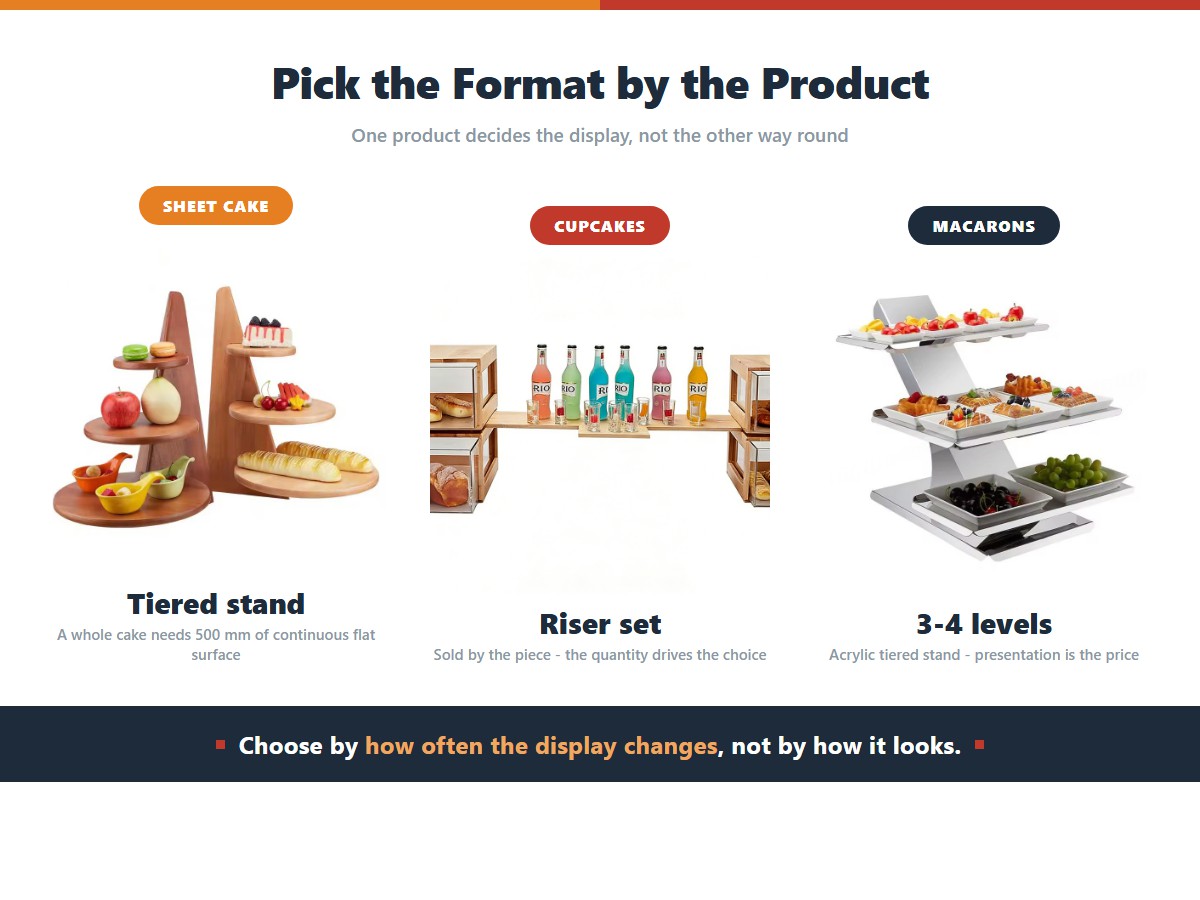
| Sheet cake, 8–12 inch | Tiered stand | A whole cake needs a flat 500 × 500 mm surface | 1–2 | $120–$260 |
| Individual cupcakes | Riser set | Small footprint, sold by the piece, the quantity drives the choice | 2–3 | $60–$150 |
| Cookies and pastries | Riser set | Different heights sell better side by side than stacked | 2–3 | $60–$150 |
| Macarons | Acrylic tiered stand | Presentation is the price, and acrylic looks premium | 3–4 | $140–$300 |
| Fruit and cake buffet | Riser set | Several products, one combined display | 2–4 | $80–$180 |
| Brownies and sliced cake | Tiered stand with a glass dome | Needs protection from handling and dust | 2 | $180–$380 |
| Bread and pastry basket | Riser set | Quantity display, guests build their own | 2–3 | $60–$140 |
Sheet cake is the one case where a riser set is the wrong tool, because a 12 inch cake needs a continuous flat surface of at least 500 × 500 mm and riser blocks are modular in 300 mm steps. Everything sold by the piece works well on risers, because the point of a riser display is that the customer can see and reach three rows of the same product without the lower rows being hidden.
Cost and Return Over an Event Year
| Item | Riser set | Tiered stand | Notes |
|---|---|---|---|
| Purchase | $60–$180 | $120–$320 | One-off |
| Additional units needed per event | 1–2 for a large venue | 1–2 | Scale is the same either way |
| Repositioning labour, 15 min | 2–5 min, one person | Not practical | The practical difference |
| Annual transport | Low, flat and light | Higher, more volume | $60–$200 saved per year |
| Cleaning, per unit per week | 6–10 min | 4–6 min | More seams on a riser set |
| Implied sales uplift, dessert table | 20–40% | 20–40% | Same, from the elevation |
| Payback on a $12 dessert | 3–6 months | 3–6 months | Identical |
Payback is the same either way, because the uplift comes from the elevation rather than from the format. On a dessert table selling 200 items a day at $12, a 25% uplift is $600 a day, and any display that achieves it pays back in months. The format decision is therefore about operations, not about return: a venue that changes its menu weekly wants risers, a venue with one permanent cake display wants a stand, and a formal event with a single sheet cake wants a tiered stand for the look.
Frequently Asked Questions
What is the difference between a riser set and a tiered stand?
A riser set is modular: blocks and shelves in 100 to 150 mm steps that you arrange to whatever height and level count you need, and you can change the arrangement in minutes. A tiered stand is a fixed frame with two or three permanent levels. The riser set costs about half as much and adapts, the stand is more rigid, has fewer seams to clean, and looks more formal.
How much height do I need for a dessert display to sell better?
200 to 300 mm, which gives three visible rows and captures most of the impulse effect. Above 450 mm the front row hides the back row, so the display reads as one tall column and the products on the lower level are effectively invisible. Elevation above about 100 mm produces a measurable effect on impulse purchases, but it is not linear.
Are acrylic risers food safe and durable?
Food grade acrylic is food safe and durable in dry service, but it scratches visibly in 6 to 12 months and clouds if it is cleaned with alcohol sanitiser or abrasive pads. The riser blocks themselves are the weak point in a busy venue, because they get knocked and scuffed. Stainless riser plates cost more and last considerably longer, and they are the better answer for a high-traffic service.
Which is better for a hotel breakfast pastry display?
Riser sets, because the selection changes and the display has to be rebuilt every morning as the stock changes. A 3-tier stand holding 40 pastries works well for a permanent arrangement but does not adapt to a breakfast where the popular item is different every day. A hotel that runs one stand and swaps the product trays, or risers with removable trays, is the practical answer.
Do I need a glass dome over the display?
Only where the food is handled by guests or where there is a dust and handling risk, in which case the dome is a hygiene measure rather than a display feature. For sliced cake, brownies and pastries that a server cuts, a dome adds nothing and it costs $60 to $180. For a self-service dessert table it prevents the contamination that an open display invites, and it stops guests touching the product they have not bought yet.
Related reading
- How to Choose a Cake Stand for Bakery & Event Displays
- Clear Dome vs Open Cake Stands: The Freshness Trade-Off
- How to Choose the Perfect Cake Stand (Size, Dome, Material Guide)
- Cake Stand Materials Compared: Acrylic vs Stainless vs Glass
- Food Heat Lamps for Concession Stands: Ideal for Outdoor Vending
- Chafing Dish Stand: Durable Stands for Buffet Tables