




Chafing Dish Hot Spots: 5 Fixes That Work in Minutes
Short answer: hot spots come from a single-layer base: the heat concentrates at the centre and the edges run 10–15°C cooler. A three-layer base with an aluminium core spreads heat within about two minutes. Keep water at 1 inch (25 mm) and rotate the pan if you cannot change the base. See models in our chafing dish range.
Ever noticed the center of your chafing dish burns while the edges stay cold? The middle of the lasagna is scalding, the sides are barely warm. That's a hot spot problem.
Single-layer stainless bases conduct heat poorly. Heat concentrates in the center. The fix? A 3-layer base.
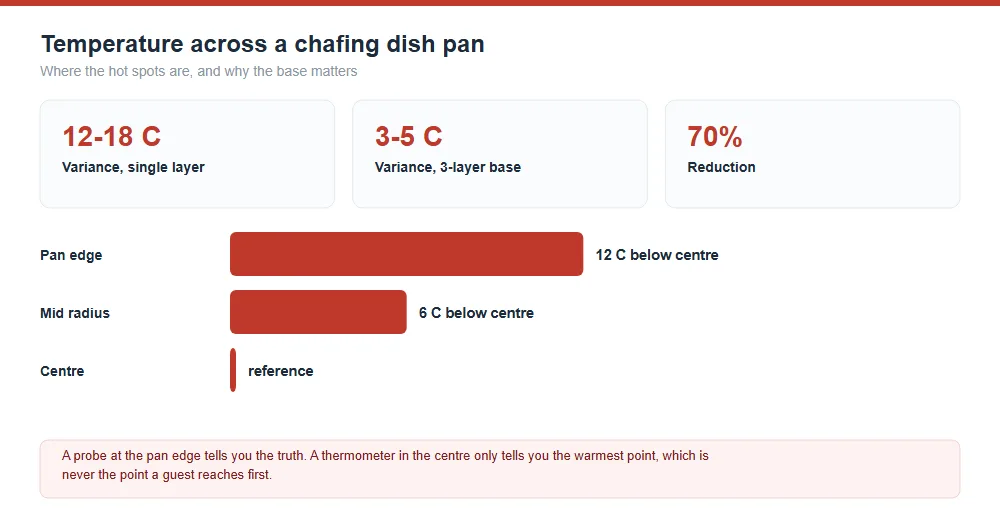
PRO TIP: 3-layer base = 5F temperature gap, vs 35F for single layer.
Single-layer: center 165F, edges 130F. 3-layer: 150F everywhere. No burnt food. No cold spots. Every bite the right temperature.
KEY TAKEAWAY: Aluminum core spreads heat. Stainless steel touches food.
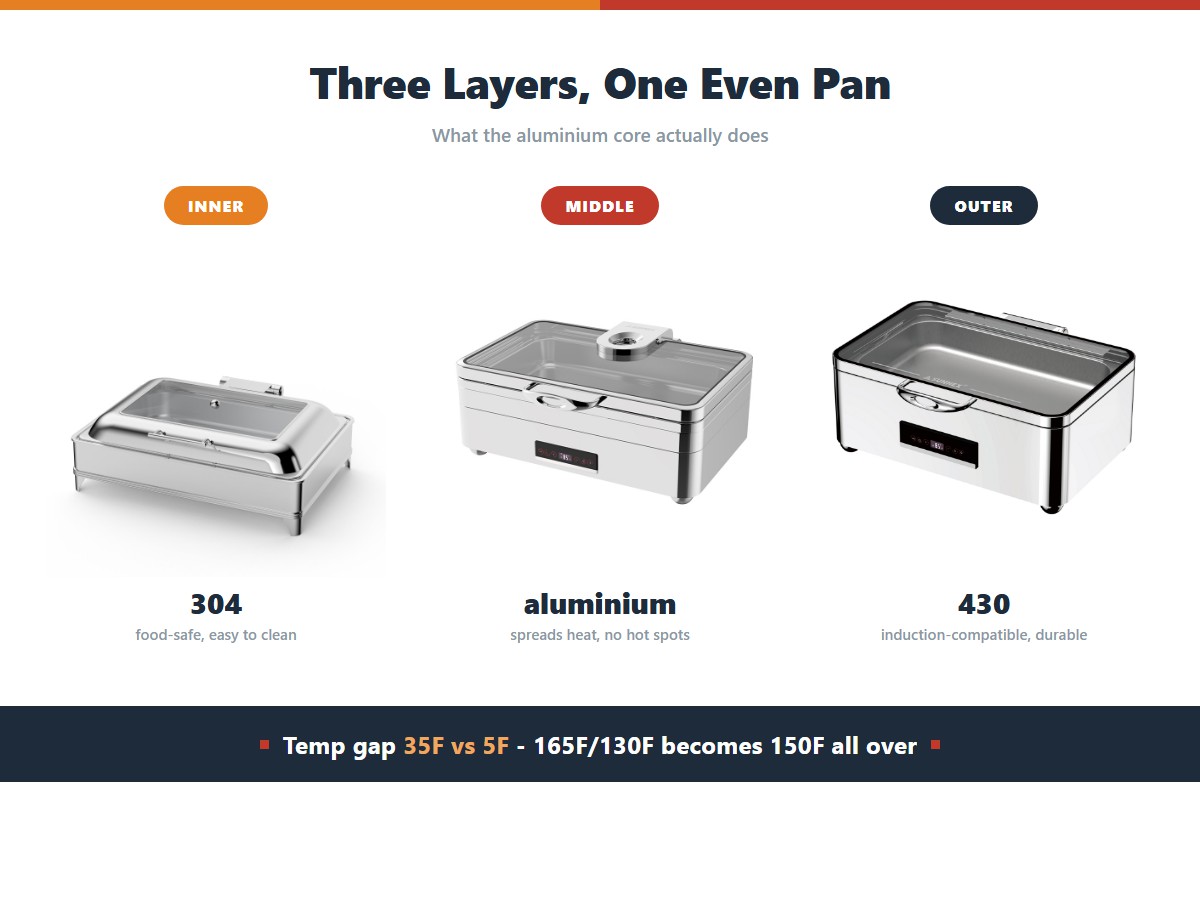
3-layer = stainless (food side) + aluminum (heat spreader) + stainless (outside). Aluminum spreads heat fast and even. Stainless is food-safe and durable.
Single-Layer vs 3-Layer Base
| Feature | Single-Layer | 3-Layer |
|---|---|---|
| Construction | Stainless only | Stainless + aluminum + stainless |
| Temp gap (center vs edge) | 35F (165F vs 130F) | 5F (150F all over) |
| Food result | Burnt center, cold edges | Evenly heated everywhere |
| Durability | Warp easily under heat | Flat, stable, warp-resistant |
| Cost | Cheaper | Higher upfront |
What the 3 Layers Do
| Layer | Material | Purpose |
|---|---|---|
| Inner (food side) | 304 stainless | Food-safe, easy to clean |
| Middle | Aluminum | Spreads heat evenly. No hot spots. |
| Outer | 430 magnetic stainless | Induction-compatible, durable |
See our stainless steel grades guide for more.
Who Needs 3-Layer?
| Venue | Why |
|---|---|
| Fine dining hotels | Every bite must be perfect. No excuses. |
| Catering companies | Reputation on the line. No burnt complaints. |
| Schools / hospitals | Food safety. Every portion reaches 140F. |
3-Layer Base Terms to Know
- 3 layer base chafing dish
- stainless steel grades 201 304 316
- chafing dish temperature guide
- even heating chafing dish
- food holding temperature chart
The Bottom Line
Single-layer = 35F temperature gap. 3-layer = 5F. No burnt center. No cold edges. Every bite the right temperature. 3-layer costs more upfront, but it lasts longer and food quality is noticeably better. For hotels and caterers, worth it.
Looking for 3-Layer Chafing Dishes?
BAVA manufactures 3-layer base chafing dishes with even heat distribution. All products CE/FDA certified, OEM/ODM available.
How to test your own pan
Put an inch of water in the pan, run the unit for 20 minutes, then check the base with an infrared thermometer at the centre and at each corner. A spread of more than 8°C tells you the base cannot even out the heat, and that the edges will always be the first place food cools.
Two fixes cost nothing: rotate the pan a quarter turn every 30 minutes, and keep the lid closed so the air above the food stays hot. One fix costs money but works permanently: a three-layer base, where an aluminium core carries heat sideways before it reaches the food. The measurable difference is 10–15°C edge-to-centre on a single layer against under 5°C on three layers.
If you run several units on one line, check them against each other rather than against a spec sheet. Put the same amount of water in three pans, run them together for 20 minutes and compare the four corners with an infrared thermometer. The one that reads lowest at the corners is the one that will complain first at service, and it is usually the oldest frame rather than the cheapest.
Frequently Asked Questions
Why is the middle of my pan hotter?
The burner or element sits under the centre. Without a conductive layer, that heat has nowhere to spread.
Do three-layer bases really help?
Yes — an aluminium core spreads heat sideways so the edge-to-centre difference drops from 10–15°C to under 5°C.
Can I fix hot spots without a new pan?
Rotate the pan every 30 minutes, keep the lid closed, and lower the setting so the centre does not overheat.
Does water depth affect evenness?
Yes. Under half an inch the buffer is gone and the centre scorches; an inch spreads the heat more evenly.
What about induction chafers?
Induction heats the base directly and evenly by design, but needs induction-rated pans.
Related reading
- Rust Spots on Stainless Steel Buffet Equipment: Causes and Removal
- Why Stainless Buffet Gear Gets Rust Spots (And Fixes)
- 2026 Global Commercial Food Warmer Market Growth & Innovation
- Hotel All-Day Dining: Stainless Buffet Stove Specs
- Your Chafing Dish Is Too Hot: The 135°F Myth
- 900W Fast-Heat Chafing Dish: Hot Food in 10 Minutes, Not 30