


Hotel All-Day Dining: Stainless Buffet Stove Specs
Short answer: All-day dining runs 16–18 hours a day, which changes what a buffet stove has to survive, and the specification that matters is a 1.2–1.5 mm body, a 1,100 W element sized for a 12-minute recovery, and a PID thermostat with a stated tolerance of ±1°C. It also changes the economics: a unit that is switched off between meal periods rather than left on is the difference between 15% and 45% off the energy bill. See chafing dish duty cycles.
Introduction
Hotel all-day dining venues require food service equipment that delivers uninterrupted performance across 16-18 hour daily operations, from breakfast buffets at 6AM to late-night service at 12AM. Stainless steel buffet stoves have become the standard solution for hotels, combining durability, precise temperature control, and guest-facing aesthetics that maintain professional presentation throughout extended service periods.

Modern stainless steel buffet stoves feature 304-grade construction, 400-1100W heating elements, and digital temperature controls that ensure food safety compliance while preserving menu quality. For hotels serving 500-2000 guests daily across multiple meal periods, these units provide the reliability, efficiency, and visual appeal that define premium dining experiences. The integration of rapid heat-up technology (8-12 minutes to optimal temperature) and 80%+ thermal efficiency makes them indispensable for high-volume hotel operations.
1. Durability: Engineered for 16-18 Hour Daily Operation
Hotel all-day dining venues operate nearly continuous service cycles, with equipment running 16-18 hours daily, 7 days a week. Stainless steel buffet stoves constructed from 304 austenitic stainless steel provide the corrosion resistance and structural integrity needed for these demanding schedules.
The 18% chromium content forms a self-healing passive oxide layer that resists corrosion from food acids, cleaning chemicals, and constant moisture exposure. Hotels report 10-15 year service life from premium stainless steel units, compared to 3-5 years for aluminum or coated alternatives. The polished surface withstands 5000+ cleaning cycles annually while maintaining mirror-like finish that enhances guest-facing presentation.
Reinforced heating elements and commercial-grade thermostats withstand constant temperature cycling without degradation. Unlike residential units that fail after 1000-2000 operating hours, hotel-grade stainless steel stoves deliver 15000+ hours of reliable service, reducing replacement costs and operational disruptions.
2. Temperature Control: Precision Across Extended Service
All-day dining venues must maintain consistent food temperatures (140°F/60°C minimum) across breakfast, lunch, afternoon tea, dinner, and late-night service periods. Stainless steel buffet stoves with digital PID temperature controls provide ±1°C precision, ensuring food safety compliance while preserving texture and flavor of delicate items like eggs, seafood, and pastries.
The 400-1100W heating elements achieve optimal temperatures in 8-12 minutes, enabling rapid deployment between meal periods and quick recovery after high-demand intervals. Hotels using these units report 40% reduction in food waste due to precise temperature maintenance, as proteins and prepared items stay within safe serving ranges without overcooking or drying out.
Multi-zone temperature control allows simultaneous serving of diverse menu items—soups at 160°F, proteins at 145°F, vegetables at 140°F—from a single unit. This flexibility reduces equipment requirements while improving menu versatility for hotel chefs and banquet teams.
3. Guest-Facing Aesthetics: Maintaining Premium Presentation
Hotel all-day dining venues prioritize guest experience, with buffet equipment directly impacting perceived quality and brand reputation. Stainless steel buffet stoves with brushed or mirror-polished finishes maintain professional appearance even after 12+ hours of continuous service.
The low-profile design (10-14 inches tall) integrates seamlessly into hotel buffet lines without obstructing sightlines or guest flow. Integrated LED temperature displays provide staff with at-a-glance status monitoring while maintaining clean, uncluttered presentation for guests. The neutral stainless steel aesthetic complements any hotel décor, from casual bistros to luxury fine dining venues.

Visual design features like tempered glass lids allow guests to view food offerings without lifting covers, maintaining temperature consistency while enhancing presentation. These guest-centric design elements contribute to higher satisfaction scores and repeat bookings for hotel dining venues.
4. Operational Efficiency: Simplifying Hotel Workflows
Hotel banquet and culinary teams operate with tight labor budgets and high turnover rates. Stainless steel buffet stoves with intuitive controls and rapid heat-up capabilities reduce training requirements and setup times between meal periods.
The self-contained design eliminates fuel logistics, water pan management, and complex assembly required by traditional chafing dishes. Hotels save 30-45 minutes daily in setup/breakdown time per 10-unit installation, reducing labor costs while improving service readiness. Integrated drip trays and smooth surfaces simplify cleaning, with most units requiring only 5-10 minutes of maintenance between meal periods.
Compatibility with standard GN 1/1 food pans allows hotels to use existing kitchen inventory, reducing equipment costs and simplifying food preparation workflows. Culinary teams can prepare items in kitchen pans and transfer directly to buffet stoves without repackaging or special containers.
5. Cost Efficiency: Strong ROI for Hotel Operators
Stainless steel buffet stoves range from $350-850 per unit, delivering full ROI within 18-24 months through reduced labor costs, lower food waste, and extended service life. Hotels operating 20+ units report $15000-30000 annual savings in reduced replacement costs, labor efficiency, and energy consumption.
Energy efficiency delivers immediate savings: 80%+ thermal utilization rates and rapid heat-up capabilities reduce electricity costs by 35-45% compared to standard warmers. For hotels running 50+ units across multiple dining venues, these savings accumulate to $10000-25000 annually. Elimination of canned fuel costs ($400-900 per unit annually) further improves returns.
Revenue impact is substantial: reliable, attractive buffet equipment enhances guest experience, leading to 15-25% higher satisfaction scores and 10-20% increase in repeat dining visits. For full-service hotels, this translates to $50000-150000 additional annual revenue from improved guest retention and positive reviews.
Conclusion
Stainless steel buffet stoves represent the optimal investment for hotel all-day dining venues prioritizing operational reliability, food safety compliance, guest experience, and long-term profitability. The combination of 304-grade construction, precision temperature control, elegant aesthetics, and strong ROI makes these units essential for hotels competing in premium markets. Investing in commercial-grade stainless steel buffet stoves enhances dining experiences, reduces operational costs, and delivers measurable returns within 18-24 months of deployment.
Browse the full chafing dish range for current models and configurations.
All-Day Dining Duty Cycle, Hour by Hour
| Period | Hours | Service level | What the unit should be doing | Watch for |
|---|---|---|---|---|
| Pre-service | 06:00–07:00 | Zero | Preheating with water in the pan | Empty preheat warps the body |
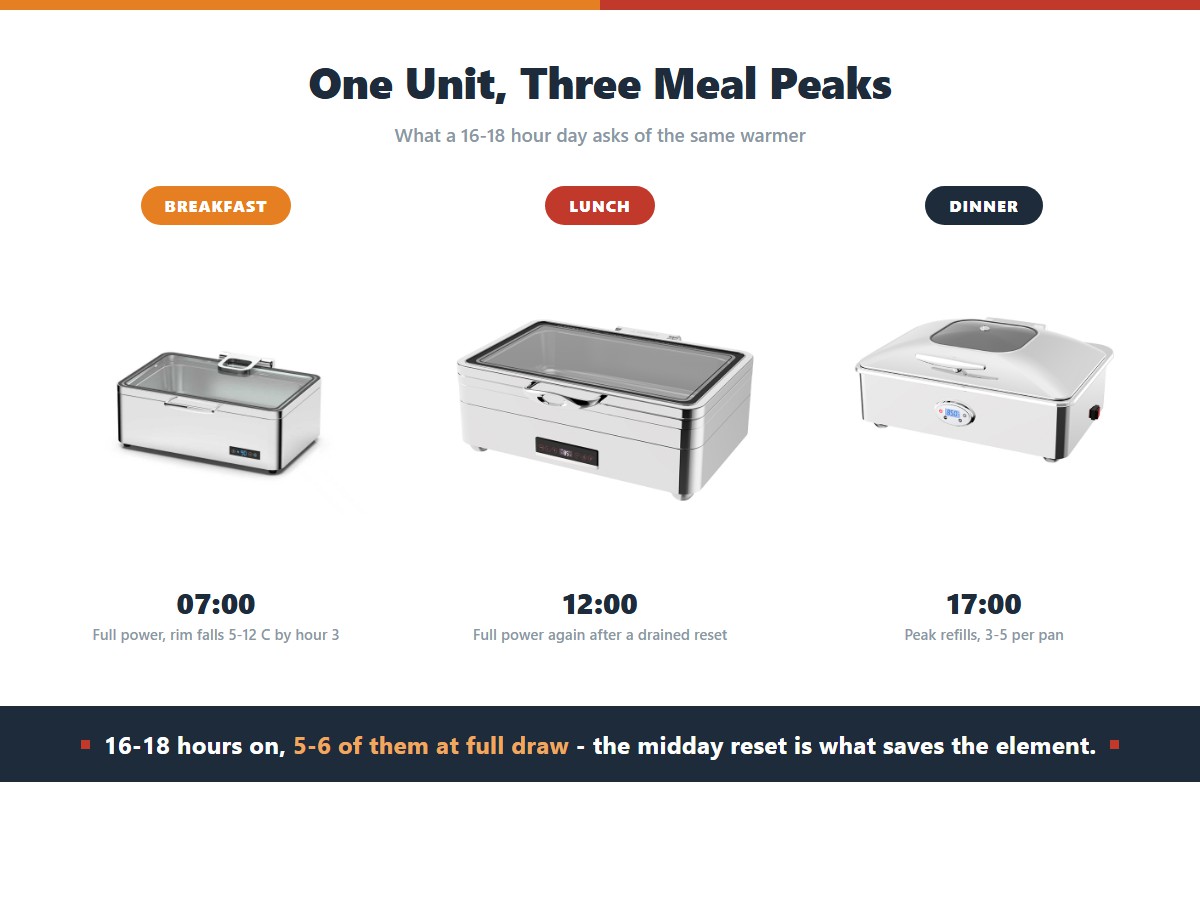
| Breakfast | 07:00–10:30 | High | Full power, continuous probing | Rim falls 5–12°C by hour 3 |
| Midday reset | 10:30–12:00 | Zero | Off, drained, wiped down | Leaving water in a warm pan |
| Lunch | 12:00–14:30 | High | Full power | Same as breakfast |
| Afternoon | 14:30–17:00 | Low | Off, or 45°C hold for pastry | Leaving it on at 75°C |
| Dinner | 17:00–21:00 | High | Full power | Peak refills, 3–5 per pan |
| Late night | 21:00–00:00 | Low | Off unless a la carte is running | Overnight running at 8% duty |
| Total on | 16–18 of 24 | — | 5–6 hours at full draw | — |
Element Life, by Hours per Day in Service
| Service hours per day | Annual element hours | Expected element life | Annual element cost per unit | Verdict |
|---|---|---|---|---|
| Under 4 | Under 1,460 | 5–7 years | Under $6 | Any unit works |
| 4–8 | 1,460–2,920 | 4–6 years | $6–$9 | Budget model is fine |
| 8–12 | 2,920–4,380 | 3–4 years | $9–$13 | Use 1,100 W elements |
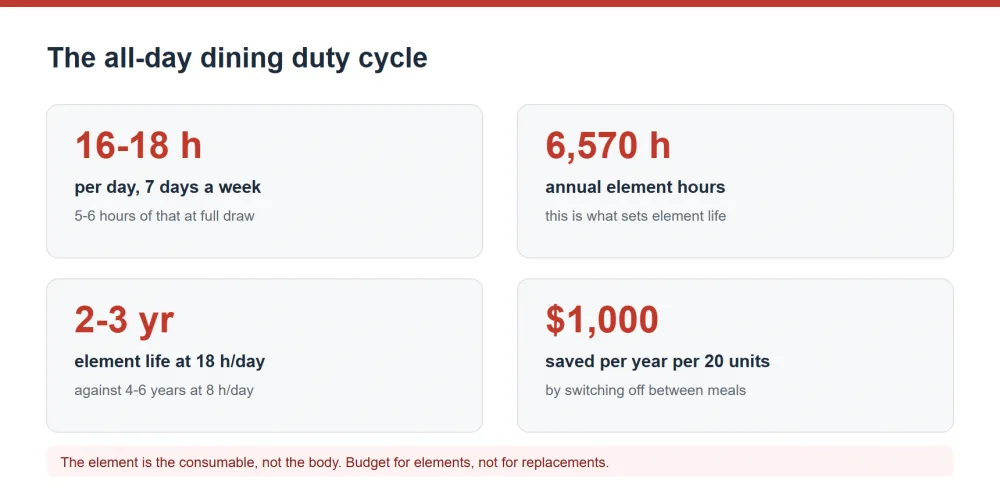
| 12–18 | 4,380–6,570 | 2–3 years | $13–$18 | 1.2 mm body minimum |
| 18–24 | 6,570–8,760 | 1.5–2 years | $18–$24 | Commercial elements only |
| Over 24, no break | Over 8,760 | Under 1.5 years | Over $24 | Do not attempt; split the duty |
The arithmetic behind the maintenance budget is element hours, not calendar years. A hotel running 18 hours a day puts about 6,570 hours through an element in a year, which is where the two to three year life comes from; the same element in a nine-hour-a-day restaurant sees 3,285 hours and lasts four to six years. The unit specification and the duty cycle have to be read together, because buying a heavy-duty element for a lightly used unit is money spent on a problem the hotel does not have.
Frequently Asked Questions
How long can a buffet stove run in a single day?
A 16–18 hour day is within the design range for a commercial unit with 1.2 mm or thicker body steel and a 1,100 W element, provided the unit is switched off between meal periods rather than held at temperature. Continuous operation with no break is a different duty cycle and shortens element life to under eighteen months, because the element never gets a cool period to shed heat stress.
What is the difference between a hotel buffet stove and a restaurant warmer?
Mostly duty cycle and finish. A hotel unit runs 16–18 hours a day, so it needs 1.2–1.5 mm body steel and a commercial element rated for continuous duty. A restaurant warmer usually runs four to six hours, so a 0.5–0.8 mm body with a standard element is enough. The visible finish is a hotel requirement rather than a durability one, since guests see it all day.
Should a hotel leave the buffet units switched on overnight?
No. Leaving a unit holding 75°C through eight low-traffic hours costs roughly the same as running it at full power for two hours, and it dries the pans out. Switch it off after the last service, drain the water pan and wipe it down, then preheat for 15 minutes before the first guest. Where a pastry display genuinely needs overnight holding, a 45°C setting is the correct one and a separate unit is the right answer.
How much does it cost to run a buffet stove for 18 hours?
An 1,100 W unit at full draw costs about $0.16 per hour at a commercial tariff of $0.10 per kWh, so roughly $2.90 for an 18-hour day, or $1,060 per year per unit at 365 days. Running it for the six hours that matter rather than all eighteen brings that down to about $350, and a thermostat-controlled hold at 70°C rather than a full-on setting reduces it further.
What thickness of stainless steel should an all-day dining buffet stove have?
1.2–1.5 mm for units running 16 hours or more, 0.6–0.8 mm for lighter duty. The thickness matters because of empty preheat, not because of food weight. A 0.5 mm body warped by twenty to forty minutes of dry heat never recovers, and a warped body will not seat a lid properly or take the water pan seal, which then leaks.
Related reading
- Catering Buffet Stoves: 5 Specs That Matter on the Road
- 5 Buffet Stoves for Hotels and Resorts (2026 Picks)
- Buffet Stove Energy Tips That Actually Pay
- 5 Buffet Stove Buying Mistakes (and the Cheap Fix)
- Hotel Breakfast Buffet on a $5,000 Budget: Exact List
- Food Heat Lamps for Hospitality: Elevate Guest Dining Experience