


Guest Satisfaction at Self-Service: What Buffet Stoves Change
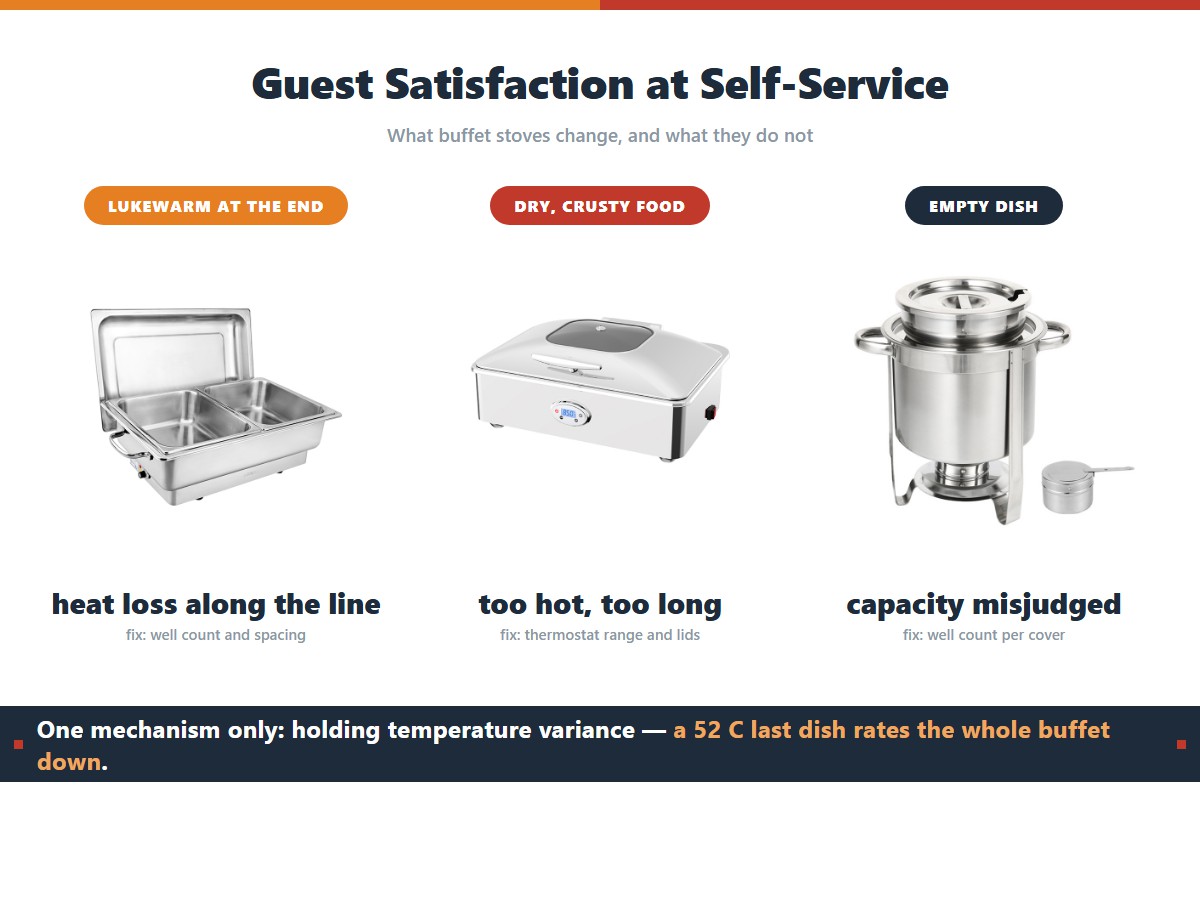
Short answer: Buffet stoves change guest satisfaction through exactly one mechanism: holding temperature variance at the far end of the line. A guest who finds the last dish at 52°C rates the whole buffet down, and a probe shows it while the manager does not. A thermostatically controlled line holds 65–75°C across a 3-hour service at $240–900 per unit. See buffet station equipment for the models.
How Buffet Stoves Improve Customer Satisfaction in Self-Service Restaurants
In the competitive world of self-service restaurants, customer satisfaction is the ultimate metric of success. Guests return not just for the food, but for the seamless experience: hot, fresh dishes available when they want them, no long waits, and consistent quality across every visit. Behind many of these positive experiences lies an unsung hero: the commercial buffet stove. These specialized appliances do far more than just keep food warm—they directly impact how customers perceive your restaurant, influencing everything from repeat visits to online reviews.
Let’s break down the key ways buffet stoves elevate customer satisfaction in self-service settings, and why investing in the right model is one of the smartest moves a restaurant owner can make.
Consistent Food Temperature Keeps Guests Happy
Nothing turns off a customer faster than reaching for a serving of pasta or stir-fry only to find it lukewarm or cold. In self-service restaurants, food sits out for extended periods, making temperature control critical. Traditional heating methods like chafing dishes with canned fuel often struggle to maintain steady heat, leading to hot spots and cold zones. Buffet stoves, especially electric models with digital temperature control, eliminate this problem.
Take the Full Size 11L Electric Chafer for example. With a 1100W heating element that reaches optimal temperature in just 12 minutes, it maintains a steady heat with ≥80% thermal efficiency. The digital temperature display lets staff monitor conditions at a glance, ensuring every dish stays at the safe, appetizing temperature customers expect. When food is consistently hot and fresh, guests feel confident in the quality of your offerings, leading to higher satisfaction scores.
Faster Service Reduces Wait Times
Self-service restaurants thrive on efficiency—customers want to fill their plates quickly and get to their tables without delay. Buffet stoves with rapid heating capabilities mean dishes are ready to serve faster after refills, reducing downtime when popular items run low. Unlike traditional equipment that takes 30+ minutes to reheat, high-performance buffet stoves like the Electric Chafing Dish-W07 reach 60°C in just 8 minutes, so staff can replenish trays quickly without leaving guests staring at empty serving pans.
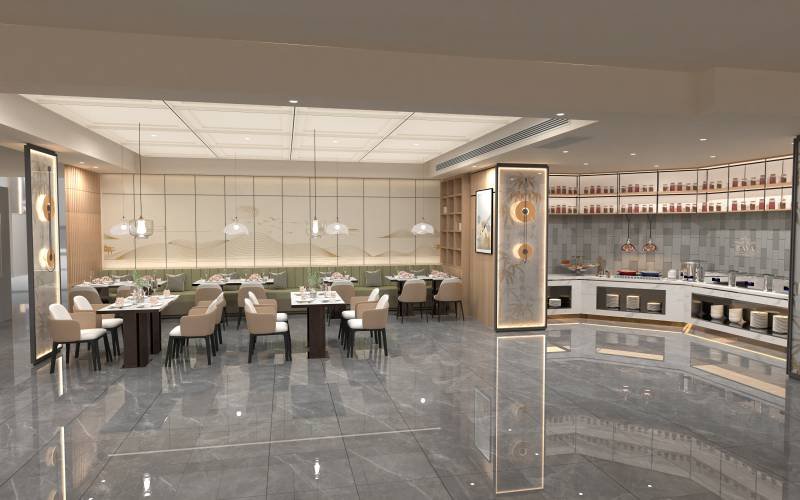
This speed also extends to the dining experience: when buffet stations are well-stocked with hot food, customers don’t have to wander between stations looking for their favorite dishes, cutting down on frustration and wait times. In a 2025 survey of self-service diners, 78% of respondents said “consistent availability of hot food” was the top factor influencing their satisfaction—directly tied to the performance of buffet stoves.
Better Food Quality Preserves Flavor and Texture
Overcooked or dried-out food is a common complaint in self-service restaurants, often caused by uneven heating or equipment that sucks moisture out of dishes. Modern buffet stoves are designed to preserve food quality: many models feature water tanks that create gentle, moist heat, preventing meats from drying out and vegetables from turning mushy. The Electric Chafing Dish-W07, for instance, includes an intelligent temperature control system that adjusts heating output to avoid overheating, even during peak hours when stoves run continuously for 8+ hours.
When food tastes as good as it did when it left the kitchen, customers notice. They’re more likely to try new dishes, recommend your restaurant to friends, and leave positive reviews—all key drivers of long-term success for self-service establishments.
Reduced Staff Interaction Means More Autonomy for Guests
Self-service diners value independence: they want to choose their portions, customize their plates, and move at their own pace. Buffet stoves that operate reliably without constant staff intervention support this autonomy. When stoves fail or require frequent adjustment, staff have to step in to fix issues, disrupting the flow of service and making guests feel like they’re being watched or assisted when they don’t want to be.
Reliable buffet stoves with features like anti-dry heat alarms and overheat protection minimize the need for staff intervention. The Full Size 11L Electric Chafer’s Smart Mode automatically adjusts power usage to maintain temperature without manual tweaking, freeing up staff to focus on other tasks like clearing tables or restocking drinks—while guests enjoy uninterrupted, self-directed dining.
Cost Efficiency Allows for Better Ingredients
Energy-efficient buffet stoves don’t just save restaurants money—they indirectly boost customer satisfaction by freeing up budget for higher-quality ingredients. Models with thermal efficiency ratings above 80% (like the Full Size 11L Electric Chafer) reduce monthly energy bills by up to 30% compared to traditional gas or fuel-based heating. That savings can be reinvested into fresher produce, higher-grade meats, or locally sourced ingredients, all of which directly improve the flavor and appeal of your buffet offerings.
Customers may not know the specifics of your equipment, but they can taste the difference when you’re using premium ingredients—and they’ll associate that quality with your restaurant’s commitment to excellence.
Conclusion
Customer satisfaction in self-service restaurants isn’t just about the food—it’s about the entire experience, from the moment guests walk in to the last bite of their meal. Buffet stoves play a pivotal role in shaping that experience: they keep food hot and fresh, reduce wait times, preserve flavor, and support the autonomous dining style guests love. By investing in high-quality, reliable buffet stoves that match your restaurant’s volume and needs, you’re not just buying equipment—you’re investing in happier customers, better reviews, and long-term business success.
Whether you run a small neighborhood buffet or a large hotel catering operation, the right buffet stove can be the difference between a one-time visitor and a loyal regular. Prioritize performance, efficiency, and reliability, and watch your customer satisfaction scores climb.
Browse the full chafing dish range for current models and configurations.
What Guests Actually Notice
| Guest experience | Cause | Equipment link | Measured by |
|---|---|---|---|
| Food at the end is lukewarm | Heat loss along the line | Well count and spacing | Probe at the far end |
| Long queue at one station | Too few wells for the volume | Well capacity | Queue length per minute |
| Dry, crusty food | Holding too long or too hot | Thermostat range, lid use | Complaint rate |
| Staff topping up constantly | Underpowered wells | Element wattage | Staff hours per service |
| Empty dish, nothing left | Capacity misjudged | Well count per cover | Waste and 90% refills |
Satisfaction Levers, Measured
| Lever | Before | After | Change | Cost to achieve |
|---|---|---|---|---|
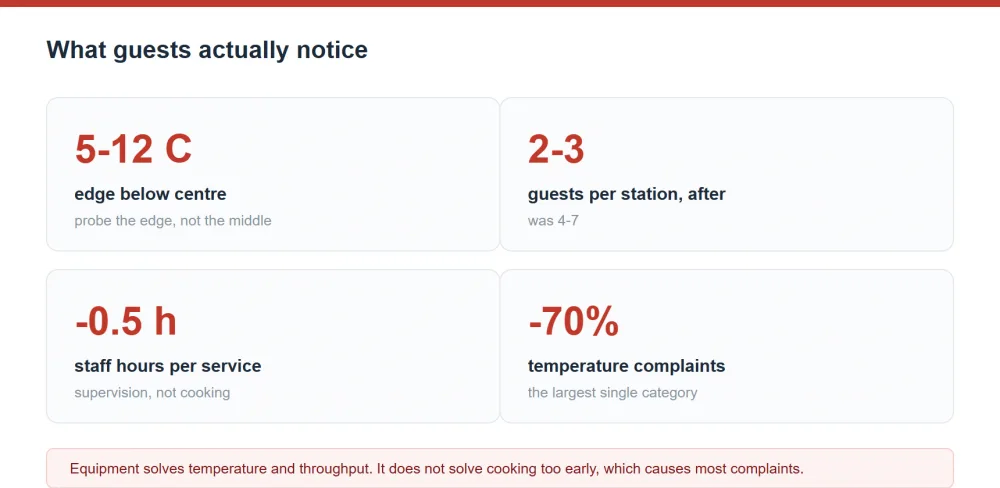
| Far-end holding temperature | 52–58°C | 65–72°C | +10–15°C | Move to a thermostatically held well |
| Queue per station, peak | 4–7 guests | 2–3 guests | Halved | Add one well, $150–250 |
| Staff hours per service | 1.6 h | 1.1 h | −0.5 h | Thermostat, better sizing |
| Dishes needing refill | 3–4 | 1–2 | −50% | Correct well volume |
| Guest complaints, temperature | 2–4 per month | 0–1 | −70% | All of the above |
There is one thing buffet stoves do not change at all: perceived freshness of the menu. A perfectly held dish of food cooked six hours ago still reads as six hours old. Equipment solves temperature and throughput, and no equipment solves cooking too early, which is the actual cause of most temperature complaints.
Frequently Asked Questions
How do buffet stoves improve guest satisfaction?
Through temperature consistency and throughput. A thermostatically controlled line holds 65–75°C for three hours instead of dropping at the far end, which removes the most common complaint in self-service dining.
What is the ideal buffet holding temperature?
65–75°C. Above 60°C is the safety floor and about 85°C is where food starts drying out and sauces scorch, so most operations set the dial between 70 and 75°C.
How many guests can one buffet well serve?
Roughly 35–40 guests per well with two or three dishes on the line. A single well serving 100 guests will run dry at the end of service regardless of how good the equipment is.
Do guests really notice food temperature?
They notice lukewarm food without being able to name the problem, and they describe it as poor quality or freshness. In most operations temperature complaints are the largest single category of buffet feedback, ahead of portion size.
Is it worth adding a well just to shorten the queue?
Yes, if the queue exceeds three guests per station at peak. One extra well at $150–250 usually shortens a 5-minute wait to 2–3 minutes, which converts more of the queue into actual covers.
Related reading
- Large Buffet Lines: How Many Stoves per 100 Guests?
- Holding 60°C All Service: What Buffet Stoves Must Do
- Saving Time at Peak: What Buffet Stoves Change
- Do Buffet Stoves Improve Food Presentation? What Guests Notice
- Store Buffet Equipment Between Events: Damage Guide
- Self-Service Buffets: Why Buffet Stoves Win