


Saving Time at Peak: What Buffet Stoves Change
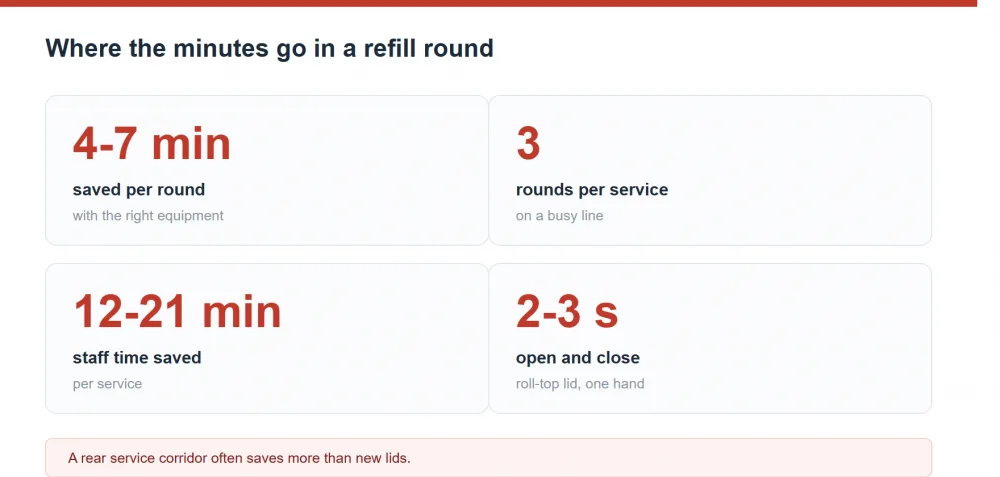
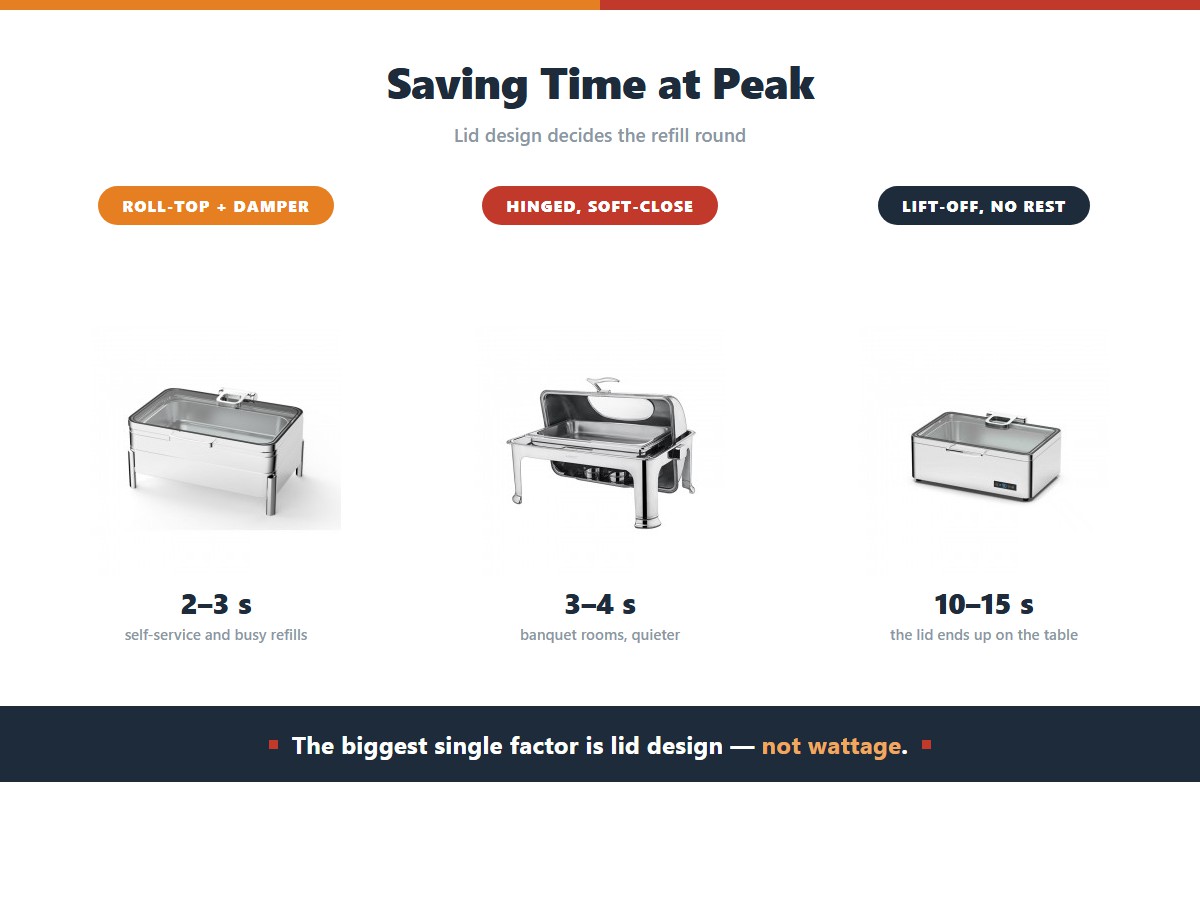
Short answer: a well-chosen buffet stove removes 4-7 minutes from every refill round, and a busy line runs three rounds per service — so the saving is 12-21 staff minutes per service, roughly 60-100 hours a year per station. The biggest single factor is lid design, not wattage. Compare frames in our chafing dish range.
Where the minutes actually go
| Step in a refill round | Time | What makes it slow |
| Walk to the line with a full pan | 40-70 s | No rear access; guests in the way |
| Lift and hold the lid | 5-15 s | Lift-off lids with no rest |
| Swap the pan | 15-25 s | Pan stuck in the water bath, no air gap |
| Wipe the rim | 10 s | Condensation drip from a cold lid |
| Close and reset | 5-10 s | Hinge that will not stay open |
Four pans per round at 60 seconds each is four minutes. That is the baseline. Equipment choices can cut it to two and a half.
Lid design is the biggest lever
| Lid type | Time per open/close | Best for |
| Roll-top with damper | 2-3 s | Self-service and busy refills |
| Hydraulic soft-close | 3-4 s | Banquet rooms, quieter operation |
| Lift-off with rest | 6-8 s | Low-volume service |
| Lift-off without rest | 10-15 s | Nothing — the lid ends up on the table |
Pan swaps: why some pans stick
A pan seats properly when the water bath is at the right level and the pan has a small air gap at the base. Overfilled water pans create a vacuum that holds the pan down; dry pans let it rock and jam. Both faults add seconds to every swap and, over a service, minutes.
Preheat scheduling saves more than any hardware
Electric units need 12-18 minutes with hot water; fuel needs 15-25. Starting the line 30 minutes before doors open means the first refill happens after the peak, not during it. A simple preheat board — one line per station, times written down — typically saves more time than upgrading the units.
Before and after: a 200-cover lunch
| Metric | Old line | After changes |
| Refill rounds | 4 | 3 |
| Minutes per round | 6.5 | 4 |
| Total staff minutes | 26 | 12 |
| Queue at peak | 4-6 min | 2-3 min |
How to measure your own line
- Time one complete refill round with a stopwatch, from picking up the pan to closing the lid.
- Count rounds per service for a week.
- Note how long a lid stays open per guest visit — this is usually the surprise.
- Multiply. If the total exceeds 25 minutes per service, the equipment or the layout is costing you money.
A layout fix that costs nothing
Before upgrading a single unit, look at where the attendant stands. If the only route from the kitchen to the hot line crosses the guest aisle, every refill round includes waiting for people to move — and that waiting, not the equipment, is often the largest item in the round. A service corridor behind the line, even a narrow one, removes it entirely. Operators who add rear access typically report the biggest single reduction in refill time, and it costs less than a set of new lids.
The second free fix is a refill trolley. Carrying one pan at a time means four trips where one would do; a trolley that holds two full pans and a spare element cuts the walking in half. Neither change requires new equipment, and both compound with better lids and correct pan sizes.
Frequently Asked Questions
Do roll-top lids really save time?
Yes. A roll-top opens and closes in 2-3 seconds with one hand, against 10-15 seconds for a lift-off lid without a rest. Over a 200-cover service that is several minutes.
Does higher wattage speed up service?
Only preheat. Once the bath is at temperature, a 900 W element holds no faster than a 500 W one, and costs more to run.
How many refill rounds should a service have?
Three for a 200-cover lunch, five or six for a three-hour all-you-can-eat dinner. More than six suggests pans are too small for the volume.
Can layout changes save more than equipment?
Often yes. A rear service corridor removes the walk through guests, which is the single largest time item in a refill round.
What is the best time to start preheating?
Thirty minutes before doors, with hot water in the pan. That covers a 12-18 minute preheat plus loading time.