




5 Buffet Stove Features That Matter (and 3 That Don't)
Short answer: Five features matter: a mechanical thermostat covering 30–100°C, at least 1,500 W per well, 0.7–0.8 mm steel body, a 3-year element warranty and a published element part number. Three that usually do not matter: digital displays, built-in timers and glass lids. Those three together account for up to $180 of price premium and buy almost nothing. See buffet station equipment.
When setting up a buffet station for your restaurant, hotel, or catering business, selecting the right buffet stove is a decision that directly impacts food quality, operational efficiency, and customer satisfaction. Unlike standard food warmers, modern buffet stoves are designed to handle high-volume service, maintain consistent temperatures, and integrate seamlessly into your existing workflow. However, with dozens of models on the market, it’s easy to get overwhelmed by specs and marketing claims. To help you cut through the noise, we’ve broken down the top 5 features you should prioritize when shopping for a buffet stove — each one validated by real-world use in busy commercial kitchens.
1. Precise Temperature Control with Wide Adjustable Range
The single most important feature of any buffet stove is its ability to maintain a consistent, safe temperature for hours on end. Food safety regulations require hot foods to stay above 63°C (145°F) to prevent bacterial growth, while overcooking can ruin the texture of delicate dishes like scrambled eggs or steamed vegetables. Look for models with digital temperature displays and adjustable ranges covering at least 45°C to 93°C (113°F to 200°F). For example, the Electric Chafing Dish W07 offers 45–89°C adjustable temp with smart control, reaching 60°C in just 8 minutes — ideal for busy breakfast buffets where speed matters.

Electric Chafing Dish W07
The Electric Chafing Dish W07 is a 900W commercial-grade unit with intelligent temperature control, anti-dry heat flash alarm, and overheat protection. Its 45–89°C adjustable range makes it suitable for everything from keeping soups warm to holding delicate pastries at safe temperatures. CE, ETL, and RoHS certified, it’s built to withstand daily use in high-traffic restaurants and hotels.
2. Rapid Heating Capability
In peak service hours, you don’t have time to wait 30 minutes for your buffet stove to reach optimal temperature. Look for models with high wattage (800W–1100W) that can hit 60°C in 15 minutes or less. The Full Size 11L Electric Chafer boasts 1100W power that heats up in just 12 minutes, with a thermal efficiency of over 80% to cut energy costs. This is especially critical for hotels that need to replenish buffet stations quickly between breakfast and lunch rushes.

Full Size 11L Electric Chafer
This 1100W full-size electric chafer features a digital temperature display, smart mode, and polished stainless steel construction. With 12-minute rapid heat-up and 80%+ thermal efficiency, it’s designed for high-volume hotels and catering businesses that need reliable, energy-efficient performance for all-day buffet service.
3. Durable, Food-Grade Construction
Buffet stoves take a beating in commercial settings — they’re scrubbed daily, exposed to high heat, and moved between event venues. Avoid models with cheap plastic components or low-grade steel that rusts after a few months. Prioritize 304 stainless steel, which is corrosion-resistant, easy to clean, and meets FDA food safety standards. Tempered glass lids are another plus: they let staff check food levels without lifting the lid, reducing heat loss.
4. Safety Protections to Prevent Accidents
Commercial kitchens are fast-paced environments where accidents can happen. A good buffet stove should include multiple safety features to protect staff and guests. Look for anti-dry burn protection (which automatically shuts off the unit if water levels get too low), overheat protection, and cool-touch exteriors to prevent burns. The Electric Chafing Dish W07 includes a dry heat flash alarm that alerts staff if the water tank is empty, while the W20 model adds an OLED touchscreen that displays error codes for quick troubleshooting.
5. Flexible Capacity and Configuration Options
Not all buffet stations are the same. A small cafe might only need a 5.5L single-pan unit, while a hotel banquet hall requires a full-size 11L model or even a double-pan stove to hold multiple dishes at once. Look for brands that offer a range of capacities and configurations — rectangular, square, or round shapes to fit your buffet layout. The Electric Chafing Dish BA Series, for example, offers 5.5L to 13.5L capacities in multiple shapes, making it easy to find a unit that fits your specific needs.
Conclusion
Choosing the right buffet stove doesn’t have to be a guessing game. By prioritizing these 5 features — precise temperature control, rapid heating, durable construction, safety protections, and flexible configuration — you can invest in a unit that will serve your business reliably for years. Remember to match the stove’s capacity to your typical service volume, and always verify certifications like CE, ETL, and FDA compliance to meet local food safety regulations. With the right buffet stove in place, you’ll reduce food waste, speed up service, and keep your guests coming back for more.
Browse the full chafing dish range for current models and configurations.
The Five That Matter
| Feature | Specify | Why it matters | Price premium |
|---|---|---|---|
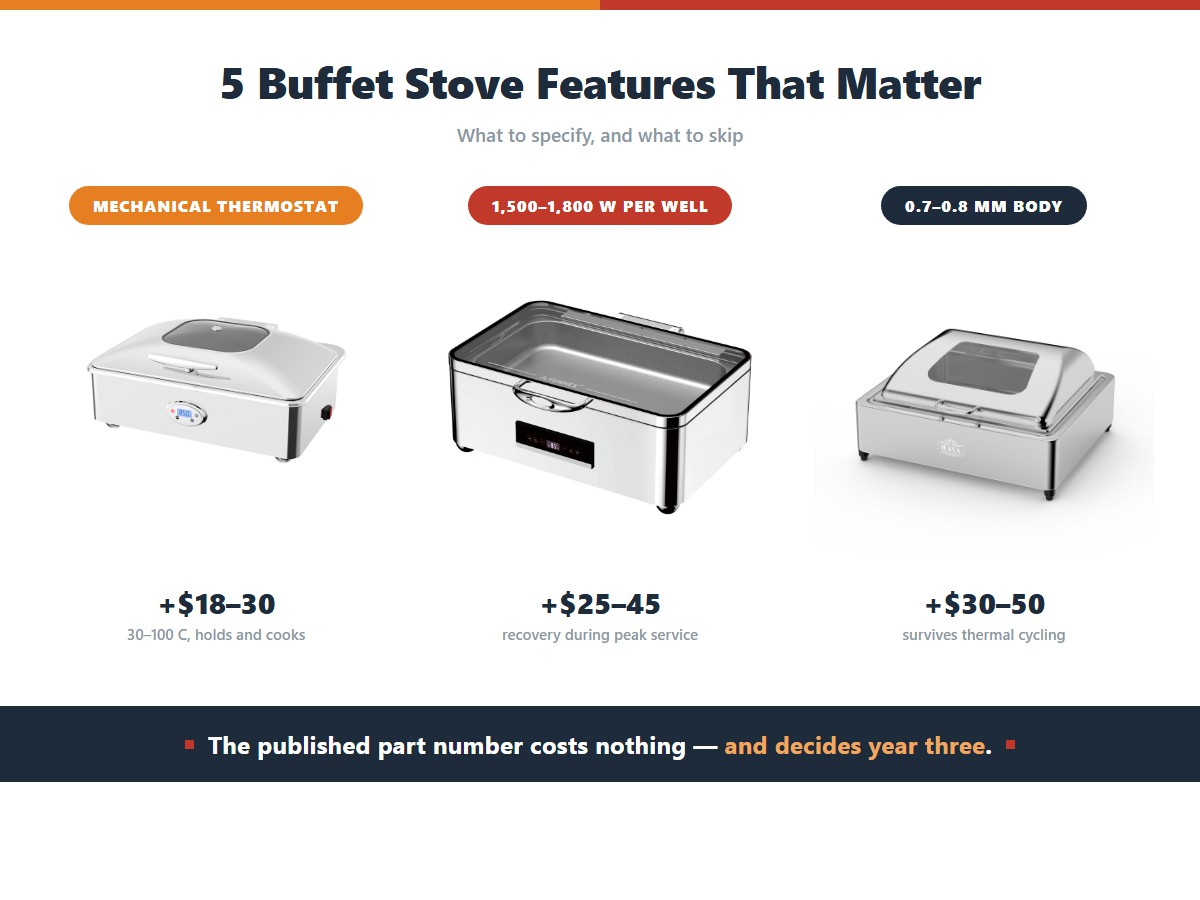
| Mechanical thermostat, 30–100°C | Required | Holds and cooks in one unit | $18–30 |
| Element wattage per well | 1,500–1,800 W | Recovery during peak service | $25–45 |
| Body steel gauge | 0.7–0.8 mm | Survives thermal cycling | $30–50 |
| Element warranty | 3 years | First part to fail, by far | $22–40 |
| Published element part number | Required | Decides year three | $0 |
The Three That Usually Do Not
| Feature | Typical premium | What it actually does | Verdict |
|---|---|---|---|
| Digital display panel | $60–150 | Shows the setpoint you already set | Adds a failure point |
| Built-in timer | $25–60 | Beeps; does not hold temperature | Do not pay for it |
| Glass lid | $40–90 | Sees the food, loses 2–4°C | Worse insulation |
| Stainless wrap, brushed | $25–50 | Finish only | Cosmetic |
| App and Wi-Fi | $120–300 | Nothing in a kitchen | Avoid entirely |
| Infrared indicator lamp | $8–18 | Tells you it is on, not the temperature | Useless |
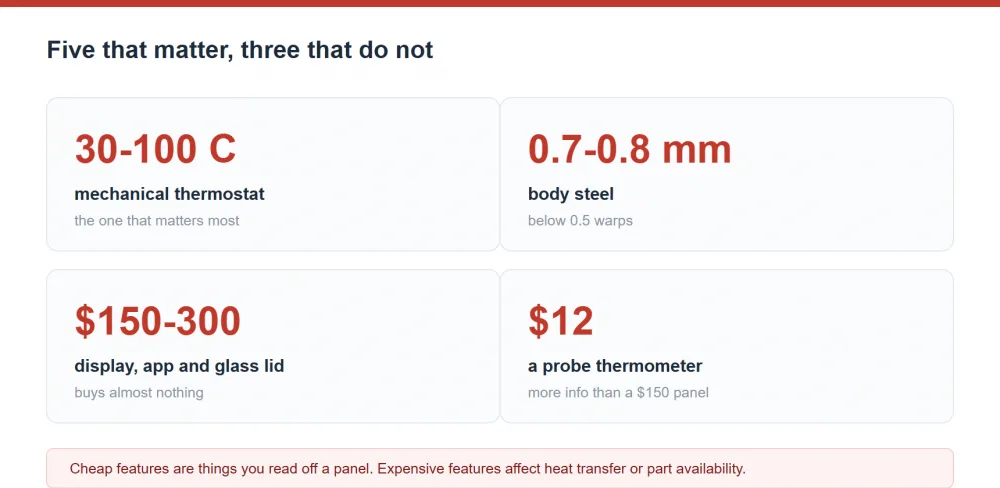
The pattern is that cheap features are things you read off a panel, and expensive features are things that affect heat transfer or part availability. A $12 probe thermometer in your pocket gives you more information than a $150 display, and it costs less than one replacement element.
Frequently Asked Questions
What is the most important feature on a buffet stove?
A mechanical thermostat covering 30–100°C. Without it you have an on/off switch, which either scorches food or runs at full power continuously and costs 30–43% more energy.
Are digital buffet stoves better than manual ones?
No, for most operations. A digital panel adds a failure point, removes the mechanical backup and saves no measurable energy. It is worth paying for only if it includes probe logging for audits.
Does a glass lid help on a buffet stove?
Rarely. Glass insulates worse than stainless and typically costs 2–4°C of holding temperature while showing you the food you have not checked anyway. Use a stainless lid.
Is a built-in timer useful on commercial equipment?
Not enough to pay for. It tells you when an interval ended but does nothing about temperature, which is the only thing that determines whether the food is safe.
How much more do premium buffet stoves cost?
Typically $150–350 more than a mid unit, of which $100–200 is display, timer and finish rather than performance. Judge the premium on element warranty and steel gauge instead.
Related reading
- Banquet Buffet Stoves: Features Worth Specifying
- Buffet Stove Features That Cut Operating Costs
- Buffet Stove Features Worth Paying For (and Ones to Skip)
- Catering Buffet Stoves: 5 Specs That Matter on the Road
- Opening a Buffet? The 2026 Equipment Checklist
- Buffet Equipment Maintenance Schedule: Don't Wait Until It Breaks