


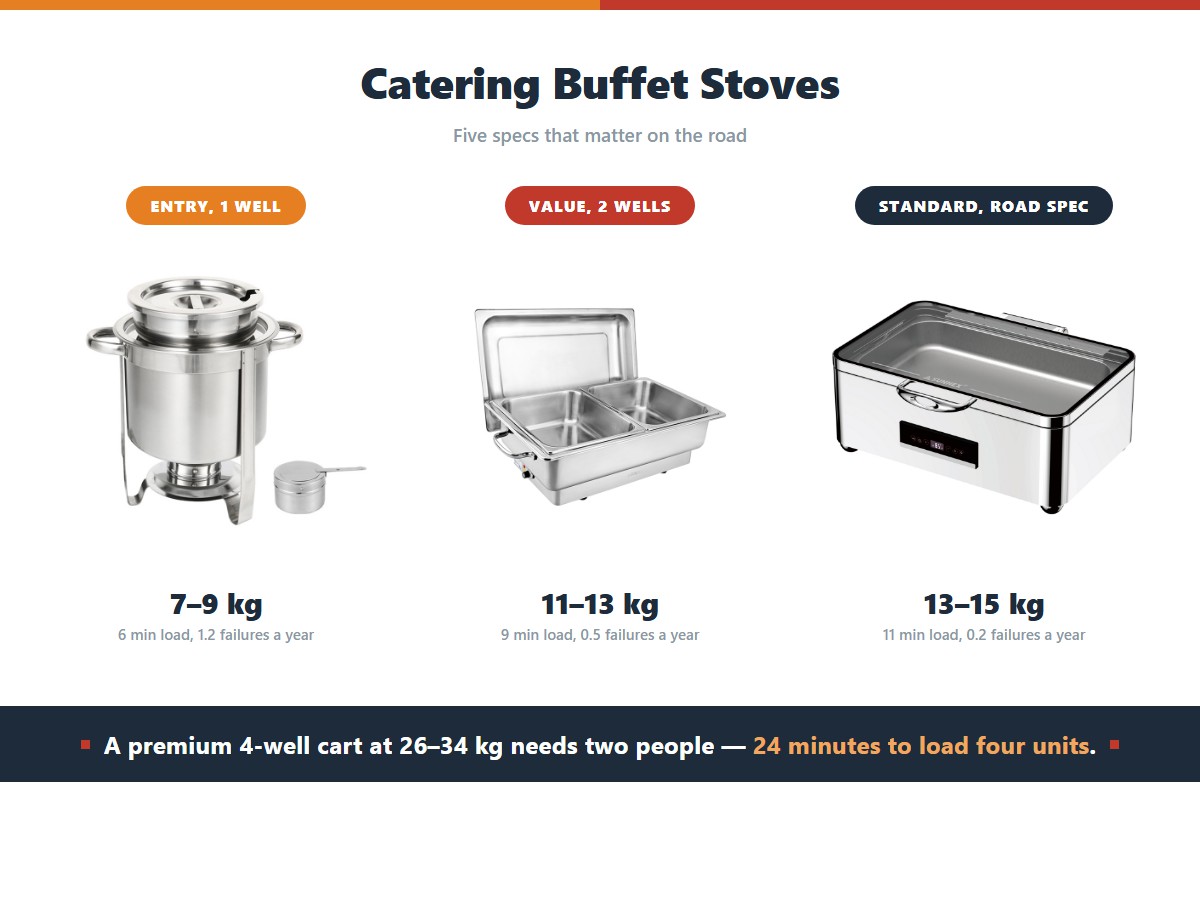
Catering Buffet Stoves: 5 Specs That Matter on the Road
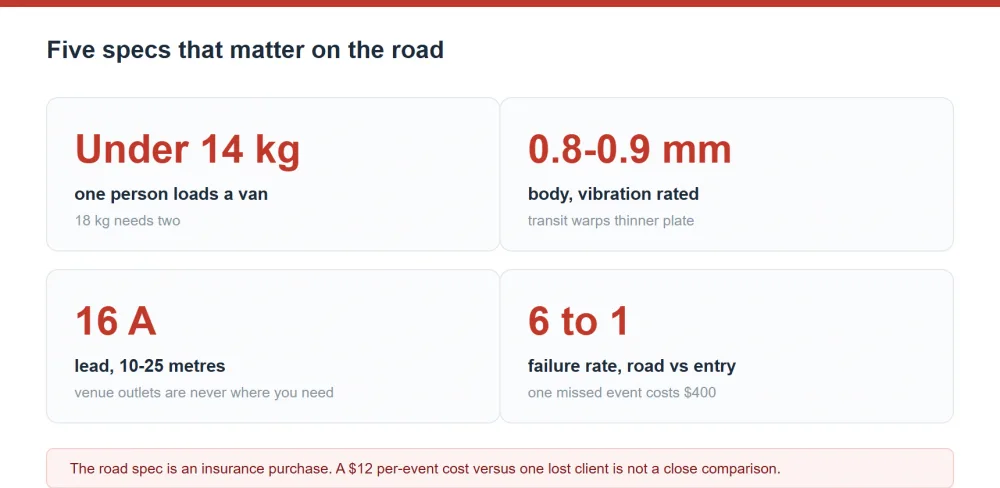
Short answer: Five specifications decide whether a buffet stove survives catering work on the road: under 14 kg lifted one-handed, 0.8–0.9 mm steel body, locking recessed castors, a self-contained fuel or a 16 A lead, and a 3-year element warranty with a published part number. A $320 unit that meets all five is cheaper per event than a $160 unit that meets two. See buffet station equipment.
Top Buffet Stoves for Catering Businesses: What to Look For
For catering businesses, buffet stoves are the backbone of efficient food service, ensuring dishes stay hot, safe, and visually appealing throughout events ranging from corporate lunches to large-scale weddings. With countless options on the market, selecting the right buffet stove can make or break your catering operations—impacting everything from food quality to labor costs and customer satisfaction. This guide breaks down the key features catering businesses should prioritize when choosing buffet stoves, along with top product recommendations to suit different operational needs.
1. Capacity and Size: Match Your Event Volume
The first consideration for any catering business is capacity. Buffet stoves come in sizes ranging from 4.5L individual serving units to 13.5L large-capacity models, with GN 1/1 size (530×325mm) being the industry standard for most catering applications. For high-volume events like hotel buffets or wedding banquets, opt for full-size 11L models that can hold enough food to serve 50+ guests per refill. Smaller catering businesses focusing on intimate events or corporate drop-off catering may prefer 5.5L–7L models that are easier to transport and store. Rectangular shapes are the most versatile for buffet lines, while round chafing dishes add an elegant touch for upscale events. Always check that the food pan size aligns with your existing buffet serveware to avoid compatibility issues.
2. Power and Heating Efficiency: Balance Speed and Energy Costs
Heating speed and energy efficiency directly impact your catering business’s bottom line. Electric buffet stoves with 900W–1100W power output can reach optimal serving temperatures in 8–12 minutes, minimizing pre-event setup time. Look for models with thermal efficiency ratings ≥80%, which reduce electricity consumption by up to 25% compared to standard models. For catering businesses operating in areas with unstable power grids, dual-voltage (110V/220V) compatibility is a must to avoid equipment damage during off-site events. Avoid underpowered models (below 400W) for large events, as they struggle to maintain consistent temperatures when filled with cold food, leading to food safety risks.
3. Temperature Control and Safety Features
Precise temperature control is non-negotiable for catering businesses to comply with food safety regulations. Digital temperature displays and adjustable thermostats (range: 45–93°C) allow you to customize heat levels for different dishes—soups and stews require higher temperatures than pastries or vegetarian options. Safety features like anti-dry heat flash alarms, overheat protection, and auto shut-off prevent accidents during busy service periods when staff may not monitor equipment constantly. For catering businesses serving alcohol at events, avoid open-flame fuel models to reduce fire risks; electric or infrared heating options are safer for indoor venues.
4. Durability and Material Quality
Catering equipment faces frequent transport, stacking, and heavy daily use, so durability is key. Choose buffet stoves made of 304 food-grade stainless steel, which resists corrosion, scratches, and dents even after years of use. Polished stainless steel finishes not only look professional but also make cleaning easier—critical for meeting hygiene standards between events. Check for certifications like CE, ETL, RoHS, and FDA compliance to ensure the equipment meets global safety and food contact regulations, especially if your catering business serves international clients or exports to overseas markets. Models with tempered glass lids allow staff to check food levels without lifting the lid, reducing heat loss and contamination risks.
5. Top Buffet Stove Recommendations for Catering Businesses
Based on the above criteria, here are three top-performing buffet stoves tailored for different catering needs:

Full Size 11L Electric Chafer
Designed for high-volume catering businesses, this 11L electric chafer features 1100W rapid heating that reaches optimal temperature in just 12 minutes, with thermal efficiency ≥80% to reduce energy costs. Its digital temperature display and Smart Mode allow precise control, while polished stainless steel construction ensures durability for daily commercial use. Ideal for hotel buffets and large-scale catering events.

Electric Chafing Dish Food Warmer
This 400W commercial electric chafing dish is ideal for small to medium-sized catering businesses, with fast heating and adjustable temperature range of 60–93°C. Made of food-grade 304 stainless steel, it includes a digital temperature control for consistent food warming, and its 2.5L water tank ensures long-lasting heat retention for busy service periods. Its compact size makes it easy to transport for off-site events.

Electric Chafing Dish-W07
Equipped with 900W rapid heating and intelligent temperature control, this chafing dish reaches 60°C in just 8 minutes. It features multi-safety protection including anti-dry heat flash alarm and overheat protection, with adjustable temperature from 45–89°C to suit different food types. Its 304 stainless steel construction and tempered glass lid make it a reliable, low-maintenance choice for fast-paced catering environments.
Conclusion
Selecting the right buffet stove for your catering business requires balancing capacity, heating efficiency, safety features, and durability. By prioritizing these key factors, you can reduce operational costs, ensure food safety compliance, and deliver consistent quality that keeps clients coming back. Whether you’re running a small boutique catering business or a large-scale hospitality operation, investing in high-quality buffet stoves will pay dividends in efficiency and customer satisfaction over time.
Browse the full chafing dish range for current models and configurations.
The Five Road Specs
| Spec | Minimum | Why on the road | Price impact | Failure without it |
|---|---|---|---|---|
| Weight | Under 14 kg | One person loads a van alone | $40–80 for lighter steel | Two staff per lift, injury risk |
| Body steel | 0.8–0.9 mm | Vibration and knocks in transit | $30–50 | Warped top, uneven heat |
| Castors | Locking, recessed | Threshold and kerb loading | $20–40 | Damage in transit, noise |
| Power or fuel | 16 A lead, or self-contained | Venues have unknown outlets | $0–150 | Site rejection |
| Element warranty | 3 years, part published | No local repair on the road | $22–40 | Disposable at year three |
Transport and Setup Economics
| Unit class | Weight | Load time, 4 units | Setup time | Cost per event | Failure rate per year |
|---|---|---|---|---|---|
| Entry, 1 well | 7–9 kg | 6 min | 12 min | $4–8 | 1.2 |
| Value, 2 well | 11–13 kg | 9 min | 14 min | $6–11 | 0.5 |
| Standard, 2 well, road spec | 13–15 kg | 11 min | 14 min | $8–14 | 0.2 |
| Premium, 4 well cart | 26–34 kg | 24 min, two people | 16 min | $18–30 | 0.1 |
A failure on the road costs far more than the equipment. A single missed event turns a $12 per-event cost into a $400 reputation cost with the client, so the road spec is really an insurance purchase. That is the argument to make when someone asks why the road-rated unit costs twice as much.
Frequently Asked Questions
What is the most important specification for a mobile catering buffet stove?
Weight, closely followed by a published element part number. Under 14 kg lets one person load a van, and a serviceable element means a breakdown does not end the unit’s life on the road.
How heavy should a portable buffet stove be?
Under 14 kg for one-person loading. Beyond 18 kg you need two staff per unit, which adds about 4 minutes of loading time per four units and creates a lifting injury risk.
Do catering buffet stoves need castors?
Locking, recessed castors are worth the $20–40. Thresholds, kerbs and vehicle ramps damage exposed feet, and a damaged base plate is not a field-repairable item.
What power lead length do I need for off-site work?
A 16 A rated lead of at least 10 metres, ideally 25 metres for banquet halls, plus an outdoor-rated RCD. Venues rarely have a socket where you need one.
Is it worth paying more for a road-rated buffet stove?
Yes, if you work off-site regularly. The failure rate difference between a road spec and an entry unit is roughly six to one, and one missed event costs more than the price gap between them.
Related reading
- Streamlining Catering Ops: Where Buffet Stoves Help
- 5 Benefits of Buffet Stoves for Catering Businesses
- Outdoor Catering: Buffet Stoves That Survive Wind
- Are Buffet Stoves Worth It? Payback by Event Volume
- Starting a Catering Business? Buy These 5 Things First
- Do Buffet Stoves Improve Service Quality? A Practical Answer